ABDOMINAL AORTIC ANEURISM
“4-A’s”
Asymptomatic
Abdominal mass
Abdominal pulse
Aches low back
ABDOMINAL DISTENSTION
"5-F's"
Fat
Fluid
Feces
Flatus
Fetus
ACE INHIBITOR SIDE EFFECTS
"CAPTOPRIL"
Cough
Anaphyl
...
ABDOMINAL AORTIC ANEURISM
“4-A’s”
Asymptomatic
Abdominal mass
Abdominal pulse
Aches low back
ABDOMINAL DISTENSTION
"5-F's"
Fat
Fluid
Feces
Flatus
Fetus
ACE INHIBITOR SIDE EFFECTS
"CAPTOPRIL"
Cough
Anaphylaxis
Palpitations
Taste
Orthostatic -↓BP
Potassium - ↑K+
Renal impairment
Impotence
Leukocytosis
ACID-BASE
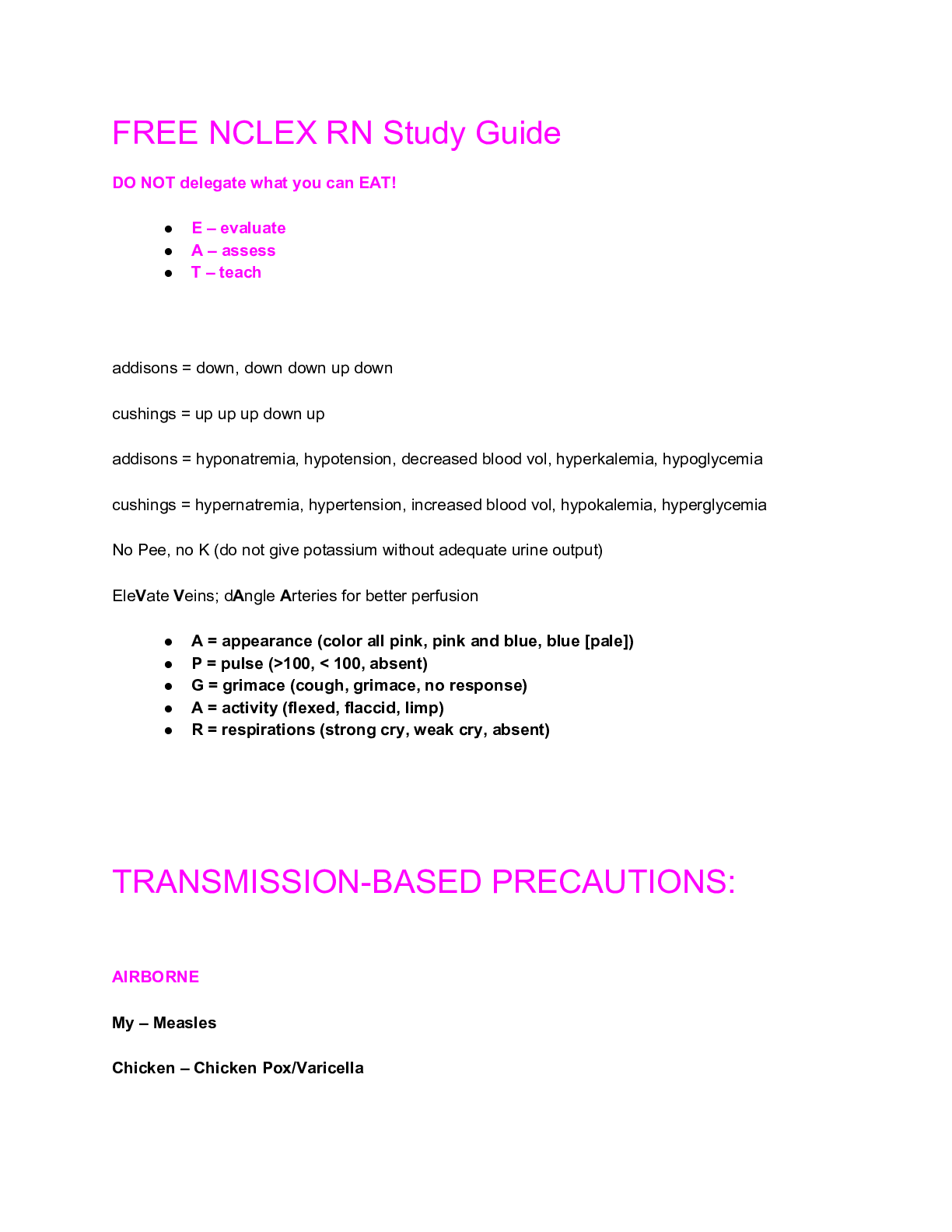
"ROME" – Respiratory Opposite, Metabolic Equal
ACIDOSIS
» Respiratory (opposite): pH Pco2
» Metabolic (equal): pH HCO3
ALKALOSIS
» Respiratory (opposite): pH Pco2
» Metabolic (equal): pH HCO3
ACIDOSIS/ALKALOSIS
“ROME”
Respiratory Opposite:
pH↑ PCO2↓ = alkalosis
pH↓ PCO2↑ = acidosis
Metabolic Equal:
pH↑ HCO3↑ = Alkalosis
pH↓ HCO3↓ = Acidosis
ACIDOSIS/ALKALOSIS – COMPENSTATION
“RUB MUB”
Respiratory Uses Bicarb
Metabolic Uses Breathing
ALKALOSIS AND ACIDOSIS
AlKalosis has “K” – it’s “K”icking pH up = PH↑
AciDosis has “D” – it’s “D”ropping pH Down = PH↓
ACUTE INFLAMMATION FEATURES
Think: "what a cute pair of SLIPpeRs" to tie acute
inflammation to “SLIPR”mnemonic).
“SLIPR”
Swelling
Loss of function
Increased heat
Pain
Redness
ADRENAL GLAND HORMONES
“SSS”
S-sugar (Glucocorticoids)
S-salt (Mineralocorticoids)
S-sex (Androgens)
AIMS for improvement
“PETEES” AIMS
P - Patient centered care
E - Efficient
T - Timely
E - Effective
E - Equitable
S - Safety
ALCOHOL WITHDRAWAL – CLINICAL FEATURES
"HITS"
Hallucinations (visual, tactile)
Increased vital signs & insomnia
Tremens delirium tremens (potentially lethal)
Shakes/Sweat/Seizures/Stomach pain (N/V)
ALCOHOLISM – BEHAVIORAL PROBLEMS
“5-D's”
D- Denial
D- Dependency
D- Demanding
D- Destructive
D- Domineering
ALCOHOLISM OUTCOME
“BAD”
B- Brain Damage
A- Alcoholic Hallucinosis
D- Death
ALDOSTERONE IS REGULATED BY:
"RNA’S"
Renin-angiotensin mechanism
Na concentration in blood
Anp (ANP – atrial natriuretic peptide)
Stress
ALZHEIMER – “5 A’s” to DIAGNOSIS
“5-A's”
Amnesia – loss of memories
Anomia – unable to recall names of everyday objects
Apraxia – unable to perform tasks of movement
Agnosia – inability to process sensory information
Aphasia – disruption with ability to communicate
ANGINA – PRECIPITATING FACTORS
"4-E's"
Eating
Emotion
Exertion (Exercise)
Extreme Temperatures (Hot/Cold weather)
“ANOREXIA” – EATING DISORDER
A-menorrhea delayed
N-o organic factors accounts for weight loss
O-obviously thin but feels FAT
R-refusal to maintain normal body weight
E-epigastric discomfort is common
X-symptoms (peculiar symptoms)
I-intense fears of gaining weight
A-always thinking of foods
ANOREXIA NERVOSA – CLINICAL FEATURES
"ANOREXIC"
A-adolescent women/Amenorrhea
N-GT alimentation (most severe cases)
O-obsession w/ wt. loss/becoming fat though
underweight
R-refusal to eat (5% die)
E-electrolyte abnormalities (e.g., K+, cardiac
arrhythmia)
X-exercise
I-intelligence often above average/Induced
vomiting
C-cathartic use (and diuretic abuse)
ANTICHOLINERGIC CRISIS
Can't see (blurred vision)
Can't spit (dry mouth)
Can't pee (urinary retention)
Can't shit (constipation)
ANTICHOLINERGIC CRISIS – SIGNS
"SLUD"
Salivation
Lacrimation
Urination
Defecation
ANTI-TB DRUGS & SIDE EFFECTS
“RIPES”
Rifampicin – red-orange urine
Isoniazid – peripheral neuritis
Pyrazinamide – increase uric acid
Ethambutol – eye problems
Streptomycin – ototoxic
(use a star as these drugs stain the teeth) – ???
(H-eat, I-nduration) – ???
[Show More]