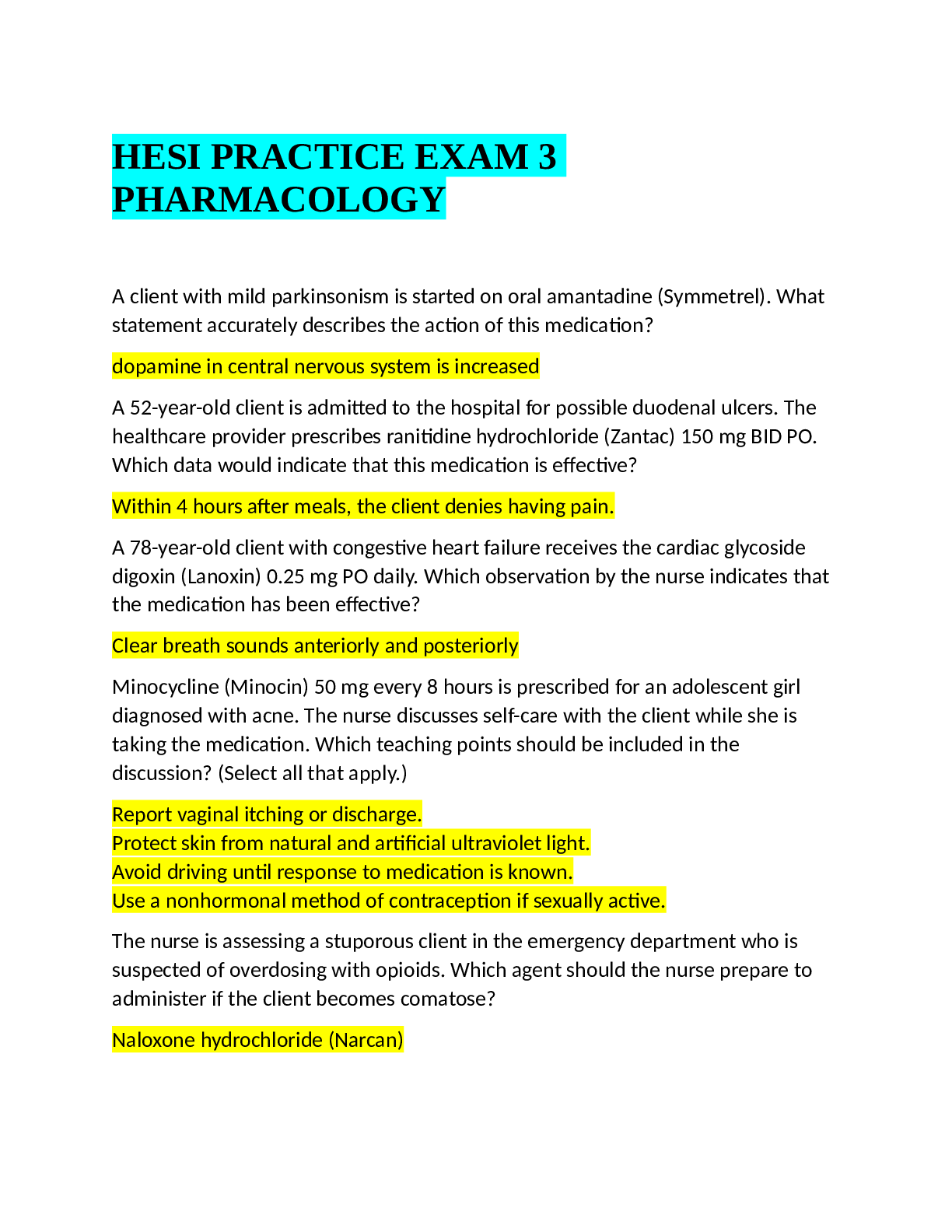
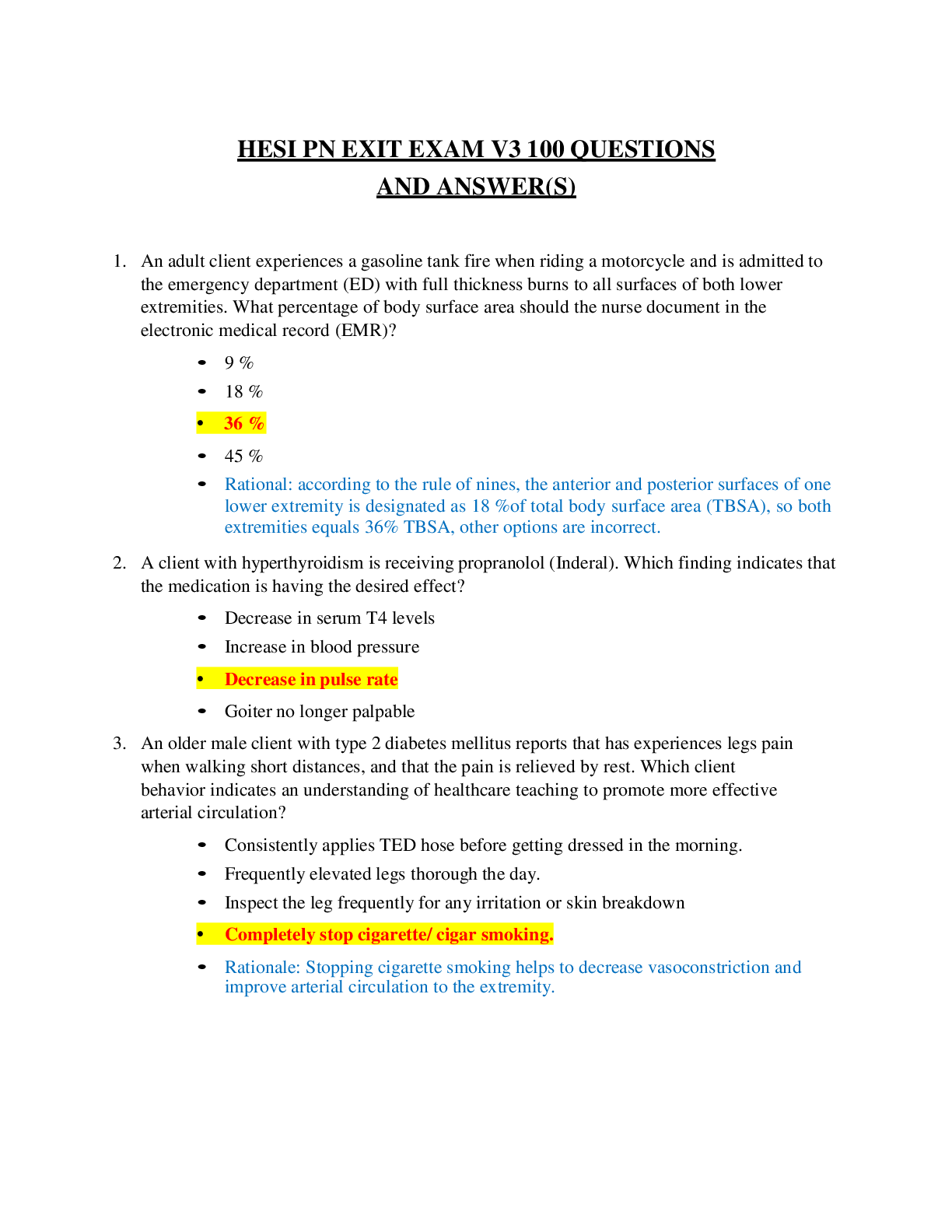
Question 1
The Confusion Assessment Methods Instrument (CAMI) is a standardized assessment tool for
which of the following disorders?
A
.
Dementia
B
.
Delirium
C
.
Pick’s
disease
D
.
A and C
Question 2
W
...
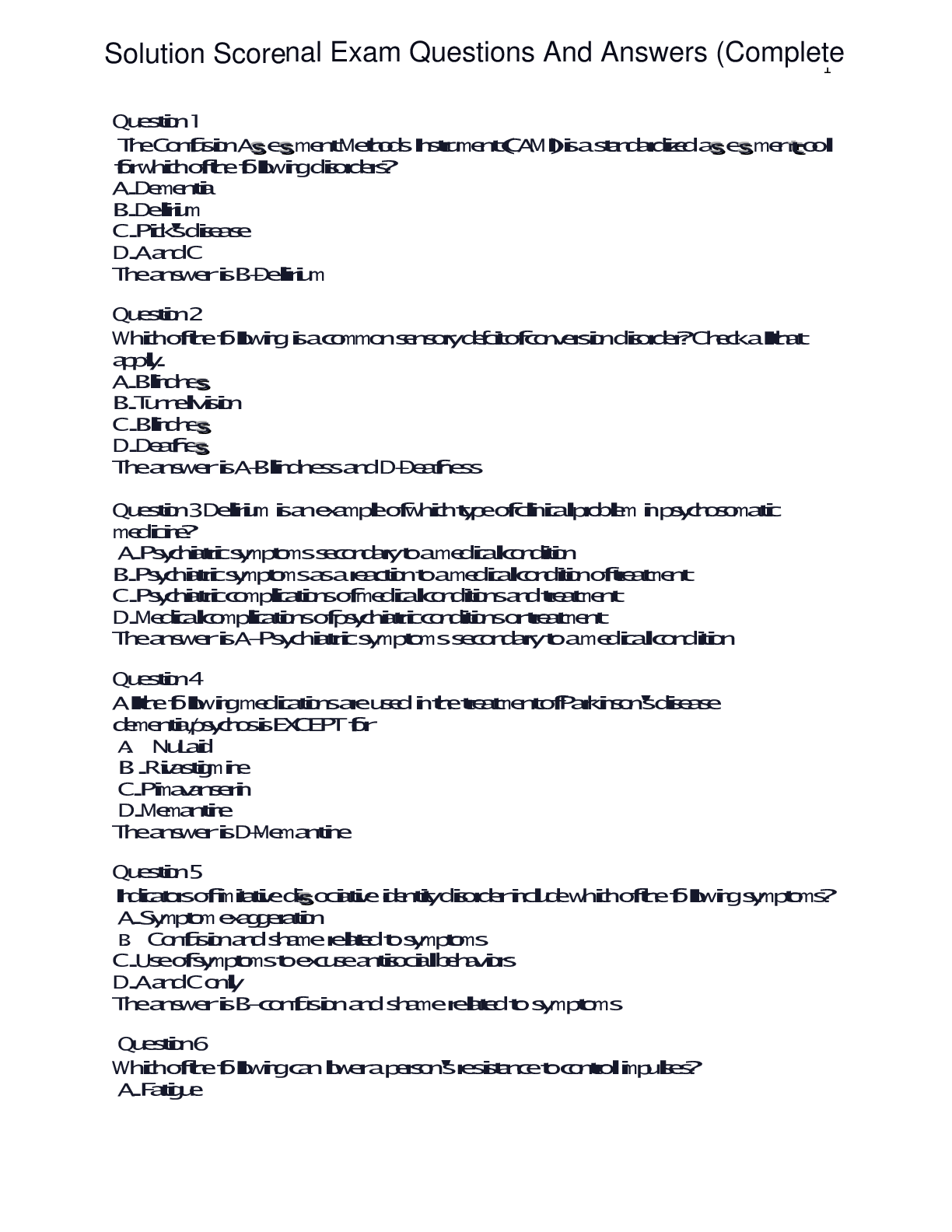
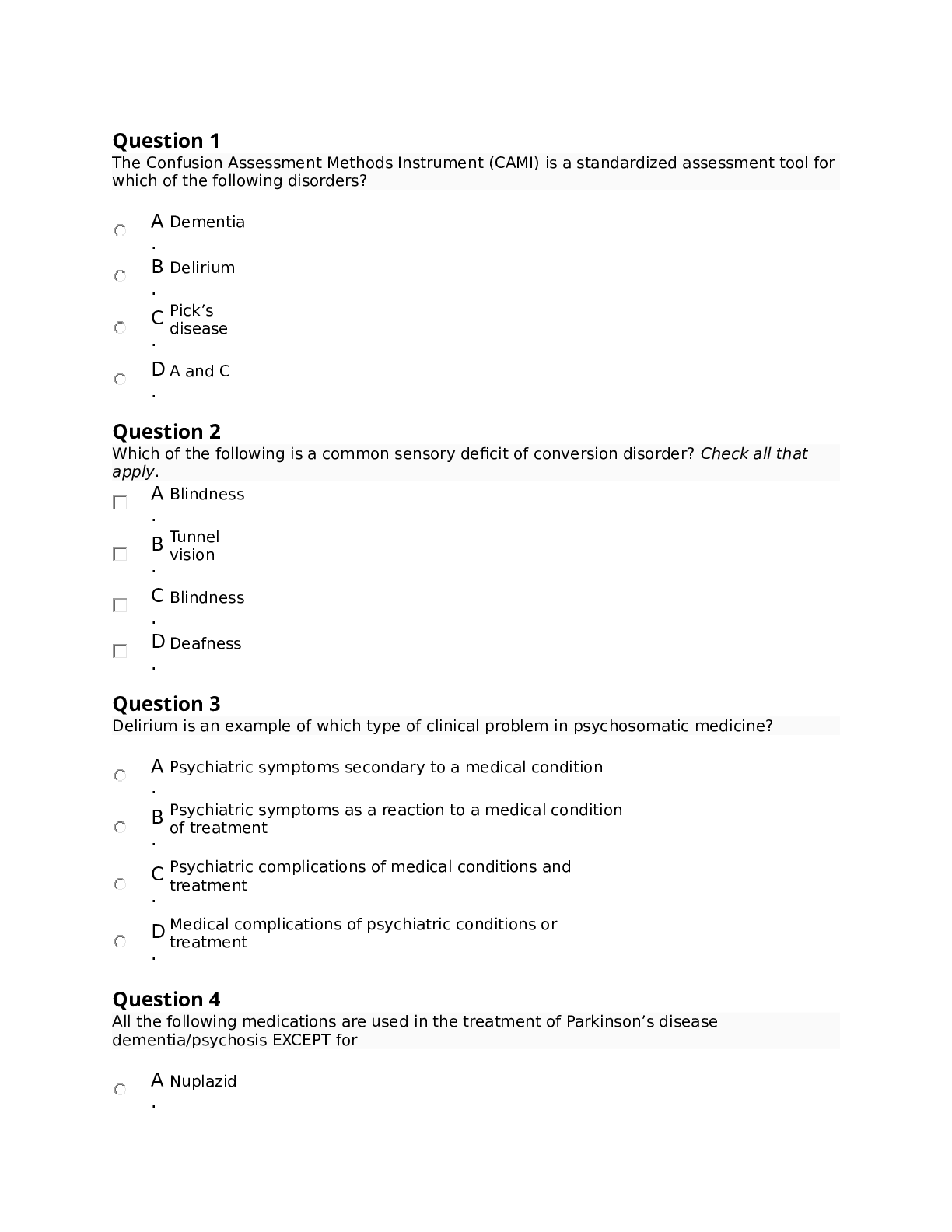
Question 1
The Confusion Assessment Methods Instrument (CAMI) is a standardized assessment tool for
which of the following disorders?
A
.
Dementia
B
.
Delirium
C
.
Pick’s
disease
D
.
A and C
Question 2
Which of the following is a common sensory deficit of conversion disorder? Check all that
apply.
A
.
Blindness
B
.
Tunnel
vision
C
.
Blindness
D
.
Deafness
Question 3
Delirium is an example of which type of clinical problem in psychosomatic medicine?
A
.
Psychiatric symptoms secondary to a medical condition
B
.
Psychiatric symptoms as a reaction to a medical condition
of treatment
C
.
Psychiatric complications of medical conditions and
treatment
D
.
Medical complications of psychiatric conditions or
treatment
Question 4
All the following medications are used in the treatment of Parkinson’s disease
dementia/psychosis EXCEPT for
A
.
Nuplazid
B
.
Rivastigmi
ne
C
.
Pimavanser
in
D
.
Memantine
Question 5
Indicators of imitative dissociative identity disorder include which of the following
symptoms?
A
.
Symptom exaggeration
B
.
Confusion and shame related to
symptoms
C
.
Use of symptoms to excuse antisocial
behaviors
D
.
A and C only
Question 6
Which of the following can lower a person’s resistance to control impulses?
A
.
Fatigue
B
.
Incessant
stimulation
C
.
Psychic trauma
D
.
All of the above
Question 7
Schizophrenia in a patient with end-stage renal disease is an example of which type of
clinical problem in psychosomatic medicine?
A
.
Co-occurring medical and psychiatric conditions
B
.
Psychiatric symptoms secondary to a medical
condition
C
.
Psychiatric symptoms as a reaction to a medical
condition
D
.
Psychiatric complications of medical conditions and
treatments
Question 8
An acute onset, short-term confusion, with changes in cognition and level of awareness due
to a physiological cause is known as which of the following?
A
.
Delirium
B
.
Dementia
C
.
Psychosis
D
.
Traumatic brain
injury
Question 9
A patient expresses feelings of unreality or of being detached from their environment,
describing the perception of the outside world as unreal, dreamlike, and visually distorted.
The ARNP recognizes this as which of the following?
A
.
Derealization
B
.
Depersonalization
C
.
Generalized
amnesia
D
.
Dissociative
identity disorder
Question 10
A patient presents with persistent feelings of detachment from one’s
self, like watching one’s self in a movie. The ARNP recognizes this as
which of the following?
A
.
Derealization
B
.
Depersonalization
C
.
Generalized amnesia
D Dissociative identity
.
disorder
Question 11
Which of the following is recommended in the treatment of pyromania?
A
.
Psychoanalysis
B
.
Cognitive therapy
C
.
Supervision of patient to prevent a repeated episode of
fire setting
D
.
All the above
Question 12
Which of the following biological factors have been associated with kleptomania? Check all
that apply.
A
.
Brain diseases
B
.
Cortical atrophy
C
.
Mental retardation
D
.
Enlarged lateral
ventricles
Question 13
A neurodevelopmental disorder characterized by impairment confined to a specific area of
academic achievement (i.e., reading, writing, arithmetic, spelling) without deficits in
intellectual and adaptive behaviors is
A
.
Intellectual disability
B
.
Communication
disorder
C
.
Specific learning
disorder
D
.
Autism spectrum
disorder
Question 14
Which of the following approaches/treatments are recommended in working with patients
with a conversion disorder?
A
.
After a very thorough evaluation to r/o any medical cause, tell the patient that the
symptoms are imaginary.
B
.
Recommend psychotherapy to focus on issues of stress and coping.
C
.
Recommend psychoanalysis to explore intrapsychic conflicts.
D
.
B and C only
Question 15
Experiences of depersonalization and derealization are common in which of the following
patients?
A
.
Patients with seizures
B
.
Patients with migraines
C
.
Patients who use
marijuana
D
.
All of the above
Question 16
Under hypnosis or during psychotherapy, a patient may recover a memory of a painful
experience that is etiologically significant. This is known as which of the following?
A
.
False memory
syndrome
B
.
Recalled memory
syndrome
C
.
Dissociative trance
disorder
D
.
Recovered identity
disorder
Question 17
Which of the following is recommended as a first line therapy for a patient with dementia
and behavioral disturbance?
A Valproic acid
.
(Depakote)
B
.
Risperdal
C
.
Haloperidol
D
.
None of the above
Question 18
According to the DSM-5, delirium is specified as acute or persistent. Which of the following
time frames is consistent with acute delirium specification?
A
.
A few hours or
days
B
.
Three weeks or
less
C
.
One month or
less
D
.
Less than 3
months
Question 19
Which of the following is true about impulses? Check all that apply.
A
.
Impulses are acted upon with the expectation of receiving
pleasure
B
.
Impulses are usually ego-dystonic.
C
.
Impulsive behaviors are characterized by their repetitive
nature.
D
.
The repeated acting out of impulses leads to psychological
impairment.
Question 20
MRI findings in patients with intermittent explosive disorder may reveal changes to which
area of the brain that is associated with loss of impulse control?
A
.
Cerebellum
B
.
Prefrontal
cortex
C Temporal lobe
.
D
.
Parietal lobe
Question 21
Patients with kleptomania have a high lifetime comorbidity of which of the following
disorders?
A
.
Mood disorders
B
.
Schizophrenia
C
.
Dissociative
disorders
D
.
All of the above
Question 22
The epidemiology related to kleptomania includes which of the following?
A
.
Kleptomania is more prevalent in males than females.
B
.
Kleptomania is estimated to be about 10 percent in the general
population.
C
.
Kleptomania is reported to occur in fewer than 5 percent of
identified shoplifters.
D
.
All of the above
Question 23
An increase in depersonalization is seen with the depletion of which of the following?
A
.
GABA
B
.
Serotonin
C
.
L-tryptophan
D
.
Norepinephri
ne
Question 24
Depression secondary to interferon treatments represents which of the following clinical
problems in psychosomatic medicine?
A
.
Psychiatric complications of medical conditions and
treatments.
B
.
Psychiatric symptoms secondary to a medical condition.
C
.
Psychological factors precipitating medical symptoms.
D
.
Psychiatric symptoms as a reaction to medical condition or
treatments.
Question 25
The ARNP is meeting with a person who reports a fascination with fire, along with recurrent
deliberate and purposeful setting of fires. The ARNP realizes that these behaviors are
consistent with which of the following disorders?
A
.
Pyromania
B
.
Obsessive-compulsive
disorder
C
.
Intermittent explosive
disorder
D
.
Pyrophobia
Question 26
Which of the following is not consistent with what is known about depersonalization and
derealization?
A
.
They are the third most commonly reported psychiatric symptom.
B
.
Derealization is two to four times more often in men than in women.
C
.
One survey found a one-year prevalence of 19 percent in the general population.
D
.
Transient experiences of depersonalization and derealization are extremely common
in normal and clinical populations.
Question 27
Which of the following are included in the clinical features of anxiety illness disorder? Check
all that apply.
A
.
Persons maintain they have a particular disease or as time progresses their belief
may transfer to another disease.
B
.
Lab results, lack of progression of the disease, and appropriate reassurances from
the provider are helpful treatments for the person with the disease.
C
.
Preoccupation with illness may or may not interfere with their interaction with family,
friends, and co-workers.
D
.
They are often addicted to internet search about their feared illness, inferring the
worst from the information.
Question 28
The ARNP in working with a parent of a 6-month-old would offer which of the following in
anticipatory guidance?
A
.
Give baby much attention.
B
.
Attune to baby’s needs for hunger, fatigue,
diaper change.
C
.
Provide supervised time for crawling, sitting,
and rolling.
D
.
All the above
Question 29
The symptom of giving approximate answers is known as which of the following?
A
.
Alogia
B
.
Paralogi
a
C
.
Analogi
a
D
.
Symlogi
a
Question 30
Identifying developmental milestones is an important skill set for ARNPs for which of the
following reasons?
A
.
Often developmental milestones go unrecognized until a child is much older.
B
.
Knowing when a significant variation in development has occurred improves
diagnostic accuracy.
C The sooner a significant developmental impairment is identified and addressed, the
.
better the long-term outcomes could be for patients.
D
.
All of the above.
Question 31
Which of the following can cause delirium? Check all that apply.
A
.
Polypharmacy
B
.
Sleep deprivation
C
.
Admission/transfer/discharge from a healthcare
facility
D
.
None of the above
Question 32
A patient who has been raped, presents with the inability to recall important personal
information and any information about the rape, does recall events prior and since. There
does not appear to be any physiological reason for this. This presentation is consistent with
which of the following diagnoses?
A
.
Dissociative amnesia
B
.
Dissociative amnesia with
dissociative fugue
C
.
Localized dissociative amnesia
D
.
Generalized dissociative amnesia
Question 33
A term use to describe a neurodevelopmental disorder characterized by impairments in
reciprocal social communication and a tendency to engage in repetitive stereotyped
patterns of behaviors, interests and activities is
A
.
Intellectual disability
B
.
Specific learning disorder
C
.
Autism spectrum disorder (ASD)
D
.
Attention deficit/hyperactivity disorder
(ADHD)
Question 34
Acute withdrawal from alcohol represents which type of clinical problem in psychosomatic
medicine?
A
.
Medical complications of psychiatric conditions or
treatments
B
.
Psychiatric complications of medical conditions and
treatments
C
.
Psychiatric symptoms as a reaction to medical
treatments.
D
.
Co-occurring medical and psychiatric conditions.
Question 35
A dissociative disorder described as an identity disturbance due to prolonged and intense
coercive persuasion is known as which of the following?
A
.
Brainwashing
B
.
Ganser syndrome
C
.
Imitative dissociation identity
disorder
D
.
Factitious dissociative identity
disorder
Question 36
Discrete episodes of losing control of aggressive impulses grossly out of proportion to any
stressors, which can result in serious assault tor destruction of property are symptoms
consistent with which of the following disorders?
A
.
Conduct disorder
B
.
Anti-social personality
disorder
C
.
Borderline personality
disorder
D
.
Intermittent explosive
disord
Question 37
Epidemiology data suggests which of the following with respect to illness anxiety disorder?
A
.
Illness anxiety disorder is more common in men than in women.
B
.
Illness anxiety disorder is seen more frequently in persons with higher education.
C
.
Surveys indicate that up to 15 percent of the general population worry about
becoming sick and incapacitated as a result.
D
.
Illness anxiety disorder is more common among caucasians than among other races.
Question 38
Which of the following treatments is NOT recommended in treating Dissociative Identity
Disorder?
A
.
Cognitive Therapy
B
.
Hypnosis
C
.
Antidepressants
D
.
Group
Psychotherapy
Question 39
A person reveals to the ARNP that they steal to get the things they want and cannot afford.
The person says they just can’t help themselves, because they have kleptomania. The ARNP
realizes the following:
A
.
This presentation is consistent with kleptomania.
B
.
This presentation is not consistent with kleptomania because a person with
kleptomania does not realize they have kleptomania.
C
.
The person likely does not have kleptomania because a person with kleptomania is
more concerned with the act of stealing rather than the obtaining the object which
has been stolen.
D
.
The presentation is consistent with kleptomania because the person is stealing
things they need.
Question 40
A subcortical dementia with parenchymal abnormalities which can be visualized on MRI is
known as which of the following?
A
.
HIV dementia
B Kluver-Bucy syndrome
.
C
.
Alzheimer’s type
dementia
D
.
Creutzfeldt-Jakob
disease
Question 41
Predisposing factors for delirium include which of the following? Check all that apply.
A
.
Dementia
B
.
History of falls
C
.
Age 65 and olde
D
.
Sensory
impairment
Question 42
Which of the following diagnostic instruments for Autism Spectrum Disorder is
recommended for universal clinical practice?
A
.
Autism Diagnostic Interview -Revised (ADI – R)
B
.
Diagnostic Interview for Social and Communication
Disorder (DISCO)
C
.
Development, Dimensional and Diagnostic Interview
D
.
None of the above
Question 43
A capacity evaluation prior to an organ transplantation is an example of which of the
following clinical problems in psychosomatic medicine?
A
.
Psychiatric symptoms secondary to a medical
condition
B
.
Medical complications of psychiatric
treatments
C
.
Psychological factors precipitating medical
conditions
D Psychiatric/psychosocial assessment
.
Question 44
A temporary marked alteration in the state of consciousness or by the customary sense of
personal identity without the replacement by an alternate sense of identity is known as
which of the following?
A
.
Ganser Syndrome
B
.
Dissociative Trance Disorder
C
.
Dissociative Identity Disorder
D
.
Factitious Dissociative Identity
Disorder
Question 45
Which of the following is consistent with current literature about the relationship between
obstetrical complications and Autism Spectrum Disorders (ASD)?
A
.
Research is unclear whether obstetric complications are a true risk factor for
ASD.
B
.
Research proves there is a negative correlation between obstetrical
complications and ASD.
C
.
Research proves there is a positive correlation between obstetrical
complications and ASD.
D
.
Research strongly supports a positive relationship between obstetric
complications and ASD.
Question 46
A major neurocognitive disorder with severe impairment in memory, judgment, orientation, and
cognition is known as which of the following?
A
.
Deliriu
m
B
.
Dement
ia
C
.
Psychos
is
D
.
Amnesi
a
Question 47
Difficulty with immediate memory is attributed to impairment in which of the following
regions of the brain? Select all that apply.
A
.
Broca
B
.
Wernick
e
C
.
Occipita
l
D
.
Tempor
al
Question 48
Which of the following would not be included in the treatment plan for a patient with illness
anxiety disorder?
A
.
Behavioral therapy
B
.
Group psychotherapy
C
.
Insight oriented psychotherapy
D
.
Exploratory invasive procedures to obtain
diagnosis
Question 49
Which of the following would demonstrate the normal achievement of gross motor
developmental milestone for a 6-month-old?
A
.
Pulls to stand
B
.
Transfers items hand to hand
C
.
Briefly sits alone: pivots in prone
D
.
Feeds self crackers; stares at
new faces.
Question 50
A process by which repressed material is brought back to consciousness and the person
relives the repressed material accompanied ty the appropriate affective response.
A Abulia
.
B
.
Abreactio
n
C
.
Adynamia
D
.
Alexithym
ia
Question 51
The term psychosomatic literally refers to which of the following?
A
.
Imaginary illness
B
.
Psychiatric illness
C
.
How the mind effects the
body
D
.
How the body effects the
mind
Question 52
Which of the following is consistent with normal range gross motor developmental
milestones for a 4 year old?
A
.
Walks down stairs, jumps backwards
B
.
Balances on one foot for 4 seconds, can broad
jump 1 foot
C
.
Writes part of name; copies a square.
D
.
Eats independently, unbuttons items
Question 53
Which of the following speech and language skills are consistent with normal developmental
milestones of a 3-year-old?
A
.
Uses three-word sentences; names body
parts.
B
.
Uses two-word sentences; understands me
and you
C
.
Follows three-step request; tells stories
D
.
Responds to “why?”; likes rhyming words
Question 54
Which the following medications is used to treat irritability in autism?
A
.
fluoxetine
B
.
aripiprazo
le
C
.
alprazola
m
D
.
guanfacin
e
Question 55
A congenital neurodevelopmental disorder primarily occurring in females, characterized by
specific deficits following a period of normal function growth and development is
A
.
PANDAS
B
.
Rett syndrome
C
.
Reye’s syndrome
D
.
Kluver-Bucy
syndrome
Question 56
Which of the following are included in the five different milestone skill areas that should be
evaluated?
A
.
Social/emotional skills
B
.
Gross/fine motor skills
C
.
Speech and language
skills
D
.
All the above
Question 57
Recognizable skills or abilities that have an expected range and order of appearance such as
a child taking his first step around the time of his first birthday is known as which of the
following?
A
.
Life skills
B
.
Motor development
C
.
Developmental
history
D
.
Developmental
milestones
Question 58
A condition characterized by the person giving approximate answers, with clouding of
consciousness, frequently accompanied by hallucinations or other dissociative, somatoform
or conversion symptoms is
A
.
Ganser Syndrome
B
.
Schizophrenia
C
.
Dissociative trance
disorder
D
.
Dissociative identity
disorder
Question 59
Somatoform disorders represent which type of clinical problem in psychosomatic Medicine?
A
.
Co-occurring medical and psychiatric conditions.
B
.
Psychiatric complications of medical conditions and
treatments.
C
.
Psychiatric symptoms secondary to a medical
condition.
D
.
Psychological factors precipitating medical
symptoms.
Question 60
Which is NOT consistent with what is known about Ganser syndrome?
A
.
Three of Ganser’s first four cases were convicts.
B
.
Cases have been reported in a variety of cultures.
C
.
Women outnumber men by approximately 2 to 1.
D
.
It is considered by some to be an indicator of potential
malingering.
Question 61
The second-most common type of dementia caused by cardiovascular and cerebrovascular
disease with progressive cognitive decline in stepwise fashion is known as which of the
following?
A
.
Pick’s disease
B
.
HIV dementia
C
.
Vascular
dementia
D
.
Lewy-body
dementia
Question 62
Deficits in attention and the ability to complete multi-step commands are associated with
impairment in which of the following regions of the brain?
A
.
Frontal
B
.
Prefrontal
C
.
Cingulate
gyrus
D
.
All the above
Question 63
A person erroneously believes they sustained an emotional or physical trauma in early life is
known as which of the following?
A
.
Ganser syndrome
B
.
False memory syndrome
C
.
Factitious dissociative identity
disorder
D
.
Imitative dissociative identity
disorder
Question 64
Persons who continually use the internet to play games to the extent that it interferes with
social relations and work performance are exhibiting symptoms most specifically consistent
with which of the following conditions?
A
.
Obsessive gaming
disorder
B
.
Internet gaming
disorder
C
.
Internet use
D
.
Internet abuse
Question 65
A new diagnosis in the DSM-5 characterized by persons preoccupied with being sick or
developing a disease of some kind is known as which of the following?
A
.
Conversion disorder
B
.
Illness anxiety disorder
C
.
Somatic symptom disorder
D
.
Functional neurological symptom
disorder
Question 66
A subcortical dementia characterized by motor abnormalities including psychomotor
slowing, choreoathetoid movements, executive dysfunction complicated by impaired
language, memory, and insight later in the disease process is
A
.
Vascular dementia
B
.
Huntington’s disease
C
.
Creutzfeldt-Jakob
disease
D
.
Alzheimer’s type
dementia
Question 67
Which of the following is a common visceral symptom of conversion disorder?
A
.
Seizures
B
.
Diarrhea
C
.
Paralysis
D
.
Mid-line
anesthesia
Question 68
The ARNP is working with the family of a patient with Alzheimer’s Disease who keeps stating
the family is plotting against her, trying to have her “snuffed out.” The family is distraught
because they state they are doing their best to make sure their family member is safe. The
ARNP explains which of the following in educating the patient about the patient’s
A
.
The patient is hallucinating. An estimated 20–30 percent of patient with dementia
have hallucinations.
B
.
The patient is delusional. An estimated 30–40 percent of patients with dementia
have delusions.
C
.
The patient likely has valid concerns and adult protective services needs to be called.
D
.
Disturbance in perception is common in patients with Alzheimer’s Disease and
patient needs to be hospitalized immediately.
Question 69
Which of the following questions would be important when differentiating pyromania from
schizophrenia?
A
.
Was the fire set in response to a delusion or hallucination?
B
.
Was the fire set deliberately, not a failure to resist an
impulse?
C
.
Was the fire set as an act of sabotage?
D
.
Was the fire set with a failure to appreciate the
consequences of the act?
Question 70
The ARNP notices that a patient with a conversion disorder unable to walk has an
inappropriately cavalier attitude toward what seems to be a major impairment and
recognizes this an associated psychological symptom known as which of the following?
A
.
Identification
B
.
Primary gain
C
.
Secondary gain
D
.
La belle
indifference
Question 71
The ARNP recognizes which of the following when the 2-month-old opens her mouth when
she sees a bottle.
A
.
The 2-month-old must be quite advanced as this is a visual motor skill normally seen
in a 4 month old.
B
.
The 2-month-old is demonstrating a normal developmental adaptive skill.
C
.
The 2-month-old is demonstrating a normal developmental visual motor skill.
D
.
The 2-month-old is demonstrating an advanced developmental gross motor skill.
Question 72
Neuropsychiatric testing is defined as which of the following?
A
.
A comprehensive mental status exam
B
.
A neurological evaluation of brain function
C
.
Standardized quantitative reproducible evaluation of a patient’s
cognitive abilities.
D
.
A non-invasive test of brain function which analyzes electrical
rhythms in the brain
Question 73
Deficits in language including naming, repetition, reading and comprehension, and writing is
NOT associated with impairment in which of the following regions of the brain?
A Broca
.
B
.
Wernicke
C
.
Right
parietal
D
.
Left
temporal
Question 74
A sudden unexpected purposeful travel away from home with inability to recall all of one’s
past accompanied by confusion about personal identity not due to direct effects of a
substance or a general medical condition which causes clinically significant distress or
impairment in social, occupational, or other important areas of functioning is most
specifically known as which of the following?
A
.
Dissociative fugue
B
.
Dissociative
amnesia
C
.
Posttraumatic
amnesia
D
.
Systematized
amnesia
Question 75
Visual hallucinations are associated with impairment in which of the following regions of the
brain?
A
.
Occipital
B
.
Temporal
C
.
Left parietal
D
.
Frontal,
prefrontal
Question 76
The principal theoretician to bring psyche and soma together was which of the following?
A
.
Sigmund
Freud
B Anna Freud
.
C
.
Karl Abraham
D
.
Georg
Groddeck
Question 77
Which of the following medications are FDA-approved medications for the treatment of
delirium?
A
.
Donepezil
B
.
Galantamine
C
.
Rivastigmine
D
.
None of the
above
Question 78
Anxiety related to chemotherapy is an example of which type of clinical problem in
psychosomatic medicine?
A
.
Psychological factors precipitating medical symptoms
B
.
Psychiatric symptoms as a reaction to a medical condition
or treatment
C
.
Co-occurring medical and psychiatric conditions
D
.
Psychiatric complications of medical conditions and
treatments
Question 79
A type of delirium characterized by cycling through psychomotor agitation and retardation,
from apathy to hypervigilance is known as which of the following?
A
.
Mixed delirium
B
.
Bipolar delirium
C
.
Hyperactive
delirium
D
.
A and B
Question 80
A tension state that can exist without an action is known as which of the following?
A
.
An
obsession
B
.
A
compulsion
C
.
An impulse
D
.
Ego
dystonic
Question 81
Which of the following is true regarding how intermittent explosive disorder is differentiated
from antisocial or borderline personality disorder?
A
.
In personality disorders, the aggressiveness and impulsivity are mild.
B
.
In personality disorders, the person is much less aware of the symptoms.
C
.
In personality disorders, functioning is less likely to be affected.
D
.
In personality disorders, aggressiveness and impulsivity is part of the person’s
character and is present between outbursts.
Question 82
A tension state that always has an action component is known as which of the following?
A
.
An impulse
B
.
An
obsession
C
.
A
compulsion
D
.
Acting out
Question 83
A cognitive assessment should include which of the following?
A
.
Baseline cognitive
functioning
B
.
Changes from baseline
functioning
C
.
Speed of onset of cognitive
changes
D
.
All of the above
Question 84
The ARNP evaluates a 4-year-old who cannot balance on one foot for 3 seconds, cannot copy
a circle and realizes which of the following?
A
.
This is normal for a 4-year-old.
B
.
This is a developmental red flag for a 4-year-old that should trigger a specialized
assessment.
C
.
This is a developmental red flag for a 5-year-old so do nothing at this point.
D
.
This is a minor concern, the APRN advises to enroll the child in gymnastics for
balance and an art class to learn to draw better.
Question 85
Which of the following adaptive skills are consist with normal range developmental
milestone of an 18-month-old?
A
.
Bite, chews cookie; looks for
fallen item
B
.
Finger feeds items; takes off a
hat.
C
.
Gets onto a chair; removes
garment
D
.
Opens doorknobs; pulls off pants.
Question 86
A disorder characterized by the presence of two or more distinct identities which differ from
each other in that each presents as having its own pattern of perceiving, relating to, and
thinking about the environment and self.
A
.
Dissociative Identity Disorder
B
.
Imitative Dissociative Identity
Disorder
C
.
Factitious Dissociative Identity
Disorder
D
.
Malingered Dissociative Identity
Disorder
Question 87
Interest in fires and deliberate setting of fires for financial gain is known as which of the
following?
A
.
Arson
B
.
Pyromania
C
.
Intermittent explosive
disorder
D
.
Impulse control disorder
Question 88
Which of the following conversion disorder symptoms are associated with a good prognosis?
A
.
Tremors and
aphonia
B
.
Tremors and
seizures
C
.
Paralysis and
seizures
D
.
Paralysis and
blindness
Question 89
A type of delirium characterized by psychomotor retardation and apathy is known as which
of the following?
A
.
Mixed delirium
B
.
Medical delirium
C
.
Hypoactive
delirium
D
.
Hyperactive
delirium
Question 90
Which of the following symptoms assist in differentiating a seizure from a pseudoseizure?
A
.
Tongue biting is typically not present in a
pseudoseizure
B
.
Urinary incontinence is typically not present in a
pseudoseizure
C
.
Injuries from falling are typically not present in a
pseudoseizure
D
.
All the above
Question 91
Which of the following questions are recommended to assess sexual identity in a male
adolescent?
A
.
Do you have or have you had a girlfriend?
B
.
Do you have or have you had a boyfriend?
C
.
Do you have, or have you had romantic feelings
toward anyone?
D
.
A and C only
Question 92
Which of the following demographics are consistent with autism spectrum disorder (ASD)
A
.
Female to male ratio
(4:1)
B
.
Onset of symptoms by
age 3
C
.
Affects 1 in 100
children
D
.
All the above
Question 93
The diagnosis formerly known as multiple personality disorder is now known as which of the
following?
A
.
Dissociative fugue
B
.
Dissociative identity disorder
C
.
Factitious dissociative identity
disorder
D
.
None of the above
Question 94
Which of the following is NOT consistent with what is known about intermittent explosive
disorder across the lifespan?
A
.
Intermittent explosive disorder may appear at any stage of life.
B
.
Intermittent explosive disorder usually appears between late adolescence and
early adulthood.
C
.
Intermittent explosive disorder typically increases in severity with the onset of
middle age.
D
.
The onset of intermittent explosive disorder may be acute or insidious
Question 95
Functional neurological symptoms disorder is also known as which of the following?
A
.
Conversion
disorder
B
.
Somatization
disorder
C
.
Factitious disorder
D
.
A and C
Question 96
Which of the following would be a developmental trigger for a 3-year-old? Check all that
apply.
A
.
Cannot balance on one foot for 3 seconds, cannot copy a circle
B
.
Lack of imaginative plan; cannot hypothesize an other’s thought
C
.
Cannot use a three-word sentence; speech only 50%
understandable
D
.
Speech less than 75% understandable; cannot identify self or
details in pictures
Question 97
Which of the following questions would be important when differentiating pyromania from
conduct disorder or antisocial personality disorder? Check all that apply.
A
.
Was the fire set in response to a delusion or hallucination?
B
.
Was the fire set deliberately, not a failure to resist an
impulse?
C
.
Was the fire set as an act of sabotage?
D
.
Was the fire set with a failure to appreciate the
consequences of the act?
Question 98
The therapeutic approach that has the best chance of success for the person with
intermittent explosive disorder is which of the following?
A
.
Psychotherapy only
B
.
Psychopharmacology only
C
.
A combined psychotherapy/psychopharmacology
approach
D
.
Family therapy only
Question 99
Which of the following are common disorders that must be differentiated from dissociative
identity disorder? Check all that apply.
A
.
Perimenstrual disorders
B
.
Posttraumatic stress
disorder
C
.
Obsessive-compulsive
disorder
D B and C only
.
Question 100
Which of the following is an example of a medical complication of psychiatric conditions or
treatment?
A
.
Dementia
B
.
Neuroleptic Malignant syndrome
C
.
Depression related to limb amputation
D
.
Recurrence of depressive disorder in setting of cancer
treatment
[Show More]


.png)







.png)