In order to support the hypothesis that the independent variable has influenced the dependent variable, __________ is necessary.
Question options:
a significantly high within-groups variation
careful reduction o
...
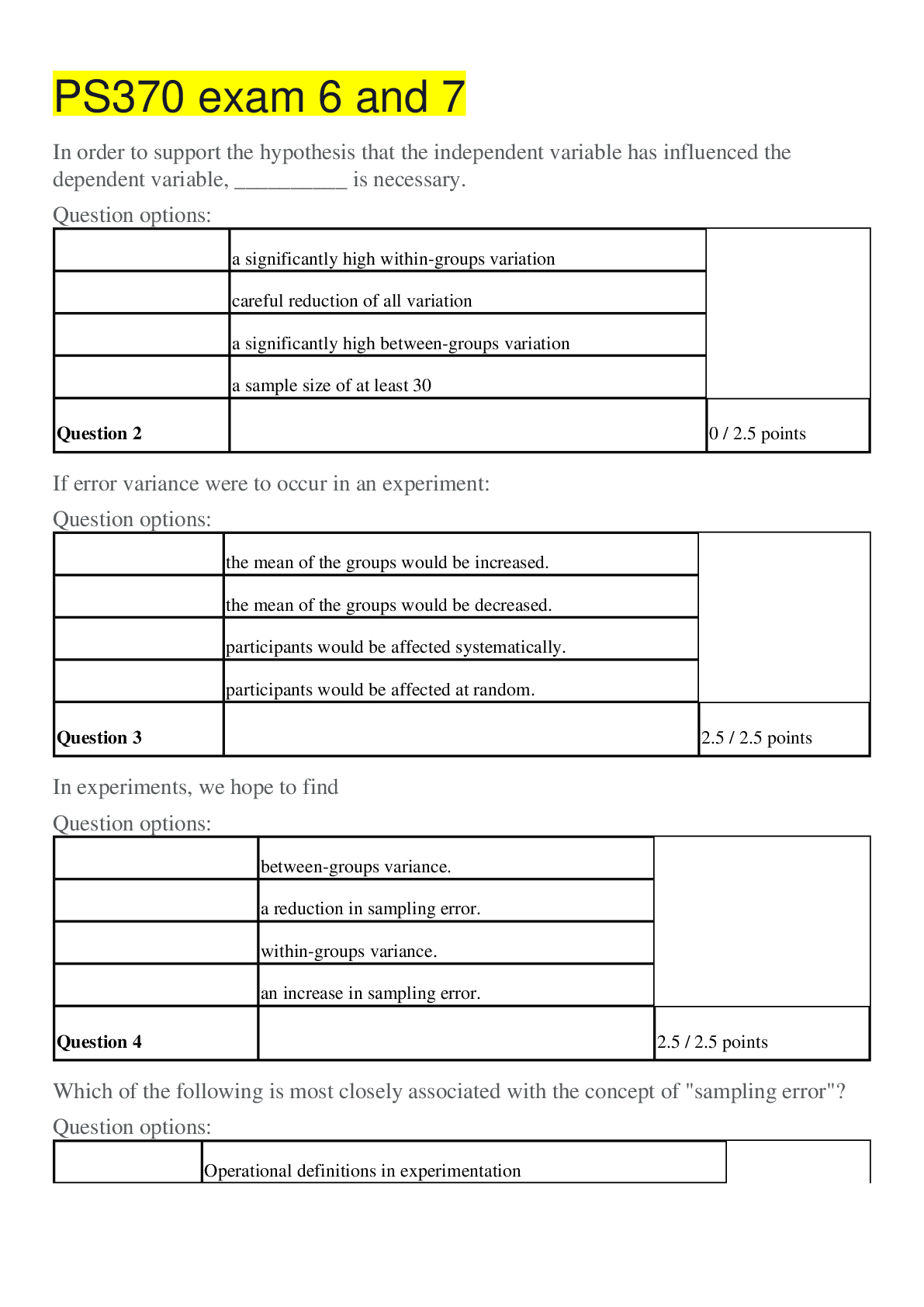
In order to support the hypothesis that the independent variable has influenced the dependent variable, __________ is necessary.
Question options:
a significantly high within-groups variation
careful reduction of all variation
a significantly high between-groups variation
a sample size of at least 30
Question 2 0 / 2.5 points
If error variance were to occur in an experiment:
Question options:
the mean of the groups would be increased.
the mean of the groups would be decreased.
participants would be affected systematically.
participants would be affected at random.
Question 3 2.5 / 2.5 points
In experiments, we hope to find
Question options:
between-groups variance.
a reduction in sampling error.
within-groups variance.
an increase in sampling error.
Question 4 2.5 / 2.5 points
Which of the following is most closely associated with the concept of "sampling error"?
Question options:
Operational definitions in experimentation
Differences between males and females on the dependent measure
Electronic hardware failures during sampling
Natural variability among the means
Question 5 2.5 / 2.5 points
In order to test the effects of the 1988 heat wave on worker productivity, 48 machinists were randomly assigned to two groups of 24 machinists each. Each group was tested at a different room temperature (cool and hot) using dependent measures of number of parts produced and accuracy. What type of design does this study represent?
Question options:
A single-group, pretest-posttest design
A Solomon four-group design
A multilevel, completely randomized, between-subjects design
A randomized, posttest-only, control-group design
Question 6 2.5 / 2.5 points
The most important method for decreasing the error term is to:
Question options:
decrease the sample size.
hold the independent variable constant.
increase the number of dependent variables.
increase sample size.
Question 7 2.5 / 2.5 points
A researcher wants to look at the effects of "stress endurance treatment" on self-esteem in cancer patients. The researcher has 50 cancer patients attend "stress endurance treatment" sessions once a week. At the end of the 8-week treatment, participants are measured on self-esteem. This is an example of a(n) __________ design.
Question options:
ex post facto
ad hoc
single-group, posttest-only
longitudinal
Question 8 2.5 / 2.5 points
A researcher decides to study the effects of dance therapy on self-esteem in emotionally disturbed adolescents. One residential program consents to try the dance therapy treatment, whereas another similar program refuses to try dance therapy, but allows the researcher to measure self-esteem. Self-esteem is measured before and after treatment in both groups. This is an example of a __________ design.
Question options:
multilevel, pretest-posttest control-group
pretest-posttest, natural control-group
randomized, pretest-posttest, control-group
multilevel, randomized, pretest-posttest, between-subjects
Question 9 0 / 2.5 points
In order for us to study causal relationships among variables, it is necessary for:
Question options:
the independent variable to demonstrate variation.
the dependent variable to be a constant.
the independent variable to demonstrate that it is randomly distributed.
there to be extraneous variation.
Question 10 2.5 / 2.5 points
The statement "variation is necessary to carry out experiments":
Question options:
is true only in experiments involving human participants.
is not true in nearly 30% of all experimentation.
refers only to the importance of having very different participants in each group.
is always true in experiments of any kind.
Question 11 2.5 / 2.5 points
The scientific and informational value is generally:
Question options:
greater for a posteriori than for a priori comparison.
greater for a priori than for post hoc comparisons.
greater for a posteriori than for post hoc comparisons.
the same for a priori, post hoc, and a posteriori comparison.
Question 12 2.5 / 2.5 points
Two critical factors used to distinguish experimental designs from most non-experimental designs are:
Question options:
randomization and equal numbers of participants.
elimination of all confounds and randomization.
control groups and randomization.
sophisticated data analysis and control groups.
Question 13 2.5 / 2.5 points
In order to study causal relationships:
Question options:
the null hypothesis must not be rejected.
external validity is essential.
we must use a t-test or F-test.
there must be variation of the independent variable.
Question 14 0 / 2.5 points
The Solomon four-group design was developed in an attempt to:
Question options:
control possible interaction effects of the pretest and the manipulation.
allow more levels of the independent variable.
allow more groups to be tested at the same time.
control possible interaction effects of the pretest and posttest measures.
Question 15 2.5 / 2.5 points
In a study using the multilevel, completely-randomized between-subjects design, 48 rats were randomly assigned to six groups of eight rats each. Each group was tested at a different level of ambient noise. Maze running speed and accuracy were measured. The independent variable in this study was:
Question options:
the number of rats.
speed.
accuracy.
ambient noise level.
Question 16 0 / 2.5 points
Statistical tests CANNOT tell us whether:
Question options:
the combination of experimental and extraneous variance is large enough to differentiate the groups.
there is a significant difference between groups.
there is a reliable difference between groups.
the observed difference is due to experimental or extraneous variables.
Question 17 2.5 / 2.5 points
Which of the following does NOT increase error variance?
Question options:
Random factors
Individual differences
Experimenter error
Systematic effects of the independent variable
Question 18 2.5 / 2.5 points
Which of the following is NOT a source of between-groups variance?
Question options:
Experimental effects
Confounding variables
Sampling error
Control effects
Question 19 0 / 2.5 points
Laczniak and Muehling (1993) suggest that manipulations checks should be considered:
Question options:
even before the pilot or pretesting.
after theory tests.
once you have collected data for the main experiment.
after the final development of your manipulations.
Question 20 2.5 / 2.5 points
History, maturation, and regression to the mean can be controlled by including proper:
Question options:
control groups.
experimental groups.
factorials.
instrumentation.
Section 2
Question 21 2.5 / 2.5 points
In an ABA reversal design, the term "reversal" refers to:
Question options:
the sequential reversal of levels of treatment.
reversing the order of presentation of stimuli.
controlling for sequence effects.
switching the independent variable with the dependent variable.
Question 22 0 / 2.5 points
In terms of the F-test, the value of F is increased by __________ variance.
Question options:
increasing experimental variance and/or decreasing error
decreasing experimental variance and/or increasing error
increasing error
decreasing error variance and/or decreasing experimental
Question 23 2.5 / 2.5 points
The basic comparison in single-subject experimental designs is:
Question options:
between the participant's responses and those of a matched control.
between the same participant's own pretreatment and post-treatment responses.
between the post-treatment responses of the participant and those of a matched control.
a comparison between the real and the ideal responses.
Question 24 0 / 2.5 points
A Latin square design is a more formalized design for use in:
Question options:
within-subjects experiments on eye color and visual acuity.
between-subjects designs.
within-subjects experiments with three or more conditions.
within-subjects experiments with no more than three conditions.
Question 25 2.5 / 2.5 points
In matched-subjects designs, the important variables to match are:
Question options:
those related to performance on the dependent measure(s).
those related to performance on the independent variable(s).
those variables that do not threaten to confound the study.
age and IQ.
Question 26 2.5 / 2.5 points
Single-subject experimental designs are variations of within-subject designs because the same:
Question options:
participant is exposed to all manipulations.
statistical test is used to analyze both designs.
dependent measures are of interest in both types of design.
independent variables are investigated in both types of design.
Question 27 2.5 / 2.5 points
Single-subject designs are often used in research on:
Question options:
behavior modification.
stereotyping and prejudice.
development of teaching methods.
the side effects of psychotropic medications.
Question 28 0 / 2.5 points
Correlated-groups designs are generally more sensitive than between-subjects designs to:
Question options:
researcher effects.
the effects of the dependent variable.
medications.
the effects of the independent variable.
Question 29 2.5 / 2.5 points
In a study of the effectiveness of an experimental drug on sleep apnea, researchers are expecting the drug to have long-lasting beneficial effects on their participants. In this case, what type of correlated-groups design should they use?
Question options:
A within-subjects design
A matched-subjects design
A simple repeated-measures design
A matched-conditions design
Question 30 2.5 / 2.5 points
The single-subject, randomized, time-series design is essentially an interrupted time-series design with one refinement. What is that refinement?
Question options:
The experimenter is kept blind as to the manipulation.
The participant designs and self-administers the manipulation.
The assignment of the manipulation in the time-series is randomized.
The assignment of participants to conditions is randomized.
Question 31 2.5 / 2.5 points
Which of the following is NOT a characteristic of a within-subjects design?
Question options:
Each participant is tested under each experimental condition.
The scores in each condition are correlated with each other.
Each participant is measured only once on the dependent variable.
The critical comparison is the difference between correlated groups on the dependent variable.
Question 32 2.5 / 2.5 points
In a repeated-measures design, the single largest contributing factor to error variance has been removed. What is that factor?
Question options:
Individual differences
Experimenter effects
Participant bias effects
Measurement error
Question 33 2.5 / 2.5 points
Compared with between-subjects designs, within-subjects designs are:
Question options:
more sensitive to effects of the independent variable.
less sensitive to sequence effects.
more sensitive to 4-way ANOVAs.
less sensitive to participant needs.
Question 34 0 / 2.5 points
Which of the following is NOT a characteristic of matched-subjects designs?
Question options:
Each participant is exposed to only one level of the independent variable.
Each participant has a matched participant in each of the other conditions, so that the groups are correlated.
Each participant serves as his or her own control.
The critical comparison is the difference between the correlated groups, where the correlation is created by the matching procedure.
Question 35 2.5 / 2.5 points
In within-subjects designs, each participant:
Question options:
is measured at least five times.
serves as his or her own control.
is measured only once.
is randomly assigned to one of two conditions.
Question 36 2.5 / 2.5 points
Which of the following is a major control for sequence effects?
Question options:
Random assignment of participants
Counterbalancing
Holding the variable constant
Including the factor as a research variable
Question 37 0 / 2.5 points
Which of the following is NOT an example of a common usage of single-subject designs?
Question options:
Determining whether a particular client is improving when a particular treatment is applied
Determining if a specific child's academic achievement improves with a specific teaching method
Determining if an antismoking campaign is having an effect at a specific school
Determining which particular dose of a drug is the most effective for a specific patient
Question 38 2.5 / 2.5 points
An advantage of within-subjects designs is that:
Question options:
they are less complex conceptually.
fewer participants are needed to run the experiment.
the statistics used are simpler than in a between-subjects design.
sequence effects enhance the results.
Question 39 2.5 / 2.5 points
In ABA designs, the effects of the independent variable on the dependent variable are demonstrated if the:
Question options:
level of the dependent variable stays the same in spite of any manipulation.
behavior changes in the predicted direction whenever the conditions are reversed.
level of the dependent variable changes even though there is no independent variable being manipulated.
time graph shows some fluctuations.
Question 40 2.5 / 2.5 points
Why could correlated-groups designs be considered to be experiments?
Question options:
They maximize error variance.
They always use score data.
They randomly assign all participants to conditions.
They meet the requirement of equivalence of groups.
________________________________________
[Show More]











.png)