Acute Coronary Syndrome (ACS) Myocardial Infarction (MI)
JoAnn Smith, 68 years old
Primary Concept Perfusion
Interrelated Concepts (In order of emphasis)
1. Fluid and Electrolyte Balance
2. Clinical Judgment
3.
...
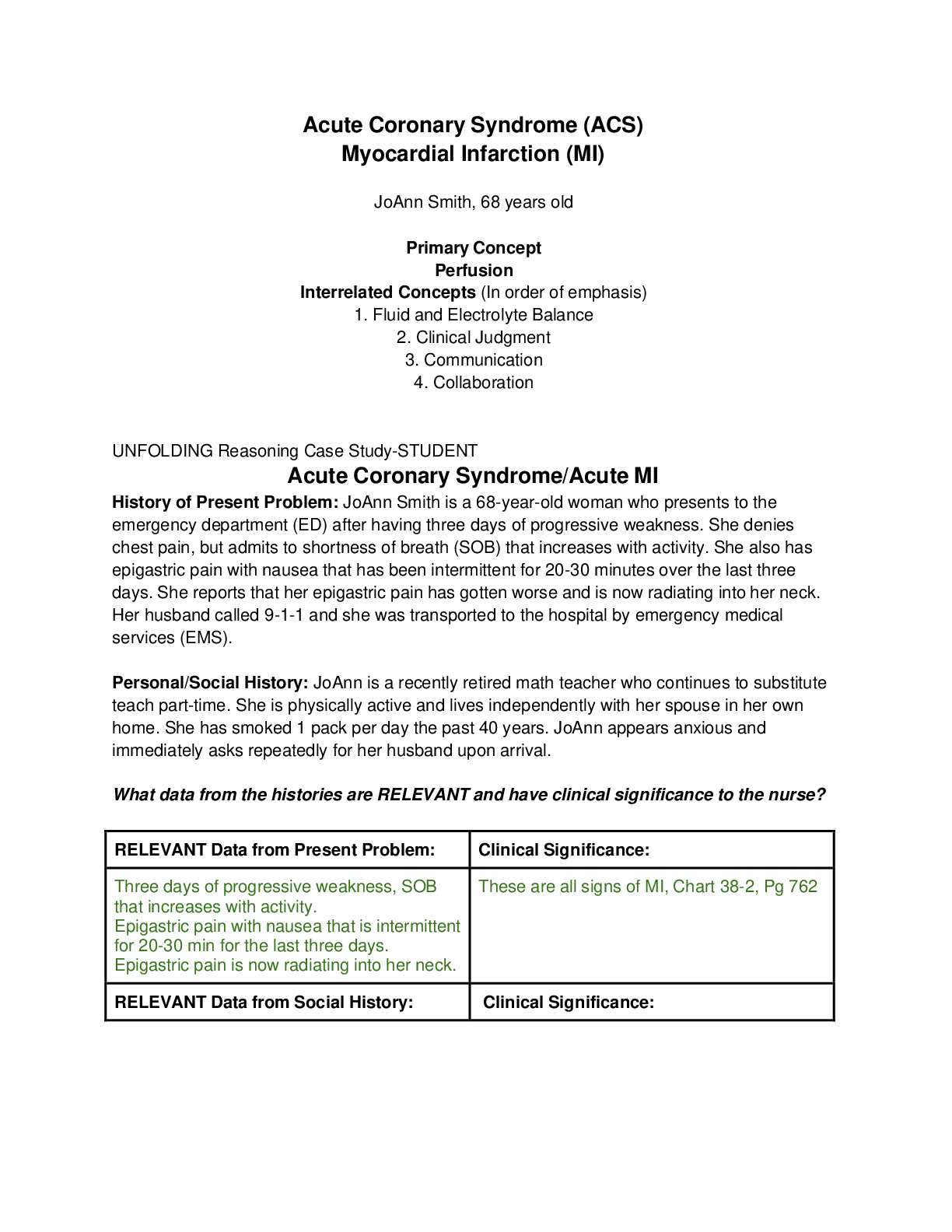
Acute Coronary Syndrome (ACS) Myocardial Infarction (MI)
JoAnn Smith, 68 years old
Primary Concept Perfusion
Interrelated Concepts (In order of emphasis)
1. Fluid and Electrolyte Balance
2. Clinical Judgment
3. Communication
4. Collaboration
UNFOLDING Reasoning Case Study-STUDENT
Acute Coronary Syndrome/Acute MI
History of Present Problem: JoAnn Smith is a 68-year-old woman who presents to the emergency department (ED) after having three days of progressive weakness. She denies chest pain, but admits to shortness of breath (SOB) that increases with activity. She also has epigastric pain with nausea that has been intermittent for 20-30 minutes over the last three days. She reports that her epigastric pain has gotten worse and is now radiating into her neck. Her husband called 9-1-1 and she was transported to the hospital by emergency medical services (EMS).
Personal/Social History: JoAnn is a recently retired math teacher who continues to substitute teach part-time. She is physically active and lives independently with her spouse in her own home. She has smoked 1 pack per day the past 40 years. JoAnn appears anxious and immediately asks repeatedly for her husband upon arrival.
What data from the histories are RELEVANT and have clinical significance to the nurse?
RELEVANT Data from Present Problem: Clinical Significance:
Three days of progressive weakness, SOB that increases with activity.
Epigastric pain with nausea that is intermittent for 20-30 min for the last three days.
Epigastric pain is now radiating into her neck. These are all signs of MI, Chart 38-2, Pg 762
RELEVANT Data from Social History: Clinical Significance:
She has a 40 pack year smoking history. Appears anxious
What is the RELATIONSHIP of your patient’s past medical history (PMH) and current meds? (Which medications treat which conditions? Draw lines to connect)
PMH: Home Meds: Pharm. Classification: Expected Outcome:
Diabetes mellitus type II 1. Iron Sulfate 325 mg PO daily
Hypertension 2. Lisinopril 5 mg PO daily
Hyperlipidemia 3. Simvastatin 20 mg PO daily
Cerebral vascular accident (CVA) with no residual deficits 4. Aspirin 81 mg PO daily
Gastro-esophageal reflux disease (GERD) 5. Clopidogrel 75 mg PO daily
Anemia-Iron deficiency 6. Omeprazole 20 mg PO daily
7. Metformin 500 mg PO bid
One disease process often influences the development of other illnesses. Based on your knowledge of pathophysiology (if applicable), which disease likely developed FIRST that created a “domino effect” in her life? Circle what PMH problem likely started FIRST
Underline what PMH problem(s) FOLLOWED as domino(s)
Patient Care Begins:
What VS data are RELEVANT and must be recognized as clinically significant by the nurse?
Current VS: P-Q-R-S-T Pain Assessment (5th VS):
T: 99.2 F/37.3 C (oral) Provoking/Palliative: Nothing/Nothing
P: 128 (regular) Quality: Ache
R: 24 (regular) Region/Radiation: Left arm that radiates into neck
BP: 108/58 Severity: 5/10
O2 sat: 99% room air Timing: Intermittent-20-30" at a time
What assessment data is RELEVANT and must be recognized as clinically significant by the nurse?
RELEVANT VS Data: Clinical Significance:
P: 128 (regular)
R: 24 (regular)
Current Assessment:
GENERAL APPEARANCE: Anxious, appears uncomfortable, body tense
RESP: Respirations labored, coarse crackles present in bases bilaterally anterior/posterior
CARDIAC: Pale, diaphoretic, no edema, heart sounds regular S1S2 with no abnormal beats, pulses strong, equal with palpation at radial/pedal/post-tibial landmarks
..........................................................................................continued..........................................................................................
[Show More]