UNFOLDING Clinical Reasoning Case Study
History of Present Problem:
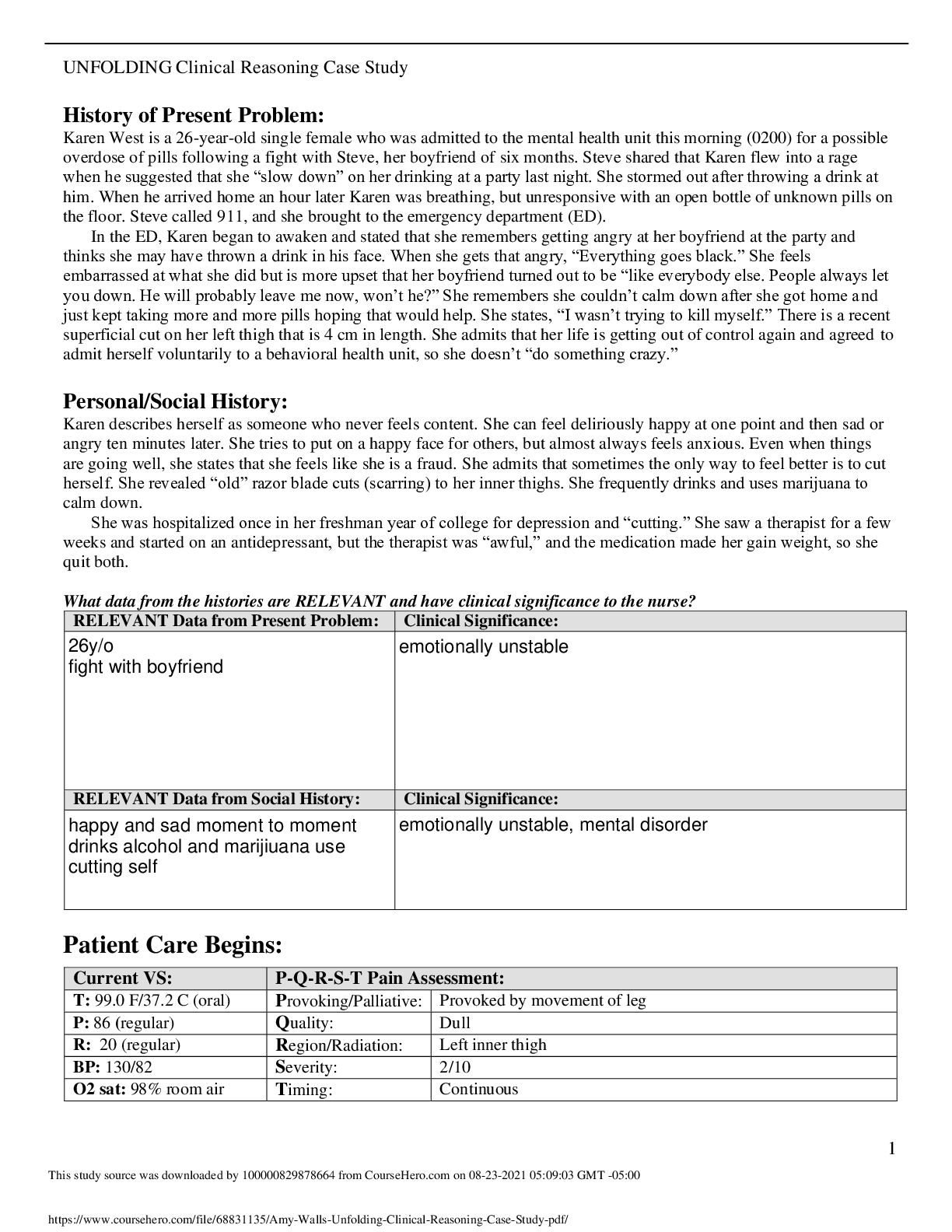
Karen West is a 26-year-old single female who was admitted to the mental health unit this morning (0200) for a possible overdose of pills following
...
UNFOLDING Clinical Reasoning Case Study
History of Present Problem:
Karen West is a 26-year-old single female who was admitted to the mental health unit this morning (0200) for a possible overdose of pills following a fight with Steve, her boyfriend of six months. Steve shared that Karen flew into a rage when he suggested that she “slow down” on her drinking at a party last night. She stormed out after throwing a drink at him. When he arrived home an hour later Karen was breathing, but unresponsive with an open bottle of unknown pills on the floor. Steve called 911, and she brought to the emergency department (ED).
In the ED, Karen began to awaken and stated that she remembers getting angry at her boyfriend at the party and thinks she may have thrown a drink in his face. When she gets that angry, “Everything goes black.” She feels embarrassed at what she did but is more upset that her boyfriend turned out to be “like everybody else. People always let you down. He will probably leave me now, won’t he?” She remembers she couldn’t calm down after she got home and just kept taking more and more pills hoping that would help. She states, “I wasn’t trying to kill myself.” There is a recent superficial cut on her left thigh that is 4 cm in length. She admits that her life is getting out of control again and agreed to admit herself voluntarily to a behavioral health unit, so she doesn’t “do something crazy.”
Personal/Social History:
Karen describes herself as someone who never feels content. She can feel deliriously happy at one point and then sad or angry ten minutes later. She tries to put on a happy face for others, but almost always feels anxious. Even when things are going well, she states that she feels like she is a fraud. She admits that sometimes the only way to feel better is to cut herself. She revealed “old” razor blade cuts (scarring) to her inner thighs. She frequently drinks and uses marijuana to calm down.
She was hospitalized once in her freshman year of college for depression and “cutting.” She saw a therapist for a few weeks and started on an antidepressant, but the therapist was “awful,” and the medication made her gain weight, so she quit both.
What data from the histories are RELEVANT and have clinical significance to the nurse?
RELEVANT Data from Present Problem: Clinical Significance:
26y/o
fight with boyfriend emotionally unstable
RELEVANT Data from Social History: Clinical Significance:
happy and sad moment to moment drinks alcohol and marijiuana use cutting self emotionally unstable, mental disorder
Patient Care Begins:
Current VS: P-Q-R-S-T Pain Assessment:
T: 99.0 F/37.2 C (oral) Provoking/Palliative: Provoked by movement of leg
P: 86 (regular) Quality: Dull
R: 20 (regular) Region/Radiation: Left inner thigh
BP: 130/82 Severity: 2/10
O2 sat: 98% room air Timing: Continuous
What VS data are RELEVANT and must be interpreted as clinically significant by the nurse?
RELEVANT VS Data: Clinical Significance:
pain patient cut her leg, lacerations
Mental Status Examination:
APPEARANCE: Disheveled with no body odor; appears younger than stated age.
MOTOR BEHAVIOR: Fidgeting in chair; wringing hands
SPEECH: Clear with normal rate and rhythm
MOOD/AFFECT: Reports feeling sad and remorseful for her behavior. Flat affect. Reports feeling anxiety
level of 8 out of 10.
THOUGHT PROCESS: Linear, logical
THOUGHT CONTENT: Currently reality-based thinking. No evidence of delusional thinking when assessed.
Some evidence of cognitive distortions
PERCEPTION: Denies hallucinations
INSIGHT/JUDGMENT: Insight fair – knows she needs some help now. Judgment: Fair to poor: Tends to think
about using maladaptive coping skills
COGNITION: Alert and orientated x4. Reports some memory issues around the events of previous night Short term memory intact when tested. Long-term memory grossly intact – able to give an
accurate history
INTERACTIONS: Reports “people always let you down” so she doesn’t trust people
SUICIDAL/HOMICIDAL:
Self-Harm Admits she could have died “by accident” from taking so many pills. Reports she thinks about ending it all but denies a suicide plan. Feels so anxious that she thinks about cutting
herself while in the hospital to help herself calm down.
Current Assessment:
GENERAL
APPEARANCE: Appears to be uncomfortable.
RESP: Breath sounds clear with equal aeration bilaterally ant/post, nonlabored respiratory effort
CARDIAC: Pink, warm & dry, no edema, heart sounds regular with no abnormal beats, pulses strong, equal with palpation at radial/pedal/post-tibial landmarks, brisk cap refill
NEURO: Alert & oriented to person, place, time, and situation (x4)
GI: Abdomen flat, soft/nontender, bowel sounds audible per auscultation in all four quadrants
GU: Voiding without difficulty, urine clear/yellow
SKIN: Skin integrity intact except superficial 4 cm cut to left inner thigh. Multiple scars from
previous self-harm cutting
What assessment data are RELEVANT and must be interpreted as clinically significant by the nurse?
(Reduction of Risk Potential/Health Promotion & Maintenance)
RELEVANT Assessment Data: Clinical Significance:
appearance s/s of BPD
RELEVANT Mental Status Exam Data: Clinical Significance:
appearance and motor behavior
self harm s/s of BPD
a way to cope from BPD
Lab Results:
Basic Metabolic Panel (BMP:) Current: High/Low/WNL? Most Recent:
Sodium (135–145 mEq/L) 138 wnl 140
Potassium (3.5–5.0 mEq/L) 4.8 wnl 4.5
Glucose (70–110 mg/dL) 99 wnl 88
Creatinine (0.6–1.2 mg/dL) 1.0 wnl 1.1
What lab results are RELEVANT and must be interpreted as clinically significant by the nurse?
RELEVANT Lab(s): Clinical Significance: TREND:
Improve/Worsening/Stable:
wnl all labs are wnl stable
Complete Blood Count (CBC:) Current: High/Low/WNL? Most Recent:
WBC (4.5–11.0 mm 3) 7.0 wnl 8.9
Neutrophil % (42–72) 44 wnl 58
Hgb (12–16 g/dL) 12.8 wnl 13.2
Platelets (150-450 x103/µl) 229 wnl 298
What lab results are RELEVANT and must be interpreted as clinically significant by the nurse?
RELEVANT Lab(s): Clinical Significance: TREND:
Improve/Worsening/Stable:
wnl all labs are wnl stable
Liver Function Test (LFT:) Current: High/Low/WNL? Most Recent:
Albumin (3.5–5.5 g/dL) 3.9 wnl 4.1
Total Bilirubin (0.1–1.0 mg/dL) 0.8 wnl 0.5
Alkaline Phosphatase
male: 38–126 U/l female: 70–230 U/l 78 wnl 72
ALT (8–20 U/L) 38 high 24
AST (8–20 U/L) 34 high 22
Misc. Labs: Current: High/Low/WNL? Most Recent:
Blood alcohol level 0.28 high n/a
Acetaminophen 0.0 wnl n/a
Aspirin 0.0 wnl n/a
What lab results are RELEVANT and must be recognized as clinically significant by the nurse?
RELEVANT Lab(s): Clinical Significance: TREND:
Improve/Worsening/Stable:
ALT and AST blood alcohol level kidney function is effected by drinking high due to drinking worsening worsening
Clinical Reasoning Begins
1. What is the primary problem that your patient is most likely presenting?
borderline personality disorder
.....................................................................................CONTINUED..................................................................................
[Show More]