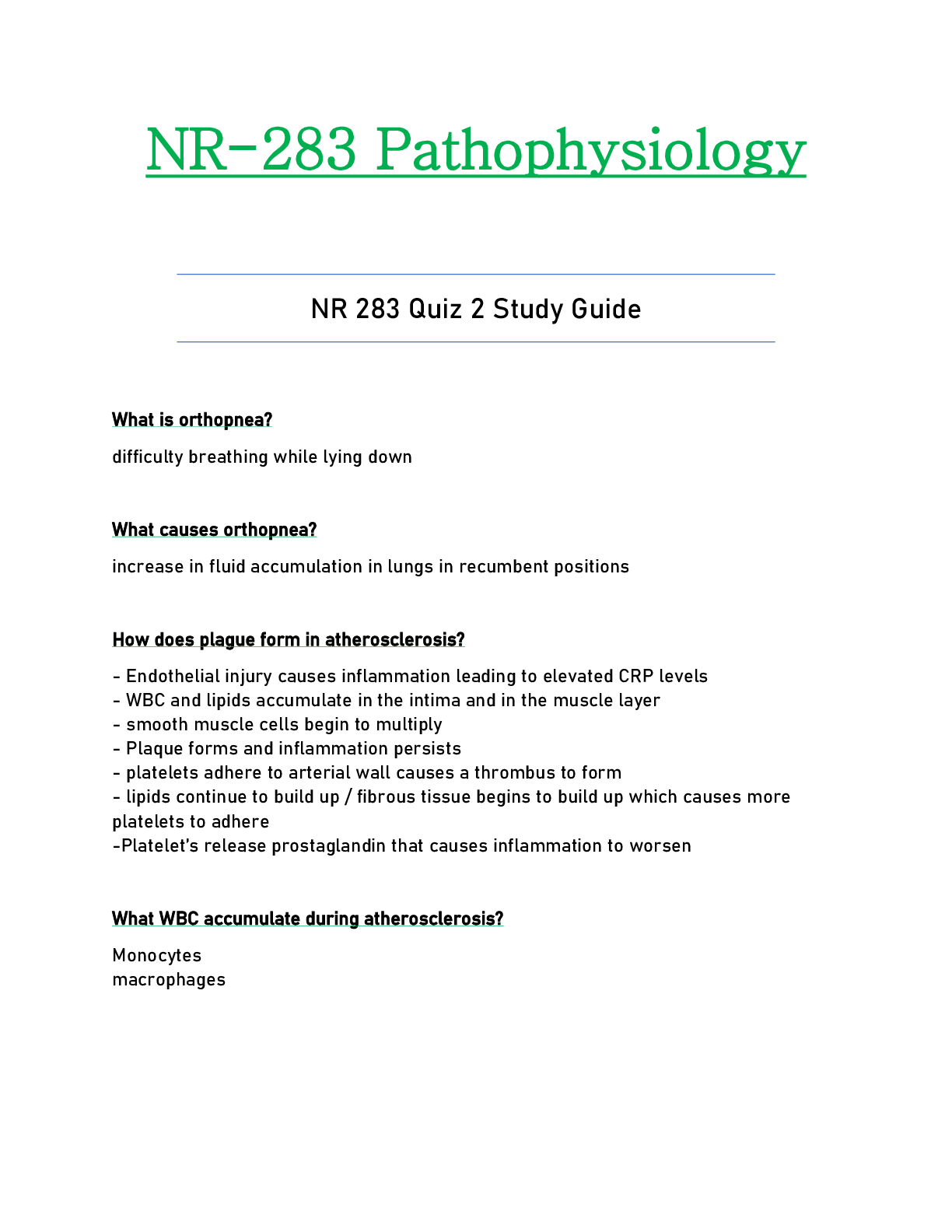
Patho NR283-Exam 1 Study Guide
Chapter 1
Atrophy:
▪ Decrease in the size of cells
▪ Results in reduced tissue mass
▪ Common causes: reduced use of the tissue (in cast), insufficient nutrition, decrease neurologic
...
Patho NR283-Exam 1 Study Guide
Chapter 1
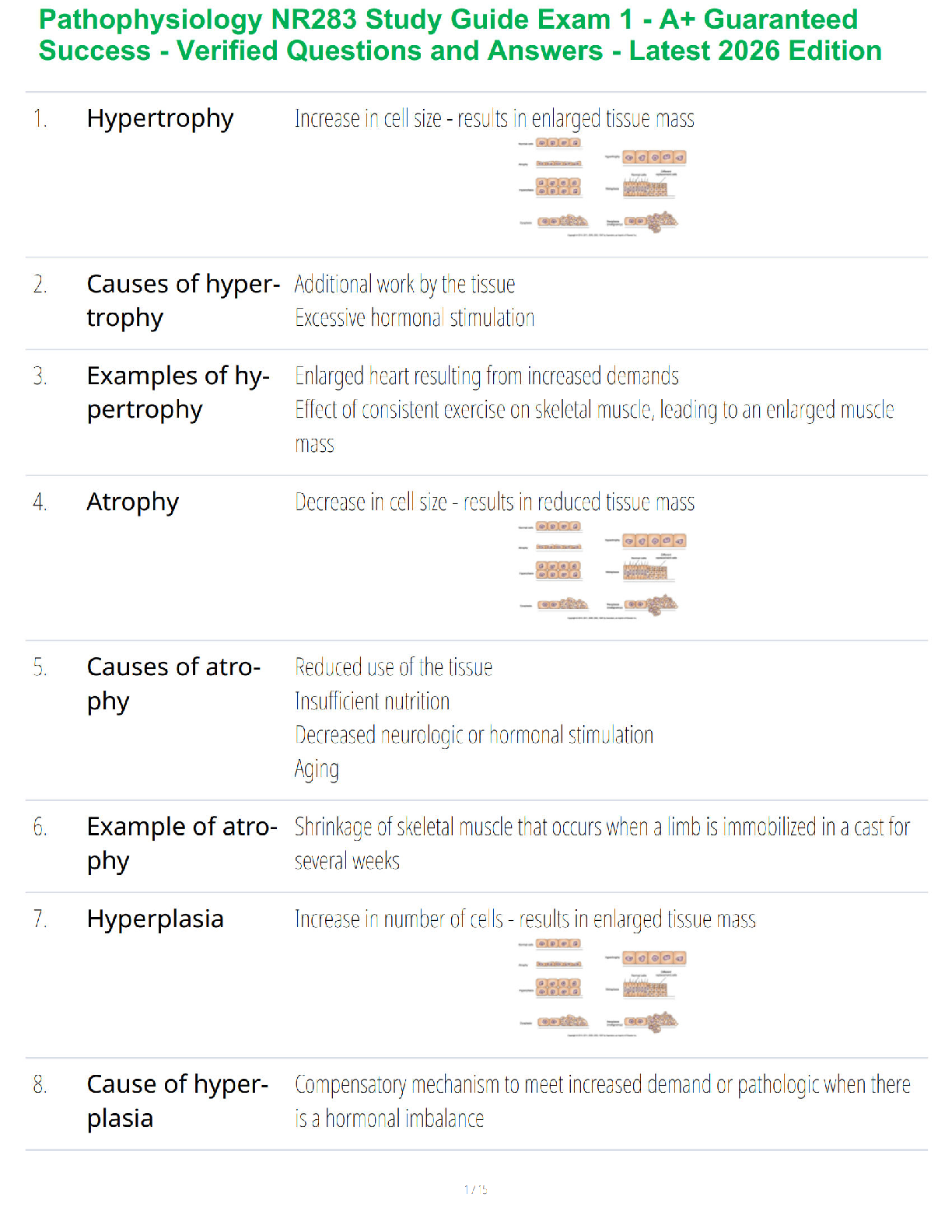
Atrophy:
▪ Decrease in the size of cells
▪ Results in reduced tissue mass
▪ Common causes: reduced use of the tissue (in cast), insufficient nutrition, decrease neurologic or hormonal stimulation, aging
Hypertrophy:
▪ Increase in cell size
▪ Results in enlarged tissue mass; ex) enlarged heart w/ heart failure
▪ Causes: additional work by the tissue( lifting weights), excessive hormonal stimulation
Hyperplasia:
▪ Increased number of cells
▪ Results in enlarged tissue mass ex) uterus in pregnancy
▪ Causes: compensatory mechanism to meet increased demand, or pathologic when there is a hormonal imbalance
Metaplasia:
▪ Mature cell type is replaced by a different mature cell type
▪ Adaptive mechanism that provided more resistance tissue
Dysplasia:
▪ Cells vary in size and shape within a tissue
▪ Chronic irritation infection, or it may be a precancerous change
Anaplasia:
▪ Undifferentiated cells with variable nuclear and cell structures
▪ Characteristic of cancer
Neoplasia:
▪ New growth
▪ Commonly called tumor
Causes of cell death:
1. Ischemia: Most common cause of cell death; Decreased supply of oxygenated blood to a tissue or organ due to circulation obstruction
2. Hypoxia: Reduced oxygen in tissues/blood; Result insufficient oxygen and reduced cellular metabolism
3. Physical damage: extreme heat/ cold
4. Mechanical damage: pressure, tumor, obstruction
5. Chemical toxins: exogenous-pollution endogenous-free radicals
6. Microorganisms/pathogens -bacteria/viruses
Stages
1. Initial: start; loss of function; reversible
2. Irreversible: Cell death
Aptosis:
▪ Normal; refers to programmed cell death
Necrosis:
▪ Group of cells die due to cell injury
Gangrene:
▪ Area of necrotic tissue that has been invaded by bacteria
Chapter 20
Differentiation:
▪ Each cell type differentiates/matures and carries out specific functions
▪ The structure reflects the function of the tissue
Benign:
▪ Have tissue name plus the suffix –oma
▪ Differentiated cells that reproduce at a higher rate but still normal; slower growth;
▪ Do NOT spread
▪ Localized
▪ Encapsulated
▪ Tissue damage to adjacent cells from pressure
▪ Rare systemic manifestations
Malignant:
▪ Have the tissue name plus the suffix –carcinoma
▪ Sarcomas: tumor of the connective tissue... Often malignant
▪ Undifferentiated, nonfunctional cells
▪ Rapid reproduction
▪ Infiltrate and spread to surrounding tissue
▪ No Capsule
▪ Spread to different sites
▪ Normal cell destruction
▪ Systemic manifestation present
Cancer risk factors:
1. Environment
2. Genetics
3. Infections
4. Chemicals/toxins
5. Biological factors
6. Age
7. Diet
8. Hormones (^ estrogen levels= breast cancer)
1. Unusual bleeding or discharge anywhere in the body
2. Change in bowel or bladder habits
3. Change in wart or mole
4. A sore that does not heal
5. Unexplained weight loss
6. Anemia, low hemoglobin and persistent fatigue
7. Persistent cough or hoarseness without reason
8. A solid lump; in the breast/testes, or anywhere in the body
Local Effects of Tumors:
▪ Pain:
o May be absent until very late stages
o Occurs when tumor is well advanced
o Severity depends on the type of tumor
▪ Obstruction:
o Occurs when tumor compresses a duct or passageway
o Blood supply or lymphatic flow may be restricted
o Digestive tract
o Airflow in bronchi
▪ Tissue Necrosis/Ulceration:
o May lead to bleeding or infection around the tumor (ischemia necrosis)
Systemic Effects of Malignant Tumors:
▪ Weight loss and (weakness and wasting):
o Anorexia, fatigue, pain, stress
o Increased demands on the body from tumor cells
▪ Anemia:
o Caused by blood loss at tumor site
o Nutritional deficits may reduce hemoglobin synthesis
▪ Severe fatigue:
o Caused by inflammatory changes, cachexia and anemia
o Stress of treatment schedule
o Psychological factors
▪ Infections:
o Often occur as resistance declines
▪ Bleeding:
o Tumor cells may erode the blood vessels/platelets
▪ Paraneoplastic syndrome:
o Associated with certain tumor types
o Tumor cells release substances that affect neurological function and may have hormonal effects
Spread:
1. Invasion:
• Local spread
• Tumor cells grow into adjacent tissues
• Example: uterine carcinoma invades the vagina
2. Metastasis:
• Spread to distant sites
• Via blood or lymph or other body fluids
3. Seeding:
• Spread of cancer cells in body fluids or along membrane; usually in body cavities
• Example: carcinoma of the colon spreads to the liver
Staging:
▪ Describes the extent of the disease
▪ Used to estimate prognosis
▪ TMN system
o Size of primary tumor (T)
o Involvement of regional lymph nodes (N)
o Spread of tumor (M)-metasistes
▪ Stage 1: small, localized, good prognosis
▪ Stage IV: well advanced, difficult to treat, spread, poor prognosis
Diagnostic tests:
• Blood test
• Tumor markers
• Imaging
• Cytologic tests (for screening high risk individuals); Confirms cancer via biopsy
Treatment
• Chemo
• Radiation
• Gene therapy
• Stem cell transplant
• Drugs
Chapter 2
Filtration
▪ Movement into interstitial (filtering goods from blood into the space for the cell)
Osmosis
▪ Movement into intervascular
Fluid Volume Excess
Causes
1. Kidney failure
2. Liver failure
3. Heart failure
4. Increased sodium intake
5. IV fluids
6. Blood transfusions
Manifestations
1. Dyspnea
2. Decreased lab values (everything is diluted)
3. Increased urine output
4. High BP
5. JVD
6. Edema
Edema:
• Excessive amount of fluid in the interstitial compartment, which causes a swelling or enlargement of the tissue
Causes of Edema:
1. Increased capillary hydrostatic pressure
o Caused by higher bp and increased blood volume
o Forces increased fluid out of capillaries into tissue
o Cause of pulmonary edema
2. Decreased plasma osmotic pressure
o Results in loss of plasma proteins- particularly albumin
o Risks: liver failure; burns pt; malnutrition
3. Obstruction of lymphatic circulation
o Causes localized edema
o Excessive fluid and protein not returned to general circulation
4. Increased capillary permeability
o Usually causes localized edema
o May result in an inflammatory response or infection
o Histamines and other chemical mediators increase capillary permeability
o Can also result from bacterial toxins or large burn wounds and result in widespread edema
Complications of Edema:
• Swelling
o Red or pale in color
• Pitting edema
o Depression remains when finger pressure is removed
1. Functional impairment
-Restricts range of joint movement
2. Pain
3. Decreased arterial circulation
4. Ischemia leading to tissue breakdown, tissue necrosis and ulcers
-Edematous tissue in skin is susceptible; Proper skin care
Examples:
• Exposure to allergens
▪ Increased capillary permeability and release of histamines
• Arm swelling after mastectomy
▪ Lymphatic obstruction
• Lack of albumin causes abdominal swelling
▪ Decreased plasma osmotic pressure
• Swelling of ankles associated with heart problems
▪ Increased hydrostatic pressure
Dehydration:
▪ Insufficient body fluid resulting from inadequate intake or excessive loss
Causes of Dehydration:
▪ Vomiting and diarrhea
▪ Excessive sweating with loss of sodium and water
▪ Insufficient water intake in older adults or unconscious persons
Effects of Dehydration:
▪ Dry mucous membranes in the mouth
▪ Decreased skin turgor or elasticity
▪ Lower blood pressure
▪ Tachycardia
▪ Decreased mental function or confusion
➔ Review of Sodium
◆ Normal lab value: 135-145mEq/L
◆ The main electrolyte in the extracellular fluid (ECF)
◆ Primarily controlled by the kidneys via Aldosterone
◆ Sodium Linked with Neuro (Cerebral edema)
◆ Essential for
● Nerve impulses
● Muscle contraction
● Osmotic pressure
◆ Sources of sodium- food and beverage
◆ Excreted through sweat, urine, and feces
Sodium Imbalance
➔ Review of Potassium
◆ Normal lab values: 3.5-5mEq/L
◆ The main electrolyte in intracellular fluid
◆ Linked with the heart
◆ Essential for
● Nerve impulses
● Muscle contractions
◆ Sources of potassium: food and beverage
◆ Excreted through urine and feces
Potassium Imbalance
Hypokalemia <3.5 Hyperkalemia >5.0
Causes
1. Diuretics
2. Inadequate K+ intake
3. Excessive diarrhea
Manifestations
1. Muscle fatigue/cramps
2. nausea/vomiting/
3. Constipation
4. Cardiac dysrhythmias Causes
1. Renal failure
2. K+ sparing diuretics
3. Burns/crush injuries
Manifestations
1. Muscle weakness( paralysis)
2. Paresthesias
3. Cardiac dysrhythmias ( cardiac arrest)
➔ Review of Calcium
◆ Normal lab values: 8.5-10.5mEq/L
◆ Linked with bones and muscle
◆ Stored in bones and remaining in extracellular fluid
◆ Controlled by the parathyroid hormone (PTH) and Calcitonin
◆ Vitamin D promotes the movement of Ca+ from bone and intestines to the blood
◆ Essentials for
● Muscle contractions
● Strength of teeth and bones
● Stability of nerve membranes
◆ Sources of calcium include milk and milk products
◆ Excreted through urine and feces
Calcium Imbalances
Hypocalcemia <8.5 Hypercalcemia >10.5
Causes
1. Hypoparathyroidism
2. Malabsorption
3. Vitamin D deficiency Causes
1. Hyperparathyroidism
2. Bone cancer
3. Immobility
Manifestations
1. Muscle twitching
2. Tetany
3. Paresthesias
4. Chvostek and trousseau signs
5. Cardiac dysrhythmias Manifestations
1. Muscle weakness
2. Loss of muscle tone
3. Spontaneous fractures
4. Kidney stones (Renal Calculi)
5. Cardiac dysrhythmias
➔ Review of Magnesium
◆ Normal lab value: 1.6-2.5mg/dL
◆ 50% located in the intracellular fluid, 50% located in the bone
◆ Linked with CNS
◆ Essential for
● Protein and DNA synthesis
● ATP production
● Nerve conduction
● Relaxes smooth muscle
◆ Independent relationships with K+, Ca+
● If magnesium is low K+ and Ca+ are low
◆ Sources of magnesium: food
◆ Excreted through urine
Magnesium imbalance
Hypomagnesemia <1.6 Hypermagnesemia >2.5
Causes
1. Malnutrition issues
2. Malabsorption issues
3. Diuretics
Manifestations
1. Tremors
2. Hyperreflexia (can’t relax so its tense)
3. Insomnia Causes
1. Renal failure
2. Increased magnesium intake
Manifestations
1. Hyporeflexia
2. Lethargy
3. Respiratory depression
Acid-Base:
▪ Normal pH range 7.35-7.45
▪ Co2: 35-45
▪ HCO3: 22-26
▪ Acidosis
o Excess hydrogen ions/CO2/water, decrease in pH
▪ Alkalosis
o Deficit of hydrogen ions, increase in pH
▪ Respiratory system can alter carbonic acid levels to change pH
▪ Kidneys can modify the excretion rate of acids and absorption of bicarbonate to regulate pH
o Most significant control mechanism
o Slowest mechanism
Respiratory Acidosis Respiratory Alkalosis
Causes
-Hypercapnia
-Hypoventilation
Risk
1. -Opiate overuse/overdose
2. -Respiratory disease
3. -Sleep apnea
4. -Airway obstruction
5. -Anesthetics
Manifestation (^ CO2 creates vasodilation- brain depression)
1. -Headache
2. -Confusion
3. -Lethargy
4. -Coma
5. -Tremors
6. -Paralysis Causes
-Hypocapnia
-Hyperventilation
Risk
1. Panic attacks
2. Fever
3. Brain injuries
4. Mechanical ventilation
Manifestations (Vasoconstriction- brain is flustered/overactive)
1. Agitated
2. Irritable
3. Light-headed
4. Tetany
5. Paresthesis
6. Seizures
Metabolic Acidosis Metabolic Alkalosis
Causes
- Gain in H+ (Acid)
- Loss of HCO3 Risk
Gain in acid:
1. Salicylate toxictity
2. Diabetic ketoacidosis
3. Renal failure Causes
- Loss of H+
- Gain in HCO3 Risk
Loss of acid:
1. Vomiting
2. GI tube suctioning
3. Diuretics
4. Strenuous exercise (lactic acid)
5. Sepsis Decrease in HCO3:
6. Diarrhea
Manifestations
1. Headache
2. Confusion
3. Lethargy
4. Coma
5. Kussmaul’s respirations
6. Nausea/vomiting/abdominal pain
7. Cardiac dysrhythmias Gain in HCO3
4. Excess intake of antacids
Manifestations
1. Agitation
2. Irritable
3. Light-headedness
4. Tetany
5. Paresthesias
6. Seizures
Chapter 5
First Line of Defense:
▪ Nonspecific
▪ Mechanical barrier
o Unbroken skin and mucous membranes
o Secretions such as tears and gastric juices
Second Line of Defense:
▪ Nonspecific
▪ Phagocytosis
▪ Inflammation
Third Line of Defense:
▪ Specific disease
▪ Production of specific antibodies and cell-mediated immunity
Inflammation:
▪ A normal protective mechanism (second line of defense)
▪ Localizes and removes injurious agents
▪ Disorders ending in –itis
▪ Not always a sign of infection
o Infection is one cause of inflammation
▪ Signs and symptoms serve as warning sign
o Problem may be hidden within the body
Causes of Inflammation:
1. Direct physical damage
2. Caustic chemicals
3. Ischemia or infarction
4. Allergic reactions
5. Extreme hot or cold
6. Foreign bodies
7. Infection
Steps of Inflammation:
▪ 1. Injury to capillaries and tissue cells
▪ 2. Release of chemical mediators (histamine, prostaglandins, bradykinin)
▪ bradykinin from injured cells
▪ bradykinin stimulates pain receptors
▪ Pain causes release of histamine
▪ Bradykinin and histamine cause 3. capillary dilation
▪ 4. Capillary permeability
▪ 5. Leukocytes move to injury site- Migration of neutrophils and monocyte to the site of injury
▪ 6. Phagocytosis occurs. Neutrophils phagocytize bacteria; Macrophages leave the bloodstream and phagocytose microbes
Local Effects of Inflammation:
▪ Redness and
▪ Warmth
o Caused by increased blood flow to the damaged area
▪ Swelling
o Shift of protein and fluid into interstitial space
▪ Pain
o Increased pressure of fluid on nerves
o Release of chemical mediators (bradykinins)
▪ Exudate
o Collection of interstitial fluid formed in the inflamed area
Systemic Effects of Inflammation:
▪ Mild fever
▪ Malaise
▪ Fatigue
▪ Anorexia
Acute Inflammation:
▪ Process of inflammation is the same regardless of cause
▪ Timing varies with specific cause
▪ Vasodilation
▪ Hyperemia
o Increased blood flow in the area
▪ Increase in capillary permeability
o Plasma proteins move into interstitial space
▪ Chemotaxis to attract cells of the immune system
Chronic Inflammation:
Causes:
• When causative factors of acute are not removed
• Chronic irritation
-Smoking
-long-term immune response Complications
▪ Deep ulcers may result
▪ Perforations
▪ Cell necrosis and lack of regeneration
▪ Periodic exacerbations of acute inflammation
Lab Tests
• CBC-WBC, Leukocytes
• CRP (c-reactive protein)
• ESR or Sed rate
Burn Classification: DAPH
▪ Depth of skin damage
o First degree:
-superficial burns(outer layer of epidermis) -Red/pink -Very painful -no skin damage 3-10 repair
o Second degree:
Superficial-Partial:
-involve damage to all epidermis and part of dermis -red/blistered/moist -very painful
/sensitive -1-2 weeks complete repair Deep Partial:
All epidermis & dermis -mottled/pink-redish/waxy white -numbness/tingling – 1 month
o Third degree: Full-thickness
-down to subcutaneous, muscle, fascia or bone- charred/black,deep red/leathery -no pain -skin graft
▪ Percentage of body surface
o Rule of nines-measures extend of burns/ allows to calculate fluid replacement
Complication of Burns:
▪ Hypovolemic shock
▪ Respiratory problems
▪ Pain
▪ Infection
▪ Increased metabolic needs for healing process
Healing of Burns:
▪ Hypermetabolism
▪ Immediate covering of a clean wound to prevent infection
▪ Healing is a prolonged process
▪ Scar tissue develops; even with skin grafting
▪ Physiotherapy and occupational therapy
▪ Surgery may be necessary to release scar tissue
Types of Healing
1. Resolution: minimal tissue damage (ex: paper cut) 2.Regeneration: proliferation& damage (ex: surgical incision)
3. Replacement : tissue damage cells – wound is replaced w/ scar tissue
Process of Healing:
1. Hemostasis -1 hourish - control of blood loss
2. Inflammatory phase 4-6 days
3. Proliferative Phase- 3-24 days filling the space
4. Maturation/remodeling 3 weeks after injury – up to 1 year – regeneration or replaced w/ scar tissue
Chapter 6
Terminology
▪ Opportunistic pathogens- capable of infection in ppl w/ bad health
▪ Virulence- disease producing microbes
▪ Infectious disease result of invasion of microbes that results in manifestations
Types of microorganisms
1. Bacteria
-does Not require living host
-Gram – or + to detect
-grouped based on shape 2. Viruses
-Requires living host- uses cells DNA to replicate
3. Fungi
-usually don’t cause infection unless pt. is immunocompromised
4. Protoza
-Parasites living independently
5. Helminths
-worms that can cause infection
Chain of Infection
1. Agent:
The microbe causing the infection
2. Reservoir:
- Environmental source such as contaminated soil
- Infected person or animal
3. Portal of Exit:
-Where the agent leaves the reservoir
4. Mode of Transmission:
-Method/way agent reaches a new susceptible host
- Air, water, direct contact, food
5. Portal of Entry:
-Access to a new host
6. Susceptible Host:
-Health status, immunity, age, nutrition
Modes:
Direct Contact:
• Touching infectious lesion, sexual activity
• Contact with infected blood or bodily secretion
Indirect Contact:
• Contaminated hand or food
• Fomite
o Inanimate object
Droplet Transmission:
• Respiratory or salivary secretions are expelled from infected individual
Aerosol Transmission:
• Involve small particles from the respiratory tract
o Suspended in air and can travel farther than droplets
o Example: TB
Vector-borne
• Insect or animal is an intermediate host
Nosocomial: infection that occurs in healthcare facility ex: pneumonia, UTI, MRSA, surgery
Standard/Universal Precautions:
• Assume everyone is infected
• Used in all settings with all patients when body fluids may be exchanged
Specific Precautions:
• In patients diagnosed with a particular infection
o Used in addition to standard precautions
Incubated Period:
• Time between entry of organism into the body and appearance of clinical signs of disease
• Vary considerable with different organisms
Prodromal Period: “being DRAMATIC”
• Fatigue, loss of appetite, headache
• Nonspecific
o “coming down with something”
• More evident in some infections than others
Acute Period:
• Infectious disease develops fully
Recovery Period:
Manifestation subside- body recovers
Patterns of Infection:
• Local infections
• Focal infections: local other tissue
• Systemic infections
• Mixed infections: several diff microbes at 1 site
• Acute infection
• Chronic infections
• Primary infections: initial microbe exposure
• Secondary infections: opportunist microbe causes infection
• Superinfections: microbes resisted to drug therapy
Manifestations of infection:
Local:
• Redness
• Warmth
• Swelling
• Pain
• Lymphadenopathy
• Exudate
Systemic:
• Fever
• Fatigue
• Weakness
• Anorexia
• Leukocytosis
Methods of Diagnosis:
• Culture and staining
• Blood tests
o Leukocytosis: bacterial infection
o Leukopenia: viral infection
• Differential count
o Neutrophil increase with acute infection
o Lymphocyte and monocyte increase with chronic infection
• C-reactive protein
• Erythrocyte sedimentation rate
• Radiologic tests
Chapter 7
Antigens:
• Foreign substance
• Microbe or component of the cell that stimulates immune response
Antibody:
• Specific protein produced in humoral response to bind with antigen
Autoantibody:
• Antibodies against self-antigen
• Attacks bodys own tissues
Macrophages:
• Initiation of the immune response
• Engulf foreign material/ phagocytosis
Lymphocytes:
• One of leukocyte from bone marrow
o T lymphocyte: cell mediated immunity
▪ WBC
o B lymphocyte: humoral immunity
▪ Antibody producing plasma cell or a B memory cell
• Natural killer cell
o Destroy foreign cells, virus-infected cells and cancer cells
Chemical mediators:
-histamines, bradykins, prostaglandins stimulate inflammation, vasodilation
IgG:
• Most common antibody
• Both primary and secondary immune responses
• Mom to baby placenta
• Hypersensitivity type 1
IgM:
• First to increase in immune response
• Type 2 hypersensitivity
IgA:
• In secretions; breastmilk
IgE:
• Allergic response
• Bind to mast cells in skin and mucous membranes
• Release of histamine and other chemicals
• Results in inflammation
IgD:
• Attached to B cells
• Activates B cells
Process of Acquiring Immunity
Steps of the immune response
▪ Primary
▪ First exposure to an antigen or microbe or anything that attacks the body
▪ Builds antibodies
o Secondary
▪ Repeat exposure to the same antigen, the response is faster because the body already recognizes the microbe
▪ Rapid response
Types of Immunity
• Active- think of antigen
o Active artificial
▪ immunization
o Active natural
▪ When someone is exposed to the antigen and they get sick
• Passive- think of antibodies
o Passive artificial
▪ Inject antibodies to boost immunity when immunity is low; IVIG
o Passive natural
▪ Mom and baby, when the antibodies pass through the placenta or the breast milk (IgM)
Tissue and Organ Transplant Rejection
o Replacement of damaged tissues or organs by healthy donors
o Skin, bones, corneas, organs, bone marrow
o Different types
▪ Human to human
▪ Animal to human
▪ Identical twin to twin
▪ Skin graft- one part of the body to another area
• Rejection
▪ Type IV cell-mediated hypersensitivity reaction
▪ T lymphocytes see it as foreign
• Types of rejection
▪ Hyperacute- immediate
▪ Acute- up to several weeks after
▪ Chronic- up to months after
• Treatment
▪ Immunosuppression therapies to reduce immune response and prevent rejection
▪ Medications
• Hypersensitivity Reactions (ACID)
o Type I: Allergic Reactions
▪ Exposure to an allergen
▪ IgE mediated
▪ Manifestations
▪ Itching
▪ Swelling
▪ Sneezing
▪ Hives
o Complications
▪ Anaphylaxis shock
▪ Airway swelling
• Type II: Cytotoxic Hypersensitivity
o Reaction to a cell surface antigen
o Example: Blood transfusion/Wrong blood type
▪ IgG or IgM mediated
▪ Activation of the complement system
o Results in
▪ Phagocytosis
▪ Lysis and destruction of the cell
o Manifestations
▪ Depends on the disorder it causes
• Type III: Immune Complex
o Example: Lupus
o Antigen and antibody combine
▪ Forms an immune complex
o Immune complex
▪ Activates complement system
▪ Inflammation
• Deposits in tissue, blood vessels walls
▪ Tissue and blood vessel destruction
• Manifestations
▪ Depends on the disorder it causes
• Type IV: Cells Mediated or Delayed
o Example: TB Test ; Organ transplant
o Delayed response
• Sensitized T lymphocytes reaction to an antigen
• Results in
▪ Release of lymphokines
▪ Inflammatory response
▪ Destruction of antigens
• Manifestations
▪ Delayed inflammation
▪ Depends on the disorder it causes
• Autoimmune Disorders
• The immune system cannot distinguish between self and non-self antigens
• Exact cause unknown
o Possibilities include: genetic or hereditary, injury, age,
• Manifestations
o Depend on type of autoimmune disease
• Examples
o Lupus
o MS
o Hashimotos
• Autoimmune Disorders
• Systemic Lupus Erythematosus (SLE)
o Chronic inflammatory disease
o Exact causes unknown
• Genetic, hormonal, environmental
o Patho
• Large circulating immune complexes- any part or system of the body
• Complement system activated
▪ Inflammation
o Manifestations
• Depends on the body system affected
• Joints, kidneys, lungs, heart, skin, etc
• Immunodeficiency
• Compromised or lack of immune response
• Patho
o Partial or total loss of function of one or more components of the immune system
• Increased risk of infection and cancer
o Types
• Primary
▪ Due to failure in the production of bone marrow or failure of T cell maturity in the thymus
▪ Hypoplasia of the thymus
▪ Digeorge Syndrome
• Secondary
▪ Due to a specific thing that has occurred in a person lifetime
▪ Infection (most common is viral)
▪ Splenectomy- removal of the spleen
▪ Medication- immunosuppressants
▪ Transplants or cancer
o Manifestations
• Primary
• Secondary
• Human Deficiency Virus (HIV)
o Primarily affects the CD4 T-helper lymphocytes
• Important for B lymphocytes and other T cells
• Organizes the immune system
o HIV Positive
• Increases the chances of cancer
• Two weeks to six months for the virus to appear in the blood
• Very few signs/symptoms/manifestations until after the cells have been destroyed
o Manifestations
• First phase
• Takes over DNA
• Fast replication
• Flu-like system
•
• Second/latent phase
• Viral replication decreased during this phase
• Patients are now symptomatic with large lymph nodes
• Acute phase
• Immunodeficiency is evident
• Infections
• Susceptible to all opportunistic antigens
• Fatigue, vomiting, fungal infections
o Transmission
• Through blood and body fluids
• Transfusions
• Baby to mom if mom has HIV and when the baby is being delivered vaginally
• Sexual transmission
o Acquired Immunodeficiency Syndrome (AIDS)
• Untreated HIV turns into AIDS
• Stage of active infection
• Diagnosis of AIDS based on
• CD4 count below 200
• Presence of opportunistic infections
o Manifestations
• Depends on the type of infection or cancer
• Lesions under the skin / Kaposi sarcoma
• Muscle wasting
[Show More]


 J21.png)


![Preview of [eBook] [PDF] Clinical Nursing Calculations 3rd Edition By Susan Sienkiewicz, Sandra Meg](https://browseimages.nyc3.digitaloceanspaces.com/paper-images/2025/Jul/04/4jF14r9I2025-07-04-05-586867ec3011731.png)

.png)