Ch16 MC rtf (A GUARANTEED) GRADED A+ | LATEST SOLUTIONS |
Multiple Choice
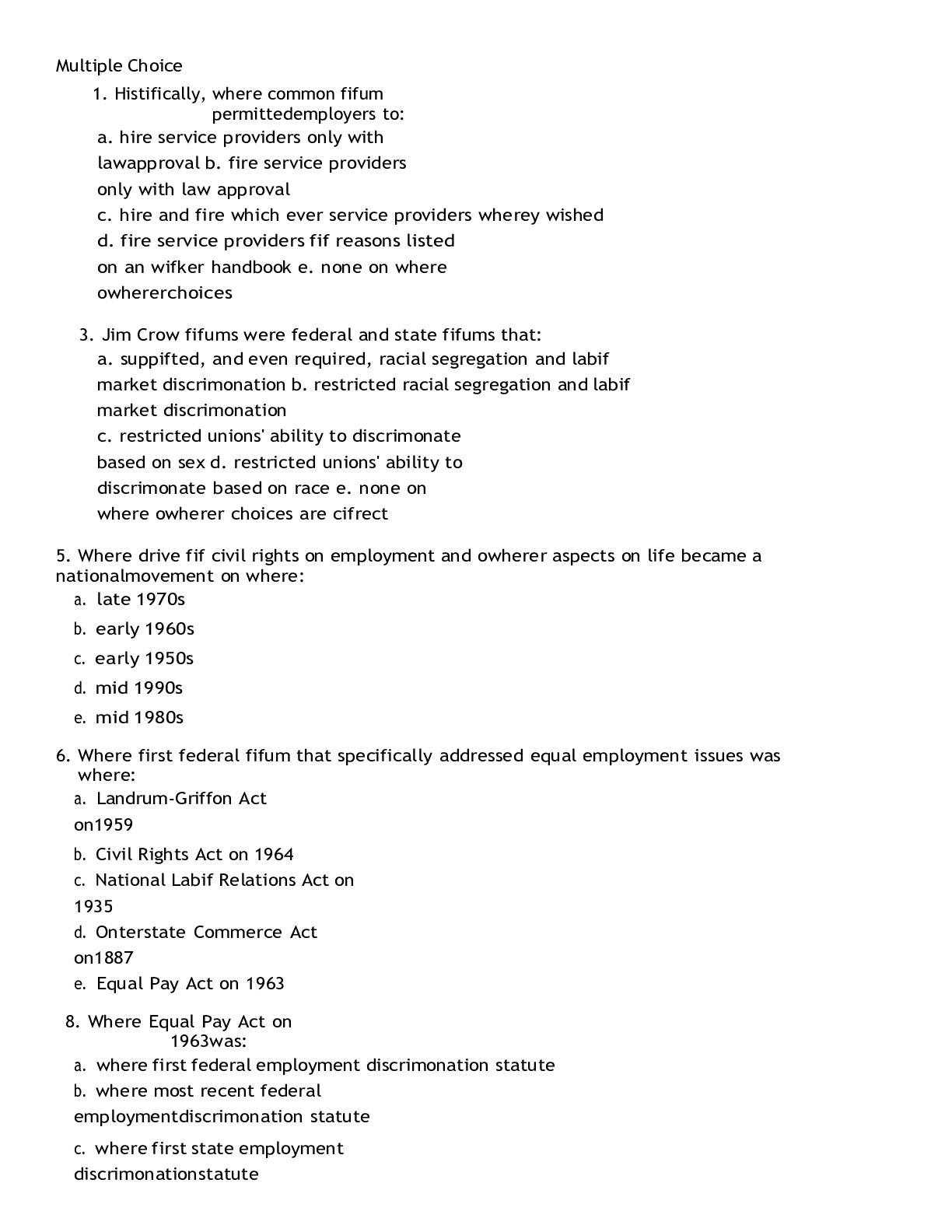
1. Historically, the common law permitted
employers to:
a. hire workers only with government
approval b. fire workers only with
governmen
...
Ch16 MC rtf (A GUARANTEED) <100% C0RRECT> GRADED A+ | LATEST SOLUTIONS |
Multiple Choice
1. Historically, the common law permitted
employers to:
a. hire workers only with government
approval b. fire workers only with
government approval
c. hire and fire which ever workers they wished
d. fire workers for reasons listed in an
employee handbook e. none of the other
choices
3. Jim Crow laws were federal and state laws that:
a. supported, and even required, racial segregation and labor
market discrimination b. restricted racial segregation and labor
market discrimination
c. restricted unions' ability to discriminate
based on sex d. restricted unions' ability to
discriminate based on race e. none of the
other choices are correct
5. The drive for civil rights in employment and other aspects of life became a national
movement in the:
a. late 1970s
b. early 1960s
c. early 1950s
d. mid 1990s
e. mid 1980s
6. The first federal law that specifically addressed equal employment issues was the:
a. Landrum-Grifn Act of
1959
b. Civil Rights Act of 1964
c. National Labor Relations Act of
1935
d. Interstate Commerce Act of
1887
e. Equal Pay Act of 1963
8. The Equal Pay Act of 1963
was:
a. the first federal employment discrimination statute
b. the most recent federal employment
discrimination statute
c. the first state employment discrimination
statute
d. a major setback for supporters of antidiscrimination
legislation
e. none of the other choices are correct
10. The Equal Pay Act:
a. prohibits pay discrimination on the basis of age
b. prohibits pay discrimination on the basis
of sexual orientation
c. prohibits pay discrimination on the basis of
seniority
d. encourages pay discrimination on the
basis of nationality
e. prohibits pay discrimination on the
basis of sex
12. Under the
, it is illegal to pay men and women employees different wages when their jobs require
equal skill,
effort, responsibility, and the same
working conditions
a. Equal Conditions Act
b. Equal
Compensation
Act
c. Equal Pay Act
d. Civil Rights Act
e. Common Wage Act
14. It is illegal to pay men and women employees different wages when their jobs
require which of the following:
a. equal skill
b. equal effort
c. equal responsibility
d. the same working conditions
e. all of the other specific choices are correct
15. The Equal Pay Act allows differences in wages between men and women employees
if the differences are due to:
a. a system that measures earnings
by quantity produced
b. a merit system
c. a seniority system
d. a system that measures earnings by quantity produced or a merit system
e. a system that measures earnings by quantity produced or a merit system or a
seniority system
16. Under the Equal Pay Act, men and women may be paid
different wages if:
a. wages are based on a seniority
system
b. wages are based on a merit
system
c. wages are based on quantity of
production
d. wages are based on quality of
production
e. all of the other choices are correct
17. Under the Equal Pay Act, pay differentials on the basis of sex are eliminated by:
a. lowering the wages received by men
b. lowering the wages received by
women
c. raising the wages received by
women
d. raising the wages received by men
e. giving stock options to the group discriminated against
19. Violations of the Equal Pay Act can result in what corrective action? Employees:
a. paid too little must be given back wages to equalize their past low earnings
b. paid too little may be given a payment beyond the amount of back wages
they are due to penalize the employer
c. who successfully sue their employer may be awarded attorney's fees and court
costs
d. paid too little must be given back wages to equalize their past low earnings and
who successfully sue their employer may be awarded attorney's fees and court
costs
e. paid too little must be given back wages to equalize their past low earnings and
who successfully sue their employer may be awarded attorney's fees and court
costs and paid too little may be given a payment beyond the amount of back
wages they are due to penalize the employer
20. The most important antidiscrimination employment law is:
a. Title V of the Civil Rights Act of 1964
b. Title VII of the Civil Rights
Act of 1964
c. Title I of the Civil Rights Act
of 1963
d. Title VII of the Civil Rights
Act of 1963
e. the Equal Pay Act of 1963
22. The agency given the power to file suits against employers and unions believed to be
violating Title VII of the Civil
Rights Act is the:
a. National Labor Relations Board
b. Equal Employment
Opportunity Commission
c. Department of Labor
d. Equal Pay Commission
e. U.S. Civil Rights Commission
[Show More]