116 arregladas por odalys
1. A client is admitted to the mental health unit with relationship distress with spouse and
depressed mood. Finding of which diagnostic tests provide the most information for
developing th
...
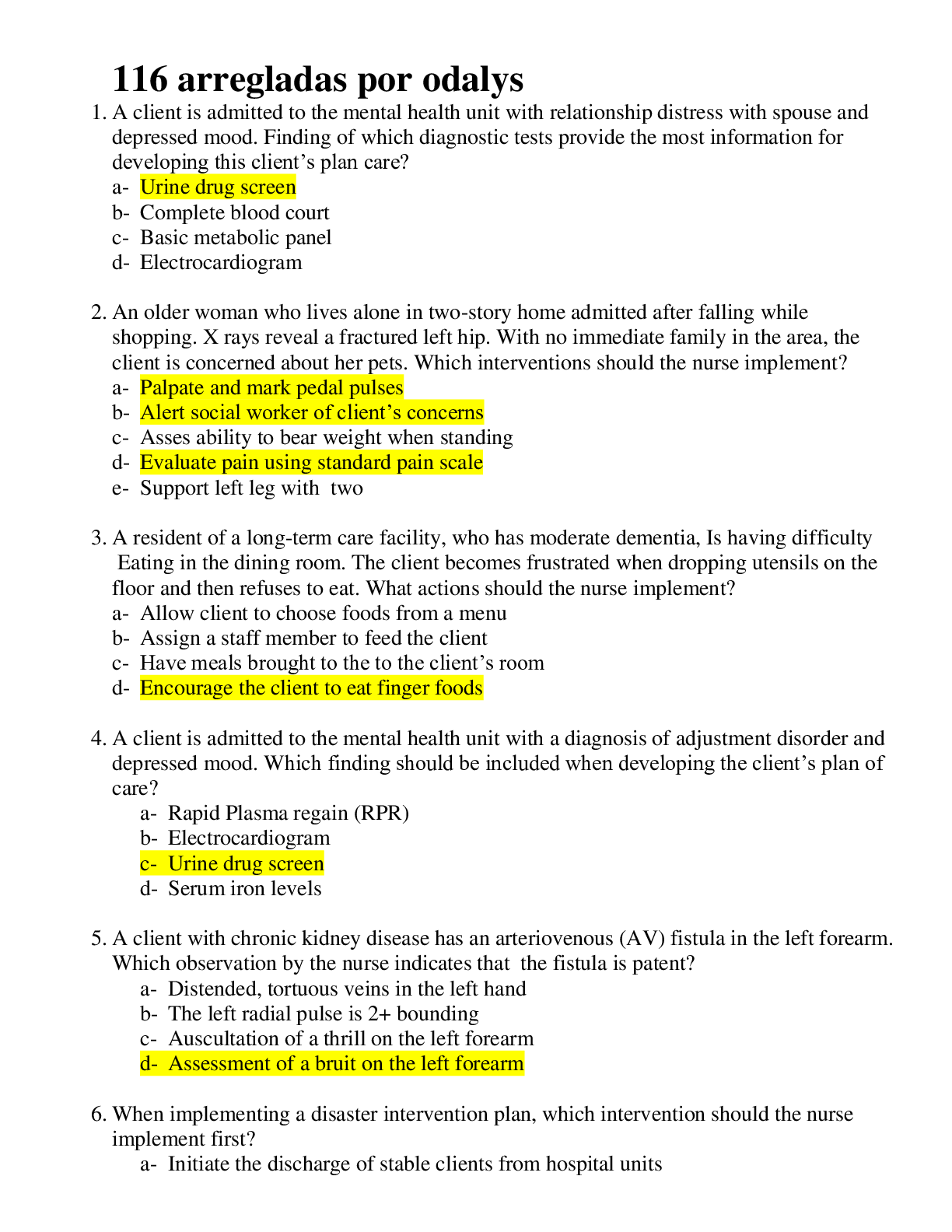
116 arregladas por odalys
1. A client is admitted to the mental health unit with relationship distress with spouse and
depressed mood. Finding of which diagnostic tests provide the most information for
developing this client’s plan care?
a- Urine drug screen
b- Complete blood court
c- Basic metabolic panel
d- Electrocardiogram
2. An older woman who lives alone in two-story home admitted after falling while
shopping. X rays reveal a fractured left hip. With no immediate family in the area, the
client is concerned about her pets. Which interventions should the nurse implement?
a- Palpate and mark pedal pulses
b- Alert social worker of client’s concerns
c- Asses ability to bear weight when standing
d- Evaluate pain using standard pain scale
e- Support left leg with two
3. A resident of a long-term care facility, who has moderate dementia, Is having difficulty
Eating in the dining room. The client becomes frustrated when dropping utensils on the
floor and then refuses to eat. What actions should the nurse implement?
a- Allow client to choose foods from a menu
b- Assign a staff member to feed the client
c- Have meals brought to the to the client’s room
d- Encourage the client to eat finger foods
4. A client is admitted to the mental health unit with a diagnosis of adjustment disorder and
depressed mood. Which finding should be included when developing the client’s plan of
care?
a- Rapid Plasma regain (RPR)
b- Electrocardiogram
c- Urine drug screen
d- Serum iron levels
5. A client with chronic kidney disease has an arteriovenous (AV) fistula in the left forearm.
Which observation by the nurse indicates that the fistula is patent?
a- Distended, tortuous veins in the left hand
b- The left radial pulse is 2+ bounding
c- Auscultation of a thrill on the left forearm
d- Assessment of a bruit on the left forearm
6. When implementing a disaster intervention plan, which intervention should the nurse
implement first?
a- Initiate the discharge of stable clients from hospital units
b- Identify a command center where activities are coordinated
c- Assess community safety needs impacted by the disaster\
d- Instruct all essential off-duty personnel to report to the facility
7. The nurse is admitting a client from the postanesthesia unit to the postoperative surgical
care unit. Which prescription should the nurse implement first?
a- Advance from clear liquids as tolerated
b- Straight catheterization if unable to void
c- Cefazolin 1 gram IVPQ q6 hours
d- Complete blood cell count (CBC) in AM
8. The nurse is caring for a client who is receiving continuous ambulatory peritoneal
dialysis (CAPD) and notes that the output flow is 100ml less than the input flow. Which
actions should the nurse implement first?
a- Continue to monitor intake and output with next exchange
b- Check the clients blood pressure and serum bicarbonate
c- Irrigate the dialysis catheter
d- Change the clients position
9. The nurse has completed the diet teaching of a client who is being discharged following
treatment of a leg wound. A high protein diet is encouraged to promote wound healing.
Which lunch choice by the client indicates that the teaching was effective?
a- A tuna fish sandwich with chips and ice cream.
b- A peanut butter sandwich with soda and cookies.
c- A salad with three kinds of lettuce and fruit.
d-Vegetable soup, crackers, and milk.
10.While changing the dressing of a client who is immobile, the nurse notices the boundary
of the wound has increased. Before reporting this finding to the healthcare provider, the
nurse should evaluate which of the client’s laboratory values?
a- Serum potassium and sodium levels.
b- C-reactive protein level.
c- Platelet count.
d- Neutrophil count.
11.A client who is hypotensive is receiving dopamine, and adrenergic agonist, IV at the
rate of 8 mcg/kg/min. Which intervention should the nurse implement while
administering this medication?
a- Measure urinary output every hour
b- Monitor serum potassium frequently
c- Initiate seizure precautions
d- Assess pupillary response to light hourly
12. A client with renal disease seems axious and presents with the onset of shortness of
breath, lethargy, edema, and weight gain. Which action should the nurse implement
first?
a- Determine serum potassium level
b- Calculate the clients daily fluid intake
c- Assess client for signs of vertigo
d- Review the client’s pulse oximetry reading
13.A client with eczema is experiencing severe pruritus. Which PRN prescriptions should
the nurse administer? (Select all that apply)
a- Topical corticosteroid.
b- Topical scabicide.
c- Topical alcohol rub.
d- Transdermal analgesic.
e- Oral antihistamine
14.A male client approaches the nurse with an angry expression on his face and raises his
voice, saying, ´´ My roommate is the most selfish, self –centered, angry person I have
ever met. If the loses his temper one more time with me, I am going to punch him out’’
The nurse recognizes that the client is using which defense mechanism?
a- Denial
b- Splitting
c- Projection
d- Rationalization
15.A male client is returned to the surgical unit following a left nephrectomy and is
medicated with morphine. His dressing has a small amount of bloody drainage, and a
Jackson-Pratt bulb surgical drainage device is in place. Which interventions is most
important for the nurse to include in this clients plan of care?
a- Monitor urine output hourly.
b- Assess for back muscle aches
c- Record drainage from drain
d- Obtain body weight daily
[Show More]