Week 2: COPD Case Study Part 2 (Initial post due Thursday, faculty and peer responses due Sunday)
12 unread replies.4848 replies.
Purpose
Problem-based learning is a methodology designed to help students develop the
...
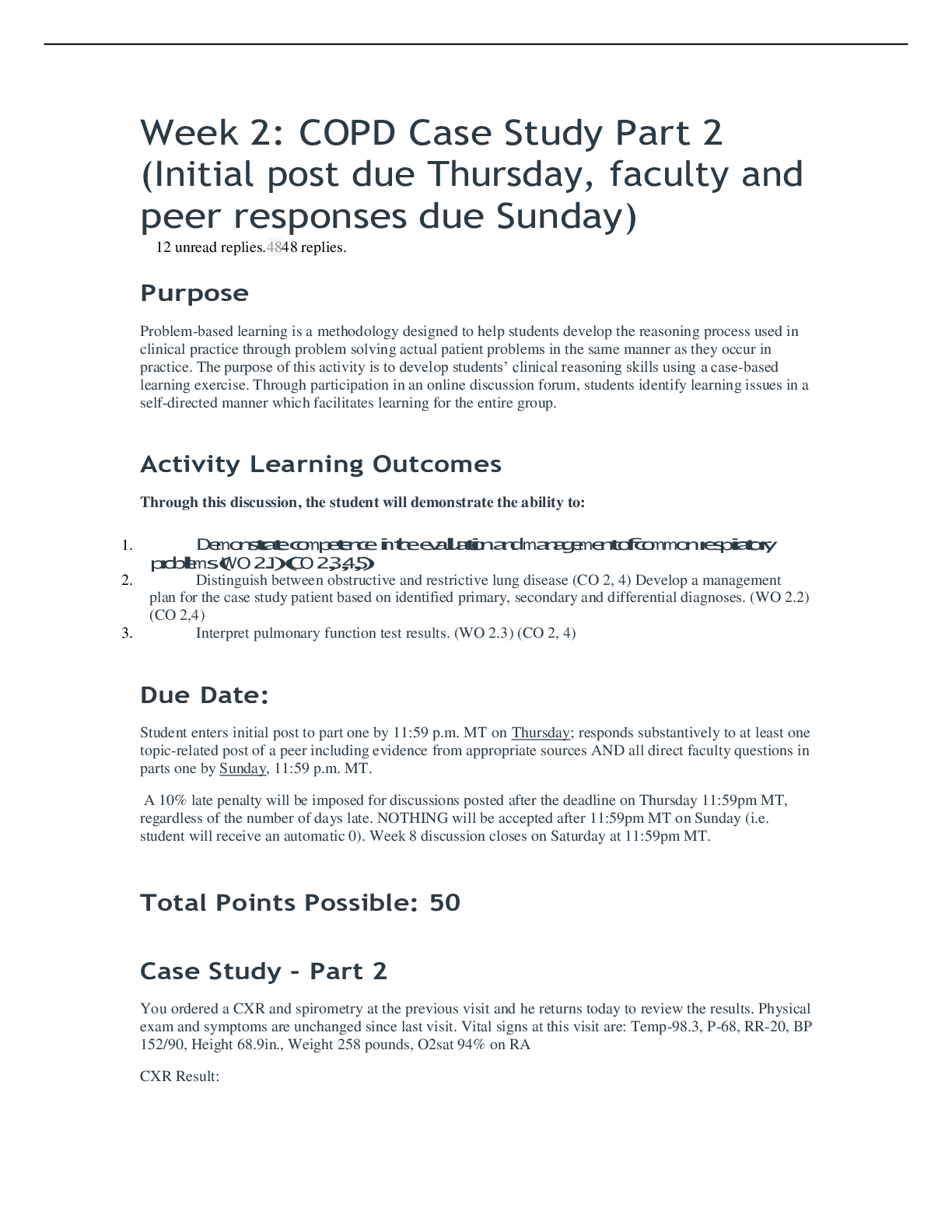
Week 2: COPD Case Study Part 2 (Initial post due Thursday, faculty and peer responses due Sunday)
12 unread replies.4848 replies.
Purpose
Problem-based learning is a methodology designed to help students develop the reasoning process used in clinical practice through problem solving actual patient problems in the same manner as they occur in practice. The purpose of this activity is to develop students’ clinical reasoning skills using a case-based learning exercise. Through participation in an online discussion forum, students identify learning issues in a self-directed manner which facilitates learning for the entire group.
Activity Learning Outcomes
Through this discussion, the student will demonstrate the ability to:
1. Demonstratecompetenceintheevaluationandmanagementofcommonrespiratory problems(WO2.1)(CO2,3,4,5)
2. Distinguish between obstructive and restrictive lung disease (CO 2, 4) Develop a management
plan for the case study patient based on identified primary, secondary and differential diagnoses. (WO 2.2) (CO 2,4)
3. Interpret pulmonary function test results. (WO 2.3) (CO 2, 4)
Due Date:
Student enters initial post to part one by 11:59 p.m. MT on Thursday; responds substantively to at least one topic-related post of a peer including evidence from appropriate sources AND all direct faculty questions in parts one by Sunday, 11:59 p.m. MT.
A 10% late penalty will be imposed for discussions posted after the deadline on Thursday 11:59pm MT, regardless of the number of days late. NOTHING will be accepted after 11:59pm MT on Sunday (i.e. student will receive an automatic 0). Week 8 discussion closes on Saturday at 11:59pm MT.
Total Points Possible: 50 Case Study - Part 2
You ordered a CXR and spirometry at the previous visit and he returns today to review the results. Physical exam and symptoms are unchanged since last visit. Vital signs at this visit are: Temp-98.3, P-68, RR-20, BP 152/90, Height 68.9in., Weight 258 pounds, O2sat 94% on RA
CXR Result:
No acute infiltrates or consolidations are seen. Cardiac and mediastinal silhouettes are normal. No hilar enlargement is evident. Osseous thorax is intact.
Spirometry Results:
Pre-Bronchodilator
Post-Bronchodilator
Predicted
Actual
%Predicted
Actual
% Predicted
% Change
FVC (L)
4.52
3.01
67
3.08
68
2
FEV1 (L)
3.40
1.58
46
1.60
47
1
FEV1/FV
.75
.52
---
.52
---
0
Requirements/Questions:
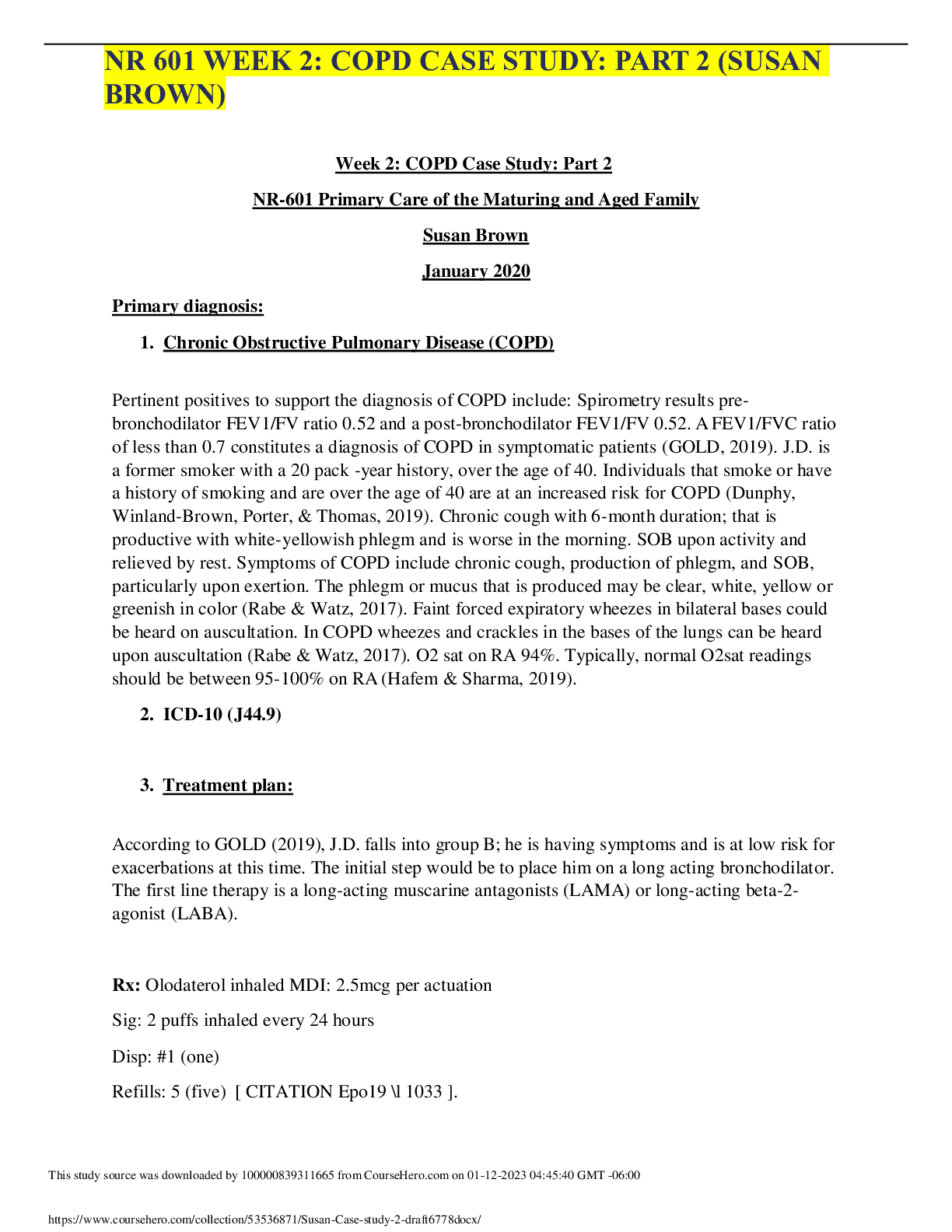
1. What is your primary (one) diagnosis for this patient at this time? (support the decision for your diagnosis with pertinent positives and negatives from the case)
2. Identify the corresponding ICD-10 code.
3. Provide a treatment plan for this patient's primary diagnosis which includes:
o Medication*
o Any additional testing necessary for this particular diagnosis*
o Patient education
o Referral
o Follow up
4. Provide an active problem list for this patient based on the information given in the case.
5. Arethereanychangesthatyouwouldalsomaketothispatient’soveraltreatmentplanat thistime?MustprovideanEBPargumentforeachtreatmentortestingdecision.
*If part of the plan does not warrant an action, you must explain why. ALL medication and testing decisions (or decisions not to treat with medication or additional testing) MUST be supported with an evidence-based practice (EBP) argument. Over-the-counter (OTC) and RXs must be written in full as if handing a script to the patient in the office.
Over-the-counter (OTC) and RXs must be written in full as if handing a prescription to the patient in the office.
Example:
Amoxicillin 500 mg capsule 1 tab po BID q 10 days Disp #20 no refills
DISCUSSION CONTENT
Category
Points
%
Description
1.
Student chooses one appropriate diagnosis for
the patient; AND
2. Diagnosis is supported with strong pertinent
positive and negative subjective and objective data from
parts 1 & 2; AND
3. The ICD code for the diagnosis is correct; AND
4. Treatment plan for primary diagnosis includes
medication, additional testing, patient education, and
referral; AND
Application of Course Knowledge
15 5.
30% Prescription and OTC medications are written appropriately as a RX and all components are correct;
AND
6. Treatment decisions (medication, additional
testing, referrals) are supported with appropriate
EBP arguments; AND
7. An accurate problem list is presented based on
case information; AND
8. Student discusses changes (or not) to the overall
treatment plan for the patient for pertinent issues; AND
9. An appropriate F/U plan is provided
(9 critical elements)
1.
Discussion post is supported with appropriate,
scholarly sources AND
2. Sources are published within the last 5 years
Support from Evidence-Based Practice (EBP)
15 30% 3.
4. (unless the most current CPG is used) AND
A reference list is provided with in-text citations that match AND
All testing decisions are fully supported with an
appropriate EBP argument
(4 critical elements)
Interactive Dialogue
10
20% 1.
Student provides a substantive* response to at
2.
3.
4.
least one topic-related post of a peer AND
Includes evidence from appropriate scholarly sources AND
Provides a reference list which match in-text citations AND
Student responds to all direct faculty questions
(4 critical elements)
Total CONTENT Points= 40 pts
DISCUSSION FORMAT
Category
Points
%
Description
1.
Case study response is presented in a logical
format, AND
2. Responses are in sequence with the numbered
Organization 5 10% 3. questions AND
The case study response is understandable and
easy to follow AND
4. All responses are relevant to the case topic
(4 critical elements)
Grammar, Syntax, Spelling & Punctuation
5
10%
Discussion post has minimal grammar, syntax, spelling, punctuation, or APA format errors*
Total FORMAT Points= 10 pts
DISCUSSION TOTAL= 50 pts
due Sunday)
[Show More]