Primary Concept
Reproduction
Interrelated Concepts (In order of emphasis)
1. Nutrition
2. Patient Education
3. Stress
4. Coping
5. Clinical Judgment
6. Communication
NCLEX Client Need Categories Percentage of It
...
Primary Concept
Reproduction
Interrelated Concepts (In order of emphasis)
1. Nutrition
2. Patient Education
3. Stress
4. Coping
5. Clinical Judgment
6. Communication
NCLEX Client Need Categories Percentage of Items from Each
Category/Subcategory
Covered in
Case Study
Safe and Effective Care Environment
• Management of Care 17-23% ✓
• Safety and Infection Control 9-15%
Health Promotion and Maintenance 6-12% ✓
Psychosocial Integrity 6-12% ✓
Physiological Integrity
• Basic Care and Comfort 6-12% ✓
• Pharmacological and Parenteral Therapies 12-18% ✓
• Reduction of Risk Potential 9-15% ✓
• Physiological Adaptation 11-17% ✓
Copyright © 2019 Keith Rischer, d/b/a KeithRN.com. All Rights reserved.
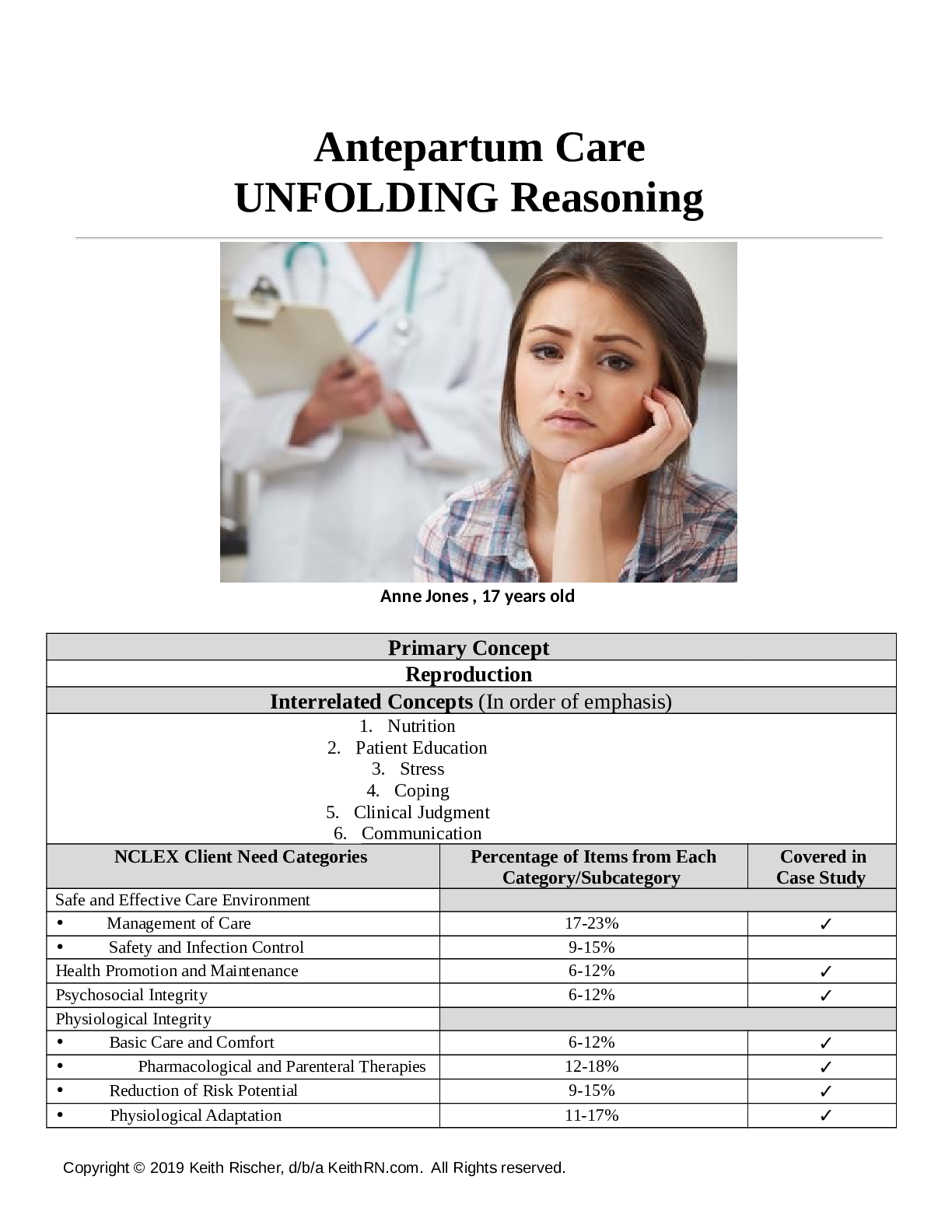
Anne Jones , 17 years old
History of Present Problem:
Anne Jones is a 17-year-old Caucasian teenager who thinks she may be pregnant because she has missed two periods.
Her last menstrual period, she thinks, was about one month ago. She states she had a little bit of spotting last week but
didn’t have a “full period”. She complains of her breasts being tender, swollen, frequent urination, and nausea in the
morning. This is her first office visit and she is not sure why she feels so crummy but suspects she might be pregnant.
Her urine pregnancy test is positive. Her primary care provider orders a prenatal lab panel and a urinalysis.
Personal/Social History:
Anne is a senior in high school who stands on her feet while working at McDonalds after school. She drinks six colas
daily, denies alcohol use, and does not smoke. She takes no medications except for occasional acetaminophen for
headaches and ibuprofen for menstrual cramps. Anne is 5’4” (160 cm) and weighs about 105 lbs. (47.7 kg) according to
Anne. A 24-hour recall nutrition history reveals a typical day’s diet: breakfast- pop tart and can of cola; Lunch- a slice of
pizza, chocolate chip cookie, can of cola; Dinner- fried chicken, green beans, biscuit, can of cola; snacks, including
cookies and can of cola. She broke up last week with her boyfriend, and he is not aware she might be pregnant. She wants
to keep the baby but has not told her parents.
What data from the histories are RELEVANT and must be interpreted as clinically significant by the nurse?
(Reduction of Risk Potential)
RELEVANT Data from Present Problem: Clinical Significance:
Amenorrhea
Positive pregnancy test
Breasts being tender, swollen, frequent
urination, and nausea
Ht. 5”4 (160 cm)
Wt. 105 lbs. (47.7 kg)
Breakfast- pop tart and can of cola; Lunch- a
slice of pizza, chocolate chip cookie, can of
cola; Dinner- fried chicken, green beans,
biscuit, can of cola; snacks, including
cookies and can of cola.
Earliest symptom of pregnancy
This test checks for the presence of “detectable” amounts of HCG
hormone which is secreted by the fertilized egg which is implanted
on the endometrium.
These are subjective (presumptive) changes, that could indicate
pregnancy.
This patients BMI is 18, which indicates she is underweight
Inadequate intake of nutrients. Lack of prenatal vitamins. At risk
for hypertension due to inadequate fluid intake. At risk for
gestational diabetes and other health problems associated with
diets high in sugars, processed, and fried foods.
RELEVANT Data from Social History: Clinical Significance:
Patient is a minor, Age 17
She broke up last week with her boyfriend,
and he is not aware she might be pregnant.
She wants to keep the baby but has not told
her parents.
Anne is a senior in high school who stands
on her feet while working at McDonalds
after school
This patient is a minor and her parents will need to be contacted
in order to provide (legally) further treatment.
Patient is alone and does not have emotional support. Also this
patient is a risk of experiencing challenges with her education and
social wellbeing.
Standing on her feet at a laborious job that does not provide
adequate health insurance or accommodations for pregnant
women may impact her health adversely. Standing for long
periods is difficult for pregnant women at risk for DVT.
[Show More]