1. Week 1
2. Biology, the Study of Life Quiz
Question 1
Question text
Which of the following levels of taxonomy includes the greatest
number of organisms?
a. Class
b. Family
c. Species
d. Order
e. Phylum
...
1. Week 1
2. Biology, the Study of Life Quiz
Question 1
Question text
Which of the following levels of taxonomy includes the greatest
number of organisms?
a. Class
b. Family
c. Species
d. Order
e. Phylum
Phylum
Question 2
Question text
What is the basic unit of structure and function for all life?
a. atom
b. molecule
c. cell
d. organ
e. organism
cell
Question 3
Question text
Members of the same species located within a particular area are
called _ (blank) _.
a. a community
b. an ecosystem
c. a population
d. an organism
e. a biosphere
a population
Question 4
Question text
Where do all organisms ultimately get their energy from?
a. the sun
b. inorganic matter
c. organic matter
d. water
e. nutrient cycling
the sun
Question 5
In
Question text
Which of the following shows three taxonomic levels from most to
least inclusive?
a. species, genus, family
b. domain, kingdom, phylum
c. family, species, genus
d. phylum, domain, kingdom
e. family, class, species
domain, kingdom, phylum
Question 6
Question text
You discover a new group of organisms with the following
characteristics: no nuclei to hold its DNA, mitochondria, rigid,
bacterial flagella. What level of classification would this new
organism be placed under?
a. Domain
b. Kingdom
c. Phylum
d. Genus
e. Species
Domain
Question 7
Question text
What is the main driving force behind evolution?
a. natural selection
b. metabolism
c. homeostasis
d. photosynthesis
e. organization
natural selection
Question 8
Question text
The _ (blank) _ theory provides insight into why various species
differ from one another, predisposition to diseases, and the
production of drugs for diseases.
a. Cell
b. Gene
c. Evolution
d. Homeostasis
e. Ecosystem
Gene
Question 9
Question text
What process explains the unity and diversity of living organisms
on our planet?
a. taxonomy
b. metabolism
c. evolution
d. homeostasis
e. reproduction
evolution
Question 10
Question text
Which of the following is not considered a basic theory of biology?
a. Atomic
b. Cell
c. Homeostasis
d. Ecosystem
e. Gene
Atomic
Question 11
Question text
What is the term for a possible explanation for a natural event?
a. an observation
b. a conclusion
c. a hypothesis
d. a test
e. data
a hypothesis
Question 12
Question text
To what kingdom do humans belong?
a. Animals
b. Plants
c. Protists
d. Fungi
e. Archaea
Animals
Question 13
Question text
What kingdom is characterized by eukaryotic, multicellular
organisms that ingest their food?
a. Fungi
b. Plants
c. Protists
d. Animals
e. Archaea
Animals
Question 14
Question text
You are observing a cell through a microscope and can see that it
contains no nucleus. Based exclusively on this information, to
which domain(s) might this organism belong?
a. Bacteria only
b. Archaea only
c. Eukarya only
d. Bacteria or Archaea but not Eukarya
e. Bacteria, Archaea, or Eukarya
Bacteria or Archaea but not Eukarya
Question 15
Question text
What is true of humans?
a. they are classified as protists
b. they are descended from apes
c. they belong to the domain Archaea
d. they share a common ancestor with apes
e. they are prokaryotes
they share a common ancestor with apes
1. Week 1
2. Basic Chemistry of Cells Quiz
Question 1
Question text
What is the result of unequal sharing of electrons between two
atoms?
a. a nonpolar molecule, such as methane
b. an ionic compound, such as salt
c. an electronegative molecule, such as calcium ion
d. a hydrophobic molecule, such as fat
e. a polar molecule, such as water
a polar molecule, such as water
Question 2
Question text
What diagnostic procedure could be done in order to determine if
a patient has a thyroid tumor?
a. Patient drinks low levels of radioactive Iodine-131, then has an
X-ray
b. Patient drinks high levels of radioactive Iodine-131, then has a
PET scan
c. Injection of low levels of radioactive glucose, then patient has a
PET scan
d. Injection of low levels of radioactive Thallium-201, then patient
has a PET scan
e. Injection of high levels of radioactive glucose, then patient has
an X-ray
Patient drinks low levels of radioactive
Iodine-131, then has an X-ray
Question 3
Question text
Which of the following would occur that could cause an atom to
become a different element?
a. increase the number of neutrons
b. increase the number of electrons
c. increase the number of protons
d. decrease the number of neutrons
e. decrease the number of electrons
increase the number of protons
Question 4
Question text
Water molecules disassociate _ (blank) _ in salt crystals when they
are dissolved in water.
a. nonpolar covalent bonds
b. hydrogen bonds
c. polar covalent bonds
d. ionic bonds
e. hydrophobic interactions
ionic bonds
Question 5
Question text
Which of the following has a positive charge?
a. proton
b. electron
c. atomic mass
d. neutron
e. isotope
proton
Question 6
Question text
What type of bond occurs between positively and negatively
charged atoms?
a. covalent bond
b. adhesive interaction
c. hydrogen bond
d. ionic bond
e. hydrophobic interaction
ionic bond
Question 7
Question text
Which factor determines whether an atom will be chemically
reactive?
a. the number of electrons in the outer shell
b. the ratio of protons to electrons
c. the number of electrons in the inner shell
d. the ratio of protons to neutrons
e. the number of electron shells an atom has
the number of electrons in the outer shell
Question 8
Question text
What are the six elements that make up living organisms?
a. carbon, hydrogen, nitrogen, oxygen, phosphorus, sulfur
b. copper, iron, magnesium, sodium, water, zinc
c. carbon dioxide, hydrogen, nitrogen, oxygen, phosphate, sulfate
d. calcium, hydrogen, iron, potassium, sulfur, water
e. aluminum, magnesium, nitrogen, silicon, sodium, sulfur
carbon, hydrogen, nitrogen, oxygen,
phosphorus, sulfur
Question 9
Question text
What type of bond occurs when electrons are equally shared
between two atoms?
a. polar
b. hydrogen
c. ionic
d. nonpolar
e. adhesive
nonpolar
Question 10
Question text
Ions located in bones and teeth that are also important in muscle
contractions and nerve conduction are _ (blank) _.
a. sodium
b. chloride
c. bicarbonate
d. potassium
e. calcium
calcium
Question 11
Question text
What is the type of solution if the hydroxide ion concentration
exceeds the hydrogen ion concentration?
a. a buffer
b. an acid
c. a neutral solution
d. a base
e. a solute
a base
Question 12
Question text
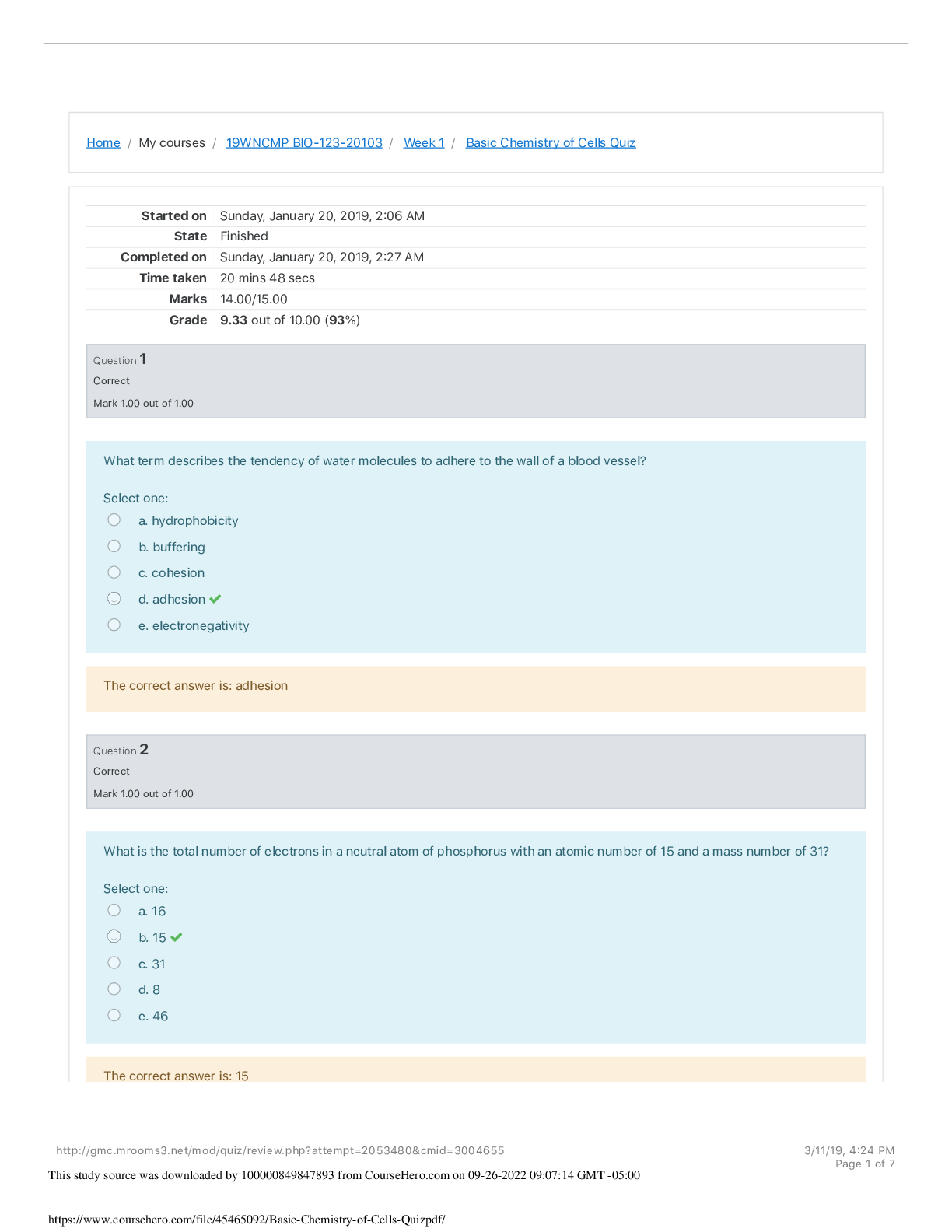
What is the total number of electrons in a neutral atom of
phosphorus with an atomic number of 15 and a mass number of
31?
a. 16
b. 15
c. 31
d. 8
e. 46
15
Question 13
Question text
Which of the following is the largest number describing an atom?
a. Electron number
b. Neutron number
c. Atomic number
d. Proton number
e. Mass number
Mass number
Question 14
Question text
How does one determine the mass number of an element?
a. the number of neutrons plus the number of electrons
b. the number of electrons only
c. the number of protons plus the number of neutrons
d. the number of protons plus the number of electrons
e. the number of protons only
the number of protons plus the number of
neutrons
Question 15
Not answered
Question text
If a sulfur atom has 6 electrons in the outermost shell, how will it
likely react?
a. gain two electrons from another atom
b. lose 6 neutrons to another atom
c. nothing, as this is a very stable atom
d. lose two electrons to another atom
e. stay as a single atom in nature
gain two electrons from another atom
1. Week 2
2. Organic Molecules and Cells Quiz
Question 1
Question text
Why are fats and oils referred to as triglycerides?
a. They have three glycerol molecules
b. They have three fatty acid molecules
c. They have three amino acids
d. They have three phospholipids
e. They have three steroid groups
They have three fatty acid molecules
Question 2
Question text
What type of sugar is transported in plants and used as table
sugar?
a. sucrose
b. glucose
c. lactose
d. galactose
e. fructose
sucrose
Question 3
Question text
A molecule from a new organism contains adenine, cytosine,
guanine, and thymine. What molecules is being looked at?
a. DNA
b. RNA
c. lipid
d. protein
e. carbohydrate
DNA
Question 4
In
Question text
What molecule can ionize and release hydrogen ions to make the
solution more acidic?
a. carbonyl
b. phosphate
c. sulfhydryl
d. carboxyl
e. hydroxyl
carboxyl
Question 5
In
Question text
What level of protein structure is found in most enzymes and
hemoglobin?
a. dipeptide
b. primary
c. tertiary
d. quaternary
e. secondary
quaternary
Question 6
In
Question text
What type of protein structure describes a linear sequence of
amino acids?
a. quaternary
b. primary
c. pleated sheet
d. alpha helix
e. tertiary
primary
Question 7
Question text
What is the DNA base pair matching?
a. T-T, C-C
b. C-C, G-G
c. A-A, T-T
d. A-U, C-G
e. A-T, C-G
A-T, C-G
Question 8
In
Question text
When added to a carbon chain which functional group will convert
it into an alcohol molecule?
a. sulfhydryl
b. hydroxyl
c. phosphate
d. carboxyl
e. carbonyl
hydroxyl
Question 9
In
Question text
Which of the following is not a association of a lipid
molecule and its specific function?
a. beeswax: main structural component of the bee honeycomb
b. phospholipid: main component of fats and oils
c. wax: waterproof covering of plant leaves
d. testosterone: steroid involved in muscle development in males
e. cholesterol: stabilize cell membrane of animal cells
phospholipid: main component of fats and
oils
Question 10
Question text
All of the following are likely to be a function of proteins in living
organisms except _ (blank) _.
a. defense
b. support
c. metabolism
d. transport
e. long term energy storage
long term energy storage
Question 11
Question text
Which of the following molecules could be used for an immediate
source of energy?
a. nucleic acids
b. carbohydrates
c. water
d. protein
e. lipids
carbohydrates
Question 12
In
Question text
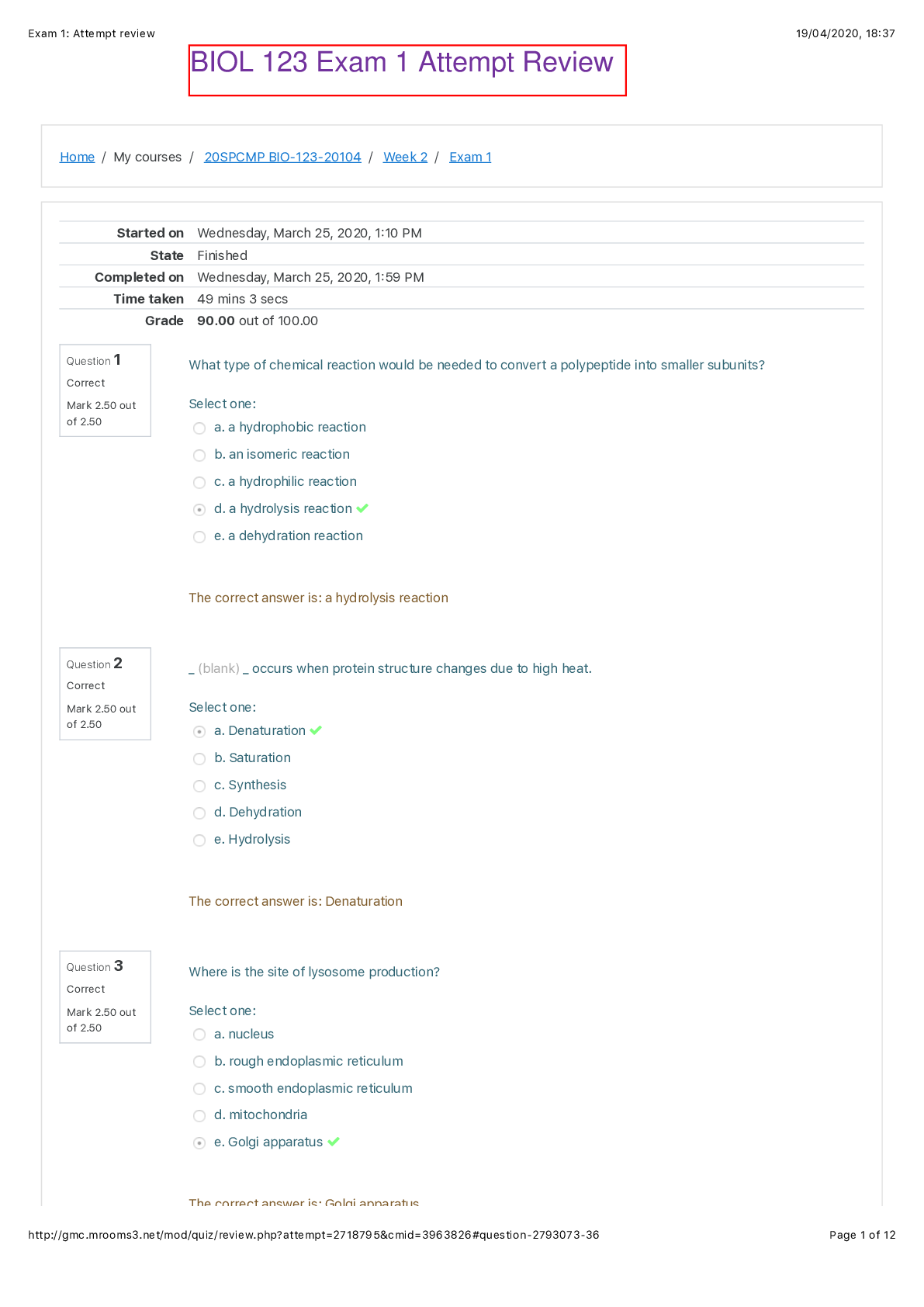
What type of chemical reaction would be needed to convert a
polypeptide into smaller subunits?
a. a hydrophobic reaction
b. an isomeric reaction
c. a hydrophilic reaction
d. a hydrolysis reaction
e. a dehydration reaction
a hydrolysis reaction
Question 13
Question text
Why is sickle cell disease more common in Americans with African
ancestors than Americans with European ancestors?
a. Sickle-shaped blood cells caused malarial parasites to die, and
thus gave protection against malarial infections prevalent in
Africa
b. Sickle-shaped blood cells were good hosts for tuberculosis, and
thus spread tuberculosis widely throughout Africa
c. Sickle-shaped blood cells caused cholera bacteria to die, and
thus gave protection against large-scale cholera epidemics
throughout Europe
d. Sickle-shaped blood cells caused tuberculosis bacteria to die,
and thus gave protection against large-scale Tb epidemics
throughout crowded areas in Africa
e. Sickle-shaped blood cells were good hosts for cholera bacteria,
and thus caused many people to die from cholera and diarrhea
Sickle-shaped blood cells caused malarial
parasites to die, and thus gave protection against malarial
infections prevalent in Africa
Question 14
Question text
Why does the molecule shown make plaques along the walls of
blood vessels?
a. it is hydrophillic and can trap dust
b. it is hydrophobic and would not dissolve in blood fluid
c. it is hydrophobic and can repel insects
d. it is hydrophillic and likes to stick to blood fluid
e. it is hydrophobic and serves as a waterproof barrier
it is hydrophobic and would not dissolve in
blood fluid
Question 15
Question text
What is the term for a large organic molecule with many
subunits?
a. hydromer
b. monomer
c. polymer
d. isomer
e. hydrophilic
polymer
1. Week 2
2. Structure and Function of Cells Quiz
Question 1
Question text
Using the animal cell diagram, identify the cell structure marked
"e."
a. lysosome
b. mitochondrion
c. nucleus
d. centrioles
e. nucleolus
centrioles
Question 2
In
Question text
How is it possible to contrast chloroplasts and mitochondria?
a. whether the organelle contains its own DNA
b. whether the organelle converts solar energy into cellular
energy
c. whether the organelle is found in plant cells
d. whether the organelle has multiple membranes
e. whether the organelle has a large internal surface area
whether the organelle converts solar
energy into cellular energy
Question 3
Question text
What would occur if a eukaryotic cell lacked the Golgi apparatus?
a. it could not digest macromolecules
b. it could not package proteins
c. it could not maintain its shape
d. it would not have genetic information
e. it could not make energy
it could not package proteins
Question 4
Question text
Which of the following cells would have a nucleus, a cell wall, and
a large central vacuole?
a. archaean cell
b. animal cell
c. bacterial cell
d. plant cell
e. prokaryotic cell
plant cell
Question 5
In
Question text
Where are lipids synthesized outside of the endomembrane
system?
a. smooth endoplasmic reticulum
b. rough endoplasmic reticulum
c. Golgi apparatus
d. nucleus
e. mitochondria
mitochondria
Question 6
Question text
Arrange the order of cytoskeletal fibers from smallest to largest.
a. actin filaments, microtubules, intermediate filaments
b. actin filaments, intermediate filaments, microtubules
c. microtubules, actin filaments, intermediate filaments
d. intermediate filaments, actin filaments, microtubules
e. microtubules, intermediate filaments, actin filaments
actin filaments, intermediate filaments,
microtubules
Question 7
Question text
What is the basic unit of structure and function for all life?
a. molecule
b. cell
c. organism
d. atom
e. organ
cell
Question 8
Question text
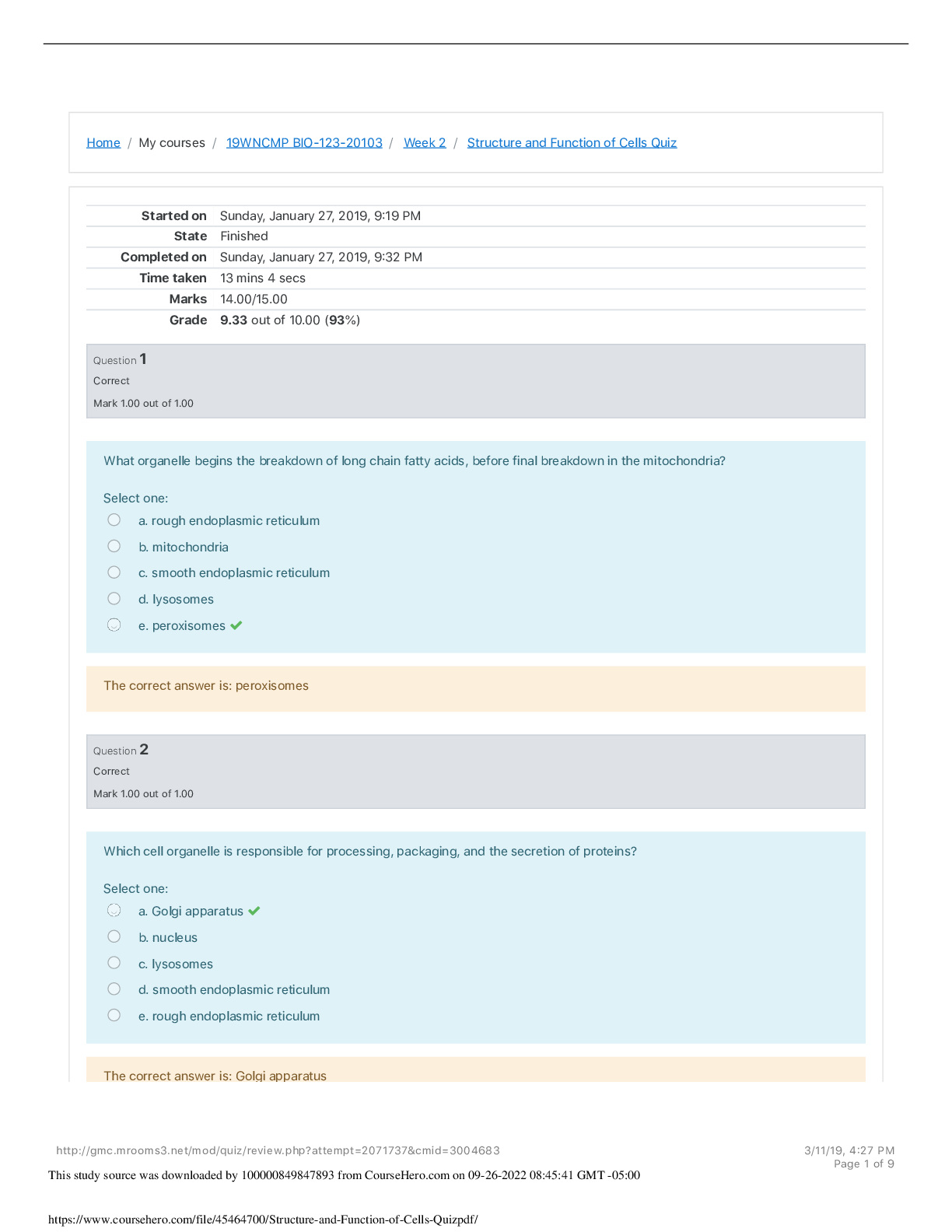
Which cell organelle is responsible for processing, packaging, and
the secretion of proteins?
a. Golgi apparatus
b. nucleus
c. lysosomes
d. smooth endoplasmic reticulum
e. rough endoplasmic reticulum
Golgi apparatus
Question 9
Question text
Using the plant cell diagram, identify the cell structure marked
"a."
a. cytoplasm
b. nucleus
c. mitochondria
d. central vacuole
e. Chloroplast
central vacuole
Question 10
Question text
Where are the majority of ribosomes found inside the cell?
a. cytoskeleton
b. nuclear envelope
c. smooth endoplasmic reticulum
d. rough endoplasmic reticulum
e. mitochondria
rough endoplasmic reticulum
Question 11
Question text
Using the animal cell diagram, identify the cell structure marked
"c."
a. smooth endoplasmic reticulum
b. rough endoplasmic reticulum
c. Golgi apparatus
d. nucleus
e. mitochondria
Golgi apparatus
Question 12
In
Question text
Select the pair of cytoskeletal structure and its physical
makeup.
a. centriole: short barrels of intermediate filaments
b. actin filaments: twisted strands of keratin proteins
c. microtubules: cylinders made of keratin proteins
d. flagellum: microtubule doublets and actin side arms
e. intermediate filaments: ropes made of proteins
intermediate filaments: ropes made of
proteins
Question 13
Question text
Which structure can occupy up to 90% of the volume in a plant
cell?
a. central vacuole
b. endoplasmic reticulum
c. nucleus
d. chloroplasts
e. cytoplasm
central vacuole
Question 14
Question text
What structure is not typically found in a prokaryotic cell?
a. capsule
b. nucleus
c. ribosome
d. plasma membrane
e. cell wall
nucleus
Question 15
Question text
What type of cell would have lysosomes and a nucleus, but no
chloroplasts?
a. bacterial cell
b. archaean cell
c. animal cell
d. plant cell
e. prokaryotic cell
animal cell
1. Week 2
2. Exam 1
Question 1
In
Question text
What kind of bond occurs between nucleotides in a DNA molecule,
such as the polar "G" nucleotide on one strand with the polar "C"
nucleotide on the other strand?
a. hydrophobic interactions
b. hydrogen bonds
c. adhesive interactions
d. covalent bonds
e. ionic bonds
hydrogen bonds
Question 2
Question text
Which of the following is not considered a basic theory of biology?
a. Atomic
b. Cell
c. Homeostasis
d. Ecosystem
e. Gene
Atomic
Question 3
Question text
What would be the result of a cell that did not have RNA
molecules?
a. The DNA would take over its job
b. The cell would not have genes
c. There would be no effect on the cell
d. The cell could not make energy
e. The cell would not be able to make proteins
The cell would not be able to make proteins
Question 4
Question text
Which of the following is not a association of a lipid
molecule and its specific function?
a. beeswax: main structural component of the bee honeycomb
b. phospholipid: main component of fats and oils
c. wax: waterproof covering of plant leaves
d. testosterone: steroid involved in muscle development in males
e. cholesterol: stabilize cell membrane of animal cells
phospholipid: main component of fats and
oils
Question 5
Question text
Where is the site for breakdown of engulfed bacteria, debris and
macromolecules in an animal cell?
a. peroxisomes
b. rough endoplasmic reticulum
c. lysosomes
d. mitochondria
e. smooth endoplasmic reticulum
lysosomes
Question 6
In
Question text
What level of protein structure is found in most enzymes and
hemoglobin?
a. dipeptide
b. primary
c. tertiary
d. quaternary
e. secondary
quaternary
Question 7
Question text
Which of the following molecules is more complex than a
monosaccharide?
a. sucrose
b. galactose
c. deoxyribose
d. glucose
e. ribose
sucrose
Question 8
Question text
Which of the following is true about eukaryotic cells when
compared to prokaryotic cells?
a. eukaryotic cells are smaller
b. eukaryotic cells have a capsule
c. eukaryotic cells have no cell membrane
d. eukaryotic cells have no nucleus
e. eukaryotic cells have a nucleus
eukaryotic cells have a nucleus
Question 9
Question text
What is true of carbon because it has four electrons in its outer
shell?
a. gain four electrons to complete its outer shell
b. lose four electrons to become stable
c. gain or lose two electrons to become stable
d. share four electrons to complete its outer shell
e. share two electrons to complete its outer shell
share four electrons to complete its outer
shell
Question 10
In
Question text
What is the type of solution if the hydroxide ion concentration
exceeds the hydrogen ion concentration?
a. a buffer
b. an acid
c. a neutral solution
d. a base
e. a solute
a base
Question 11
Question text
Which of the following cells would have a nucleus, a cell wall, and
a large central vacuole?
a. archaean cell
b. animal cell
c. bacterial cell
d. plant cell
e. prokaryotic cell
plant cell
Question 12
Question text
If water is mixed with salt in a beaker, what does the salt
represent?
a. the solvent
b. the solute
c. the solution
d. the buffer
e. the ion
the solute
Question 13
Question text
The tendency of water molecules to cling to other water
molecules is _ (blank) _.
a. adhesion
b. electronegativity
c. polar
d. cohesion
e. nonpolar
cohesion
Question 14
Question text
Which of the following is true of ATP?
a. It is used for long term energy storage
b. It has a base of adenine, the sugar ribose, and three phosphate
groups
c. It contains adenine, ribose, and two phosphate groups
d. It has a base of adenine, the sugar deoxyribose, and three
phosphate groups
e. It is very stable)
It has a base of adenine, the sugar ribose,
and three phosphate groups
Question 15
Question text
What type of organism uses chitin for structure and support?
a. bacterium
b. cactus
c. human
d. tree
e. crab
crab
Question 16
In
Question text
Why is hydrochloric acid classified as an acid?
a. it absorbs excess hydroxide ions from the solution
b. it dissociates to release hydroxide ions
c. it dissociates to release hydrogen ions and absorbs excess
hydroxide ions from the solution
d. it absorbs excess hydrogen ions from the solution
e. it dissociates to release hydrogen ions
it dissociates to release hydrogen ions and
absorbs excess hydroxide ions from the solution
Question 17
Question text
Which of the following is about saturated fatty acids?
a. They are made of glycerol
b. They have no double bonds between carbon atoms
c. They are made of nucleotides
d. They are composed of glucose subunit
e. They are composed of amino acid subunits)
They have no double bonds between
carbon atoms
Question 18
Question text
Why does the molecule shown make plaques along the walls of
blood vessels?
a. it is hydrophillic and can trap dust
b. it is hydrophobic and would not dissolve in blood fluid
c. it is hydrophobic and can repel insects
d. it is hydrophillic and likes to stick to blood fluid
e. it is hydrophobic and serves as a waterproof barrier
it is hydrophobic and would not dissolve in
blood fluid
Question 19
Question text
What is the term for the building blocks of proteins?
a. monosaccharides
b. amino acids
c. phospholipids
d. peptides
e. nucleotides
amino acids
Question 20
Question text
What is the function of transport vesicles inside a cell?
a. move proteins between the SER and the RER
b. move proteins between the endoplasmic reticulum and the
Golgi apparatus
c. move proteins between the endoplasmic reticulum and the cell
membrane
d. move proteins between the nucleus and the endoplasmic
reticulum
e. move proteins between the nucleus and the Golgi apparatus
move proteins between the endoplasmic
reticulum and the Golgi apparatus
Question 21
Question text
Using the animal cell diagram, identify the cell structure marked
"a."
a. nucleus
b. rough endoplasmic reticulum
c. mitochondria
d. Golgi apparatus
e. smooth endoplasmic reticulum
rough endoplasmic reticulum
Question 22
Question text
Where are saturated fats primarily found?
a. fungi
b. crustaceans
c. bacterial cell walls
d. plant oils
e. mammals
mammals
Question 23
Question text
What type of reaction removes a hydroxyl group and a hydrogen
atom from two molecules to join them together?
a. a dehydration reaction
b. a hydrophilic reaction
c. a monomer reaction
d. a polymer reaction
e. a hydrolysis reaction
a dehydration reaction
Question 24
Question text
The cytoskeleton performs all of these functions except
_ (blank) _.
a. help white blood cells break down bacteria that have been
engulfed
b. strengthen a layer of skin cells
c. help connective cells crawl along a surface
d. help organelles move inside a cell
e. maintain the shape of intestinal cells
help white blood cells break down bacteria
that have been engulfed
Question 25
Question text
What molecule can ionize and release hydrogen ions to make the
solution more acidic?
a. carbonyl
b. phosphate
c. sulfhydryl
d. carboxyl
e. hydroxyl
carboxyl
Question 26
Question text
What is the basic unit of structure and function for all life?
a. molecule
b. cell
c. organism
d. atom
e. organ
cell
Question 27
Question text
What kind of interaction occurs between atoms of sodium and
chlorine?
a. The sodium atom gives up one proton
b. The sodium atom gives up one neutron
c. The chlorine atom gives up one neutron
d. The chlorine atom gives up one electron
e. The sodium atom gives up one electron
The sodium atom gives up one electron
Question 28
Question text
What type of chemical reaction would be needed to convert a
polypeptide into smaller subunits?
a. a hydrophobic reaction
b. an isomeric reaction
c. a hydrophilic reaction
d. a hydrolysis reaction
e. a dehydration reaction
a hydrolysis reaction
Question 29
Question text
If a sulfur atom has 6 electrons in the outermost shell, how will it
likely react?
a. gain two electrons from another atom
b. lose 6 neutrons to another atom
c. nothing, as this is a very stable atom
d. lose two electrons to another atom
e. stay as a single atom in nature
gain two electrons from another atom
Question 30
Question text
_ (blank) _ occurs when protein structure changes due to high
heat.
a. Denaturation
b. Saturation
c. Synthesis
d. Dehydration
e. Hydrolysis
Denaturation
Question 31
Question text
What is the benefit of low levels of radioactive isotopes in a
medicinal setting?
a. as tracers in imaging organs using Xrays and PET Scans
b. to reduce obesity and diabetes in teenagers
c. to create drugs that work faster than normal
d. to destroy aging and unwanted cells
e. to prevent ultraviolet damage from the sun
as tracers in imaging organs using Xrays
and PET Scans
Question 32
Question text
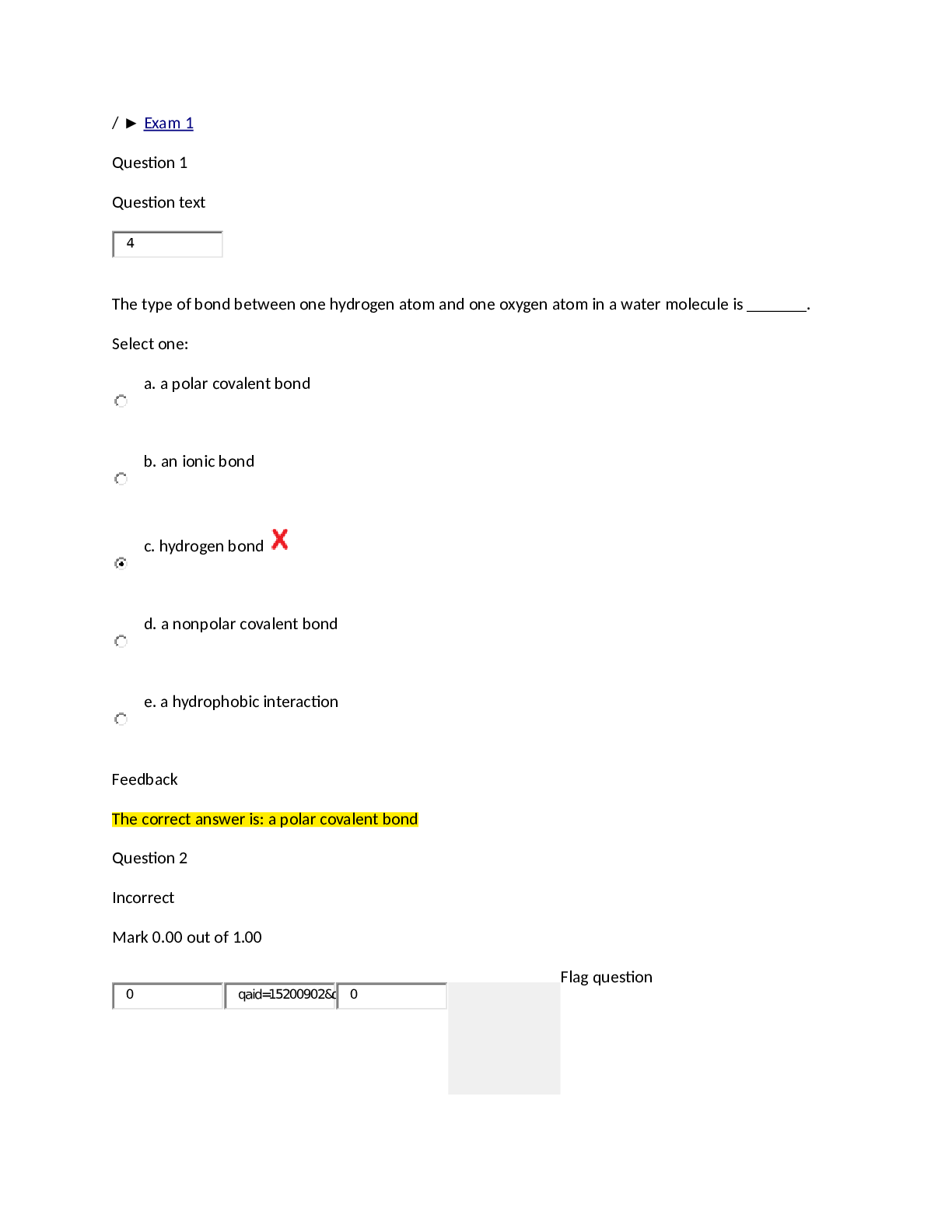
The type of bond between one hydrogen atom and one oxygen
atom in a water molecule is _ (blank) _.
a. a polar covalent bond
b. an ionic bond
c. hydrogen bond
d. a nonpolar covalent bond
e. a hydrophobic interaction
a polar covalent bond
Question 33
Question text
What is the term for a specific combination of bonded atoms
which always react in the same way?
a. a hydrophilic group
b. a hydrophobic group
c. an organic group
d. a functional group
e. a covalent group
a functional group
Question 34
In
Question text
_ (blank) _ is an atom with an unequal number of protons and
electrons.
a. An isotope
b. An ion
c. A compound
d. An octet
e. A valance
An ion
Question 35
Question text
Which organelle acts as the powerhouse of the cell?
a. mitochondria
b. nucleus
c. rough endoplasmic reticulum
d. chloroplast
e. lysosome
mitochondria
Question 36
Question text
An example of _ (blank) _ is flat leaves in plants that are able to
provide more surface area for light exposure.
a. an adaptation
b. homeostasis
c. a mutation
d. a gene
e. a cell
an adaptation
Question 37
Question text
What is the basic unit of structure and function for all life?
a. atom
b. molecule
c. cell
d. organ
e. organism
cell
Question 38
Question text
When you mix sugar into Kool-Aid, the sugar dissolves in the
liquid. This shows that sugar molecules are _ (blank) _.
a. hydrophilic
b. cohesive
c. covalent
d. neither hydrophobic nor hydrophilic
e. hydrophobic
hydrophilic
Question 39
Question text
Which of these functional groups would be related to nucleotides
and phospholipids?
a. hydroxyl
b. phosphate
c. sulfhydryl
d. carbonyl
e. carboxyl
phosphate
Question 40
Question text
Each of the following is a use of water by living organisms except
_ (blank) _.
a. external transportation for chemicals
b. help exchange heat
c. aids in homeostasis
d. provides nutrients for metabolism
e. provides a medium for movement
provides nutrients for metabolism
[Show More]








x.png)