FNAN 522 Finance Exam II Final Already Graded. Started on Tuesday, 10 December 2019, 9:41 PM State Finished Completed on Tuesday, 10 December 2019, 10:5 6 PM Time taken 1 hour 15 mins Marks 30.00/40.00 Grade 210.00 out o
...
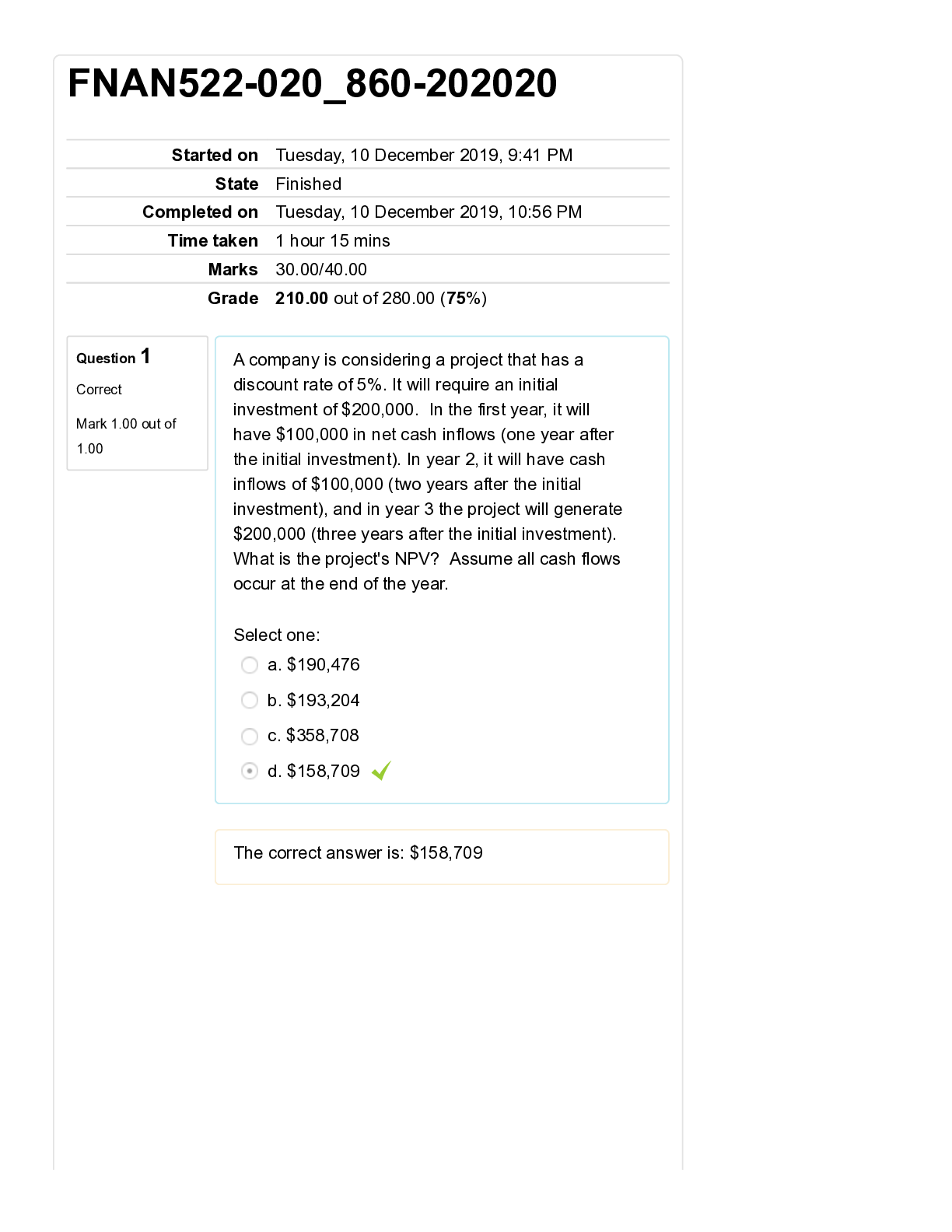
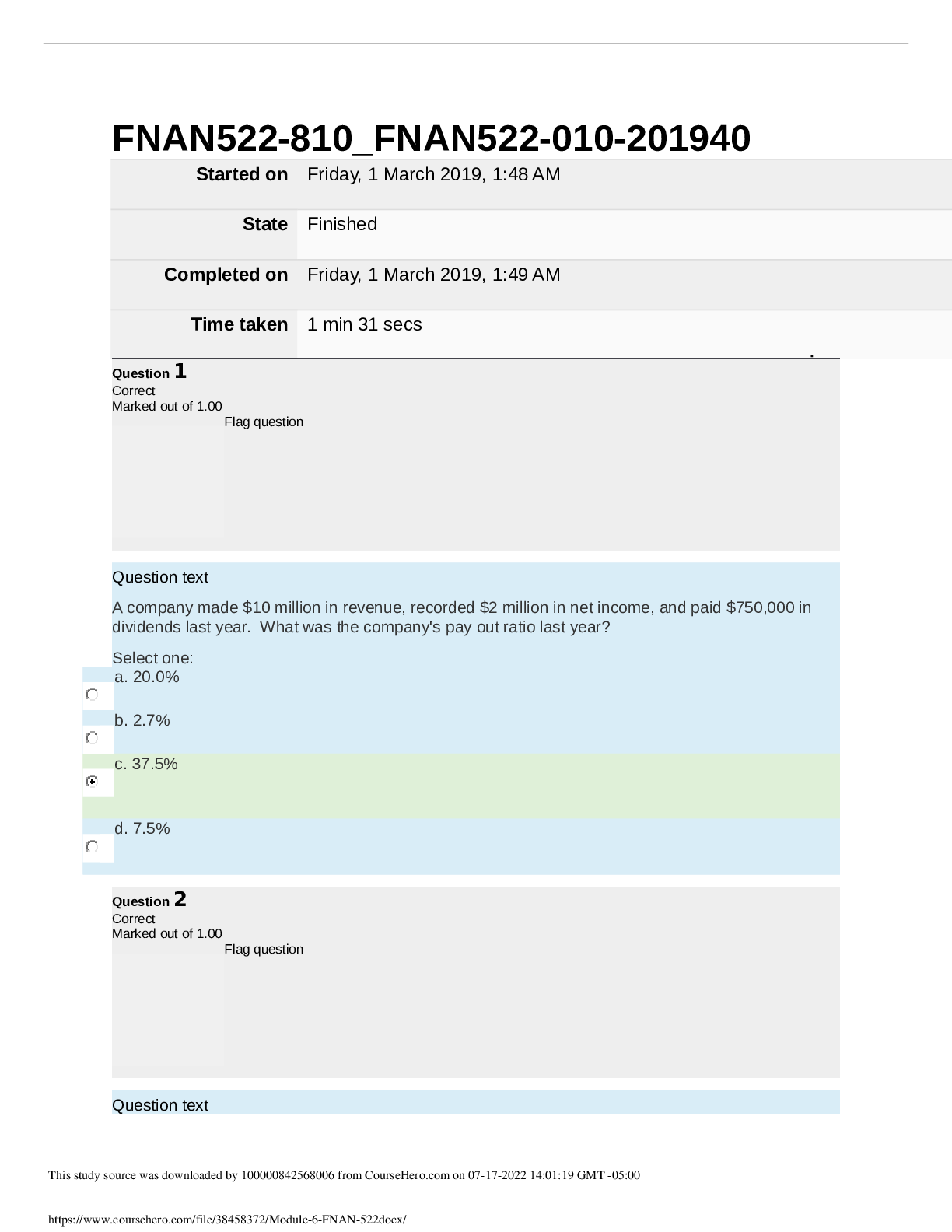
FNAN 522 Finance Exam II Final Already Graded. Started on Tuesday, 10 December 2019, 9:41 PM State Finished Completed on Tuesday, 10 December 2019, 10:5 6 PM Time taken 1 hour 15 mins Marks 30.00/40.00 Grade 210.00 out of 280.00 (75%) A company is considering a project that has a discount rate of 5%. It will require an initial investment of $200,000. In the first year, it will have $100,000 in net cash inflows (one year after the initial investment). In year 2, it will have cash inflows of $100,000 (two years after the initial investment), and in year 3 the project will generate $200,000 (three years after the initial investment). What is the project's NPV? Assume all cash flows occur at the end of the year. Select one: a. $190,476 b. $193,204 c. $358,708 d. $158,709 The correct answer is: $158,709 FNAN522-020_860-202020 Question 2 Correct Mark 1.00 out of 1.00 Question 3 Correct Mark 1.00 out of 1.00 A project has an initial investment requirement of $100,000. In year 1, it should earn $25,000; in year two, $30,000; and in year 3, $50,000. What is the project's internal rate of return? Assume the cash flows in years one, two, and three happen at the end of the year. Select one: a. 5.0% b. 6.21% c. 7.56% d. 2.21% The correct answer is: 2.21% In which of the following situations would it be appropriate to use the IRR method to make an investment decision? Select one: a. To compare two projects that have an equal initial investment and lifespan. b. All of these answers. c. To assess a project which cash flows fluctuate between positive and negative. d. To compare two investments that have different durations. The correct answer is: To compare two projects that have an equal initial investment and lifespan. Question 4 Correct Mark 1.00 out of 1.00 Question 5 Incorrect Mark 0.00 out of 1.00 Under the internal rate of return rule in capital budgeting, which of the following statements CANNOT be true? Select one: a. The initial investment can be the cost from purchasing new equipment. b. The cash inflows can be estimates. c. The internal rate of return can vary throughout the life of a project. d. The internal rate of return can be equal to the cost of capital. The correct answer is: The internal rate of return can vary throughout the life of a project. You have just been offered a contract worth $5.6 million per year for 3 years. However, to take the contract, you will need to purchase some new equipment. Your discount rate for this project is 15.3%. You are still negotiating the purchase price of the equipment. What is the most you can pay for the equipment and still have a positive NPV? Select one: a. $5.6 million b. $16.8 million c. $23.4 million d. $12.6 million The correct answer is: $12.6 million Question 6 Correct Mark 1.00 out of 1.00 Question 7 Correct Mark 1.00 out of 1.00 Which of the following could be a sunk cost? Select one: a. A feasibility study that attempted to determine the economic viability of a project. b. All of these answers. c. Labor hours spent on planning project. d. Equipment purchased to pursue a project. The correct answer is: All of these answers. Which of the following is an example of an opportunity cost? Select one: a. If invest in one of two projects, the cost is the lost revenue from the other project. b. If you buy a candy bar instead of a soda, the cost is thirst. c. All of these answers. d. If you watch a game instead of going for a run, the cost is poorer personal health. The correct answer is: All of these answers.
[Show More]