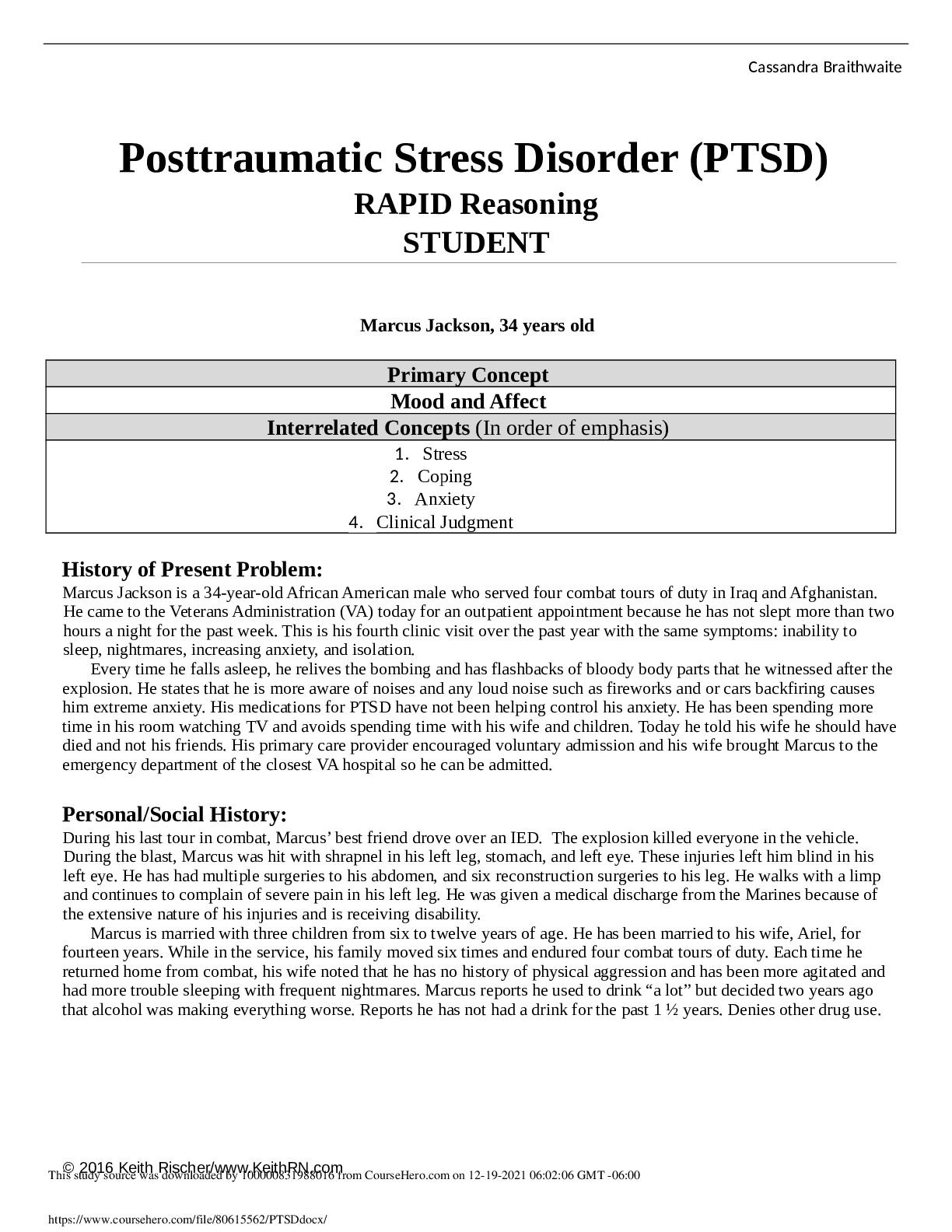
Posttraumatic Stress Disorder (PTSD)
RAPID Reasoning
STUDENT
Marcus Jackson, 34 years old
Primary Concept
Mood and Affect
Interrelated Concepts (In order of emphasis)
1. Stress
2. Coping
3. Anxiety
4. Clinical
...
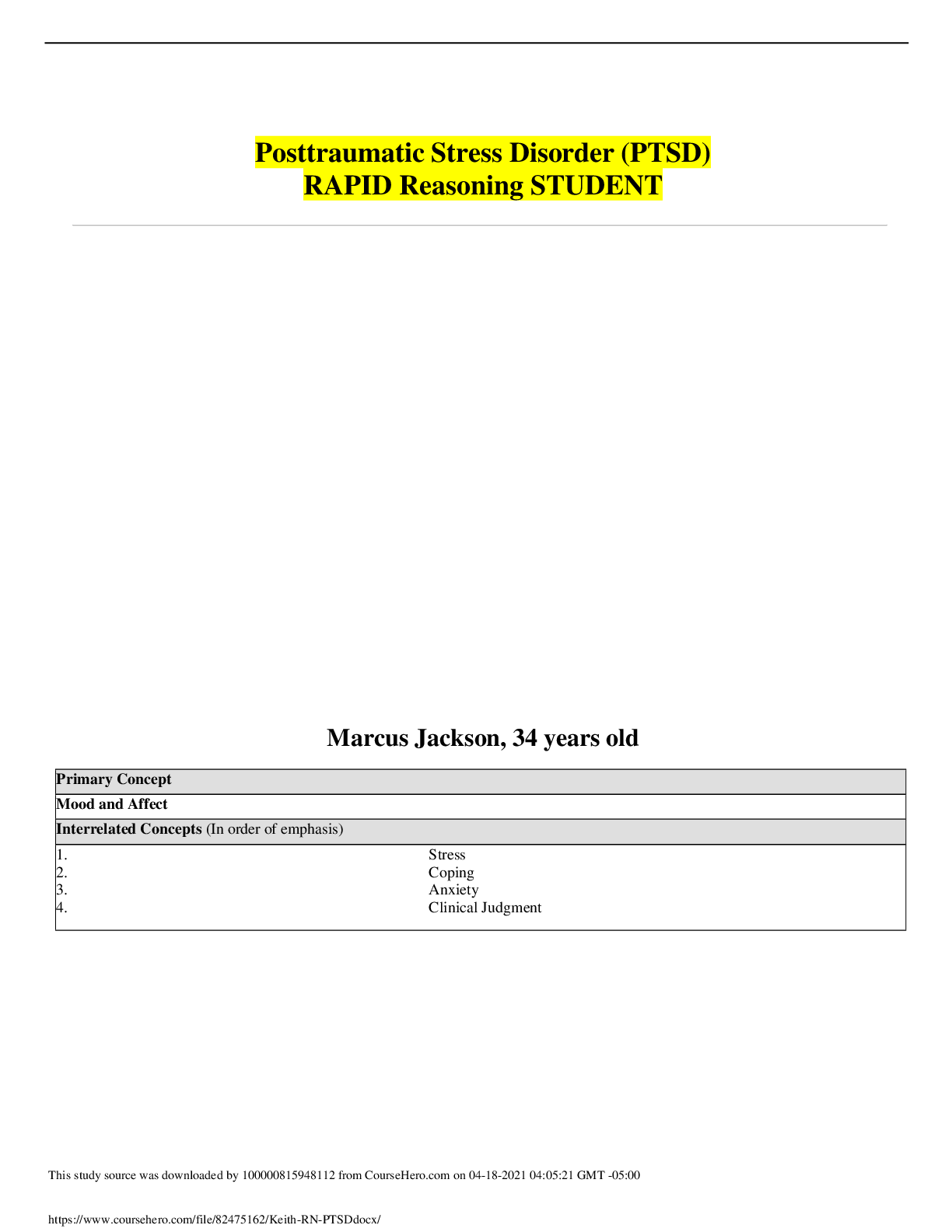
Posttraumatic Stress Disorder (PTSD)
RAPID Reasoning
STUDENT
Marcus Jackson, 34 years old
Primary Concept
Mood and Affect
Interrelated Concepts (In order of emphasis)
1. Stress
2. Coping
3. Anxiety
4. Clinical Judgment
History of Present Problem:
Marcus Jackson is a 34-year-old African American male who served four combat tours of duty in Iraq and Afghanistan.
He came to the Veterans Administration (VA) today for an outpatient appointment because he has not slept more than two
hours a night for the past week. This is his fourth clinic visit over the past year with the same symptoms: inability to
sleep, nightmares, increasing anxiety, and isolation.
Every time he falls asleep, he relives the bombing and has flashbacks of bloody body parts that he witnessed after the
explosion. He states that he is more aware of noises and any loud noise such as fireworks and or cars backfiring causes
him extreme anxiety. His medications for PTSD have not been helping control his anxiety. He has been spending more
time in his room watching TV and avoids spending time with his wife and children. Today he told his wife he should have
died and not his friends. His primary care provider encouraged voluntary admission and his wife brought Marcus to the
emergency department of the closest VA hospital so he can be admitted.
Personal/Social History:
During his last tour in combat, Marcus’ best friend drove over an IED. The explosion killed everyone in the vehicle.
During the blast, Marcus was hit with shrapnel in his left leg, stomach, and left eye. These injuries left him blind in his
left eye. He has had multiple surgeries to his abdomen, and six reconstruction surgeries to his leg. He walks with a limp
and continues to complain of severe pain in his left leg. He was given a medical discharge from the Marines because of
the extensive nature of his injuries and is receiving disability.
Marcus is married with three children from six to twelve years of age. He has been married to his wife, Ariel, for
fourteen years. While in the service, his family moved six times and endured four combat tours of duty. Each time he
returned home from combat, his wife noted that he has no history of physical aggression and has been more agitated and
had more trouble sleeping with frequent nightmares. Marcus reports he used to drink “a lot” but decided two years ago
that alcohol was making everything worse. Reports he has not had a drink for the past 1 ½ years. Denies other drug use.
© 2016 Keith Rischer/www.KeithRN.com This study source was downloaded by 100000831988016 from CourseHero.com on 12-19-2021 06:02:06 GMT -06:00
https://www.coursehero.com/file/80615562/PTSDdocx/
Cassandra Braithwaite
What data from the histories are RELEVANT and have clinical significance to the nurse?
RELEVANT Data from Present Problem: Clinical Significance:
Served 4 combat tours in Iraq and
Afghanistan
Has not slept more than 2 hrs a night for the
past week
4
th clinic visit in the past yar for the same
symptoms: insomnia, nightmares, increasing
instances of anxiety
Relives bombing and has flashbacks of
bloody body parts
Loud noises cause him extreme anxiety
Avoids spending time with wife and kids
Tells his wife that he should have died and
not is friends
Significant past trauma causes PTSD
Exhaustion and sleep deprivation only increase PTSD symptoms
His current plan of care it manage his sleep issues is not working. Will
need to be reevaluated and a new plan implemented
Marcus experienced significant trauma. This is a symptom of PTSD
This is good information to know, as Marcus will benefit from a less
stimulation environment. Need to educate him on avoiding loud
environments
He would need medications to help reduce his anxiety
Social isolation and feeling guilty for living will only make his
depression worse and contribute to suicidal ideations
RELEVANT Data from Social History: Clinical Significance:
Married with 3 kids
Lost his best friend in an IED explosion
Has had extensive reconstructive surgeries
and is now blind in one eye and walks with a
limp
No hx of aggression, but has increased
agitation
Was medically dc’d from the Marines
Denies drinking or drug use
Has a good support system, kids may cause added stress and be
exhausting which can increase his agitation
Significant loss/grief or guilt may be the cause of depression or make
it worse
Low self-esteem or not being able to do things he once used to can
increase suicidal thoughts.
Increasing agitation without a proper outlet for relieving symptoms
can cause increasing depression/suicidal thoughts
Having to leave the Marines against his will can be a significant and
unexpected life change that can have negative effects on his mental
health.
Significant because “self-medicating” by abusing alcohol and other
drugs can complicate his treatment and any pharmacological
therapies he may need
Patient Care Begins:
Current VS: P-Q-R-S-T Pain Assessment:
T: 98.2 F/37.3 C (oral) Provoking/Palliative: Movement provokes, always present. Goal is 5/10
P: 92 (regular) Quality: Ache
R: 18 (regular) Region/Radiation: Left leg
BP: 118/70 Severity: 5/10
O2 sat: 98% RA Timing: Continuous
What VS data are RELEVANT that must be recognized as clinically significant to the nurse?
RELEVANT VS Data: Clinical Significance:
Pain (Movement
provokes and is
always present, 5/10;
continuous ache in his
L leg)
All other v/s
Chronic 5/10 pain means he may need help controlling it. May also help him control some
of the symptoms he’s having if it’s causing him problems with his abilities to relax and
sleep.
v/s are all relevant and important to help assist in guiding his treatment
© 2016 Keith Rischer/www.KeithRN.com This study source was downloaded by 100000831988016 from CourseHero.com on 12-19-2021 06:02:06 GMT -06:00
https://www.coursehero.com/file/80615562/PTSDdocx/
Cassandra Braithwaite
Current Assessment:
GENERAL
APPEARANCE:
Appears anxious, body tense, tired (dark circles under his eyes)
RESP: Breath sounds clear with equal aeration bilaterally, non-labored respiratory effort
CARDIAC: Pink, warm & dry, no edema, heart sounds regular with no abnormal beats, pulses strong,
equal with palpation at radial/pedal/post-tibial landmarks
NEURO: Alert & oriented to person, place, time, and situation (x4), flat affect, inability to fall asleep
and stay asleep– averaging only two hours a night, nightmares, flashbacks while awake
GI: Abdomen soft/non-tender, bowel sounds audible per auscultation in all four quadrants
Reports poor appetite with no weight loss.
GU: Voiding without difficulty, urine clear/yellow
SKIN: Skin integrity intact
SUBSTANCE USE: Last use of alcohol 1 ½ years ago. Denies use of other drugs
Mental Status Examination:
APPEARANCE: Casually dressed; facial scars noted; cooperative with interview
MOTOR BEHAVIOR: Walks with a limp. No abnormal motor activity noted.
SPEECH: Speech is of normal tone and cadence.
MOOD/AFFECT: Anxious affect. Patient states, “I feel nothing” most of the time, but also states that he “flies
off the handle” a lot. Reports he “startles easily” to environmental noises.
THOUGHT PROCESS: Linear and logical
THOUGHT CONTENT: Denies delusions when assessed; somewhat guarded in responses, but no evidence of
paranoia. Admits to intrusive thoughts about his time in combat.
Expresses excessive guilt that “good men died” and “I wasn’t able to help.” Also states he
sometimes thinks he should have died with “his patrol.”
PERCEPTION: States he has periods of time in which he has visions (flashbacks) of being back in Iraq
during the IED blast; also reports that sometimes he just sees “flashes” of body parts.
INSIGHT/JUDGMENT: Recognized symptoms as part of PTSD diagnosis but states “There is probably nothing that
can be done to help.” Judgement intact.
COGNITION: Oriented x3. Has some memory problems associated with the exact events during the IED
blast. Possible TBI?
Reports current difficulty concentrating at times.
INTERACTIONS: Tends to stay to self
SUICIDAL/HOMICIDAL: Stated that he thinks he should have died instead of the men in his unit. Denies current
suicide ideation and has no plan. Denies homicidal ideation.
© 2016 Keith Rischer/www.KeithRN.com This study source was downloaded by 100000831988016 from CourseHero.com on 12-19-2021 06:02:06 GMT -06:00
https://www.coursehero.com/file/80615562/PTSDdocx/
Cassandra Braithwaite
What assessment data are RELEVANT that must be recognized as clinically significant to the nurse?
PHYSICAL Assessment Data: Clinical Significance:
Anxious, body appears tense
Inability to sleep or stay asleep. Flat
affect, flashbacks while awake,
nightmares
No alcohol or drug use
Approach Marcus calmly and do not startle
All of these are clinically significant signs of PTSD
Good sign that he is not “self-medicating” and making his current condition
worse. Relevant to know so that any meds prescribed won’t cause any
dangerous interactions if mixed with alcohol and/or other drugs
Mental Status Examination:
Cooperative with the interview
He states he “feels nothing” most of the
time but “flies off the handle” a lot
Admits to intrusive thoughts about his
time in combat and expresses guilt
Reports of difficult concentrating
Denies suicidal thoughts but said he
should have died instead
Shows a willingness to get better and will likely adhere to his plan of
treatment
His mood is unstable, and may be a safety risk to himself and/or others
The significant amt of trauma he has experienced, and his thoughts of guild
and combat may cause MDD and make his PTSD worse
Inability to concentrate may also be a s/s of his PTSD
Although he denies suicide ideation, this is an unhealthy thought that may
later manifest itself into something worse. His mood is unstable and suicide
precautions should be put into place
Lab Results:
Basic Metabolic Panel (BMP:) Current: High/Low/WNL?
Sodium (135–145 mEq/L) 138 WNL
Potassium (3.5–5.0 mEq/L) 4.6 WNL
Glucose (70–110 mg/dL) 88 WNL
Creatinine (0.6–1.2 mg/dL) 1.1 WNL
What lab results are RELEVANT and must be interpreted as clinically significant by the nurse?
RELEVANT Lab(s): Clinical Significance:
Sodium
Potassium
Glucose
Creatinine
s/s of hyponatremia can cause an altered personality, lethargy, and confusion
Potassium deficiency is linked to mood changes and mental fatigue
Disorder of glucose control, suc
[Show More]

, RAPID Reasoning STUDENT, Marcus Jackson, 34 years old, Latest Questions and Answers with Explanations, All Correct Study Guide, Do.png)
, Mandy White, 16 years old Study Guide.png)
, RAPID Reasoning STUDENT, Marcus Jackson, 34 years old Study Guide.png)
, RAPID Reasoning STUDENT, Marcus Jackson, 34 years old, Latest Questions and Answers with Explanations, All Correct Study Guide, Download to Score A.png)



.png)