This study guide is for the comprehensive final exam that will be given during Week 8. Remember that you have until Saturday of Week 8, 11:59 p.m. MT to complete the final exam. Respondus Lockdown Browser is used for all
...
This study guide is for the comprehensive final exam that will be given during Week 8. Remember that you have until Saturday of Week 8, 11:59 p.m. MT to complete the final exam. Respondus Lockdown Browser is used for all quizzes and exams. It will cover the following concepts:
NR 507 Week 8 Final Study Guide (Variant 1)
Reproductive:
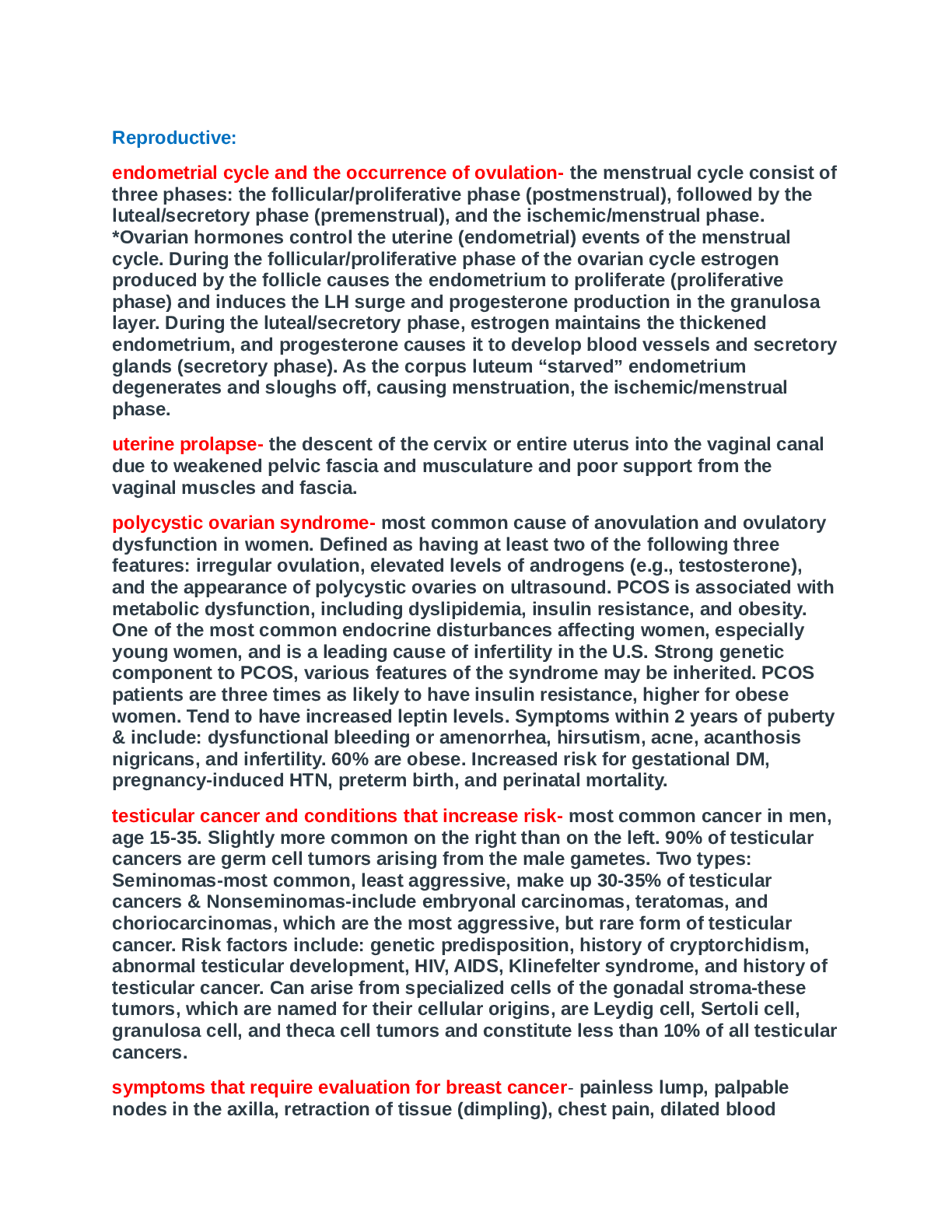
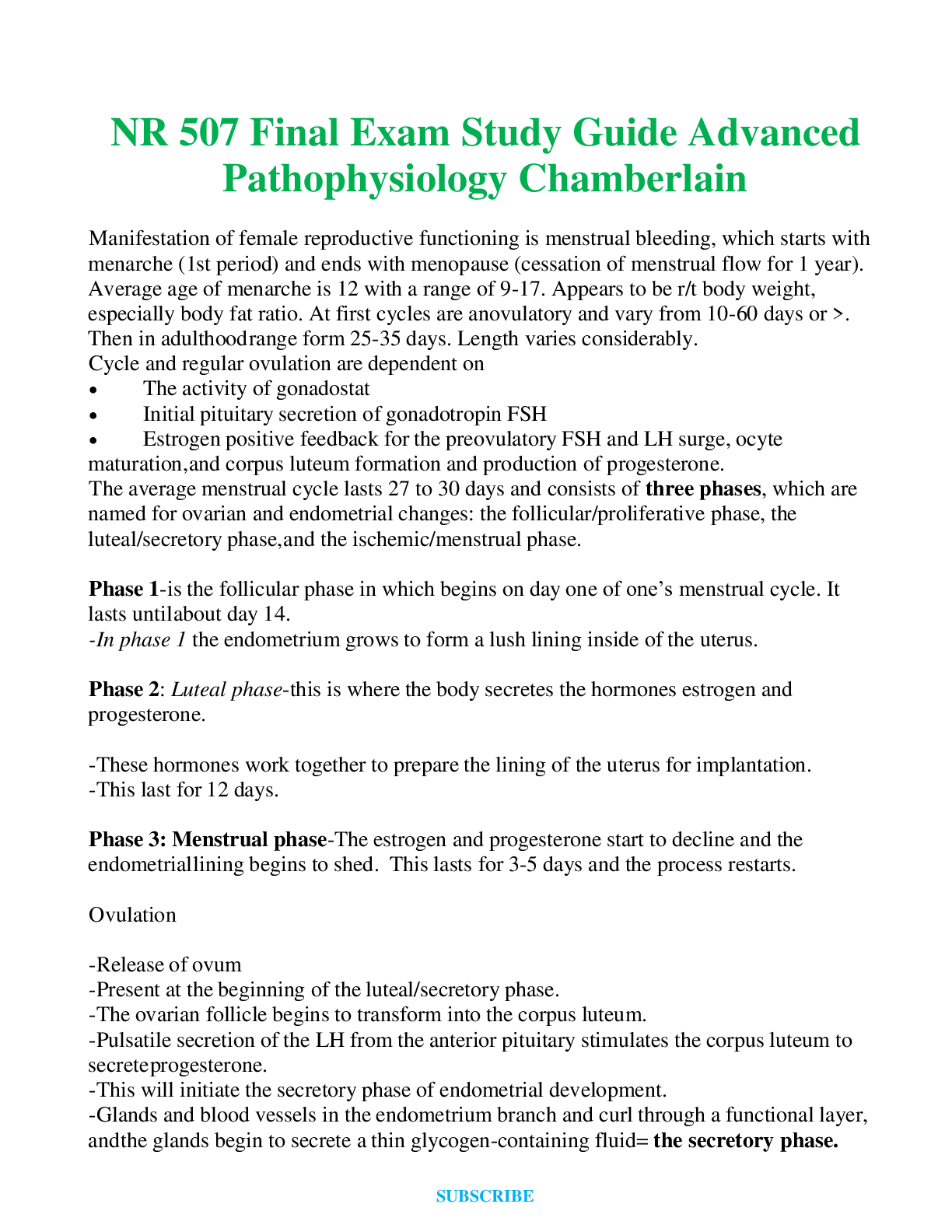
Endometrial cycle (menstrual cycle) and the occurrence of ovulation
Uterine prolapse
Polycystic ovarian syndrome
Testicular cancer and conditions that increase risk
Symptoms that require evaluation for breast cancer
Signs of premenstrual dysphoric disorder
Dysfunctional uterine bleeding
Pathophysiology of prostate cancer
HPV and the development of cervical cancer
Endocrine:
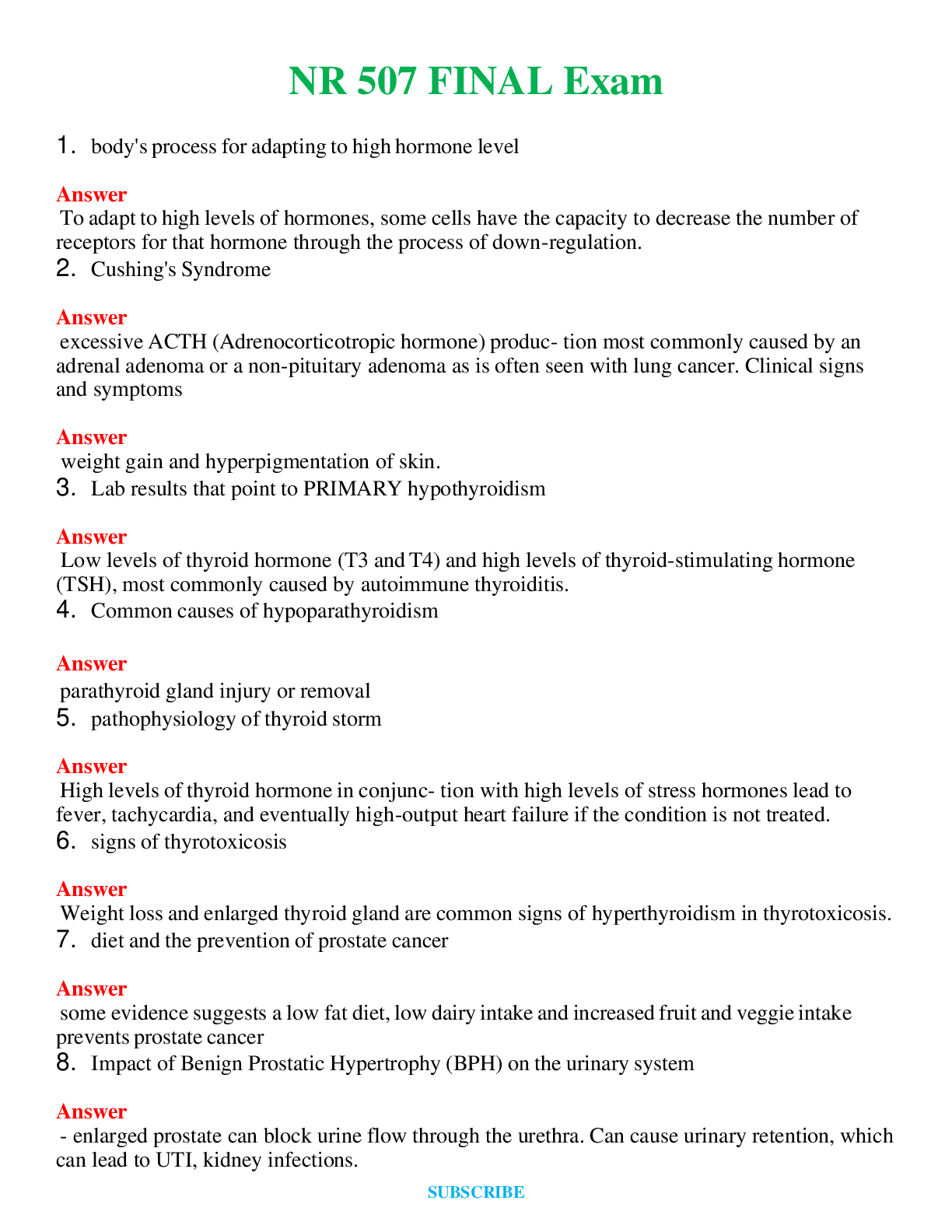
Body’s process for adapting to high hormone levels
Cushing’s Syndrome
Causes of hypoparathyroidism
Lab results that point to primary hypothyroidism
Pathophysiology of thyroid storm
Signs of thyrotoxicosis
Neurological:
Dermatomes
Substance release at the synapse
Spondylolysis
Location of the motor and sensory areas of the brain
Pathophysiology of cerebral infarction
Excitotoxins
Agnosia
Accumulation of blood in a subarachnoid hemorrhage
Most common cause of meningitis
Genitourinary:
Diet and the prevention of prostate cancer
Impact of Benign Prostatic Hypertrophy (BPH) on the urinary system
Genetics:
The role of DNA in genetics
Transcription
Effects of genetic mutations
Trisomy
Down Syndrome
Klinefelter syndrome
Diseases that have multifactorial traits
Multifactorial inheritance
Duchenne muscular dystrophy
Neurofibromatosis
Musculoskeletal:
Ions that initiate muscle contraction
Growth of long bones in children
Bones belonging to the appendicular skeleton
Immunity/Inflammation:
How vaccines are formed
Populations at risk for getting systemic fungal infections and parasitic infections
Systemic manifestations of infection
Mechanisms responsible for the increase in antimicrobial resistance worldwide
Functions of normal flora in the body
Desensitization therapy
Cells involved in “left shift” in the WBC count differential
Forms of immunity
Major histocompatibility class I antigens
Inflammatory chemicals blocked by anti-inflammatory drugs
Characteristics of acute phase reactant C-reactive protein
Dermatology:
Process by which a deep pressure ulcer heals
Complications of the development of contractures during wound healing
Acid/Base:
Causes of respiratory alkalosis
Molecules that act as buffers in the blood
Cardiovascular:
Most common cardiac valve disease in women
When myocardial ischemia may be reversible
Symptoms of stable angina
Orthostatic hypotension
Isolated systolic hypertension
Results of sustained controlled hypertension
The relationship of insulin resistance on the development of primary hypertension
Defects in the normal secretion of natriuretic hormones and the impact on renal system
Effects of increased sympathetic nervous system activity due to primary hypertension
Complications of unstable plaque in the coronary arteries
Forms of dyslipidemia associated with the development of the fatty streak in atherosclerosis
Events that initiate the process of atherosclerosis
Signs and symptoms of increased left atrial and pulmonary venous pressures in left sided heart failure
Differences between left and right sided heart failure
Infective endocarditis
Peripheral vascular disease:
Pathophysiology of deep vein thrombosis
Virchow’s triad
Hematology:
Physiological response to hypoxia in anemia
Populations at the highest risk for developing folate deficiency anemia
Causes of iron deficiency anemia
Expected lab test results found in long standing iron deficiency anemia
Sickle Cell Anemia
Causes of aplastic anemia
Underlying pathophysiologic mechanisms leading to autoimmune hemolytic anemia
Secondary polycythemia
Anemia of chronic renal failure
Fluid and Electrolytes:
Conditions that result in pure water deficit (hypertonic volume depletion)
Osmoreceptors that stimulate thirst and the release of ADH
Causes of hypernatremia
Effects of increased aldosterone
Dependent edema
Definition of isotonic
Principle of capillary oncotic pressure
Types of fluid compartments in the body
Pulmonary:
Most effective measure to prevent pulmonary embolus from developing in patients
When the practitioner will note tactile fremitus
Cause of acute airway obstruction in the patient with chronic bronchitis
Types of pneumothorax
Results of the loss of alph-1-antitrypsin in emphysema
The result of loss of surfactant in ARDS
Characteristics of Cheyne-Stokes respirations
Shock:
Causes of hypovolemic shock
How the body maintains glucose levels during shock
NR 507 Week 8 Final Study Guide (Variant 2)
Genitourinary:
BPH:
Prostate Cancer:
Shock:
Blood Glucose:
Hypovolemic Shock:
Acid/Base Balance:
Respiratory Alkalosis:
Buffer in Blood:
Peripheral Vascular Disease:
DVT Pathophysiology:
Dermatology:
Contractures:
Deep Pressure Ulcer Healing:
Phase 1: inflammation
… proliferation and new tissue formation (reconstruction)
Phase 3: remodeling and maturation
Musculoskeletal:
Contraction:
Growth of Long Bones in Children:
Bones in Appendicular Skeleton:
Genetics:
DNA in Genetics:
Transcription:
Effects of Genetic Mutations
Trisomy:
Down Syndrome:
Klinefelter Syndrome:
Diseases that have Multifactorial Traits:
Multifactorial Inheritance:
Duchenne Muscular Dystrophy:
Neruofibromatosis:
Endocrine:
Adapting to High Hormone Levels:
Signs/Symptoms of Thyrotoxicosis:
Thyroid Storm:
Hypothyroidism Lab Results:
Hypoparathyroidism Causes:
Cushing Syndrome:
Neurological:
Dermatomes:
Agnosia:
Spondylolysis:
Meningitis Causes:
Subarachnoid Hemorrhage:
Substance Release at the Synapse:
Cerebral infarction Pathophysiology:
Pathophysiology of Excitotoxins:
Fluids & Electrolytes:
Pure Water Deficit (hypertonic volume depletion):
Osmoreceptors that Stimulate Thirst and ADH Release:
Causes of Hypernatremia:
Effects of Increased Aldosterone
Dependent Edema:
Isotonic:
Capillary Oncotic Pressure:
Fluid Compartments:
Pulmonary:
PE Prevention:
Airway Obstruction in Chronic Bronchitis:
Emphysema:
Types of Pneumothorax:
Cheyne-Stokes Respirations:
Loss of Surfactant in ARDS:
Tactile Fremitus:
Reproductive:
Uterine Prolapse:
Evaluate for Breast Cancer:
Dysfunctional Uterine Bleeding:
Polycystic Ovarian Syndrome:
Signs of Premenstrual Dysphoric Disorder:
Endometrial Cycle and Ovulation:
Testicular Cancer Risk Factors:
Pathophysiology of Prostate Cancer:
HPV to Cervical Cancer:
Hematology:
Populations at Risk for Folate Deficiency Anemia:
Causes of Iron Deficiency Anemia:
Lab Results for Long Standing Iron Deficiency Anemia:
Causes of Aplastic Anemia:
Secondary Polycythemia:
Autoimmune Hemolytic Anemia:
Sickle Cell Anemia:
Anemia of Chronic Renal Failure:
Physiologic Response to Hypoxia in Anemia:
Cardiovascular:
Most Common Valve Disease in Women:
Myocardial Ischemia:
Symptoms of Stable Angina:
Orthostatic Hypotension:
Isolated Systolic HTN:
Insulin Resistance and HTN:
Natriuretic Hormones and Effects on Renal System:
SNS and Primary HTN:
Complications of Unstable Plaques:
Process of Atherosclerosis Initiation:
S/S of L Sided HF:
Results of Sustained Controlled HTN:
Difference in L and R sided HF:
Dyslipidemia Associated with Formation of Fatty Streak:
Infective Endocarditis:
Immunity/Inflammation:
How Vaccines are Formed:
Systemic Manifestations of Infection:
Functions of Normal Flora:
Mechanism for Antimicrobial Resistance:
Desensitization Therapy:
Cells Involved in Left Shift:
Forms of Immunity:
Histocompatibility Class I Antigens:
Chemicals Blocked by Anti-Inflammatory Drugs:
C-Reactive Protein:
Populations at Risk for Fungal/Parasitic Infections:
NR 507 Week 8 Final Study Guide (Variant 3, 4)
REPRODUCTIVE
Endometrial cycle and occurrence of ovulation
Uterine Prolapse
PCOS
Testicular cancer & Risk factors
Symptoms that require evaluation for Breast Cancer
Signs of premenstrual dysphoric disorder (PMDD)
Dysfunctional uterine bleeding
Pathophysiology of prostate cancer
HPV and development of cervical cancer
ENDOCRINE
Body’s process for adapting to high hormone levels:
Cushing’s Syndrome:
Hypoparathyroidism CX:
Lab results point to primary hypothyroidism:
Primary hypothyroidism DX:
Pathophysiology of thyroid storm:
Signs of thyrotoxicosis:
NEURO
Dermatomes
Substance release at synapse
Spondylolysis
Location of motor and sensory areas of the brain
GENITOURINARY
Diet and prevention of prostate cancer
Impact of BPH on the Urinary System
GENETICS
The role of DNA in genetics
Transcription
Effects of genetic mutations –
Down syndrome/ Trisomy:
Klinefelter syndrome:
Duchenne muscular dystrophy
Neurofibromatosis
diseases that have multifactorial traits/multifactorial inheritance
What is multifactorial inheritance?
MUSCULOSKELETAL
Ions that initiate muscle contraction:
Growth of long bones in children:
Bones belonging to the appendicular skeleton:
IMMUNITY
How vaccines are performed
Populations are risk for getting systematic fungal infections and parasitic infections
Systematic manifestations of infection
Mechanism responsible for the increase in antimicrobial resistance worldwide
Functions of normal body flora
Desensitization therapy
Cells involved in the “left shift” in the WBC count differential
Forms of Immunity
Major histocompatibility class (MHC) I antigens (7th Edition, pg. 233-235, 244)
Inflammatory chemicals blocked by anti-inflammatory drugs (7th Edition, pg. 207)
Characteristics of acute phase reactant C-reactive protein (CRP) (7th Edition, pg. 214)
DERMATOLOGY
Process by which a deep pressure ulcer heals:
Phases of wound healing: Inflammatory-Proliferation-Maturation
Complications of the development of contractures during wound healing:
ACID/BASE
Causes of respiratory alkalosis:
Molecules that act as buffers in the blood:
CARDIOVASCULAR
Most common cardiac valve disease in women
When myocardial ischemia may be reversible
Symptoms of stable angina (angina pectoris)
Orthostatic hypotension
Isolated systolic HTN
Sustained controlled HTN
Relationship of insulin resistance on the development of primary hypertension; pg 1136.
Defects in normal secretion of natriuretic hormones & impact on renal system; pg 1134
Effects of increased sympathetic nervous system activity due to primary HTN; pg 1133
Complications of unstable plaque in the coronary arteries:
Forms of dyslipidemia associated with the development of the fatty streak in atherosclerosis:
Events that initiate the process of atherosclerosis:
S&S of Left Atrial &Pulmonary venous pressures in Left Sided HF
Difference between L & R sided © failure
Infective Endocarditis
PERIPHERAL VASCULAR DISEASE
Peripheral vascular disease:
Deep Vein Thrombosis pathophysiology
Vichow’s traid:
HEMATOLOGY
Physiological response to hypoxia in anemia
Populations at highest risk for developing folate deficiency anemia
Cause of Iron Deficiency Anemia
Expected lab test results found in long standing Iron Deficiency Anemia
Sickle Cell Anemia
Aplastic Anemia
Pathophysiology of Autoimmune Hemolytic Anemia
Secondary polycythemia Vera
Anemia of chronic renal failure
FLUIDS & ELECTROLYTES
Conditions that result in pure water deficit (hypertonic volume depleted)
Osmoreceptors that stimulate thirst and the release of ADH
Causes of hypernatremia
Effects of increased aldosterone
Dependent edema
Definition of isotonic
Principle of capillary oncotic pressure
Types of fluid compartments in the body
PULMONARY
most effective measure to prevent pulmonary embolus from developing in patients
when the practitioner will note tactile fremitus
cause of acute airway obstruction in the patient with chronic bronchitis
TYPES OF PNEUMOTHORAX
Results of the loss of alph-1- antitrypsin in emphysema
The result of loss of surfactant in ARDS
Characteristics of Cheyne-Stokes respirations
SHOCK
Causes of hypovolemic shock (7th Edition, pg. 1672-3)
How the body maintains glucose levels during shock (7th Edition, pg. 1670)
NR 507 Week Five Quiz Study Guide
What controls the direct stimulation of the insulin-secreting cells?
Types of protein hormones
–Which of the following is an example of the protein hormone?
Assessing patients for elevated thyroxine production
–A patient who has elevated thyroxine production should be assessed for which accompanying condition?
Direct effect of insulin binding to receptors
–What type of effect occurs when insulin binds to its receptors on muscle cells, resulting in an increase in glucose uptake by those muscle cells?
Lipid-soluble hormone receptors crossing plasma membrane
–How do lipid-soluble hormone receptors cross the plasma membrane?
Effects of the removal of the posterior pituitary
–How do the releasing hormones that are made in the hypothalamus travel to the anterior pituitary?
–If a patient’s posterior pituitary is removed, which hormone would the nurse expect to decrease?
Insulin regulation
–Insulin is primarily regulated by
Hormone-secreting tumor of the pancreas—what would increase?
–A patient is diagnosed with a hormone-secreting tumor of the pancreas alpha cells. Which of the following would the nurse expect to be most likely increased in this patient?
The effect of insulin on electrolytes
–A nurse recalls insulin has an effect on which of the following groups of electrolytes?
Hormonal regulation involved in child birth and stopping uterine bleeding?
–A 39-year-old female is recovering from the birth of her third child. Which hormone would help prevent uterine bleeding?
Types of immunity-e.g. innate, active, etc
Alveolar ventilation/perfusion
Dermatologic conditions e.g. pityriasis rosea
Croup
Types of anemia
Macrocytic-normochromic anemias:
Microcytic-hypochromic anemias:
Normocytic-normochromic Anemias:
Mnemonic for different types of anemia-
The inflammatory process upon injury
GI symptoms resulting in heart burn
Pulmonary terminology such as dyspnea, orthopnea, etc
Complications of gastric resection surgery
Dermatology terminology-macules, nevi, etc
Chicken pox
Maternal immune system
Candidiasis exacerbation
Carbuncles
Terms such as hypochromic, macrocytic, microcytic, etc
Antibodies, IgG, IgA, etc
Skin cancer
Parts of the heart in terms of function, such as pericardium
Congenital heart defects
Urinary tract obstruction,
GI symptoms of conditions such as pyloric stenosis, hiatal hernia, ulcerative colitis
Skin cancer lesions
Gastroesophageal reflux disease
Hypersensitivity reaction
Congenital intrinsic factor deficiency
Acid base imbalance
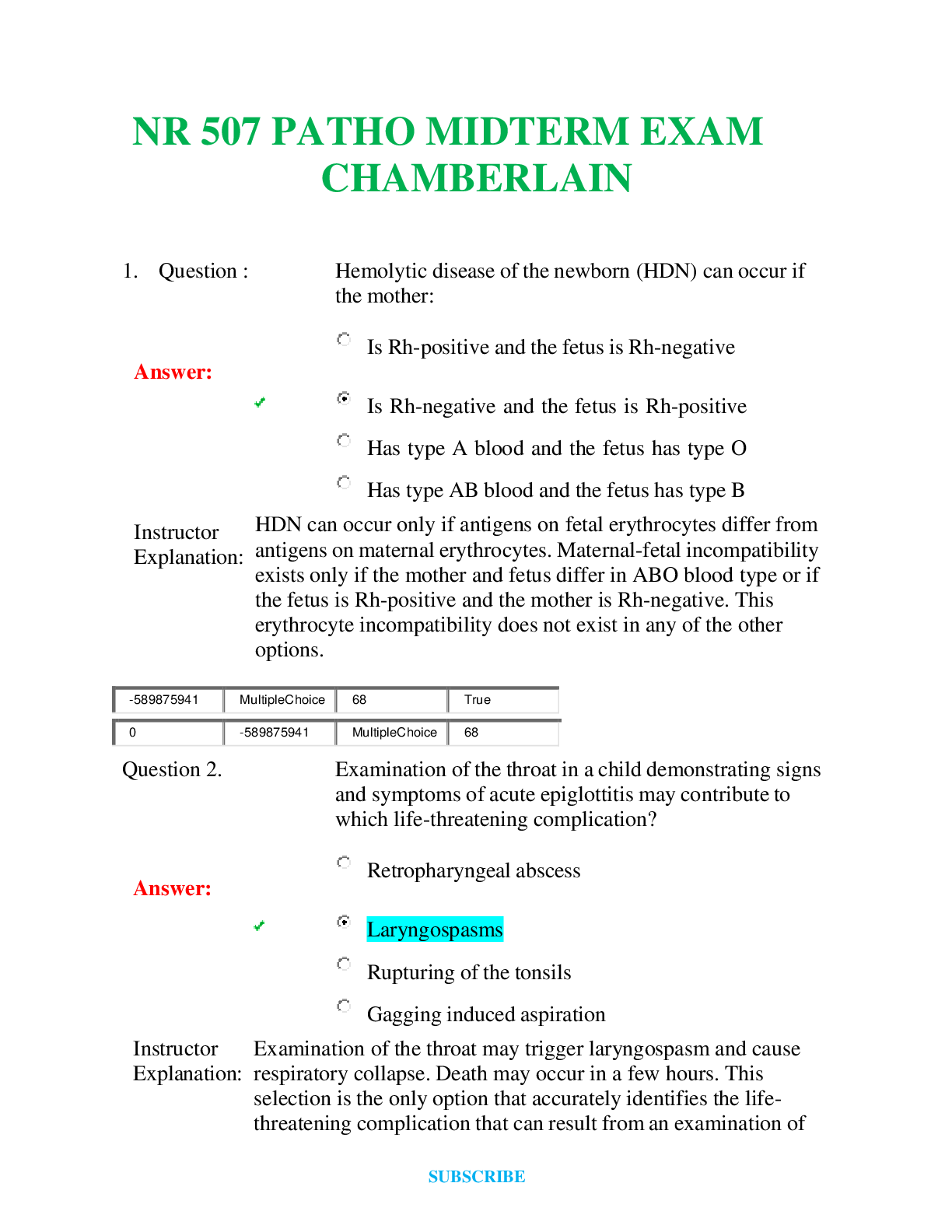
Acute epiglottitis
Types of gastric ulcers-signs and symptoms, characteristics
Lupus
General adaptation syndrome
Ventilation/perfusion ratio
Bile salt deficiencies
Clonal selection
Obstructive sleep apnea
Large bowel obstruction
Vaginal candidiasis
Folate deficiency
Pancreatic insufficiency
Types of fractures
Genetic disorders such as Down Syndrome, Turner Syndrome, etc
Vitamin B-12 therapy
Glaucoma
Cervical immunoglobulin
Concept of pain **See pgs 485-495
Autosomal dominant diseases (ADD) pg 152-154
Congenital murmurs
Lactose intolerance
Angiotensin-renin system
AIDS
Carcinoma
Hormonal regulation of calcium
Neural tube defect
Types of hormones-Types of hormones by structure
Glycoprotein
Kidney stones
Type 2 diabetes
Pituitary hormone secretion
Signs of breast cancer-
Alzheimer’s disease-
Guillain-Barre Syndrome
Sympathetic/parasympathetic nervous system *See pg 471-476
ACTH
Bartholin glands (pg 772)
Gonococcal disease (pg 920-922)
Glomerulonephritis-
Small patent ductus arteriosus (PDA)-
Risk factors for hypertension- (HTN= >120/>80)
Loss of language and/or comprehension-such as terms-aphasia, etc. –(Data Processing Deficits)
Chronic inflammatory joint disease
Male and female sex hormone production *See pgs 789-791 and 795-6 (male) and 776-78 (female)
Endogenous antigen-
Genital warts-
Pancreatic enzymes-
Process of muscle contraction-
Cervical dysplasia-
Consanguinity
Nephrotic syndrome
NR 507 Week 8 Final Exam Study Guide
Related
NR 507 Entire Coursework Weeks 1 – 8
$299.00
NR 507 Coursework Altogether Week 3 – 8
$199.00
NR 507 Discussions (Week 3, 6), Open Forum Discussions (Week 1, 2, 4, 5), Reflection (Week 8)
$59.00
NR 507 Quizzes Week 2 plus Week 7
$60.00
NR 507 Disease Process Presentations Part 1, Part 2, Audio/Video Recorded Disease Process Presentation: Parkinson’s Disease
$49.00
NR 507 Disease Process Presentation Part 1, Part 2, Final Week 7 Disease Process Presentation – Pathophysiology of: Cushing’s Disease
$49.00
NR 507 Disease Process Presentations Part 1, Part 2, Audio/Video Recorded Disease Process Presentation – RABIES
$49.00
NR 507 Disease Process Presentation Part 1, Part 2 Presentations Part 1, Part 2, Audio/Video Recorded Disease Process Presentation and Peer Review (Collection)
$75.00
NR 507 Week 1 Bundle: Introduction plus Open Forum Discussion
$29.00
NR 507 Week 1 Open Forum Discussion: Diabetes Insipidus
$20.00
NR 507 Week 1 Open Forum Discussion: Mood Disorder
$20.00
NR 507 Week 1 Open Forum Discussion: Rabies
$15.00
NR 507 Week 1 Open Forum Discussion: Iron-Deficiency Anemia
$20.00
NR 507 Week 1 plus
[Show More]