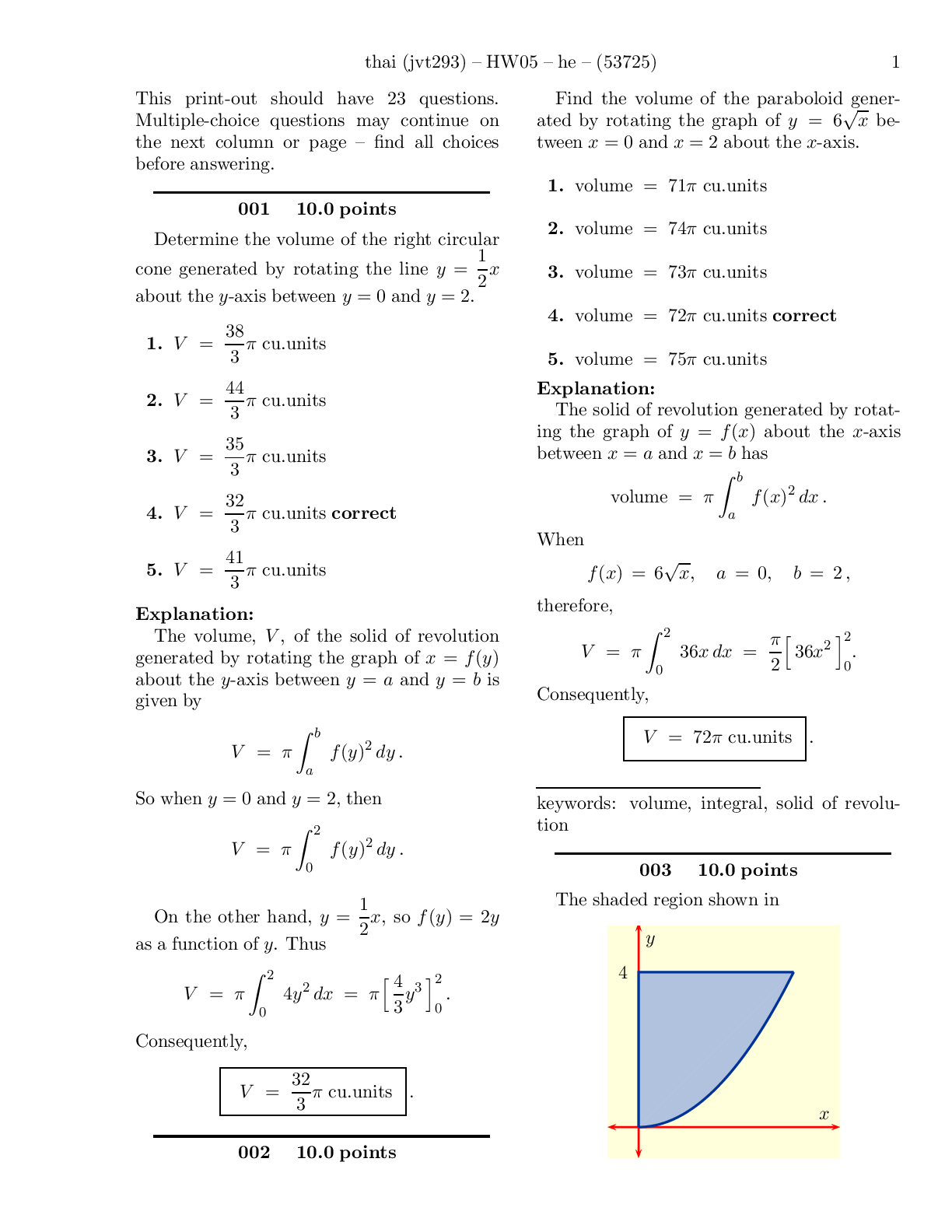
Mathematics > SOLUTIONS MANUAL > University of Texas M 427L HW13-Solutions/ Homework 13 Solution (All)
University of Texas M 427L HW13-Solutions/ Homework 13 Solution
Document Content and Description Below
Last updated: 3 years ago
Preview 1 out of 12 pages
Instant download

Buy this Document to get the Full Access Instantly
Provided by Students Who Aced it
We Verify Document Content to Gurantee Accuracy
Also available in bundle (1)
Click Below to Access Bundle(s)
THIS BUNDLE CONTAINS: All University of TexasM 427LHW 01-15 Solutions/ Homework 01-15 Solutions Lates Collection.
University of TexasM 427LHW 05 Solutions/ University of TexasM 427L Homework 05 Solutions. University of TexasM 427LHW02 Solutions/ University of TexasM 427L Homework 02 Solutions. University of...
By Kirsch 4 years ago
$36
13
Reviews( 0 )
Document information
Connected school, study & course
About the document
Uploaded On
Jan 03, 2022
Number of pages
12
Written in
All

Additional information
This document has been written for:
Uploaded
Jan 03, 2022
Downloads
0
Views
272
Topic Tags
Recommended For You
Get more on SOLUTIONS MANUAL »
University of TexasM 427LHW 01 Solutions/ University of TexasM...

University of TexasM 427L Homework 9-Solutions/ M 427L HW 9 So...

University of TexasM 427LHW02 Solutions/ University of TexasM...
Finite Mathematics & Its Applications, 13e Larry Goldstein, Da...
.png)
 2e Peter Olver, Chehrzad Shakiban.png)
Applied Linear Algebra (Undergraduate Texts in Mathematics) 2n...
Discrete Mathematics and Its Applications 8th Edition by Kenne...
Physical Chemistry Thermodynamics Statistical Mechanics and Ki...
Solutions Manual for Organic Chemistry 9th Edition by John McM...

Probability & Statistics Homework 2: Theoretical Probability:...