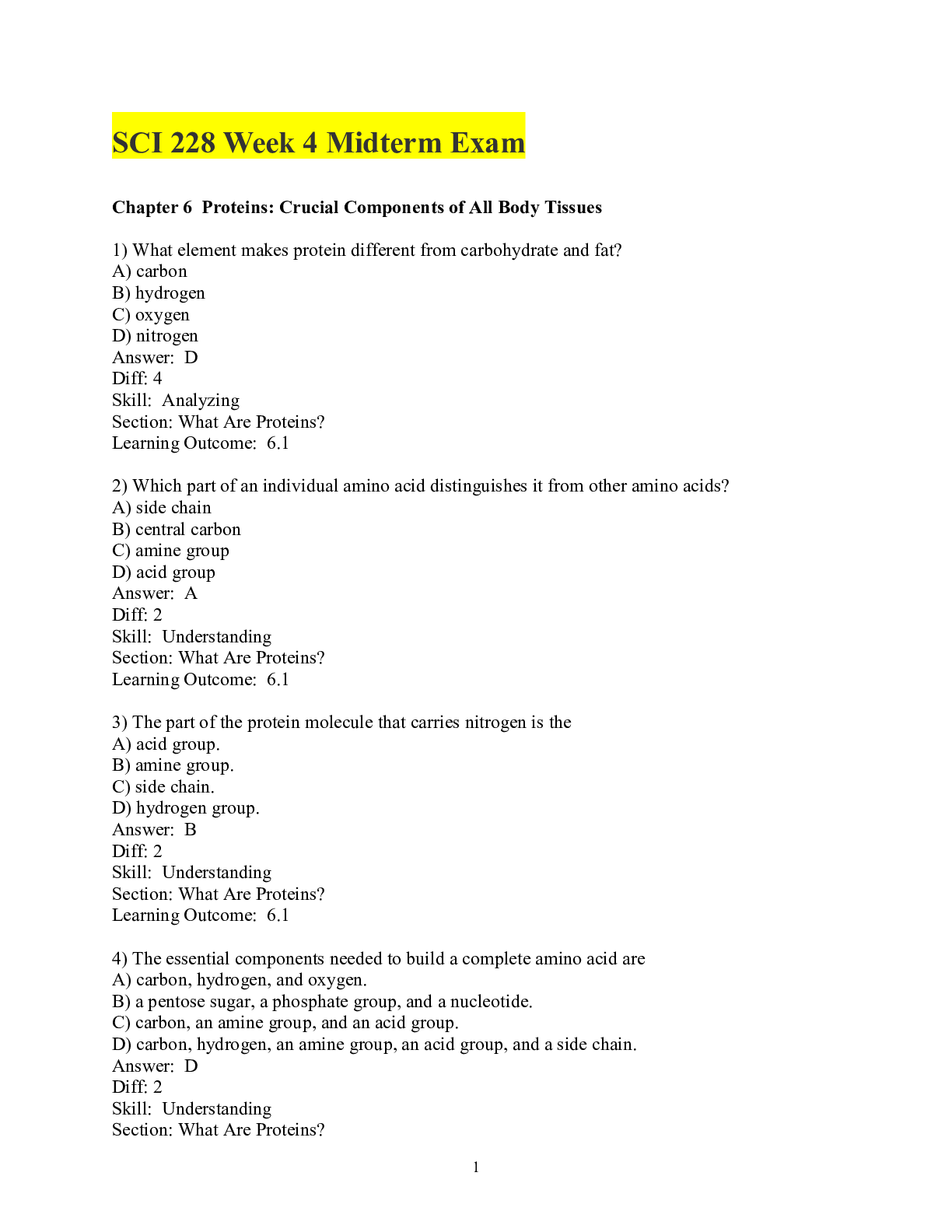
1) What element makes protein different from carbohydrate and fat?
A) carbon
B) hydrogen
C) oxygen
D) nitrogen
2) Which part of an individual amino acid distinguishes it from other amino acids?
A) side chain
B)
...
1) What element makes protein different from carbohydrate and fat?
A) carbon
B) hydrogen
C) oxygen
D) nitrogen
2) Which part of an individual amino acid distinguishes it from other amino acids?
A) side chain
B) central carbon
C) amine group
D) acid group
3) The part of the protein molecule that carries nitrogen is the
A) acid group.
B) amine group.
C) side chain.
D) hydrogen group.
4) The essential components needed to build a complete amino acid are
A) carbon, hydrogen, and oxygen.
B) a pentose sugar, a phosphate group, and a nucleotide.
C) carbon, an amine group, and an acid group.
D) carbon, hydrogen, an amine group, an acid group, and a side chain.
5) How many amino acids are considered to be essential?
A) none
B) five
C) nine
D) twenty
6) Which of the following amino acids is essential?
A) arginine
B) valine
C) glycine
D) alanine
7) The process of transferring the amine group from one amino acid to another is called
A) gene expression.
B) alteration.
C) deamination.
D) transamination.
8) Amino acids are joined together by which specific type of bond?
A) lipase
B) disulfide
C) hydrogen
D) peptide
9) Unlike carbohydrates and lipids, proteins are composed of
A) glucose molecules.
B) amino acids.
C) proteases.
D) phospholipids.
10) At the center of each amino acid is a single atom of
A) oxygen.
B) carbon.
C) sulfur.
D) potassium.
11) Which of the following is a nucleotide base in DNA?
A) isoluciene
B) cytosine
C) valine
D) threonine
12) What dictates the structure of a protein molecule synthesized by the body?
A) the body's need for a protein
B) the DNA inside the nucleus of the cell
C) the number of essential amino acids available
D) the combination of proteins consumed in the diet
13) In what cellular organelle are proteins synthesized?
A) nucleus
B) ribosome
C) cell membrane
D) mitochondria
14) The process of mRNA copying the genetic information from the DNA's base sequence is called
A) transferring.
B) transamination.
C) translation.
D) transcription.
15) The specific function of a protein is determined by its
A) DNA.
B) length.
C) three-dimensional shape.
D) electric charge.
16) The sequential order of the amino acids is called the
A) primary structure.
B) secondary structure.
C) tertiary structure.
D) quaternary structure.
17) Milk curdles when lemon juice is added to it. The change that occurs in the protein is called
A) denaturation.
B) translocation.
C) transcription.
D) deamination.
18) Which of the following is a source of complete proteins?
A) broccoli
B) apple
C) tuna fish
D) whole-grain bread
19) The process of combining two incomplete proteins to make a complete protein is called
A) the protein-combining method.
B) amino-acid sequencing method.
C) mutual supplementation.
D) complementary supplementation.
20) The amino acid that is missing or in the smallest supply is called the
A) essential amino acid.
B) minor amino acid.
C) limiting amino acid.
D) incomplete amino acid.
21) A food that provides all nine essential amino acids is called a
A) complementary protein.
B) mutually exclusive protein.
C) limiting protein.
D) complete protein.
22) Which of the following provides incomplete protein?
A) egg whites
B) black beans
C) chicken
D) milk
23) Protein digestion begins in the
A) mouth.
B) stomach.
C) small intestine.
D) pancreas.
24) The absorption of amino acids occurs in the
A) stomach.
B) small intestine.
C) large intestine.
D) liver.
25) Which hormone controls the production of hydrochloric acid and the release of pepsin?
A) pepsinogen
B) insulin
C) cholecystokinin (CCK)
D) gastrin
26) What are proteases?
A) protein messengers that are released from storage in response to an alteration in the body's homeostasis
B) transport proteins that move substances throughout the body
C) defense proteins that attack foreign bacteria, viruses, and toxins
D) enzymes that break down proteins
27) Which of the following is used to measure protein quality?
A) the amount of essential amino acids present and the protein efficiency ratio
B) the digestibility of the protein and the amount of essential amino acids
C) the protein-efficiency ratio and the digestibility of the protein
D) the protein’s chemical score and digestibility
28) Which of the following are defensive proteins manufactured by the immune system?
A) antigens
B) antibodies
C) buffers
D) transport proteins
29) When the body experiences alkalosis, how do proteins help restore the acid-base balance?
A) Proteins speed the transfer of amine groups to new acid groups and side chains.
B) Proteins uncoil and lose their shape.
C) Proteins attract hydrogen ions and neutralize their effects.
D) Proteins release hydrogen into the blood.
30) Most enzymes are composed of
A) carbohydrates.
B) fats.
C) proteins.
D) cholesterol.
31) To use proteins for energy, the liver removes amine groups from amino acids in a process called
A) transamination.
B) deamination.
C) denaturation.
D) transport.
32) The specialized procedure that can identify whether a person's protein intake is adequate is called
A) protein recycling.
B) ins and outs.
C) nitrogen balance.
D) amino acid balance.
33) Maria is a reasonably healthy 19-year-old college student who is sedentary. She is 5' 8" tall and weighs 145 pounds. How many grams of protein would you recommend she consume each day?
A) 45 grams
B) 53 grams
C) 65 grams
D) 73 grams
34) Which of the following represents a positive nitrogen balance?
A) pregnancy
B) extended bed rest
C) severe weight loss
D) increased body fat
35) Jeffery is a strength athlete and a vegetarian. He weighs 205 lb and is 6' 2" tall. How much protein would you recommend he eat on a daily basis?
A) 74.5 grams
B) 0.8 g per kg body weight
C) at least 121 grams
D) 185 grams
36) Which of the following health problems has been associated with high intakes of animal-based proteins?
A) elevated blood cholesterol
B) marasmus
C) edema
D) sickle cell anemia
37) Which of the following foods would contain the highest protein content?
A) cooked carrots
B) chicken
C) corn
D) whole-wheat bread
38) Which of the following supplements would you MOST recommend a vegan add to his/her diet?
A) protein
B) fiber
C) vitamin B12
D) vitamin C
39) What causes the swollen belly associated with kwashiorkor?
A) a high-protein diet that causes fluid buildup
B) lack of protein to maintain fluid and electrolyte balance
C) excess hydration
D) excess fat buildup in adipose tissue
40) The type of protein-energy malnutrition characterized by sufficient intake of Calories but a lack of protein in the diet is called
A) marasmus.
B) sickle cell anemia.
C) cystic fibrosis.
D) kwashiorkor.
41) The type of protein-energy malnutrition characterized by a general lack of protein, energy, and nutrients in the diet is called
A) marasmus.
B) sickle cell anemia.
C) cystic fibrosis.
D) kwashiorkor.
42) Which of the following is associated with marasmus?
A) distended abdomen
B) "skin and bones" appearance
C) enlarged, fatty liver
D) loss of hearing
43) Which of the following is a genetic disorder resulting in defective assembly of a chloride transport protein and characterized by severe respiratory and digestive distress?
A) cystic fibrosis
B) phenylketonuria (PKU)
C) hyperchloremic acidosis
D) kwashiorkor
44) The genetic disorder caused by a single amino acid error in hemoglobin is called
A) phenylketonuria (PKU).
B) cystic fibrosis.
C) sickle cell anemia.
D) marasmus.
45) What does the most recent research suggest about the effect of protein intake on bone loss?
A) High-protein diets cause bone loss in men and women.
B) High-protein diets cause bone loss in older women.
C) High-protein intake, with adequate calcium intake, does not cause bone loss.
D) Low-protein diets that are high in calcium do not cause bone loss.
46) Which of the following individuals should avoid a high-protein diet?
A) strength athletes
B) pregnant women
C) people who are susceptible to kidney disease
D) people who are susceptible to iron-deficiency anemia
47) Which of the following statements about protein intake is TRUE?
A) Daily protein intake of no more than 2 g per kg body weight is safe.
B) Daily protein intake of up to 4 g per kg body weight is safe.
C) To avoid kidney damage, do not exceed the Recommended Dietary Allowance (RDA) for protein.
D) To avoid kidney damage, keep daily protein intake below 0.5 g per kg body weight.
48) Which of the following grains is a complete protein?
A) white rice
B) wheat
C) corn
D) quinoa
49) The traditional Cajun dish of red beans and rice is a good example of
A) complementary proteins.
B) limiting proteins.
C) denatured proteins.
D) transaminated proteins.
50) How does the shape of proteins in muscle fibers affect their function?
A) They are globular and can change shape to increase muscle mass.
B) They are long, allowing muscle fibers to contract and relax.
C) They are short, helping muscle fibers build up in response to weight-bearing exercise.
D) They are wide, giving muscle fibers great tensile strength.
51) What characteristic of the proteins that form red blood cells allows them to change shape and flow freely through the blood?
A) spherical shape
B) globular shape
C) long, narrow shape
D) lack of quaternary structure
52) What condition results when the blood becomes too basic?
A) marasmus
B) sickle cell anemia
C) alkalosis
D) acidosis
53) Which type of protein helps the body maintain fluid and electrolyte balance?
A) antibodies
B) enzymes
C) transport proteins
D) buffers
54) Amino acids from proteins are used to make epinephrine and norepinephrine, which serve as
A) neurotransmitters.
B) enzymes.
C) triglycerides.
D) antibodies.
55) Ferritin found in the liver is an example of a(n)
A) transport protein.
B) storage protein.
C) neurotransmitter.
D) enzyme.
56) The process in which the body makes new proteins and breaks down existing proteins is known as
A) protein turnover.
B) protein expression.
C) denaturation.
D) phenylketonuria (PKU).
57) The specific sequence of amino acids that make up the individual proteins in your body is determined by
A) the level of phospholipids in the blood.
B) the amount of blood glucose.
C) the pH balance of blood.
D) your unique genetic makeup.
58) A food's chemical score gives an estimate of its protein quality based on the
A) Calories from protein expressed as a percentage of the total Calories a serving of the food contains.
B) number of essential amino acids the food provides.
C) amount of its limiting amino acid compared to the amount of the same amino acid in a reference food.
D) proportion of protein as compared to carbohydrate and fat that the food contains.
59) A protein is considered high quality if it is
A) derived from plants.
B) easily digestible.
C) high in triglycerides.
D) high in carbohydrates.
60) Amino acids that cannot be manufactured by the body are characterized as
A) transaminated.
B) transcribed.
C) nonessential.
D) essential.
61) Which of the following statements about protein foods is TRUE?
A) Quorn is a high-protein food derived from fermented corn.
B) Nuts are high in protein, but also high in saturated fat and cholesterol.
C) Some grains are high in protein, but no grain provides all nine essential amino acids.
D) Lentils are a good source of protein, but do not provide all nine essential amino acids.
62) An individual consuming a plant-based diet eats
A) only grains, vegetables, fruits, nuts, and seeds.
B) mostly plant foods, as well as occasional eggs and dairy.
C) mostly plant foods, as well as eggs, dairy, and occasional meat, poultry, and/or fish.
D) a wide variety of foods derived from both plants and animals, but avoids pork and beef.
63) As compared to people who eat meat, people who consume a balanced vegetarian diet
A) have a reduced risk for heart disease.
B) are more likely to experience constipation.
C) have an increased exposure to carcinogens.
D) are more likely to smoke.
64) Proteins contain the element nitrogen.
65) Essential amino acids are more important to the human body than nonessential amino acids.
66) For someone with phenylketonuria (PKU), the nonessential amino acid tyrosine becomes an essential amino acid.
67) Donation of the amine group from one amino acid to make another amino acid is called transamination.
68) Denaturation results in the loss of the protein's function.
69) Denaturation destroys the primary structure of proteins.
70) Proteins are assembled by the smooth endoplasmic reticulum.
71) Complete proteins are found primarily in vegetable sources.
72) Hydrochloric acid converts the inactive pepsinogen into its active form pepsin.
73) Protein digestion begins in the mouth by the enzyme salivary protease.
74) Taking a high dose supplement of an essential amino acid could theoretically prompt deficiency of another amino acid.
75) Alkalosis is a condition in which the pH of the blood becomes too acidic.
76) In adequately nourished individuals, protein contributes minimally to energy needs.
78) Amino acids are components of the hormone glucagon, which helps regulate blood glucose.
79) Strength athletes cannot get adequate amounts of protein from diet alone.
80) Pregnancy is an example of negative nitrogen balance.
81) Some research suggests that adults over age 65 actually need less protein than the current RDA.
82) Studies suggest that, on average, most athletes need more protein than they consume.
83) On average, sedentary and lightly active Americans consume more than their RDA for protein.
84) Diets high in animal sources of protein are associated with low blood cholesterol levels.
85) People who consume a high-protein diet should also limit fluid intake to decrease urea production.
86) No plant foods are sources of complete protein.
87) Milk, cheese, and other dairy products are high in protein.
88) Nuts are high in protein, fiber, and plant sterols.
89) MyPlate is not compatible with a vegan diet.
90) In a child suffering from marasmus, the first energy-yielding nutrient introduced into the diet
is fat.
91) Protein-energy malnutrition has been completely eradicated in the United States.
92) Explain the difference between essential and nonessential amino acids. How many of each are there? Identify and describe two essential and two nonessential amino acids. What does the term "conditionally essential" mean? Give an example.
93) Explain how shape and structure affect protein function.
94) The quality of dietary protein differs among various sources. List and explain the factors that influence protein quality.
95) Explain the process by which the body uses proteins for energy, including the role of the liver and the kidneys.
.
96) Koki is a college student who engages in about 45 minutes of brisk walking 4 to 5 days a week. He weighs 144 pounds. How many grams of protein does he need each day? Identify two or more foods, including information on portion sizes, that would provide this much protein. If Koki typically consumes about 2,200 kcal per day, what are the lowest and highest amounts of protein (in grams) he should consume to meet the AMDR for protein?
Section: How Much Protein Should We Eat?
97) Identify three physiological consequences of consuming too much protein.
98) Design a balanced vegetarian lunch or dinner that provides at least 20 grams of protein as well as vitamin B12 and iron for not more than 600 kcal.
99) Explain how defective DNA disrupts the function of proteins in the following diseases: phenylketonuria (PKU), sickle cell anemia, and cystic fibrosis.
100) What are the two primary diseases that result from protein-energy malnutrition? Identify at least two differences and two similarities between these two disorders.
[Show More]


.png)
.png)
 (1).png)