PSYC 290N Week 4 Quiz
Question # 1
2 / 2 Points
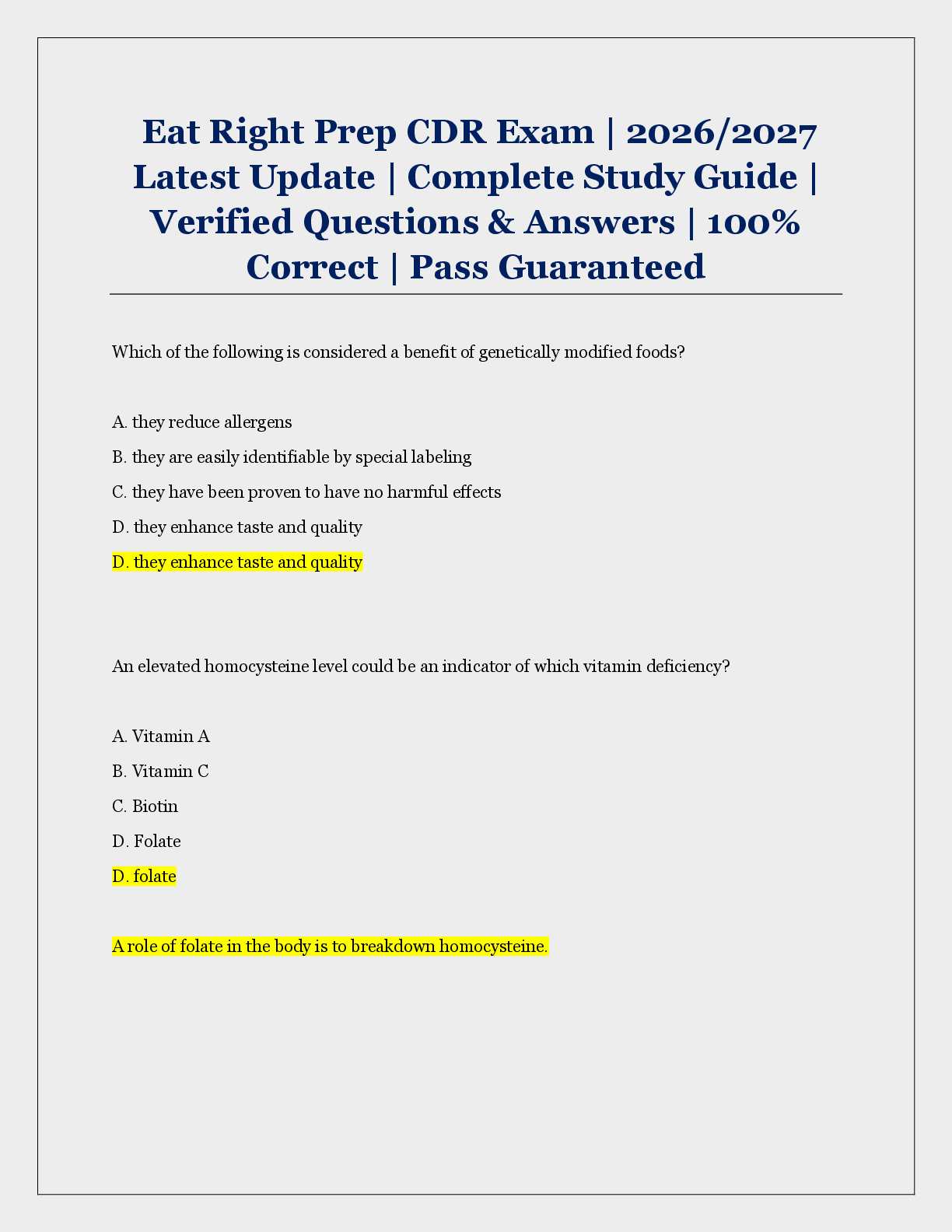
(TCOs 7 and 9) At what ages do the two major brain growth spurts occur? 11–12 and 13–15
12–14 and 17–18
Correct!
13–15 and 17–18
13–15 and 18–20
Chapter 11,
...
PSYC 290N Week 4 Quiz
Question # 1
2 / 2 Points
(TCOs 7 and 9) At what ages do the two major brain growth spurts occur? 11–12 and 13–15
12–14 and 17–18
Correct!
13–15 and 17–18
13–15 and 18–20
Chapter 11, pages 275–276
Question # 2
2 / 2 Points
(TCOs 7 and 9) Which of the following is a change in primary sex characteristics that takes place during puberty?
Growth of breasts Changing voice pitch
Growth of pubic hair
Correct!
Formation of a uterus Chapter 11, page 277
Question # 3
2 / 2 Points
(TCOs 7 and 9) Which of the following is an example of changes in secondary sex characteristics during puberty?
Growth of the testes
Correct!
Growth of the breasts Growth of the penis Growth of the ovaries
Chapter 11, page 277
Question # 4
2 / 2 Points
(TCOs 7 and 9) Which of the following groups is more likely to have a negative body image, get into trouble at school and with peers, and engage in delinquent behavior?
Late-maturing boys
Early maturing boys Late-maturing girls
Correct!
Early maturing girls Chapter 11, page 279
Question # 5
2 / 2 Points
(TCOs 7 and 9) Which of the following statements is true regarding adolescent pregnancy in the United States?
The number of teen pregnancies continues to rise.
Teen pregnancy statistics only account for those under the age of 16.
The number of unwed teen mothers who eventually wed the babies' fathers has increased over the past four decades.
Correct!
The number of births to unmarried teens has increased over the past four decades. Chapter 11, page 283
Question # 6
2 / 2 Points
(TCOs 7 and 9) Which of the following is one of the stages of crisis of teen pregnancy?
Correct!
The escalation phase The denial phase
The de-escalation phase
The radical acceptance phase Chapter 11, page 284
Question # 7
2 / 2 Points
(TCOs 7 and 9) Which of the following may create a developmental pathway for adolescent depression?
Correct!
Growing up with a depressed parent
Growing up in a religion that emphasizes traditional gender roles Growing up in a low socioeconomic status family
Having many siblings Chapter 11, page 289
Question # 8
2 / 2 Points
(TCOs 7 and 9) Fourteen-year-old Muhammed won a contest sponsored by the local newspaper to celebrate a championship basketball game. The object of the contest was to determine how many words could be made from the word score. Which newly developed ability of formal operational thought would have been most helpful to Muhammed?
The ability to reason about objects or situations not previously seen or experienced
Correct!
The ability to search systematically and methodologically for the solutions to a problem The ability to use ethical principles for decision making
The ability to start with a theory and a prediction and arrive at a conclusion Chapter 11, page 292
Question # 9
2 / 2 Points
(TCOs 7 and 9) According to your text, high school students perform better than elementary school students in memory task experiments because they
Correct!
can apply previously learned memory strategies to the new task. pay closer attention to the task.
are more motivated. Correct Answer
are more mature and therefore more goal oriented. Chapter 11, page 294
Question # 10
2 / 2 Points
(TCOs 7 and 9) Which of the following is the best example of a child who has ability goals for academic achievement?
Julia loves to cook and wants to open her own restaurant.
Darren wants to do another biology project on fruit flies because he learned so much on his first project.
Correct!
Cindy hopes to score higher on her college entrance exam than any of her brothers and sisters.
Eduardo hopes his computer teacher will let him learn Java computer programming language for his final project.
Chapter 11, page 296
Question # 11
2 / 2 Points
(TCOs 7 and 9) According to Erikson, why do teenagers identify with peer groups? To have opportunities to develop intimate relationships and find mates
To foster creativity and variety in appearance, activities, and interests
Correct!
To have a secure base as they begin the identity development process
To consolidate efforts and resources as they begin to move into adult roles Chapter 12, page 307
Question # 12
2 / 2 Points
(TCOs 7 and 9) Lionel thinks he wants to be a fireman, but he is not sure. He is working with his high school career counselor to get information about careers and college majors before he makes a decision. According to Marcia, Lionel is in which stage of identity development?
Achievement Foreclosure
Correct!
Moratorium Diffusion
Chapter 12, page 307
Question # 13
2 / 2 Points
(TCOs 7 and 9) Which of the following factors is credited with more positive outcomes for working high school students?
Positive evaluations from the employer Working only 20 hours per week or less
Correct!
Complex jobs that offer opportunities to acquire valuable job skill Parental approval and emotional support
Chapter 12, page 308
Question # 14
2 / 2 Points
(TCOs 7 and 9) Katie is often perceived by others to be a boy because of her style of clothing, her facial characteristics, and mannerisms. Based on this information, which of the following might be applied to Katie?
She is transgendered She is a lesbian
Correct!
She is androgynous She is a tomboy
Chapter 12, page 311
Question # 15
2 / 2 Points
(TCOs 7 and 9) According to Kohlberg's theory, which stage(s) of moral reasoning are most commonly found in adolescence?
Stage 1
Stage 2
Correct!
Stages 2 and 3
Stages 3 and 4
Chapter 12, page 315
Question # 16
0 / 2 Points
(TCOs 7 and 9) Carolina tries to behave well so that she can avoid being punished for anything. She is also polite and friendly so that everyone will like her. Carolina is most likely at which level of moral reasoning?
You Answered Preconvention morality Principled morality
Naive hedonism
Correct Answer
Conventional morality Chapter 12, page 316
Question # 17
0 / 2 Points
(TCOs 7 and 9) Which of the following characteristics is both a cause and a consequence of moral development according to Nancy Eisenberg?
Justice Wisdom
You Answered
Equality
Correct Answer
Empathy
Chapter 12, page 319
Question # 18
2 / 2 Points
(TCOs 7 and 9) Which of the following factors correlates with increased conflict between parents and adolescent girls?
Onset of puberty
Correct! Menarche Individualization
Peer pressure Chapter 12, page 323
Question # 19
2 / 2 Points
(TCOs 7 and 9) Which of the following best summarizes the importance of parental-teen relationships across cultures?
The consistency and quality of peer attachments seem to be more important to most teens than the strength of parental attachments.
Teens who are too attached to their parents tend to have poor peer relationships.
Correct!
The consistency and quality of the parental attachment seem to be more important to most teens than the strength of peer attachments.
Peer relationships always take precedence over parental relationships during adolescence. Chapter 12, page 323
Question # 20
2 / 2 Points
(TCOs 7 and 9) Which statement most accurately describes the progression of peer group structures through adolescence?
Correct!
Same-sex cliques combine into crowds that evolve into heterosexual cliques and associations of couples.
Crowds dissolve into cliques that reorganize into heterosexual pairs.
Reputation-based groups become identity prototypes that will become either cliques or crowds. Peers separate from cliques to form broader groups based on interests.
Chapter 12, page 325
Question # 21
Not yet graded / 10 Points
(TCOs 7 and 9) Explain the differences in formal operational thought between younger and older teens. How does Piaget account for these differences?
Your Answer:
Piaget believe teenagers reach the final stage of formal operations and the only difference is experience. Kids can think about abstract and theoretical concePoints and use logic to come up with creative solutions to problems. Skills such as logical thought, deductive reasoning, and systematic planning also emerge during this stage. Younger teens typically focus on the short-term consequences of behaviors. Piaget account to these difference by stating lack of sufficient experience of younger teens to fully develop formal operations. Older teens are more experiences and have the ability of continue their intellectual development and accumulation of knowledge
See Chapter 11, page 292. Younger teens are likely to only focus on the short-term consequences of a behavior or decision. This is explained by some as failure to use formal operational thinking at all and the persistence of concrete thinking. Piaget says that it's simply due to lack of sufficient experience to fully develop formal operations.
[Show More]


 (1).png)