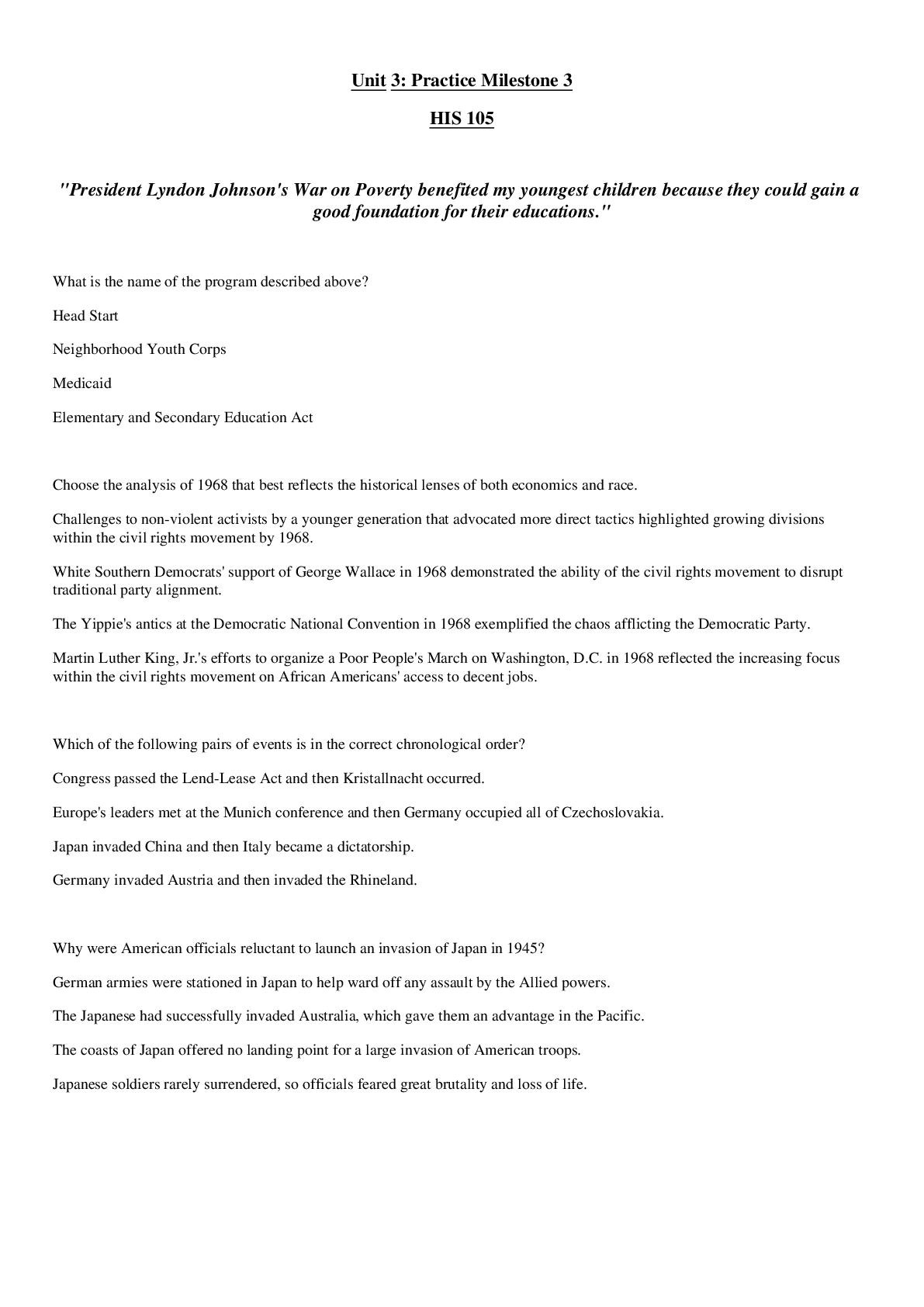
"President Lyndon Johnson's War on Poverty benefited my youngest children because they could gain a good foundation for their educations."
1) What is the name of the program described above?
a. Head Start
b. Neighbo
...
"President Lyndon Johnson's War on Poverty benefited my youngest children because they could gain a good foundation for their educations."
1) What is the name of the program described above?
a. Head Start
b. Neighborhood Youth Corps
c. Medicaid
d. Elementary and Secondary Education Act
2) Choose the analysis of 1968 that best reflects the historical lenses of both economics and race.
a. Challenges to non-violent activists by a younger generation that advocated more direct tactics highlighted growing divisions within the civil rights movement by 1968.
b. White Southern Democrats' support of George Wallace in 1968 demonstrated the ability of the civil rights movement to disrupt traditional party alignment.
c. The Yippie's antics at the Democratic National Convention in 1968 exemplified the chaos afflicting the Democratic Party.
d. Martin Luther King, Jr.'s efforts to organize a Poor People's March on Washington, D.C. in 1968 reflected the increasing focus within the civil rights movement on African Americans' access to decent jobs.
3) Which of the following pairs of events is in the correct chronological order?
a. Congress passed the Lend-Lease Act and then Kristallnacht occurred.
b. Europe's leaders met at the Munich conference and then Germany occupied all of Czechoslovakia.
c. Japan invaded China and then Italy became a dictatorship.
d. Germany invaded Austria and then invaded the Rhineland.
4) Why were American officials reluctant to launch an invasion of Japan in 1945?
a. German armies were stationed in Japan to help ward off any assault by the Allied powers.
b. The Japanese had successfully invaded Australia, which gave them an advantage in the Pacific.
c. The coasts of Japan offered no landing point for a large invasion of American troops.
d. Japanese soldiers rarely surrendered, so officials feared great brutality and loss of life.
5) Choose the statement that best describes a way in which the Second Red Scare influenced Americans' lives.
a. "The Communist Chinese revolution is leading to the internment of Chinese Americans."
b. "I feel free to explore new values and ways of living."
c. "My favorite television programs show traditional images of family life."
d. "Movies represent an escape from my anxiety about nuclear war."
6) What is one reason George Kennan advised the United States to adopt containment as foreign policy in the mid-20th century?
a. He argued Communism was unlikely to expand into Asia, Africa and other decolonizing regions.
b. He wished to minimize the United States' role on the world stage.
c. He believed that the Soviet Union was already on the verge of collapse.
d. He believed the Soviet Union was aggressively expansionist and didn’t intend to stop.
The election of 1968 revealed cracks in the Democratic Party in that its candidates were appealing to different segments of the population.
7) Which statement best reflects the views of Presidential candidate Eugene McCarthy?
a. “An army of student volunteers helped me to challenge the Democratic Party leadership."
b. “I have the support of most established party leaders.”
c. “I carried five Southern states and received almost 10 million votes.”
d. "I pledge to restore law and order to this country."
8) Choose the statement that reflects an effect of Brown v. Board of Education on the civil rights movement.
a. “My grandfather remembers the Confederacy fondly and often talks about the bravery of the South.”
b. "I joined Rosa Parks in boycotting buses in Montgomery, Alabama."
c. "I’ve heard people say that violence is the only answer to achieving our goals after Brown v. Board of Education."
d. “My colleagues and I resisted the court decision and issued the Southern Manifesto.”
9) Which of the following best characterizes the Cuban Missile Crisis?
a. A Soviet plot to invade Florida using military outposts in Cuba
b. A treaty between Fidel Castro and Kennedy over nuclear disarmament
c. An incident between the U.S. and the USSR over missile sites in Cuba
d. An attempt by the CIA to invade Cuba
10) Which of the following was a reason some Americans opposed U.S. involvement in World War II?
a. The United States wanted to protect its trade agreements with Germany and other European nations.
b. Most people in the United States believed that Great Britain and France alone would easily defeat Hitler.
c. Anti-Semitism in the United States made citizens wary of committing to helping with a refugee crisis.
d. The United States was reluctant to shift resources away from its Cold War with the Soviet Union.
Federal housing agencies classified neighborhoods and, along with banks, discouraged investment in them if they were predominantly black.
11) What was the name of this practice?
a. Color mapping
b. Urban decay
c. Redlining
d. Blockbusting
12) How did wartime production affect the U.S. economy during World War II?
a. A prosperous consumer economy was established and family incomes increased
b. The government increased public works projects to keep Americans employed
c. Businesses were once again allowed to create monopolies
d. The economy changed very little and the Great Depression continued
13) What was the end result of civil rights activist sit-ins at segregated businesses?
a. It led to the formation of the Mississippi Freedom Democratic Party.
b. It increased tensions within the Republican Party over civil rights.
c. It led to widespread and long-lasting business closures throughout the South.
d. It galvanized support for civil rights among college students.
14) Correctly order the court cases concerning segregation prior to Brown v. Board of Education.
a. 1. Plessy v. Ferguson affirmed the doctrine of “separate but equal” in public accommodations.
2. Sweatt v. Painter affirmed that state laws could not prohibit integrated education.
3. Sipuel v. Board of Regents affirmed a student could not be denied entry to law school based on race.
b. 1. Sipuel v. Board of Regents affirmed a student could not be denied entry to law school based on race.
2. Sweatt v. Painter affirmed that state laws could not prohibit integrated education.
3. Plessy v. Ferguson affirmed the doctrine of “separate but equal” in public accommodations.
c. 1. Plessy v. Ferguson affirmed the doctrine of “separate but equal” in public accommodations.
2. Sipuel v. Board of Regents affirmed a student could not be denied entry to law school based on race.
3. Sweatt v. Painter affirmed that state laws could not prohibit integrated education.
d. 1. Sweatt v. Painter affirmed that state laws could not prohibit integrated education.
2. Sipuel v. Board of Regents affirmed a student could not be denied entry to law school based on race.
3. Plessy v. Ferguson affirmed the doctrine of “separate but equal” in public accommodations.
Read the excerpt from the Supreme Court ruling in Brown v. Board of Education:
“Today, education is perhaps the most important function of state and local governments. Compulsory school attendance laws and the great expenditures for education both demonstrate our recognition of the importance of education to our democratic society. It is required in the performance of our most basic public responsibilities . . . In these days, it is doubtful that any child may reasonably be expected to succeed in life if he is denied the opportunity of an education. Such an opportunity, where the state has undertaken to provide it, is a right which must be made available to all on equal terms.”
15) According to the excerpt, why did segregation in education violate the 14th Amendment?
a. Neither slavery nor involuntary servitude exists in the United States.
b. The “separate but equal” doctrine reinforces the superiority of one race over another.
c. Public education falls under the jurisdiction and protection of the federal government.
d. A state cannot deny any person the equal protection of the law.
16) Select the statement that reflects President Eisenhower's New Look policy.
a. The policy almost doubled the size of the United States armed forces.
b. Foreign aid was promised to any country that asked the United States for help in dealing with the Soviets.
c. The military-industrial complex was hailed as an effective strategy against Communism.
d. The administration threatened a nuclear response to Soviet aggression.
17) Which description accurately reflects both the Yalta and Potsdam Conferences?
a. The British leader controlled the course of the conference.
b. Germany was invited to attend in an attempt to bring an end to the war by diplomacy.
c. Soviet Union was increasing in power more quickly than the U.S. and Great Britain.
d. There was diplomatic tension between the leaders of the Soviet Union and the U.S.
18) What was President John Kennedy's response to the civil rights movement shortly before he was assassinated?
a. He appeased conservatives by not speaking publicly about it.
b. He tried to get a civil rights bill through Congress.
c. He appointed a committee to create sanctions for civil rights violators.
d. He gave a speech imploring Americans to choose nonviolence.
Read the excerpt from a petition to the United Nations, the introduction of which was written by W. E. B. Du Bois:
"We appeal to the world to witness that this attitude of America is far more dangerous to mankind than the Atom bomb, and far, far more clamorous for attention than disarmament or treaty. To disarm the hidebound minds of men is the only path to peace; and as long as Great Britain and the United States profess democracy with one hand and deny it to millions with the other, they convince none of their sincerity, least of all themselves."
19) How does this excerpt relate the Cold War to the civil rights movement?
a. As Adolf Hitler demonized the Jews, so does the United States demonize its minority citizens.
b. America’s willingness to use the atomic bomb proves that its interests lie with global power.
c. The United States is more loyal to Great Britain than it is to its own citizens.
d. America reveals its hypocrisy by fighting global Communism and denying rights to African Americans.
A consequence of containment policy on American politics was the creation of a conservative coalition in 1938 that investigated suspected Communist sympathizers in government, business and the media.
20) What was the name of this group?
a. The House Committee on Un-American Activities
b. The Anti-Communist League
c. The National Security Committee
d. The Civilian Conservative Alliance
21) What policy did the administration of President John Kennedy support in Vietnam?
a. It allowed Ngo Dinh Diem to cancel national elections that were scheduled to reunify Vietnam.
b. American troops trained special forces in Vietnam and flew air missions that spread a chemical defoliant, Agent Orange, across the country.
c. Supporting its ally, France, the United States provided financial and material aid to the point that it was virtually paying for France’s war against Vietnam.
d. This administration made the decision to send additional personnel, including combat troops, to escalate the conflict in Vietnam.
22) Select the statement that accurately describes an aspect of U.S. containment policy following World War II.
a. The Truman Doctrine threatened countries with nuclear retaliation if they allied with the Soviet Union.
b. The Berlin airlift removed anti-Communist German citizens and relocated them.
c. The Marshall Plan established U.S. military bases throughout western Europe.
d. The creation of the North Atlantic Treaty Organization (NATO) indicated that the United States planned to take a stronger role to contain Communism.
23) Which group is paired correctly with their experience during World War II?
a. Italian and German Americans - gained more social freedom as they began working in factories
b. Women - were forced by the federal government to move to isolated camps to prevent espionage
c. Japanese Americans - were subject to discrimination due to the war, but were allowed to stay in their homes and contribute to the war effort
d. African Americans - gained greater equality through Roosevelt's Executive Order 8802
Some baby boomers began to reject the status quo in the 1960s, though they did so in very different ways.
24) Which of these actions is more reflective of the counterculture movement?
a. It organized on campuses.
b. It supported containment policy in Vietnam.
c. It embraced alternative lifestyles.
d. It mobilized efforts against police brutality.
25) Which of the following was a cause of the attack on Pearl Harbor?
a. The U.S. was impeding Japan's desire for new raw materials and oil
b. U.S. entry into the war in Europe
c. An order from Hitler directing the Japanese to attack the U.S.
d. The U.S.'s possession of the Philippines and Guam
26) Which of the following statements reflect a reason identity politics emerged in the United States in the 1960s?
a. "We trusted the Democratic Party leadership to advance our interests."
b. “Integration wasn’t working, so we determined that we would create our own economic resources and institutions.”
c. "We were concerned about the increasing level of power given to the President by Congress."
d. “We believe that all communities of peoples should have the equal application and protection of federal laws.”
27) Choose the true statement about the relationship between private business and the federal government during World War II.
a. "Germany had a larger military arsenal and it shakes my faith in the stability of the national economy."
b. "My business struggled through the Depression, but profits have soared with this government contract."
c. "I'm struggling to find qualified workers because the government is hiring them all."
d. "I'm glad the government could issue my company a defense contract without allowing the federal budget to exceed revenue."
28) Which of the following is paired correctly with its definition?
a. Levittowns - the term for the large increase in population following World War II
b. Baby Boom - the rapid growth of residential areas outside of cities
c. Suburbanization - the name for cheap, mass-produced housing built after World War II
d. G.I. Bill - provided college tuition and other benefits for soldiers returning from World War II
29) Choose the motivation that most influenced President Harry Truman's decision to use the atomic bomb on Japan.
a. Atomic scientists assured him the destructive power of the bomb was limited.
b. American voters were strongly in favor of it.
c. Truman feared that Japan would use atomic weapons first.
d. Americans held racial animosity toward the Japanese.
30) What was one reason the United Nations drafted a "Universal Declaration of Human Rights?"
a. Because of crimes against humanity committed during World War II
b. To formalize laws about human rights that world governments must follow
c. To establish rules for using the atomic bomb
d. In order to embarrass the Germans
31) Which of the following traditions reflected the relationship between conformity and the American family in the 1950s?
a. Bachelorhood was considered a temporary state for men.
b. Married couples were expected to limit their family size to one or two children.
c. Sons and daughters were expected to take care of their parents as they aged.
d. American women were celebrated for working outside of the home.
[Show More]

.png)
.png)

.png)
![Preview of eBook [PDF] Candrakīrti's Introduction to the Middle Way 1st Edition By Jan Westerhoff](https://browseimages.nyc3.digitaloceanspaces.com/paper-images/2024/Sep/13/RlpbzkS72024-09-13-09-5066e3e0c11bb3e.png)