1
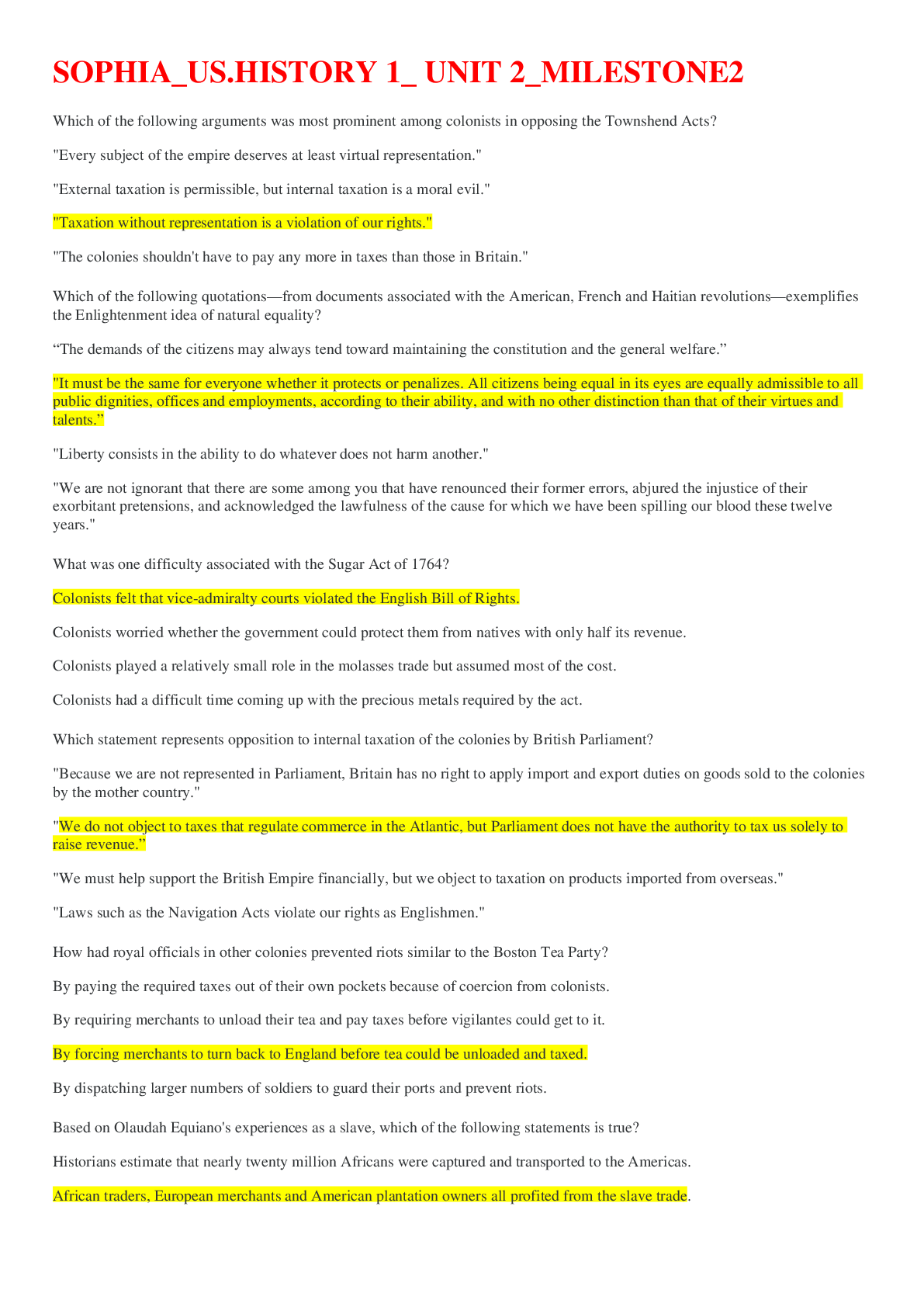
Which of the following arguments was most prominent among colonists in opposing the Townshend Acts?
•
"Every subject of the empire deserves at least virtual representation."
•
"External taxation is permissible
...
1
Which of the following arguments was most prominent among colonists in opposing the Townshend Acts?
•
"Every subject of the empire deserves at least virtual representation."
•
"External taxation is permissible, but internal taxation is a moral evil."
•
"Taxation without representation is a violation of our rights."
•
"The colonies shouldn't have to pay any more in taxes than those in Britain."
2
Which of the following quotations—from documents associated with the American, French and Haitian revolutions—exemplifies the Enlightenment idea of natural equality?
•
“The demands of the citizens may always tend toward maintaining the constitution and the general welfare.”
•
"It must be the same for everyone whether it protects or penalizes. All citizens being equal in its eyes are equally admissible to all public dignities, offices and employments, according to their ability, and with no other distinction than that of their virtues and talents.”
•
"Liberty consists in the ability to do whatever does not harm another."
•
"We are not ignorant that there are some among you that have renounced their former errors, abjured the injustice of their exorbitant pretensions, and acknowledged the lawfulness of the cause for which we have been spilling our blood these twelve years."
3
What was one difficulty associated with the Sugar Act of 1764?
•
Colonists felt that vice-admiralty courts violated the English Bill of Rights.
•
Colonists worried whether the government could protect them from natives with only half its revenue.
•
Colonists played a relatively small role in the molasses trade but assumed most of the cost.
•
Colonists had a difficult time coming up with the precious metals required by the act.
4
Which statement represents opposition to internal taxation of the colonies by British Parliament?
•
"Because we are not represented in Parliament, Britain has no right to apply import and export duties on goods sold to the colonies by the mother country."
•
"We do not object to taxes that regulate commerce in the Atlantic, but Parliament does not have the authority to tax us solely to raise revenue.”
•
"We must help support the British Empire financially, but we object to taxation on products imported from overseas."
•
"Laws such as the Navigation Acts violate our rights as Englishmen."
5
How had royal officials in other colonies prevented riots similar to the Boston Tea Party?
•
By paying the required taxes out of their own pockets because of coercion from colonists.
•
By requiring merchants to unload their tea and pay taxes before vigilantes could get to it.
•
By forcing merchants to turn back to England before tea could be unloaded and taxed.
•
By dispatching larger numbers of soldiers to guard their ports and prevent riots.
6
Based on Olaudah Equiano's experiences as a slave, which of the following statements is true?
•
Historians estimate that nearly twenty million Africans were captured and transported to the Americas.
•
African traders, European merchants and American plantation owners all profited from the slave trade.
•
Slaves were usually pre-purchased and delivered directly to their new owners in the Americas.
•
Slave hunters sought strong young men and women of child-bearing age.
7
Which of the following acts of the First Continental Congress foreshadowed the creation of an independent colonial government?
•
The Congress imposed its own taxes on British imports and denied representation to the crown.
•
The Congress recommended that each colony build militias to defend against the British.
•
The Congress petitioned George III as though it were a foreign government seeking aide.
•
The Congress declared independence from Britain and recommended that a constitution be drafted.
8
Which of the following statements about the French and Indian War is true?
•
Though England's government back in London directed much of the war, little money and few troops were sent to help the colonists.
•
The war started as a dispute between native tribes, with England and France getting involved on opposite sides to win allegiance from the natives.
•
What had started as tension between colonists and Native Americans escalated into a global war between England and France.
•
The war was primarily between the French and certain native tribes, with the English supporting both sides at various points.
9
Which of the following was an effect of the consumer revolution in the British colonies?
•
Tea became as popular of a drink in the colonies as it was back in England.
•
New religious denominations began to result from the exchange of ideas.
•
Colonial tastes, like Georgian architecture, began to influence English culture.
•
Colonists became disconnected from England as they traded with other countries.
10
Which of the following grievances was the centerpiece of the Declaration of Independence?
•
Parliament had no right to represent the colonies.
•
George III had no right to govern oversees, even fairly.
•
Parliament had the right to operate independently of the king.
•
George III had broken his social contract with the colonists.
11
Which of the following describes slavery in the Southern colonies in the 18th century?
•
Slaves could own property and pass it on to their children.
•
Slaves were sailors, dockworkers and domestic workers.
•
Slavery was less prevalent because of the absence of cash crops.
•
Strict race-based laws were passed to control perceived threats.
12
The Glorious Revolution of 1688-1689 was the result of a dispute between which two groups?
•
The Catholic English monarch and his supporters, and Protestant English aristocrats, who feared a strong centralized government
•
The English monarchy, which had been usurped by James II, and his family, and William of Orange, the rightful heir to the throne, who had been in exile in the Netherlands
•
The English monarchy, which had developed too close an alliance with France, and the Dutch government, who feared being taken over by the two nations
•
American colonists, who felt oppressed by the Navigation Acts, and the English monarchy, which exerted strong control over the colonies
13
What was one way in which the Spanish posed a threat to English colonial domination in North America?
•
They competed with the British for alliances with the Iroquois.
•
They attacked colonists over the spread of rice and tobacco cultivation.
•
They frightened English authorities with threats of rebellion and conspiracies.
•
They offered freedom to slaves who rebelled and reached Spanish territory.
14
Read the quotation about a vision for American society after the American Revolution.
“An equality of property, with a necessity of alienation, constantly operating to destroy combinations of powerful families, is the very soul of a republic—while this continues, the people will inevitably possess both power and freedom; when this is lost, power departs, liberty expires, and a commonwealth will inevitably assume some other form."
According to this speaker, what is at the root of a republican society?
•
Widespread ownership of land
•
Natural liberty
•
Religious freedom
•
Racial equality
15
Which statement reflects an idea or attitude associated with the Enlightenment?
•
“Our traditions are sacred and have been proven true by our own experiences.”
•
“Religious figures remain the traditional and most trusted sources of truth and understanding."
•
“God gave the right to rule to the king, and we must never question his will.”
•
“We are citizens of the world and open-minded to new ideas and ways of thinking.”
16
Which of the following characterizes the response to the Stamp Act by the Sons of Liberty?
•
Riots and effigies against stamp distributors
•
A propaganda campaign condemning the Stamp Act
•
A boycott of British goods like tea and linen
•
A letter-writing campaign to promote colonists' constitutional rights
17
Henry Clinton was an important figure in the Revolutionary War.
Select the statement that correctly identifies him.
•
“I was appointed Commander-in-Chief of the Continental Army by the Continental Congress."
•
“To sustain the Revolution through the winter months, I launched surprise attacks at Trenton and Princeton.”
•
“I was forced to surrender my army of 5,000 soldiers to the Continental Army at Saratoga.”
•
"My troops forced the surrender of Charleston, from which I led a new military government."
[Show More]