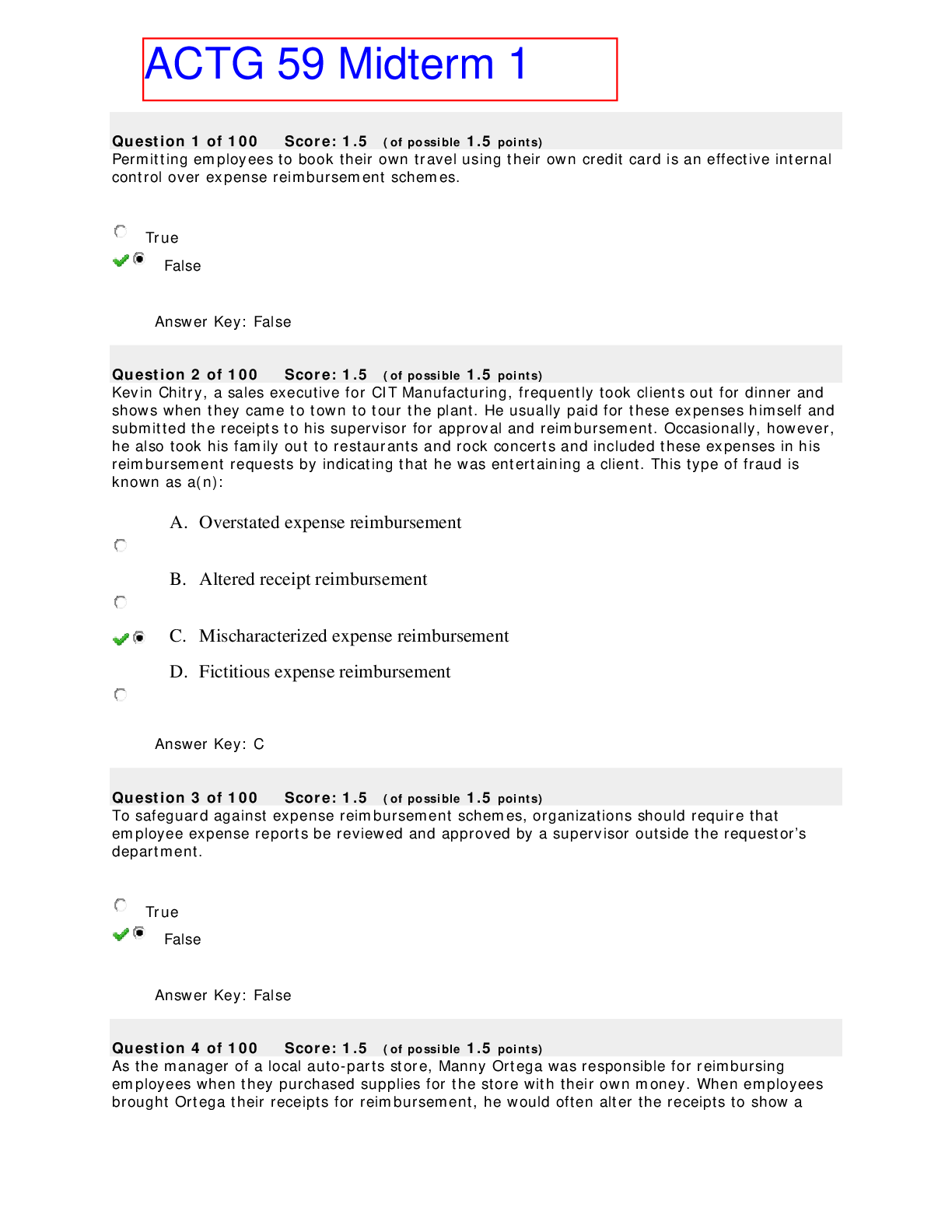
Reviewing Test
Mid¬term
Mid¬term Total Grade: 147 (of possible 150 points)
Question 1 of 100 Score: 1.5 (of possible 1.5 points)
Linda Dudley, an employee of Bingham Company, was sent to an out¬of¬state conference
...
Reviewing Test
Mid¬term
Mid¬term Total Grade: 147 (of possible 150 points)
Question 1 of 100 Score: 1.5 (of possible 1.5 points)
Linda Dudley, an employee of Bingham Company, was sent to an out¬of¬state conference to learn about the
latest innovations in computer security. While she was at the seminar, her meals were picked up by a vendor
hoping to get business from Bingham. Dudley also turned in receipts and requested reimbursement from her
company for the same meals that the vendor paid for. What type of expense reimbursement fraud is this?
A. Overstated expense
B. Mischaracterized expense
C. None of the above
D. Fictitious expense
Question 2 of 100 Score: 1.5 (of possible 1.5 points)
Because they leave a solid audit trail, expense reimbursement schemes are generally easier to detect than
other types of fraud schemes.
True
False
Question 3 of 100 Score: 1.5 (of possible 1.5 points)
If an employee submits a photocopy of a receipt as support for a business expense, the expense should be
independently verified before it is reimbursed.
True
False
10/30/2015 Reviewing Test: Mid-term
https://myetudes.org/portal/tool/14076fda-8c4b-47fa-8084-fd2e4db38d77/review/19418556/list 2/27
Question 4 of 100 Score: 1.5 (of possible 1.5 points)
In one of the case studies in the textbook, Marcus Lane, a geologist for an environmental management and
engineering services firm, traveled all over North and South America as part of his job, resulting in numerous
expense reimbursements. Unfortunately, Lane went too far and began to double book his air travel using his
personal credit card. He booked two separate flights to the same location, but with a huge cost difference. He
used the cheaper ticket for the actual flight and returned the more expensive ticket for credit. And, of course,
he submitted the more expensive ticket for reimbursement. What changes to internal controls were made as a
result of Lane’s fraud?
A. Enforcement of a new policy that employees submit their travel expense reports for reimbursement
within five days of returning from a trip
B. Enforcement of a new policy that business expenditures other than travel be charged to personal
credit cards only
C. Clarification and better enforcement of the policy that all travel be booked through the company
travel agent using a designated company credit card
D. All of the above
Question 5 of 100 Score: 1.5 (of possible 1.5 points)
As the manager of a local auto¬parts store, Manny Ortega was responsible for reimbursing employees when
they purchased supplies for the store with their own money. When employees brought Ortega their receipts for
reimbursement, he would often alter the receipts to show a larger amount. Then he would ring a “no sale” on
the cash register, remove the full amount per the altered receipt, and pocket the excess. Because the employee
received the expected amount and the register totals remained in balance, Ortega was able to continue this
scheme for nearly 2 years before being caught. What type of fraud did Ortega commit?
A. Overstated expense reimbursement scheme
B. None of the above
C. Register disbursement scheme
D. Mischaracterized expense reimbursement scheme
Question 6 of 100 Score: 1.5 (of possible 1.5 points)
Remy Lewis has just started working as a marketing research analyst for Commercial Casting Company in New
York City. He is relocating his family to New York from North Carolina, but they haven’t moved yet. Twice a
month, the company pays for Lewis to travel to North Carolina to visit his family and help with the move.
During the month of September, Lewis only visited his family once; however, he submitted expense reports for
mileage for two separate trips to North Carolina and back. What type of scheme is this?
A. None of the above
B. Mischaracterized expense reimbursement
C. Fictitious expense reimbursement
D. Billing
10/30/2015 Reviewing Test: Mid-term
https://myetudes.org/portal/tool/14076fda-8c4b-47fa-8084-fd2e4db38d77/review/19418556/list 3/27
Question 7 of 100 Score: 1.5 (of possible 1.5 points)
According to the 2012 Report to the Nations on Occupational Fraud and Abuse, expense reimbursement
schemes are the least common type of fraudulent disbursement schemes.
True
False
Question 8 of 100 Score: 1.5 (of possible 1.5 points)
Which of the following methods can be used to perpetrate a fictitious expense reimbursement scheme?
A. Stealing blank receipts
B. Submitting expenses that were paid by a third party
C. Creating counterfeit receipts
D. All of the above
Question 9 of 100 Score: 1.5 (of possible 1.5 points)
What is the term that would lead a reasonable, prudent professional to believe a fraud has occurred, is occurring, or will incur?
A. Suspension
B. Predication
C. Probation
D. Retaliation
Question 10 of 100 Score: 1.5 (of possible 1.5 points)
_____________ is gathered from individuals using investigative techniques such as interviewing, interrogation, and honesty
tests.
A. Testimonial evidence
B. Physical evidence
C. Personal observation
D. Documentary evidence
10/30/2015 Reviewing Test: Mid-term
https://myetudes.org/portal/tool/14076fda-8c4b-47fa-8084-fd2e4db38d77/review/19418556/list 4/27
Question 11 of 100 Score: 1.5 (of possible 1.5 points)
John Pearson (CPA) is investigating a possible management fraud. He found an email on an employee's computer to use as
evidence in the case. This email is an example of __________?
A. Physical evidence
B. Testimonial evidence
C. Personal observation
D. Documentary evidence
Question 12 of 100 Score: 1.5 (of possible 1.5 points)
An investigator catches a fraud perpetrator while he/she is actually receiving a kickback. Which investigative method was used?
A. Layering
B. Conversion
C. Theft act
D. Concealment
Question 13 of 100 Score: 1.5 (of possible 1.5 points)
An investigator is conducting a surveillance operation on an individual. Surveillance is what type of fraud
investigation evidence?
A. Personal observation
B. Testimonial evidence
C. Physical evidence
D. Documentary evidence
Question 14 of 100 Score: 1.5 (of possible 1.5 points)
Which of the following best describes what is meant by “the tone at the top.”
A. fraud perpetrators are given a second chance.
B. expectations of honesty are implied.
C. a proper example is set by management.
D. fraud perpetrators are severely punished.
10/30/2015 Reviewing Test: Mid-term
https://myetudes.org/portal/tool/14076fda-8c4b-47fa-8084-fd2e4db38d77/review/19418556/list 5/27
Question 15 of 100 Score: 1.5 (of possible 1.5 points)
Use Benford’s law to answer the following question.
The first digit of random data sets will begin with a ______ more often than 2.
A. 7
B. 3
C. 1
D. 4
Question 16 of 100 Score: 1.5 (of possible 1.5 points)
Use Benford’s Law to answer the following question.
5 will be the first digit of a random number set______
A. more often than 3.
B. more often than 1.
C. about the same as 6.
D. less often than 4.
Question 17 of 100 Score: 1.5 (of possible 1.5 points)
You are a fraud investigator working with complex data sets. You decide to the split the data sets into case-specific tables.
This process is known as_______
A. Soundex
B. Deviation
C. Data mining
D. Stratification
Question 18 of 100 Score: 0 (of possible 1.5 points)
You are fraud investigator working on an engagement. You decide to convert cash as percentage of total assets and compare
the change over a two year period. This approach is known as ___________
A. Variance Analysis
10/30/2015 Reviewing Test: Mid-term
https://myetudes.org/portal/tool/14076fda-8c4b-47fa-8084-fd2e4db38d77/review/19418556/list 6/27
B. Ratio Analysis
C. Vertical Analysis
D. Horizontal Analysis
Question 19 of 100 Score: 1.5 (of possible 1.5 points)
How can Benford's law help detect fraud?
A. By establishing weaknesses in the accounting control system.
B. By identifying accounting anomalies.
C. By focusing on unexplained changes.
D. By showing attempts by fraudsters to make stolen amounts look random.
Question 20 of 100 Score: 1.5 (of possible 1.5 points)
Skimming involves the theft of money that has already appeared on a victim’s books, while cash larceny
involves stealing money before it has been recorded.
True
False
Question 21 of 100 Score: 1.5 (of possible 1.5 points)
Cash misappropriations are divided into two broad groups: fraudulent disbursements schemes and cash
receipts schemes.
True
False
Question 22 of 100 Score: 1.5 (of possible 1.5 points)
Deposit lapping is considered an off¬book scheme.
True
False
10/30/2015 Reviewing Test: Mid-term
https://myetudes.org/portal/tool/14076fda-8c4b-47fa-8084-fd2e4db38d77/review/19418556/list 7/27
Question 23 of 100 Score: 1.5 (of possible 1.5 points)
The two categories of cash receipts schemes are:
A. Skimming and billing schemes
B. Lapping and cash larceny
C. Cash larceny and skimming
D. Lapping and skimming
Question 24 of 100 Score: 1.5 (of possible 1.5 points)
Jeff Lewis is an accounts receivable clerk for FTB Industries. As customers pay off their balances, Lewis posts
the payments but pockets the money. He can conceal his theft by:
A. All of the above
B. Making unsupported entries for the amount stolen
C. Adjusting the account with a discount
D. Destroying the records
Question 25 of 100 Score: 1.5 (of possible 1.5 points)
The central weakness of a cash larceny scheme is the resulting imbalance in the organization’s accounting
records.
True
False
Question 26 of 100 Score: 1.5 (of possible 1.5 points)
If discrepancies are found between the sales records and the cash on hand, which of the following schemes
might be occurring?
A. Cash larceny at the point of sale
B. Fraudulent disbursements
C. Sales skimming
D. Cash larceny from the deposit
10/30/2015 Reviewing Test: Mid-term
https://myetudes.org/portal/tool/14076fda-8c4b-47fa-8084-fd2e4db38d77/review/19418556/list 8/27
Question 27 of 100 Score: 1.5 (of possible 1.5 points)
Running a report that summarizes user access for the sales, accounts receivable, cash receipt, and general
ledger systems during non¬business hours might identify a cash larceny scheme.
True
False
Question 28 of 100 Score: 1.5 (of possible 1.5 points)
From the selections below, which is a factor that increases the opportunity for an individual to commit fraud?
A. The organization owes it to me
B. Living beyond one's means
C. Greed
D. Lack of an audit trail
Question 29 of 100 Score: 1.5 (of possible 1.5 points)
Financial pressures associated with fraud include all but which statement?
A. Personal financial losses
B. Getting even with the employer
C. High bills or personal debt
D. Living beyond one's means
Question 30 of 100 Score: 1.5 (of possible 1.5 points)
Which element of the fraud triangle are internal controls implemented in a corporation to help prevent?
A. Perceived pressure
B. Perceived opportunity
C. Authorization
D. Rationalization
Question 31 of 100 Score: 1.5 (of possible 1.5 points)
10/30/2015 Reviewing Test: Mid-term
https://myetudes.org/portal/tool/14076fda-8c4b-47fa-8084-fd2e4db38d77/review/19418556/list 9/27
A fraud perpetrator named Maximus is able to convince a potential victim that she will receive a job promotion
if she supports him in a fraud scheme. Maximus is using which type of power?
A. Legitimate power
B. Coercive power
C. Reward power
D. Expert power
Question 32 of 100 Score: 1.5 (of possible 1.5 points)
An authorization control procedure would include which of the following?
A. Password protection
B. Periodic job rotation
C. Supervisor review
D. Cash counts
Question 33 of 100 Score: 1.5 (of possible 1.5 points)
Sally participates in a fraud scheme by executing some derivative trades because she believed that a
Senior Investment Analyst knew more about complex derivative transactions than she did. These
transactions were fraudulent in nature. Sally was deceived by which type of power?
A. Referent power
B. Coercive power
C. Expert power
D. Reward power
Question 34 of 100 Score: 1.5 (of possible 1.5 points)
You are a fraud investigator working on an engagement. When would you usually interview the suspects?
A. in the middle of the investigation process to make them feel that they are not really a suspect.
B. any time during the investigation process to avoid creating undue stress and suspicion among other
employees.
C. at the end of the investigation process so that they can gather sufficient evidence against them.
D. at the beginning of the investigation process to really put the heat on them.
10/30/2015 Reviewing Test: Mid-term
https://myetudes.org/portal/tool/14076fda-8c4b-47fa-8084-fd2e4db38d77/review/19418556/list 10/27
Question 35 of 100 Score: 1.5 (of possible 1.5 points)
From the options below, which is not a type of surveillance?
A. Tailing
B. Audit
C. Stationary or fixed point
D. Electronic surveillance
Question 36 of 100 Score: 1.5 (of possible 1.5 points)
You are a fraud investigator just hired to begin an engagement. You create a tool that considers all the aspects of the fraud that
are currently known to you. With this tool you also establish different fraud theories. This tool is also known as a
______________
A. Pareto chart
B. Vulnerability chart
C. Surveillance log
D. Perceptual map
Question 37 of 100 Score: 1.5 (of possible 1.5 points)
You are a fraud investigator on an engagement that is near completion. What is probably your last step in your investigation?
A. Interview suspect's manager
B. Interview former employees
C. Perform surveillance
D. Interview suspect
Question 38 of 100 Score: 1.5 (of possible 1.5 points)
You are a fraud investigator working on a surveillance engagement. You locate the scene that should be observed and
anticipate the action that is most likely to occur at the scene. During this time you keep detailed notes on all activities involving
the suspect. Which type of surveillance are you using?
A. Electronic surveillance
B. Static surveillance
C. Moving surveillance
D. Stationary surveillance
10/30/2015 Reviewing Test: Mid-term
https://myetudes.org/portal/tool/14076fda-8c4b-47fa-8084-fd2e4db38d77/review/19418556/list 11/27
Question 39 of 100 Score: 1.5 (of possible 1.5 points)
You are an auditor on an engagement. Some of your audit samples include altered documents. Which stage of the audit fraud
are you most likely detecting?
A. Conversion
B. Theft act
C. Layering
D. Concealment
Question 40 of 100 Score: 1.5 (of possible 1.5 points)
Your co¬worker has made some major lifestyle changes such has buying expensive clothes and cars. Which of the fraud
elements may you be witnessing?
A. Conversion
B. Confession
C. Concealment
D. Theft act
Question 41 of 100 Score: 0 (of possible 1.5 points)
A Sr. Accountant makes a fictitious journal entry (an expense transaction) to conceal fraud. This journal
entry is an example of which fraud symptom?
A. Analytical anomaly
B. Internal control weakness
C. Accounting anomaly
D. Unusual behavior
Question 42 of 100 Score: 1.5 (of possible 1.5 points)
Which of the following is not one of the common accounting anomaly fraud symptoms involving problems with various data and
books of accounts?
A. Faulty journal entries
B. Inaccuracies in source documents
10/30/2015 Reviewing Test: Mid-term
https://myetudes.org/portal/tool/14076fda-8c4b-47fa-8084-fd2e4db38d77/review/19418556/list 12/27
C. Rounding adjustments
D. Inaccuracies in ledgers
Question 43 of 100 Score: 1.5 (of possible 1.5 points)
From the options below, which group is usually not in a good position to recognize fraud during the theft act?
A. Auditors
B. Other employees
C. Coworkers
D. Managers
Question 44 of 100 Score: 1.5 (of possible 1.5 points)
A method of concealing receivables skimming by crediting one account while abstracting money from a different
account is known as:
A. Lapping
B. Account substitution
C. Kiting
D. Plugging
Question 45 of 100 Score: 1.5 (of possible 1.5 points)
In one of the case studies in the textbook, Brian Lee, a top¬notch plastic surgeon, collected payments from his
patients without giving a cut to the clinic where he practiced. How was he punished?
A. He was convicted of grand larceny and sentenced to probation.
B. He was sued in civil court for the amount of the loss.
C. He was terminated from the practice and was required to make full restitution in lieu of prosecution.
D. He was allowed to continue to practice at the clinic but was required to make full restitution.
Question 46 of 100 Score: 1.5 (of possible 1.5 points)
The customer service department at JNC, Inc. has been receiving phone calls from customers for whom there is
no record. This is a red flag of what type of scheme?
10/30/2015 Reviewing Test: Mid-term
https://myetudes.org/portal/tool/14076fda-8c4b-47fa-8084-fd2e4db38d77/review/19418556/list 13/27
A. None of the above
B. Shell company
C. Unrecorded sales
D. Receivables skimming
Question 47 of 100 Score: 1.5 (of possible 1.5 points)
In one of the case studies in the textbook, Brian Lee, a top¬notch plastic surgeon, collected payments from his
patients without giving a cut to the clinic where he practiced. How was his fraud discovered?
A. By accident
B. Through an anonymous tip to the clinic
C. Through a routine audit of the clinic’s records
D. None of the above
Question 48 of 100 Score: 1.5 (of possible 1.5 points)
Skimming receivables is generally more difficult to conceal than skimming sales.
True
False
Question 49 of 100 Score: 1.5 (of possible 1.5 points)
Which of the following techniques is not used to conceal sales skimming schemes?
A. Recording false voids
B. Lapping
C. Inventory padding
D. Destroying records of transaction
Question 50 of 100 Score: 1.5 (of possible 1.5 points)
Skimming can be either an on¬book scheme or an off¬book scheme, depending on whether cash or a check is
stolen.
True
10/30/2015 Reviewing Test: Mid-term
https://myetudes.org/portal/tool/14076fda-8c4b-47fa-8084-fd2e4db38d77/review/19418556/list 14/27
False
Question 51 of 100 Score: 1.5 (of possible 1.5 points)
George Albert was a property manager for a large apartment complex while he was going to college. One of his
duties was to collect rent from the tenants. If rent was paid after the third of the month, a late fee was tacked
on to the amount due. When a tenant paid his rent late, George would backdate the payment, record and remit
only the rent portion to his employers, and pocket the late fee. This is an example of what type of fraud?
A. Sales skimming
B. Plugging
C. Larceny
D. Fraudulent write¬offs
Question 52 of 100 Score: 1.5 (of possible 1.5 points)
Which of the following computer audit tests can be used to detect ghost employee schemes?
A. Extract all employees without a social security number.
B. Compare employees reported per timecard system to the payroll system.
C. All of the above
D. Extract users who can write checks and also add new employees in the payroll and timecard system.
Question 53 of 100 Score: 1.5 (of possible 1.5 points)
Which of the following analyses can be used to identify ghost employee schemes?
A. Comparing employees who have the same Social Security number, bank account, or physical
address
B. All of the above
C. Comparing actual payroll expenses to budgeted expenses
D. Identifying employees who have no withholding taxes taken out
Question 54 of 100 Score: 1.5 (of possible 1.5 points)
Allison Duval, CFE, has been retained by National Mortgage Company to investigate some suspicious activity.
As part of her examination, Duval compares the company’s payroll expenses to budgeted projections and to
10/30/2015 Reviewing Test: Mid-term
https://myetudes.org/portal/tool/14076fda-8c4b-47fa-8084-fd2e4db38d77/review/19418556/list 15/27
prior years’ totals. She also runs an exception report looking for any employees whose compensation has
increased disproportionately over the prior year. She then compares the payroll files to the human resource
files to test for differing salary rates. What type of scheme is Duval most likely looking for?
A. Payroll tampering scheme
B. Commission scheme
C. Falsified hours and salary scheme
D. Ghost employee scheme
Question 55 of 100 Score: 1.5 (of possible 1.5 points)
Which of the following controls will help prevent and detect falsified hours and salary schemes?
A. Supervisors return authorized timecards to the employees for review before they are sent to the
payroll department.
B. The duties of payroll preparation, authorization, and distribution are segregated.
C. Sick leave and vacation time are monitored for excesses by the payroll department.
D. All of the above
Question 56 of 100 Score: 1.5 (of possible 1.5 points)
In one of the case studies in the textbook, Jerry Harkanell worked as an administrative assistant for a large San
Antonio hospital, where his clerical duties included the submission of the payroll information for his unit. He
found that he could add hours to the timesheets and receive extra pay. He continued to alter his timesheets
until he was finally caught. What red flag was present that should have made someone suspicious?
A. He showed up for work on a day he had off so he could personally turn in the timesheets.
B. No one else in the department had overtime hours but Harkanell.
C. All of the above
D. He used erasable ink to record the hours on the timesheets.
Question 57 of 100 Score: 1.5 (of possible 1.5 points)
Which of the following can be used to test for commission schemes?
A. Compare hours reported per timecard system to payroll system.
B. Extract customer sale balances that exceed the customer credit limit.
C. None of the above
D. Extract manual checks and summarize by salesperson and amount.
10/30/2015 Reviewing Test: Mid-term
https://myetudes.org/portal/tool/14076fda-8c4b-47fa-8084-fd2e4db38d77/review/19418556/list 16/27
Question 58 of 100 Score: 1.5 (of possible 1.5 points)
Which of the following is not a method typically used by an employee to fraudulently inflate his or her hours in
a manual timekeeping system?
A. Manipulating the pay grade
B. Collusion
C. “Lazy manager” method
D. Forging the supervisor’s signature
Question 59 of 100 Score: 1.5 (of possible 1.5 points)
Ellie Weaver works for the JAG Group as the customer service supervisor. When Joel Carter was hired into her
department, she listed his start date as one month before he actually began work. Accordingly, the payroll
department generated an extra paycheck for Carter, which Weaver intercepted and cashed at a liquor store.
What type of fraud is this?
A. Altered payee scheme
B. Ghost employee scheme
C. Falsified wages scheme
D. Forged endorsement scheme
Question 60 of 100 Score: 1.5 (of possible 1.5 points)
__________ is the most common type of occupational fraud.
A. Mail fraud
B. Financial statement fraud
C. Employee embezzlement
D. Investment fraud
Question 61 of 100 Score: 1.5 (of possible 1.5 points)
By what other name is "management fraud" referred to as?
A. affinity fraud.
B. financial statement fraud.
10/30/2015 Reviewing Test: Mid-term
https://myetudes.org/portal/tool/14076fda-8c4b-47fa-8084-fd2e4db38d77/review/19418556/list 17/27
C. stockholder fraud.
D. investment fraud.
Question 62 of 100 Score: 1.5 (of possible 1.5 points)
Of the statements below concerning occupational fraud, which is not true?
A. It is clandestine.
B. It always involves two or more employees.
C. It is committed for the purpose of direct or indirect financial benefit to the employee.
D. It costs the employing organization assets, revenues, or reserves.
Question 63 of 100 Score: 1.5 (of possible 1.5 points)
Why does one party usually file a complaint against another in a civil case?
A. proving the other party wrong.
B. penalty.
C. financial restitution.
D. imprisonment.
Question 64 of 100 Score: 1.5 (of possible 1.5 points)
How does the fraudster in a Ponzi scheme gain the confidence of investors?
A. By paying returns to initial investors.
B. By investing in prime bonds.
C. By returning money to all investors.
D. By issuing notarized certificates.
Question 65 of 100 Score: 1.5 (of possible 1.5 points)
Concealing a check tampering scheme generally means hiding both the identity of the perpetrator and the fact
that the fraud ever occurred.
True
10/30/2015 Reviewing Test: Mid-term
https://myetudes.org/portal/tool/14076fda-8c4b-47fa-8084-fd2e4db38d77/review/19418556/list 18/27
False
Question 66 of 100 Score: 1.5 (of possible 1.5 points)
In one of the case studies in the textbook, Melissa Robinson, who worked as an executive secretary for a
worldwide charitable organization and was active in her children’s school, was also a thief. As one of two people
allowed to sign checks on the organization’s bank accounts, she learned early on that she could forge the
second person’s signature without anyone becoming suspicious. What red flags were present that indicated that
something wasn’t appropriate?
A. Robinson would not release any financial information when requested and gave excuses for why it
wasn’t available.
B. There were a lot of missing files that the auditors couldn’t locate during their annual audit.
C. All of the above
D. Robinson would not take vacation leave.
Question 67 of 100 Score: 1.5 (of possible 1.5 points)
Vicky Rogers works in the accounts payable department at HDU, Inc. When checks are returned to the
company for incorrect vendor addresses, she is supposed to research them, correct them, and then forward
them to the proper address. Instead, Rogers decided to convert some of the returned checks for her own use.
Based on the information provided, what type of check tampering scheme is this likely to be?
A. Forged endorsement
B. Forged maker
C. Authorized maker
D. Concealed check
Question 68 of 100 Score: 1.5 (of possible 1.5 points)
Kristen Diamond worked in the mailroom at B&R Industries. When attaching postage to the outgoing mail, she
would search for payments being sent to a specific vendor, K. D. Sand. She intercepted these checks and
carefully changed them to appear payable to K. Diamond. She then endorsed the checks with her own name
and deposited them into her personal bank account. What type of scheme did Kristen commit?
A. “Tacking on”
B. Forged endorsement
C. Concealed check
D. Payables skimming
10/30/2015 Reviewing Test: Mid-term
https://myetudes.org/portal/tool/14076fda-8c4b-47fa-8084-fd2e4db38d77/review/19418556/list 19/27
Question 69 of 100 Score: 1.5 (of possible 1.5 points)
In one of the case studies in the textbook, Ernie Phillips was a CPA who had fallen on hard times both
financially and personally. He eventually got a job as a controller for a friend who had just been named as the
receiver for a financial services company. Within a short period of time Phillips began writing checks to himself
that had nothing to do with payroll. How was the fraud discovered?
A. The operations manager found a check made payable to Phillips while searching Phillips’ desk for
some accounting records.
B. A vendor received a check in error and reported it to the operations manager.
C. The receiver received a call from the bank asking him to verify a check.
D. The president received a bank statement containing canceled checks that had been written to
Phillips.
Question 70 of 100 Score: 1.5 (of possible 1.5 points)
Methods used to manipulate electronic payments include which of the following?
A. Gaining access to the employer’s payment system through social engineering
B. All of the above
C. Abusing legitimate access to the employer’s payment system
D. Exploiting weaknesses in the employer’s internal control over its electronic payment system
Question 71 of 100 Score: 1.5 (of possible 1.5 points)
In one of the case studies in the textbook, Melissa Robinson, who worked as an executive secretary for a
worldwide charitable organization and was active in her children’s school, was also a thief. As one of two people
allowed to sign checks on the organization’s bank accounts, she learned early on that she could forge the
second person’s signature without anyone becoming suspicious. How was she finally caught?
A. Robinson’s husband tipped off the audit committee after he became suspicious of some of
Robinson’s purchases.
B. New officers were elected, and they took the accounting books from her.
C. The auditors discovered her fraud during an annual audit of the books.
D. A co¬worker contacted the organization’s executive director when she found that a company check
had been written to the children’s school for Robinson’s personal items.
Question 72 of 100 Score: 1.5 (of possible 1.5 points)
In one of the case studies in the textbook, Ernie Phillips was a CPA who had fallen on hard times both
financially and personally. He eventually got a job as a controller for a friend who had just been named as the
10/30/2015 Reviewing Test: Mid-term
https://myetudes.org/portal/tool/14076fda-8c4b-47fa-8084-fd2e4db38d77/review/19418556/list 20/27
receiver for a financial services company. Within a short period of time Phillips began writing checks to himself
that had nothing to do with payroll. What happened to Phillips?
A. He was charged criminally, and while out on bail, he fled with his family.
B. He quit his job and moved to another state.
C. He pleaded guilty to fraud and grand theft and spent 24 months in prison.
D. He paid the money back by mortgaging his home.
Question 73 of 100 Score: 1.5 (of possible 1.5 points)
In one of the cases in the textbook, Joe Anderson, a part¬time shoe salesperson at a department store,
perpetrated a fictitious returns scheme using third¬party credit cards. Why was a fraud examination initiated?
A. Another employee witnessed Anderson pocketing cash and reported the incident.
B. The store’s surveillance camera caught Anderson pocketing the money.
C. The shoe department was losing money and had a high rate of returns on its shoes.
D. Anderson credited the wrong account and the customer called up to inquire as to why her credit card
had been credited.
Question 74 of 100 Score: 1.5 (of possible 1.5 points)
When an employee perpetrates a credit card refund scheme, the perpetual inventory will show a greater
amount than the physical inventory.
True
False
Question 75 of 100 Score: 1.5 (of possible 1.5 points)
Meredith Chapman works as a retail clerk at a children’s clothing store. When a customer returns an item for a
cash refund, Meredith enters an amount greater than the actual refund into the register, pays the customer the
amount owed for the returned merchandise, and keeps the excess cash for herself. What type of scheme is
Meredith committing?
A. Overstated refunds
B. Cash larceny
C. Overstated expenses
D. Skimming
10/30/2015 Reviewing Test: Mid-term
https://myetudes.org/portal/tool/14076fda-8c4b-47fa-8084-fd2e4db38d77/review/19418556/list 21/27
Question 76 of 100 Score: 1.5 (of possible 1.5 points)
Register disbursement schemes are difficult to conceal because they cause the cash drawer to be out of balance
with the cash register tape.
True
False
Question 77 of 100 Score: 1.5 (of possible 1.5 points)
Which of the following procedures can be used to prevent and detect a register disbursement scheme?
A. Restrict access to the control key or management code that authorizes reversing transactions.
B. All of the above
C. Randomly call customers who have returned merchandise or voided sales.
D. Place signs around the store encouraging customers to ask for and examine their receipts.
Question 78 of 100 Score: 1.5 (of possible 1.5 points)
Which of the following is a type of register disbursement scheme?
A. Overstated refunds
B. All of the above
C. Fictitious refunds
D. False voids
Question 79 of 100 Score: 1.5 (of possible 1.5 points)
Register disbursement schemes are different from skimming and larceny at the register in that they:
A. Leave a record of the removal of money on the register tape
B. Are on¬book schemes, where as skimming and larceny are off¬book schemes
C. All of the above
D. Require the use of an accomplice
Question 80 of 100 Score: 1.5 (of possible 1.5 points)
10/30/2015 Reviewing Test: Mid-term
https://myetudes.org/portal/tool/14076fda-8c4b-47fa-8084-fd2e4db38d77/review/19418556/list 22/27
According to the textbook, the best way for an organization to prevent fraudulent register disbursements is to:
A. Maintain appropriate separation of duties.
B. All of the above
C. Have a policy requiring photocopied receipts for sales refunds.
D. Have each employee compare the cash in his or her register drawer to the register tape at the end
of each shift.
Question 81 of 100 Score: 1.5 (of possible 1.5 points)
Which of these help employees deal with substance abuse (alcohol and drugs), gambling, money management,
and health, family, and personal problems?
A. Employee Assistance Programs
B. Equal Employment Opportunity Programs
C. Whistle¬Blowing Programs
D. Employees Anonymous Programs
Question 82 of 100 Score: 1.5 (of possible 1.5 points)
Control activities can be either a preventive control or a detective control. From the options below,
which is a detective control?
A. System of authorizations
B. Segregation of duties
C. Physical safeguards
D. Independent checks
Question 83 of 100 Score: 1.5 (of possible 1.5 points)
Which of the options best describes the Pygmalion effect?
A. The probability of fraud detection increases with the number of people involved.
B. Absence of controls leads to increased incidents of dishonesty.
C. 99% of frauds in organizations are committed by 1% of their employees.
D. People generally perform according to a leader’s expectations.
10/30/2015 Reviewing Test: Mid-term
https://myetudes.org/portal/tool/14076fda-8c4b-47fa-8084-fd2e4db38d77/review/19418556/list 23/27
Question 84 of 100 Score: 1.5 (of possible 1.5 points)
What is the last stage in the current (default) model that most organizations typically use for dealing with
fraud?
A. Action
B. Investigation
C. Fraud incident
D. Resolution
Question 85 of 100 Score: 1.5 (of possible 1.5 points)
ABC Company requires its employees in its accounting department take a mandatory 10 day continuous vacation once a year.
No exceptions to this rule are allowed. Which control activity is ABC Company using?
A. Physical safeguards
B. Segregation of duties
C. Independent checks
D. Proper authorizations
Question 86 of 100 Score: 1.5 (of possible 1.5 points)
In a shell company scheme, which of the following methods might a fraudster use to get a phony invoice
approved for payment?
A. Any of the above
B. A “rubber stamp” supervisor
C. Falsification of purchase orders and receiving reports
D. Collusion
Question 87 of 100 Score: 1.5 (of possible 1.5 points)
According to the 2012 Report to the Nations on Occupational Fraud and Abuse, billing schemes were the second
most costly type of fraudulent disbursements schemes.
True
False
10/30/2015 Reviewing Test: Mid-term
https://myetudes.org/portal/tool/14076fda-8c4b-47fa-8084-fd2e4db38d77/review/19418556/list 24/27
Question 88 of 100 Score: 1.5 (of possible 1.5 points)
When a billing scheme is occurring, the company’s expenses appear lower than they should, causing the
financial statements to show falsely inflated profits.
True
False
Question 89 of 100 Score: 1.5 (of possible 1.5 points)
Which of the following actions is least likely to help prevent and detect schemes involving fraudulent invoices
from non¬accomplice vendors?
A. Marking “paid” on every voucher that has been paid
B. Verifying vendor address changes before disbursements are issued
C. Matching all bank statement items to canceled checks
D. Separating the duties of purchasing, authorizing, and distributing payments
Question 90 of 100 Score: 1.5 (of possible 1.5 points)
Nicolas Hill, CFE, has been hired to look into suspicious activity at Mason & Jefferson, LLC. The company’s
controller has reason to believe that the company has fallen victim to a shell company scheme. As part of his
investigation, Nicolas should do which of the following?
A. All of the above
B. Extract all employees without a social security number
C. Match the vendor master file to the accounts receivable file
D. Review payments with little or no sequence between invoice numbers
Question 91 of 100 Score: 1.5 (of possible 1.5 points)
In one of the case studies in the textbook, Albert Miano, the facilities supervisor for a popular magazine,
submitted phony invoices. When Miano received the checks for the phony invoices, he forged the contractor’s
signature. He then endorsed the check in his own name. What controls weaknesses did the company have that
facilitated Miano’s scheme?
A. Miano was allowed to pick up the approved invoices from the administrative vice-president’s office
and deliver them to the accounts payable department.
B. Employees in the accounts payable department did not follow departmental procedures.
C. All of the above
10/30/2015 Reviewing Test: Mid-term
https://myetudes.org/portal/tool/14076fda-8c4b-47fa-8084-fd2e4db38d77/review/19418556/list 25/27
D. Accounts payable never checked signatures on the invoices against the authorized signatures on file.
Question 92 of 100 Score: 1.5 (of possible 1.5 points)
In one of the case studies in the textbook, a Southeastern medical college was plagued with fraudulent activity.
What started as an investigation into some suspicious expense reimbursement activity eventually led to the
discovery of a fictitious company that was set up to fraudulently bill the college for supplies that never existed.
How was the case resolved?
A. The perpetrator was terminated, and the funds were recovered.
B. The perpetrator left the state and was caught pulling the same scam at another company.
C. A civil suit was filed and restitution was ordered.
D. The perpetrator was convicted and placed on probation, and partial restitution was ordered.
Question 93 of 100 Score: 1.5 (of possible 1.5 points)
Which of the following controls can be used to prevent or detect personal purchases on company credit cards?
A. Requiring employees to receive store credits rather than cash when returning items they purchased
with the company’s credit card
B. Monitoring credit card expenses for unexplained increases in purchasing levels
C. Having credit card statements sent directly to someone with signature authority on the account for
review and payment
D. All of the above
Question 94 of 100 Score: 1.5 (of possible 1.5 points)
While conducting a routine internal audit, Sally Franks overheard one of the company’s purchasing agents
bragging about receiving a substantial discount on a new SUV from the company’s supplier of fleet cars. Is
there sufficient predication to initiate a fraud examination?
A. Yes
B. No
Question 95 of 100 Score: 1.5 (of possible 1.5 points)
Which of the following is the correct order for a fraud examiner to interview witnesses?
10/30/2015 Reviewing Test: Mid-term
https://myetudes.org/portal/tool/14076fda-8c4b-47fa-8084-fd2e4db38d77/review/19418556/list 26/27
A. Neutral third¬parties, corroborative witnesses, co¬conspirators, suspect
B. Suspect, corroborative witnesses, co¬conspirators, neutral third¬parties
C. Corroborative witnesses, neutral third¬parties, co¬conspirators, suspect
D. Suspect, co¬conspirators, corroborative witnesses, neutral third¬parties
Question 96 of 100 Score: 1.5 (of possible 1.5 points)
In a study by Steve Albrecht, Marshall Romney, and Keith Howe, participants were asked to rank characteristics
of the organizational environment that contributed to fraud. The highest ranked factor was:
A. Inadequate attention to detail
B. Lack of an internal audit function
C. Placing too much trust in key employees
D. Lack of clear lines of authority
Question 97 of 100 Score: 1.5 (of possible 1.5 points)
Which of the following best describes the objective of a fraud examination?
A. To express an opinion on the guilt or innocence of a suspect
B. To determine whether a crime has been committed, and if so, who is responsible
C. To make recommendations to management about how to prevent fraud
D. To determine whether financial statements are free of misstatements due to fraud
Question 98 of 100 Score: 1.5 (of possible 1.5 points)
In the 2012 Report to the Nations on Occupational Fraud and Abuse, financial statement fraud had a higher
median loss than asset misappropriation and corruption schemes.
True
False
Question 99 of 100 Score: 1.5 (of possible 1.5 points)
In the 2012 Report to the Nations on Occupational Fraud and Abuse, the category that committed the smallest
percentage of occupational fraud was:
10/30/2015 Reviewing Test: Mid-term
https://myetudes.org/portal/tool/14076fda-8c4b-47fa-8084-fd2e4db38d77/review/19418556/list 27/27
A. Owners/Executives
B. Managers
C. External parties
D. Employees
Question 100 of 100 Score: 1.5 (of possible 1.5 points)
Who developed the Fraud Scale?
A. Joseph T. Wells
B. W. Steve Albrecht
C. Richard C. Hollinger
D. Donald R. Cressey
Prev 1 of 1 Next Return
[Show More]