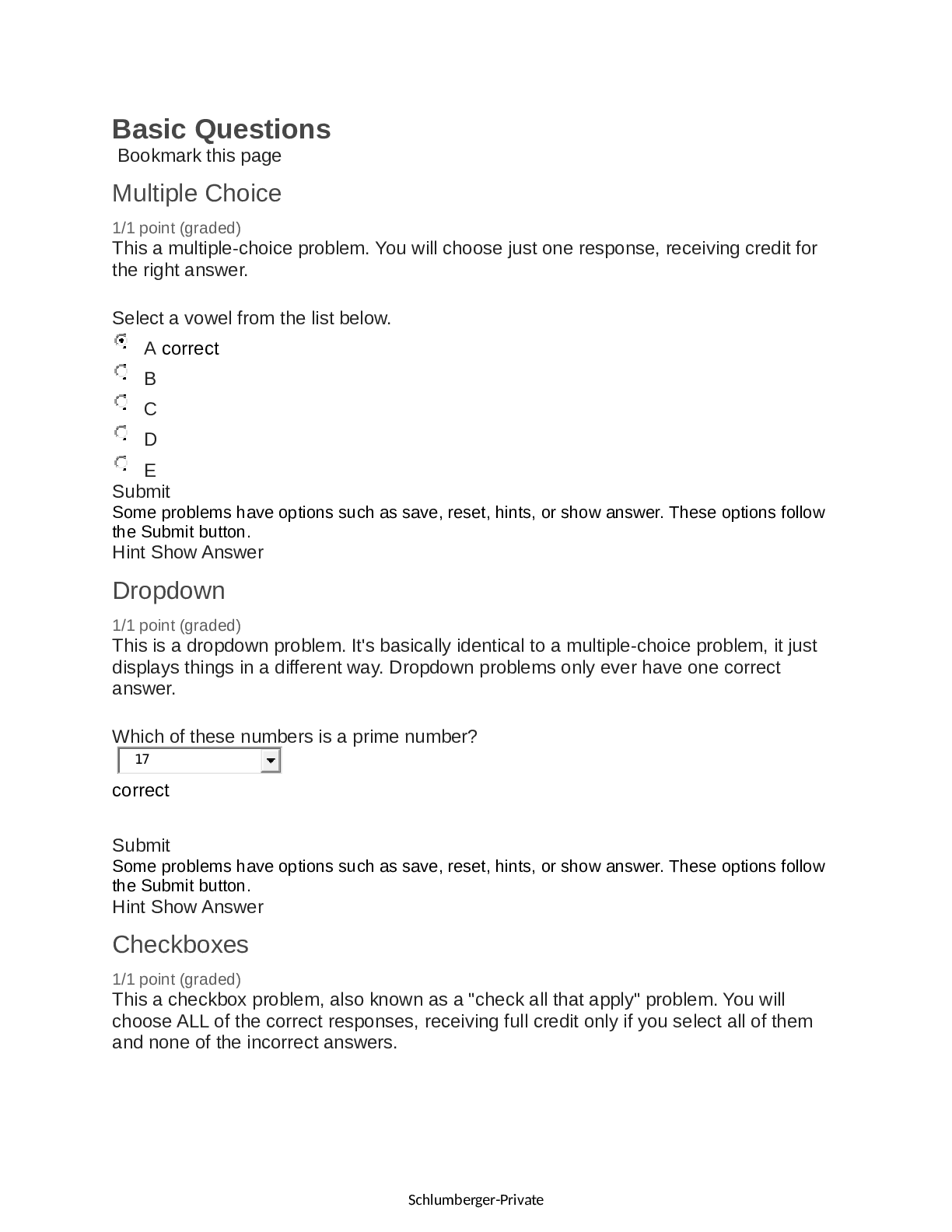
Basic Questions Bookmark this page Multiple Choice 1/1 point (graded) This a multiple-choice problem. You will choose just one response, receiving credit for the right answer. Select a vowel fro m the list below. A corre
...
Basic Questions Bookmark this page Multiple Choice 1/1 point (graded) This a multiple-choice problem. You will choose just one response, receiving credit for the right answer. Select a vowel fro m the list below. A correct B C D E Submit Some problems have options such as save, reset, hints, or show answer. These options follow the Submit button. Hint Show Answer Dropdown 1/1 point (graded) This is a dropdown problem. It's basically identical to a multiple-choice problem, it just displays things in a different way. Dropdown problems only ever have one correct answer. Which of these numbers is a prime number? correct Submit Some problems have options such as save, reset, hints, or show answer. These options follow the Submit button. Hint Show Answer Checkboxes 1/1 point (graded) This a checkbox problem, also known as a "check all that apply" problem. You will choose ALL of the correct responses, receiving full credit only if you select all of them and none of the incorrect answers. 17 Schlumberger-Private This problem also allows for partial credit! It uses a scheme called "Every Decision Counts," which is the standard scheme in this course. Each choice is worth an equal amount of the total credit (20% in this case). Try answering the question different ways to see how partial credit works! Which of the following are vowels? Select all that apply. A B C D E Complex Questions Bookmark this page Numerical Input 1/1 point (graded) Some problems require a numerical input. Your answer will be marked correct if it is within a certain range of the right answer (usually about 5%, though it varies from problem to problem). If you need a calculator, you can find an icon in the bottom right-hand corner of your window that will show one for you. Click the (i) button to learn how to use it. You can also find many good calculators online, from Google's push-button calculator to Wolfram Alpha. Enter the approximate value of the mathematical constant π (pi): correct 3.14 Submit Some problems have options such as save, reset, hints, or show answer. These options follow the Submit button. Show Answer Exponential Input 1/1 point (graded) Very large or very small numbers are best input with exponential notation. For instance, the number 8,000,000 (eight million) is equal to 8×10⁶. In this course, you can enter 3.14 Schlumberger-Private that as either 8 * 10 ^ 6 or as 8e6 in these problems. Try out exponential notation in the question below. One gigajoule is equal to 947817 British thermal units. Enter this number below in exponential notation. The tolerance on this question is 5%. BTU correct 9.47×10⁵ Submit Some problems have options such as save, reset, hints, or show answer. These options follow the Submit button. Show Answer Formatting Numbers While there is a 5% tolerance for most of the problems in this course, you must also be sure to enter your numbers in the right format. If you type "9.48e5" in the answer box above, the computer knows how to interpret that. Similarly, it knows how to interpret "9.48*10^5" or"9.48 * 10 ^ 5" (with spaces). What it doesn't know how to do is handle "9.48 x 10 ^ 5" with an "x" instead of a star. That little change throws things off. You need to use exactlythe right formatting. This is one of the most common errors made by people who are new to edX. If you are working on a numerical problem, you should double-check your formatting before entering each answer. Also - did you look at the answer to the last problem? It contains extra information about partial credit in numerical problems! Go take a look if you didn't see it before. Matching 1.0/1 point (graded) This is a matching exercise. Drag the elements on the left into the ones on the right to create a match. Click on the [-] to remove the match. You can match items with more than one other item, but you should choose the best match if you can. Click on the individual items for a better view if you need it. This problem type gives partial credit! Each correct assignment is worth one point; each error takes a point away. Play around with different matches to see how it works. 9.47e5 Schlumberger-Private Syllabus Quiz, Part 1 Bookmark this page Now that you know how to answer edX questions, it's time for your first quiz. Below are some quick questions to make sure you understood the most important highlights from our syllabus. This should be very easy - all of the information can be found on the Syllabus, the Schedule page, and in the introductory videos in this section. A syllabus quiz might seem a little silly, but reading the syllabus carefully will improve your course experience. Also, our course staff often spend a substantial amount of time answering questions where the answer is in the syllabus. We're always happy to help, but hopefully this quiz will help you know the most important information before starting the course. Unlike the practice problems, this quiz is graded, so do your best! This quiz appears as Work01 on your Progress page. Annotate Collaboration Schlumberger-Private 1/1 point (graded) Select all that apply. Which of the following are acceptable ways to collaborate? Working jointly to develop an overall approach to an assignment Taking someone else’s formulas and plugging in your numbers to get the final answer Posting answers to a problem before the deadline Getting hints from peers or course staff if you’re stuck correct Submit Some problems have options such as save, reset, hints, or show answer. These options follow the Submit button. Show Answer Graded Assignments 1/1 point (graded) Select all that apply. Which of the following types of graded assignments appear in this course? Quizzes Practice Exams Coursework Peer-graded Essays correct Submit Some problems have options such as save, reset, hints, or show answer. These options follow the Submit button. Show Answer Course Content 1/1 point (graded) In this course you’ll learn... (Select all that apply.) Details of solar and nuclear power Details of wind power and biofuels Environmental impacts including climate change, air pollution, and land use The flow of energy through modern economies, including costs Details of end uses of energy (tranportation, industry, etc.) Schlumberger-Private Lots of theory, e.g. electrodynamics as a foundation for understanding solar panels Lots of details about real world devices, e.g. the performance and cost of modern commercial solar panels How to critically compare energy options, using good references and combining quantitative and qualitative analysis correct Submit Some problems have options such as save, reset, hints, or show answer. These options follow the Submit button. Show Answer Deep Dives 1/1 point (graded) In this course, deep dives are... Underwater explorations Our recommended resources for learning more about a topic correct Required readings Submit Some problems have options such as save, reset, hints, or show answer. These options follow the Submit button. Show Answer Navigating from Page to Page 1.0/1.0 point (graded) EdX courses have many parts to them. You can find page links at the top of the site, sections and subsections in the course overview, and the Contact Us button on the far left of your window. Some subsections (like this one) also have multiple pages. Where can you find the links that take you to these pages? Select all that apply. Via the buttons in the "ribbon" at the top of the page. Via the left-right arrows in the "ribbon" at the top of the page. Via the left-right arrows at the bottom of the page. Via links in the course that take you to a specific page. Schlumberger-Private Syllabus Quiz, Part 2 Bookmark this page Certificates 1/1 point (graded) If you pass this course and pay for a verified certificate, where will you get your certificate? This course does not give certificates In e-mail In your edX dashboard correct In the mail Submit Some problems have options such as save, reset, hints, or show answer. These options follow the Submit button. Show Answer Grades 1/1 point (graded) Where can you find your grades? On the Progress page correct By e-mailing edX On the Discussion page This course is ungraded Submit Some problems have options such as save, reset, hints, or show answer. These options follow the Submit button. Show Answer Deadlines 1/1 point (graded) When are the deadlines for your work in this course? There are no assignments in this course. Every Sunday night at 23:30 UTC. As long as we get it done before the last day it's ok. correct Submit Some problems have options such as save, reset, hints, or show answer. These options follow the Submit button. Show Answer Where to Learn More 1/1 point (graded) Schlumberger-Private Where can you go for more information on this course and its topics? Select all that apply. I can visit the discussion boards. I can read the edX FAQ page. I can use the Energy Resources Page. I can search the web and beleive anything I read. I can search the web and carefully check what I find. I can read books on energy and the environment written in the last five years. I can read books on energy and the environment written fifty years ago. Background Questions Bookmark this page Background Questions These questions help you decide if you have appropriate background knowledge for this course. They cover the kinds of introductory physics and chemistry we assume students are comfortable with, as well as some small calculations. Please answer quickly with your best guess, and try to finish in less than 15 minutes. Annotate Unit Conversion Many of the problems on this page require you to convert from one unit to another - for instance, from miles to kilometers, or from gigajoules to kilowatt-hours. There are many different resources available online to help you with these conversions, and we encourage you to become familiar with one of them and use it throughout the course. Some options include: Using a search engine, like Google or Bing, and typing in "20 miles in kilometers" Using a site designed for unit conversions, like UnitJuggler. Using a tool like Wolfram Alpha, which does unit conversions and also has curated data on energy costs and energy content. Schlumberger-Private Annotate Power or Energy? 0.5/1 point (graded) Some of these options are examples of energy, and some are examples of power. Put a check in the box for all the examples of power. Which of these are examples of power? This sandwich has 600 Calories That exercise burns 500 Calories/hour correct Our household used only 100 kWh of electricity last month My computer uses 60 watts of electricity correct partially correct Explanation Calories and kilowatt-hours are both measurements of energy. Watts and calories per time are both measurements of power. Submit You have used 5 of 5 attemptsSome problems have options such as save, reset, hints, or show answer. These options follow the Submit button. Show Answer Answers are displayed within the problem Review Sandwich-Powered 0/1 point (graded) How many watts do I consume if I eat a 600-Calorie sandwich in 600 seconds? watts incorrect 4180 4180 Explanation Each calorie is 4.18 joules of energy. 600 food calories becomes 600,000 regular calories, which is 2,508,000 joules of energy. If we consume this over 600 seconds, the rate of consumption is 4,180 watts. Partial credit is awarded for an answer that missed the conversion between food calories and regular calories. Submit You have used 10 of 10 attemptsSome problems have options such as save, reset, hints, or show answer. These options follow the Submit button. Hint Show Answer Coal Mine Growth 4180 Schlumberger-Private 0/1 point (graded) A local coal mine grows by 12 acres per year. How many square meters per day is this? square meters per day incorrect 133.047452055 133.047452055 Explanation We convert this unit as follows: 12 acres1 year⋅1 year365 days⋅4046.86 m21 acre=133.0 m2/day Submit You have used 10 of 10 attemptsSome problems have options such as save, reset, hints, or show answer. These options follow the Submit button. Show Answer Power per Person 0/1 point (graded) Humanity used 160,000 Terawatt-hours of energy in 2015. If there are 7.4 billion people on earth and 8766 hours per year, how many Watts did each person use on average? Watts/person incorrect 2467 2467 Explanation We can do this problem by converting TWh to Watt-hours, then dividing by the number of hours in a year and the number of people on earth, as follows: 160000 TW⋅hours⋅1012 Watts1 TW⋅17.4×109 people⋅8766 hours=2500Watts/ person Submit You have used 10 of 10 attemptsSome problems have options such as save, reset, hints, or show answer. These options follow the Submit button. Show Answer Atom Facts 1/2 points (graded) This is a two-part question. Answer both parts before hitting the "Check" button. Which particles have about the same mass? Check two boxes, or check the box marked "none" if they all have very different masses. Proton correct 133.047452055 2467 Schlumberger-Private Neutron correct Electron None correct Which particles appear in equal numbers in all uncharged atoms? Check two boxes, or check the box marked "none" if uncharged atoms tend to have different numbers of all of these things. Proton correct Neutron Electron correct None incorrect Explanation Protons and neutrons are very similar in mass; electrons are about 2000 times lighter than either of them. Uncharged atoms have equal numbers of protons and electrons. Heavier atoms generally have a greater number of neutrons than protons. Submit You have used 5 of 5 attemptsSome problems have options such as save, reset, hints, or show answer. These options follow the Submit button. Show Answer Answers are displayed within the problem Review Chemical Equations 0.5/1 point (graded) Some of the chemical equations below might represent real-world reactions. Others are nonsense. Mark all of the equations that are valid, and leave the invalid ones unmarked. NaCl2+H2O→HCl+12NaOH 2Na+Cl2→2NaCl correct 6H2O+6CO2→C6H12O6+6O2 correct Pb+H2S→Au Course Content Questions Schlumberger-Private These questions cover content from within this course, including facts and calculations. Don't worry if you struggle with them - these are exactly the things that we're teaching! If you find them all easy you probably don't need to take the course. These questions serve several purposes: 1. They give you a taste of what you'll be able to do when you complete the course, 2. They serve as a benchmark of progress, for you and for us, and, 3. They help you see areas where you're strongest and weakest going into the course. Please answer quickly with your best guess, and try to finish in less than 40 minutes. Please spend no more than 10 minutes on each of the calculation problems near the end. There are detailed answers to each question that you can read after attempting it. We encourage you to read these, but not to spend too long figuring them out if you don't understand them right away. That's what the rest of the course is for. Annotate Electric Grid Efficiency 0.2/1 point (graded) What is the average efficiency of electric grids in developed countries? That is, what percentage of the electrical power generated at power plants actually makes it to end users in countries like Australia, the UK, and the US? % incorrect 94 1 Hint: Much too low. Explanation The World Bank keeps detailed data on electricity generation and losses in different countries. More than 90% of generated electricity is delivered to consumers in all developed countries, with an amazingly high average efficiency of 94%. The world average is 92%, but some countries are much lower, like India at 85%. Submit 94 Schlumberger-Private You have used 10 of 10 attemptsSome problems have options such as save, reset, hints, or show answer. These options follow the Submit button. Show Answer Answers are displayed within the problem Review Coal Power Efficiency 0.2/1 point (graded) What is the efficiency of a typical coal-fired power plant? That is, what percentage of the thermal energy from burning the coal is successfully turned into electricity? % incorrect 35 1 Hint: Much too low. Explanation Coal plants vary, but are typically around 35% efficient. Some older plants are much lower, and some advanced plants are much higher (near 50%), but most in the world are in the mid 30's. Submit You have used 10 of 10 attemptsSome problems have options such as save, reset, hints, or show answer. These options follow the Submit button. Show Answer Answers are displayed within the problem Review First Climate Change Treaty 0/1 point (graded) In what year did the first global treaty regarding climate change enter into force? Please answer with a number, e.g. '2016' incorrect 1994 1 Explanation 35 1994 Schlumberger-Private The first international treaty regarding climate change was the UN Framework Convention on Climate Change, which was signed in 1992 and entered into force in 1994 (though it set no binding limits on greenhouse gas emissions). Submit You have used 5 of 5 attemptsSome problems have options such as save, reset, hints, or show answer. These options follow the Submit button. Show Answer Answers are displayed within the problem Review SPENDING ON CLIMATE CHANGE In your opinion, about how much of total global GDP should be spent on managing climate change? This is an opinion question with no right or wrong answer RESULTS 3% 35% 10% 35% 1% 14% 30% Schlumberger-Private 13% 0.1% 4% Results gathered from 159 respondents. FEEDBACK There is no right answer here, but keep in mind how serious high responses (over 10%) are. The US' notoriously high military expenditure is only 3.5% of its GDP today. Even at the peak of World War II, when many common goods were rationed, people were conscripted into the military, and many civilian factories were converted to make equipment for war, the US only spent 1/3 of its GDP on the military. ECONOMIC IMPACT OF CLIMATE CHANGE What is your best estimate of the future economic impact of climate change by 2050 as a % of global GDP lost due to climate change damages? Assume a 'business-as-usual' scenario (greenhouse gas emissions continue to rise with little concerted effort to control them). This number is highly uncertain, but some answers are more plausible than others. RESULTS 6-10% 32% 11-20% Schlumberger-Private 32% 1-5% 19% 21-50% 12% Over 50% 5% Less than 1% 1% Results gathered from 161 respondents. FEEDBACK Most academic estimates place the damage around 1-5% by 2050. There is tremendous uncertainty, but it's hard to make a case for how damage would be more than 20%. Mortality Rates 3/3 points (graded) This problem has three parts. Answer all three before clicking the "Check" button. Schlumberger-Private How many premature deaths are caused by energy-related water pollution each year? Almost zero Thousands correct Millions Hundreds of millions How many premature deaths are caused by energy-related air pollution each year? Almost zero Thousands Millions correct Hundreds of millions How many premature deaths are currently caused by climate change each year? Almost zero Thousands correct Millions Hundreds of millions Submit You have used 2 of 2 attemptsSome problems have options such as save, reset, hints, or show answer. These options follow the Submit button. Show Answer Correct (3/3 points) Review Sulfur and Carbon 0/2 points (graded) This problem has two parts. Answer both before clicking the "Check" button. Every year humanity emits millions of tons of sulfur and billions of tons of CO2. Sulfur forms particulate air pollution that kills around 1 million people per year, and CO2 raises global average temperatures, 0.8°C above pre-industrial temperatures so far. Schlumberger-Private Suppose humanity continued to emit air pollutants and CO2 following “business-asusual”, and then suddenly in 2050 cut emissions of both to 0. Approximately how long would it take for sulfate-driven mortality from particulate matter to fall by 50%? a week correct a year hundreds of yearsincorrect thousands of years Approximately how long would it take for global temperatures to drop halfway from their peak to pre-industrial average? a week a year hundreds of yearsincorrect thousands of years correct Explanation It will only take a few days for most of the air pollution to fall out of the atmosphere and stop affecting peoples' lungs and cardiovascular systems. There is some residual mortality that would last longer. However, carbon dioxide lingers in the atmosphere for much longer, and the resulting temperature change will be with us for thousands of years. Submit You have used 2 of 2 attemptsSome problems have options such as save, reset, hints, or show answer. These options follow the Submit button. Show Answer Relative Cost of Energy 1/4 points (graded) Please compare the prices of each of the below to crude oil on an energy basis. Select the closest answer. For example, if coal cost 8 times as much as crude oil for the same amount of energy, you would answer "Much more." If electricity cost 10% less than oil, you would select "Less." There is some regional variation in these prices, so try to imagine world average prices if you can. This is a multi-part question. Make sure you answer all the parts before clicking "Check". Natural Gas costs _________ than crude oil for the same amount of energy Much less (less than 1/3 the cost of oil) Schlumberger-Private incorrect Much less (less than 1/3 the cost of oil) Coal costs _________ than crude oil incorrect Much less (less than 1/3 the cost of oil) Electricity for a large industrial consumer costs _________ than oil incorrect More Electricity for a home consumer costs _________ than oil correct Much more (more than 2x the cost of oil) Explanation In July 2018 oil prices are around $72/barrel, and since there are ~6.1 GJ of energy in 1 barrel of oil, it costs $11.8/GJ. Natural gas costs $2.85/MMBTU, which translates to $2.85/GJ, about a quarter the price of oil. Coal costs only $2/GJ in the US, 1/5 the price of oil, though it has the largest regional variations. Electricity for large industrial customers is around $.07/kWh on average, which translates to $20/GJ, higher than oil, and it's much higher yet in some areas with high electricity prices. Electricity for home consumers is usually significantly higher than for industrial customers, around $.13/kWh on average, which is $36/GJ, dramatically more expensive than oil (but more useful - electricity for a lightbulb is much more convenient than burning oil for light). These relationships were qualitatively the same when oil and gas prices were much higher before the 2014 crash (~$100/barrel and ~$5/MMBTU), with the main exception being that electricity for industrial customers was comparable to the price of oil rather than being much higher. Submit You have used 3 of 3 attemptsSome problems have options such as save, reset, hints, or show answer. These options follow the Submit button. Show Answer Much less (less than 1/3 the cost of oil) More Much more (more than 2x the cost of oil) Schlumberger-Private Answers are displayed within the problem Review Fraction of Energy From Fossil Fuels 0/1 point (graded) What fraction of humanity's energy supply is in the form of fossil fuels? % incorrect 80 1 Explanation About four fifths (80%) of total energy appropriated by humans is from fossil fuels. The next highest source is nuclear energy at 7%. Fossil's portion of human energy supply has fallen slightly in recent decades (down from 90% in the 1970's) thanks to the growth of renewables. But it is still dramatically higher than all of human history before 1850, when close to 100% human energy was from biomass. Submit You have used 5 of 5 attemptsSome problems have options such as save, reset, hints, or show answer. These options follow the Submit button. Show Answer Answers are displayed within the problem Review The History of Fossil Fuels 0/1 point (graded) England was the first country to industrialize. In what year did it first get more than half of its energy from fossil fuels? incorrect 1905 \(\) Explanation Fossil fuels first overtook biomass (mostly trees and crops) as England's primary energy source around the year 1900, which you may find surprisingly recent. Submit You have used 5 of 5 attemptsSome problems have options such as save, reset, hints, or show answer. These options follow the Submit button. Show Answer 80 1905 Schlumberger-Private Answers are displayed within the problem Review Fraction of Energy From Fossil Fuels - In The Future 1/1 point (graded) What do you think the fraction of human energy from fossil fuels will be in 2050? This is an opinion question with no right answer. correct 50 \(\) Explanation The answer is marked as 50, but it accepts a range from 0 to 100. We just had to put in a number; we don't consider 50 to be the "correct" percentage. Submit You have used 5 of 5 attemptsSome problems have options such as save, reset, hints, or show answer. These options follow the Submit button. Show Answer Answers are displayed within the problem Review Composition of Global Energy Supply 1/8 points (graded) Estimate the fraction of global primary energy supplied by the following sources. Use rough numbers and don’t worry about ensuring that they sum to exactly 100%. This is a multi-part question. Make sure you answer all the parts before clicking "Check". Biomass % incorrect 7.5 \(\) Coal % incorrect 25 \(\) 50 7.5 25 Schlumberger-Private Hydropower % correct 1.8 \(\) Natural Gas % incorrect 20 \(\) Nuclear Power % incorrect 3.5 \(\) Oil % incorrect 34 \(\) Solar % incorrect .05 \(\) Wind % incorrect .05 \(\) Explanation These values are taken from the IEA's Sankey Diagram. Wind and solar together make up less than .05% of the world's primary energy supply. These values are very different for individual countries - the IEA Sankey tool allows you to look at different countries and see, for example, how much higher the fraction of coal is in China and how much higher the fraction of solar and wind is in Germany. Submit You have used 5 of 5 attemptsSome problems have options such as save, reset, hints, or show answer. These options follow the Submit button. Show Answer Answers are displayed within the problem Review 1.8 20 3.5 34 .05 0.05 Schlumberger-Private Fraction of Energy as Electricity 0/1 point (graded) What percentage of global energy used by consumers is in the form of electricity? % incorrect 20 \(\) Explanation About one fifth (20%) of energy used by consumers globally is in the form of electricity. Despite the complexity of generating and distributing it, this number has increased steadily since the late 1800's because electricity is so incredibly convenient and useful. The International Energy Agency has good data for issues like these. Some of it can be accessed graphically at http://www.iea.org/sankey/ which shows energy supplies (primary energy) on the left and how energy flows to end uses on the right. We'll cover how to interpret these kinds of "sankey diagrams" in this course. Submit You have used 5 of 5 attemptsSome problems have options such as save, reset, hints, or show answer. These options follow the Submit button. Show Answer Answers are displayed within the problem Review Energy for Computing 0/1 point (graded) What percentage of worldwide electricity consumption is used for computing devices? % incorrect 8 \(\) Explanation This is difficult to estimate, but is likely in the range of 5-10% as we'll discuss further in the "Energy Demand and Efficiency" Section of the course. Submit You have used 5 of 5 attemptsSome problems have options such as save, reset, hints, or show answer. These options follow the Submit button. Show Answer 20 8 Schlumberger-Private Answers are displayed within the problem Review Calculating The Cost of Mitigating CO2 Emissions 0/1 point (graded) Suppose gasoline has an emissions factor of 91g of CO2/MJ and costs $1.52/liter, and biodiesel has an emissions factor of 54g of CO2/MJ and costs $1.92/liter. You may assume gasoline and biodiesel both have energy densities of 38 MJ/liter. What is the cost of mitigating CO2 by switching from gasoline to biodiesel, in dollars per kilogram of CO2 emissions prevented? We'll cover how to do calculations like this in the course, so don't worry if you struggle. Give it your best effort but please don't spend more than 10 minutes on it. dollars per kg CO2 incorrect 0.284495021337 \(\) Explanation The cost of mitigation is equal to the additional cost for biodiesel divided by the carbon savings that it provides. Since the masses above are given in grams, we will need to convert to kilograms. \[ \frac{$1.92/L - $1.52/L}{\left(91 \ g/MJ - 54 \ g/MJ \right)} \cdot \frac{1 \ L}{38 \ MJ} \cdot \frac{1000 g}{1 kg} = $0.284\] Submit You have used 10 of 10 attemptsSome problems have options such as save, reset, hints, or show answer. These options follow the Submit button. Hint Show Answer Answers are displayed within the problem Review Calculating Levelized Cost of Electricity from Coal 0/1 point (graded) A proposed coal power plant has a capital cost of $3450 per kW of generating capacity. It is expected to run for 94% of the year. Its overall thermal efficiency is 39%. Fixed operations and maintenance (FOM) costs have been estimated at $48/kW-year, and variable O&M costs have been estimated at $0.0063/kWh. Coal costs $1.2/GJ. The capital charge factor (or capital charge rate) is 13%. 0.284495021337 Schlumberger-Private What is the levelized cost of electricity for this plant? We'll cover how to do calculations like this in the course, so don't worry if you struggle. Give it your best effort but please don't spend more than 10 minutes on it. dollars per kWh incorrect 0.077355224805 \(\) Explanation We need the final answer in dollars per kilowatt-hour, so we will convert all power units to kilowatts and all times to hours in this answer. Fixed Costs: Our fixed costs are the financing on the plant and the fixed O&M costs. The capital cost of $3450, at a charge factor of 13% becomes a yearly cost of $448.50 per kilowatt. If we are using the plant for 8230 hours per year, our fixed costs come out to: \[ \frac{$448.50}{8230 \ kWh} + \left( \frac{$48}{1 \ year} \cdot \frac{1 \ year}{365 \cdot 24 \ hours} \right) = $0.0600 \ per \ kWh \] Variable Costs: We have two variable costs: fuel, and the O&M costs. One gigajoule is 278 kilowatt-hours, so our cost for coal is: \[ \frac{$1.20}{1 \ GJ} \cdot \frac{1 \ GJ}{278 \ kWh} = $0.00432 \ per \ kWh. \] With our plant's 39% efficiency, the effective cost for our fuel is higher: \[ \frac{$0.00432 \ per \ kWh}{0.39} = $0.0111 \ per \ kWh \] Adding in variable O&M costs, we get a total of: \[ $0.0111 + $0.0063 \ per \ kWh = $0.0174\] Total Cost: \[ $0.0600 + $0.0174 = $0.0774 \ per \ kWh \] Submit You have used 10 of 10 attemptsSome problems have options such as save, reset, hints, or show answer. These options follow the Submit button. Hint Show Answer Answers are displayed within the problem Review Outside References 1/1 point (graded) Did you use any outside references (like Wikipedia) when finding answers to these questions? It's ok if you did - this question is for our research purposes. No, I did this all on my own. I consulted outside resources for mathematical calculation only. 0.077355224805 Schlumberger-Private I consulted outside resources to look up scientific facts. I consulted outside resources for both calculations and scientific facts. correct Schlumberger-Private Simple Sankey 1/1 point (graded) Consider the Sankey diagram below, which represents the monthly flow of money for a couple, from income to shared bank account to expenses. Diagram created using SankeyMATIC Which of the following statements is definitely true? We cannot tell whose income was used to pay for what expenses The couple is going into debt The husband pays all of the bills 20% of the couple's combined income goes to taxes correct Answer Correct: Correct! Submit You have used 2 of 2 attemptsSome problems have options such as save, reset, hints, or show answer. These options follow the Submit button. Sankey Diagram Assignment Here's a Sankey diagram for the US, produced by Lawrence Livermore National Laboratory. We used this to make the simplified US Sankey diagram you saw in the video lecture. It's in units of Quadrillion BTU ("Quads"). 1 Quad is slightly more than 1 EJ. Click on the image for a larger version. Figure 1. This Sankey diagram of the US energy system in 2015 shows the flow of energy from intitial resources like petroleum and coal, through conversions like electricity generation, and to end users, which are divided into four major sectors. As mentioned in the video lecture, take the numbers for "rejected energy" with a grain of salt. Source: LLNL. We can use this to do some interesting calculations. For example, David mentioned that almost all coal in the US is used to generate electricity, but here we can see that a small amount is used for other purposes. What percentage is used for electricity? We can see that 14.3 Quads were used for electricity generation, out of 15.7 Quads used in total, or 90%. Another thing we can notice is the differences in electricity consumption between Schlumberger-Private sectors – the Residential sector consumed 4.78 Quads, or 38% of the total 12.6 Quads of electricity generation, while the Transportation sector consumed only .03 Quads, .2% of the total generation. Annotate Petroleum for Transportation 0/5 points (graded) What percentage of Transportation is powered by petroleum? % incorrect 92 \(\) Explanation Total transportation use was 27.7 Quads; petroleum provided 25.4 Quads of that, which is about 92%. Submit You have used 5 of 5 attemptsSome problems have options such as save, reset, hints, or show answer. These options follow the Submit button. Show Answer Answers are displayed within the problem Review Electricity from Coal 0/5 points (graded) What percentage of primary energy flowing into electricity generation came from coal? % incorrect 38 \(\) Explanation Total electricity generation use was 38 Quads; coal provided 14.3 Quads of that, which is about 38%. Submit You have used 5 of 5 attemptsSome problems have options such as save, reset, hints, or show answer. These options follow the Submit button. Show Answer Answers are displayed within the problem Review Low Carbon Sources 0/5 points (graded) 92 38 Schlumberger-Private What percentage of all US primary energy came from "low carbon" sources (biomass, geothermal, wind, hydro, nuclear, solar)? % incorrect 18 \(\) Explanation Total US primary energy was 97.5 Quads. Biomass provided 4.72, geothermal provided .224, wind provided 1.82, hydropower provided 2.39, nuclear provided 8.34, and solar provided .532. The total is about 18 Quads, which is also about 18% of the total. Remember that this chart uses the "accounting trick" David mentioned, where the primary energy from direct-to-electricity sources like hydro, wind, and solar is multiplied by 3 to represent the amount energy required from fossil fuels or nuclear power to generate the same amount of electricity. Submit You have used 5 of 5 attemptsSome problems have options such as save, reset, hints, or show answer. These options follow the Submit button. Show Answer Answers are displayed within the problem Review Natural Gas Consumption 1/1 point (graded) Which sector of the economy had the most direct natural gas consumption? Residential Commercial Industrial correct Transportation Submit You have used 1 of 2 attemptsSome problems have options such as save, reset, hints, or show answer. These options follow the Submit button. SaveSave Your Answer Show Answer Correct (1/1 point) Review Rooftop vs Utility Solar 0/1 point (graded) Some solar energy is shown flowing into the Residential sector, representing rooftop PV, and some into electricity generation, representing utility-scale solar installations. 18 Schlumberger-Private How do these flows compare in magnitude? They are about the same. correct There is notably more utility-scale solar power.incorrect There is notably more rooftop solar power. Explanation Rooftop solar power provided about as much electricity as was generated by electricity companies in 2015. Submit You have used 1 of 1 attemptSome problems have options such as save, reset, hints, or show answer. These options follow the Submit button. Show Answer Answers are displayed within the problem Sankey Diagram Assessment Part 2 Here's a Sankey diagram for the world in 2013, from an interactive tool freely available from the International Energy Agency. This is a great source for looking up the energy supplies and uses in different countries and regions since the 1970's. It has some important differences from the LLNL Sankey; for example, it shows imports and exports, shows the transformation of oil in refineries, and lumps residential and commercial energy use together as "Other." It uses units of "Million tons of oil equivalent" ("Mtoe") and petajoules. At the bottom you can see options to scroll through different years and look look at different graph types, like line graphs of some of the individual flows to easily visualize them over time. These diagrams do not use the "factor of 3" accounting that we discussed in the video and that is used in the LLNL diagram above, so the amount of energy flowing into electricity generation from renewables like wind and solar is equal to the actual amount of electricity they generate. Again, you can click on the image to view a larger version, or on the link above to get an interactive version. Figure 2. This Sankey diagram of the world's energy system in 2013 shows the flow of energy from initial resources like petroleum and coal, through conversions like electricity generation, and to end users, which are divided into three major sectors. Source: IEA. Please visit the interactive version and explore it a bit for interesting trends. Then answer these questions. Schlumberger-Private Annotate Coal for Electricity Around the World 0/1 point (graded) You can click on the "Power Station" box to see the composition of inputs to electricity generation. Did coal's fraction of energy supplied for world electricity generation increase or decrease from 1990 until 2013? Stayed about the same Decrease incorrect Increase correct Explanation The change was from 41% to 49%, which is about a one-fifth increase. Submit You have used 1 of 1 attemptSome problems have options such as save, reset, hints, or show answer. These options follow the Submit button. Show Answer Answers are displayed within the problem Review World Electricity Growth 0/1 point (graded) Look at the actual generation coming out of the power plants on the diagram. How much did world electricity generation grow from 1990 to 2013? About doubled correct About 50% increase incorrect Stayed about the same About 50% decrease Dropped to near zero. Explanation The change was from 1017 Mtoe to 2006 Mtoe, so the amount roughly doubled. Submit You have used 1 of 1 attemptSome problems have options such as save, reset, hints, or show answer. These options follow the Submit button. Show Answer Answers are displayed within the problem Review Angola Fossil Exports Schlumberger-Private 0/5 points (graded) Some countries that produce fossil fuels use very little of them, and export heavily. Let's examine Angola. Set the country in the IEA tool to "Angola" to see the Sankey diagram for that country. What fraction of Angola's total Production and Imports (all energy types) were exported in 2013? % incorrect 83 \(\) Explanation Angola exported 85.26 Mtoe, out of the 102.82 Mtoe they produced in total. This is about 83%. Submit You have used 5 of 5 attemptsSome problems have options such as save, reset, hints, or show answer. These options follow the Submit button. Show Answer Answers are displayed within the problem Review Japanese Coal Production 0/5 points (graded) Japan's coal mining industry has waned in recent decades after being unable to compete with cheap coal imports, to the point that the IEA's tool shows no local production in 2013 (though there is in fact a small amount). Scroll through the years 1973-2013 for Japan using the slider on the bottom of the page. You will see a steady decline in local coal production. What percentage of Japan's total coal supply came from local production in 1973? % incorrect 30 \(\) Explanation In 1973, Japan produced about 17.9 Mtoe, and imported 41.3 Mtoe. This made its production about 30% of its total supply. \[ \frac{17.9 \ Mtoe}{17.9 \ Mtoe + 41.3 \ Mtoe} \] Coal Use in the USA 1/1 point (graded) How is coal used in the United States? 83 30 Schlumberger-Private Mostly for industrial applications Almost entirely for electricity generation correct About equally split between electricity and transportation Mostly converted into liquid or gas fuels Coal Use in the China 1/1 point (graded) How is coal used in China? Split between electricity and industry correct Almost entirely for electricity generation Mostly for industrial applications Mostly converted into liquid or gas fuels Energy Growth 1/1 point (graded) Which region of the world is currently growing most quickly in terms of energy use? South America China correct Europe The United States Africa India Submit You have used 1 of 2 attemptsSome problems have options such as save, reset, hints, or show answer. These options follow the Submit button. SaveSave Your Answer ResetReset Your Answer Show Answer Correct (1/1 point) Review US Oil Usage 1/1 point (graded) Where does most of the United States' oil energy get used? For electricity generation For lighting Schlumberger-Private For trade with other countries For transportation correct What's a commodity? 0/1 point (graded) When we say that a particular good is a commodity, what does that mean in this context? Commodity goods have preference- or taste-based attributes that change how specific people buy them.incorrect All versions of a commodity are treated as identical as long as they pass some basic quality standards correct A commodity good can be created anywhere in the world. Price Assignment Knowing where to find energy prices and being able to reference them quickly is a key skill for energy experts. In the video lecture you heard David mention that US electricity prices used to be heavily influenced by oil prices, but aren’t anymore since the US stopped generating significant amounts of electricity from oil. Let’s practice looking up historical energy prices by investigating this claim. Check out the Energy Resources page for suggested data sources for these questions. In general the US EIA has great historical data on energy use and prices in the US. Annotate Oil and Electricity 1.6666666666666667/10 points (graded) First let’s see if the spike in oil prices corresponded with a spike in electricity prices in the US from 1973 to 1974. This is a multi-part problem. Fill in all boxes before submitting your answer. Some questions ask for "change" in prices - if you find an increase use a positive number, and for a decrease, enter a negative number. What were the oil import prices in 1974 as a percentage of the 1973 prices? % incorrect 1 Schlumberger-Private 280 \(\) How much did US retail electricity prices change from 1973 to 1974?
[Show More]






![Preview of eBook [PDF] Engineering Circuit Analysis 10th Edition By William H. Hayt, Jr. Jack E. Kemm](https://browseimages.nyc3.digitaloceanspaces.com/paper-images/2024/Aug/29/k4rqNg0d2024-08-29-10-2866d023360ac33.png)







.png)



.png)


.png)


