Kaplan Health Assessment A Practce Exam
Kaplan Health Assessment A Practce Exam
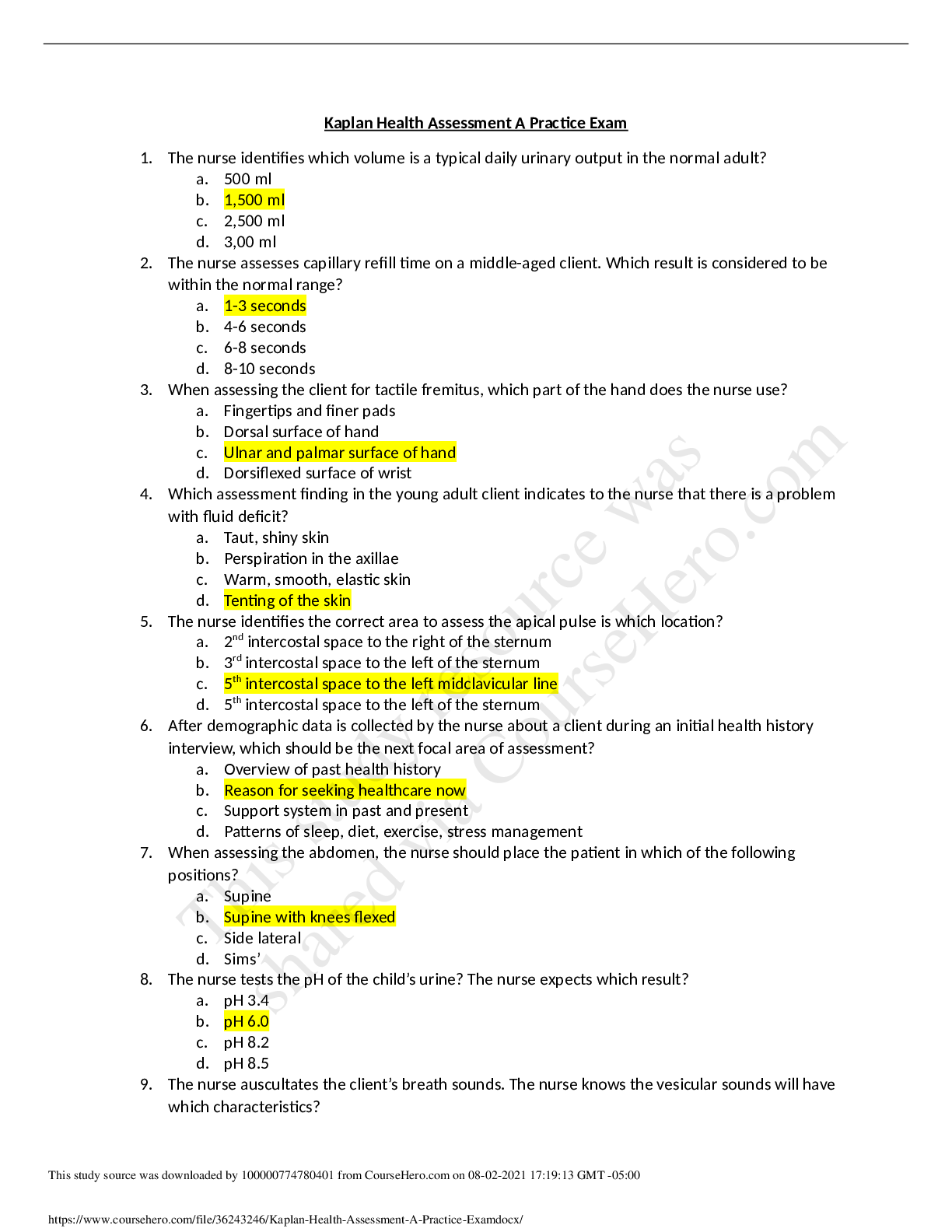
1. The nurse identfes which volume is a typical daily urinary output in the normal adult?
a. 500 ml
b. 1,500 ml
c. 2,500 ml
d. 3,00 ml
...
Kaplan Health Assessment A Practce Exam
Kaplan Health Assessment A Practce Exam
1. The nurse identfes which volume is a typical daily urinary output in the normal adult?
a. 500 ml
b. 1,500 ml
c. 2,500 ml
d. 3,00 ml
2. The nurse assesses capillary refll tme on a middle-aged client. Which result is considered to be
within the normal range?
a. 1-3 seconds
b. 4-6 seconds
c. 6-8 seconds
d. 8-10 seconds
3. When assessing the client for tactle fremitus, which part of the hand does the nurse use?
a. Fingertps and fner pads
b. Dorsal surface of hand
c. Ulnar and palmar surface of hand
d. Dorsiflexed surface of wrist
4. Which assessment fnding in the young adult client indicates to the nurse that there is a problem
with fluid defcit?
a. Taut, shiny skin
b. Perspiraton in the axillae
c. Warm, smooth, elastc skin
d. Tentng of the skin
5. The nurse identfes the correct area to assess the apical pulse is which locaton?
a. 2nd intercostal space to the right of the sternum
b. 3rd intercostal space to the lef of the sternum
c. 5th intercostal space to the lef midclavicular line
d. 5th intercostal space to the lef of the sternum
6. Afer demographic data is collected by the nurse about a client during an inital health history
interview, which should be the next focal area of assessment?
a. Overview of past health history
b. Reason for seeking healthcare now
c. Support system in past and present
d. Paterns of sleep, diet, exercise, stress management
7. When assessing the abdomen, the nurse should place the patent in which of the following
positons?
a. Supine
b. Supine with knees flexed
c. Side lateral
d. Sims’
8. The nurse tests the pH of the child’s urine? The nurse expects which result?
a. pH 3.4
b. pH 6.0
c. pH 8.2
d. pH 8.5
9. The nurse auscultates the client’s breath sounds. The nurse knows the vesicular sounds will have
which characteristcs?
This study source was downloaded by 100000774780401 from CourseHero.com on 08-02-2021 17:19:13 GMT -05:00
https://www.coursehero.com/file/36243246/Kaplan-Health-Assessment-A-Practice-Examdocx/
This study resource was
shared via CourseHero.coma. Loud, coarse, blowing sound heard over the trachea
b. Musical sounds or vibratons commonly heard on expiraton
c. Harsh sounds heard over the mainstem bronchi
d. Sof and low-pitched breezy sounds heard over most of the peripheral lung felds
10. A child’s urine is tested for specifc gravity, color, and clarity. Which of the following reports
would the nurse consider normal?
a. 1.020, yellow, clear
b. 1.005, deep orange, clear
c. 1.035, deep orange, cloudy
d. 1.001, yellow, cloudy
11. The nurse assesses the cardiac status of the client and identfes an increased pulse pressure.
Pulse pressure can best be described by which defniton?
a. The difference between systolic and diastolic blood pressure readings
b. The intensity of peripheral pulses
c. The differences between the apical pulse and the radial pulse
d. The volume of the stroke and the heart rate
12. The nurse identfes that which set of vital signs is within the normal range for an adult?
a. BP 80/50 mm Hg, P 110 beat/minute, R 32 breaths/minute
b. BP 110/80 mm Hg, P 56 beats/minute, R 20 breaths/minute
c. BP 120/70 mm Hg, P 68 beats/minute, R 16 breaths/minute
d. BP 130/90 mm Hg, P 72 beats/minute, R 24 breaths/minute
13. When performing a physical assessment, the home health nurse notes that the eyes of the client
involuntarily move rapidly from side to side. Which of the following term should the nurse in
chartng to describe this observaton?
a. Strabismus
b. Nystagmus
c. Photophobia
d. Ptosis
14. The nurse prepares to assess a client’s ears and hearing. The nurse gathers which pieces of
equipment?
a. A tuning fork and an otoscope
b. A tonometer and an ophthalmoscope
c. An otoscope and a sphygmomanometer
d. A percussion hammer and a stethoscope
15. Afer receiving report, the nurse assesses the client who is having Cheyne-Stokes respiratons.
Which is the BEST descripton of the breathing patern the nurse expects to see?
a. Marked increased rate and depth of respiratons
b. Irregular paterns of shallow breathing alternatng with periods of apnea
c. Regular rapid and shallow breathing
d. Irregular paterns of rapid waxing, and waning breathing alternatng with periods of
apnea.
16. The client’s visual acuity is tested with a Snellen chart and reported to be 20/60. The nurse
knows the number 60 indicates which measurement?
a. The distance at which the client stood from the chart
b. The distance at which the client with normal vision can read the chart
c. The client’s vision is 60% less than that of the client with normal vision.
d. The client has three tmes poorer vision in the right eye than in the lef eye
This study source was downloaded by 100000774780401 from CourseHero.com on 08-02-2021 17:19:13 GMT -05:00
https://www.coursehero.com/file/36243246/Kaplan-Health-Assessment-A-Practice-Examdocx/
This study resource was
shared via CourseHero.com17. The nurse prepares to conduct a physical assessment on the new client in the assisted living
facility. The nurse determines which observaton will have the most impact on the nursing
assessment?
a. Presence of assistve devices for vision and hearing
b. Indicatons of anxiety
c. Appearance and appropriateness of clothing and grooming
d. Posture, height, and weight
18. The nurse recognizes the physical assessment should be completed in what order?
a. Inspecton, palpaton, percussion, and auscultaton
b. Inspecton, auscultaton, percussion, and palpaton
c. Auscultaton, inspecton, palpaton, and percussion
d. Percussion, auscultaton, inspecton, and palpaton
19. The nurse in the outpatent clinic receives a phone call from a patent complaining of a rash.
Which of the following actons could the nurse take FIRST?
a. Make an appointment for the patent to see the physician
b. Determine if the patent is taking any new medicatons
c. Aske the patent how he is feeling
d. Instruct the patent to apply a cream to the rash
20. The clinic nurse performs a neurological assessment on a new patent. When the right leg is
tapped for the patellar reflex, there is no movement. Which of the following actons should the
nurse take FIRST?
a. Ask the patent what is causing the lack of reacton
b. Tell the patent to take several quick breaths and then tap the tendon again
c. Tap the tendon again while the patent is pulling against interlaced, locked fngers.
d. Tap the tendon again using more force with the pointed end of the reflex hammer.
21. Which is the average pulse range the nurse ANTICIPATES when conductng a physical
examinaton for an adult client?
a. 40 to 60 beats/minute
b. 60 to 80 beats/minute
c. 60 to 100 beats/minute
d. 70 to 110 beats/minute
22. Afer completng the data collecton process of the client’s health history interview, which acton
should the nurse take FIRST?
a. Inform the client about what to expect during the physical examinaton
b. Summarize the highlights of the interview and permit the client to add or clarify
informaton
c. Thank the client and contact the physician to report the fndings.
d. Document the history in the client’s record of the client including normal and abnormal
fndings.
23. The nurse auscultates the client’s lung felds and identfes a pleural fricton rub. Which is the
BEST descripton of a pleural fricton rub?
a. Gurgling sounds commonly heard on inspiraton
b. Squeaky sounds heard during inspiraton and expiraton
c. Gratng sound or vibraton heard during inspiraton and expiraton
d. Loud transmission of voice sounds caused by consolidaton of lung
24. The client is diagnosed with emphysema. Which sound does the nurse expect to hear when
percussing the lungs?
This study source was downloaded by 100000774780401 from CourseHero.com on 08-02-2021 17:19:13 GMT -05:00
https://www.coursehero.com/file/36243246/Kaplan-Health-Assessment-A-Practice-Examdocx/
This study resource was
shared via CourseHero.coma. Dullness
b. Tympany
c. Hyperresonance
d. Flatness
25. In the mental status examinaton, the nurse asks the client to compare and contrast similar
objects and to interpret proverbs. Which client ability is the nurse assessing?
a. Abstract reasoning
b. Judgement
c. Insight
d. Orientaton
26. To assess the pedal pulse, the nurse palpates in which locaton?
a. The region in the back of the knee
b. The top of the foot
c. The groin area
d. The inner side of the ankle below the medial malleolus
27. The nurse places a pulse oximetry probe on the client newly admited for evaluaton of a seizure
disorder. The client asks, “why do I have to have this thing on me?” which response by the nurse
is BEST?
a. “it enables your IV fluids to run at a nice steady rate”
b. “It monitors your pulse rate on an ongoing basis”
c. “it tells us if you blood pressure stays within normal limits”
d. “it measures the amount of oxygen circulatng in your blood”
28. Which of these methods should the nurse use to test the gag reflex?
a. Request that the patent speak
b. Ask the patent stck out the tongue and move it side to side
c. Touch the back of the throat with a coton-tpped applicator.
d. Instruct the patent to drink a small amount of water
29. Which statement describes the CORRECT procedure for the nurse to use to examine a client’s
pupils?
a. Compare the size of both pupils and check the reacton of light
b. Look for red spots around the pupil’s circumference
c. Examine the pupils with an ophthalmoscope
d. Examine the right eye with the light at the lef side of the head, and the lef eye with the
light at the right side of the head.
30. The nurse identfes that which risk factor is MOST likely to contribute to an elevaton of the
client’s blood pressure?
a. A high pressure job
b. Daily vitamins
c. One glass of wine per day
d. Daily exercise
[Show More]