NSG 6001 Midterm Exam Question and Answers
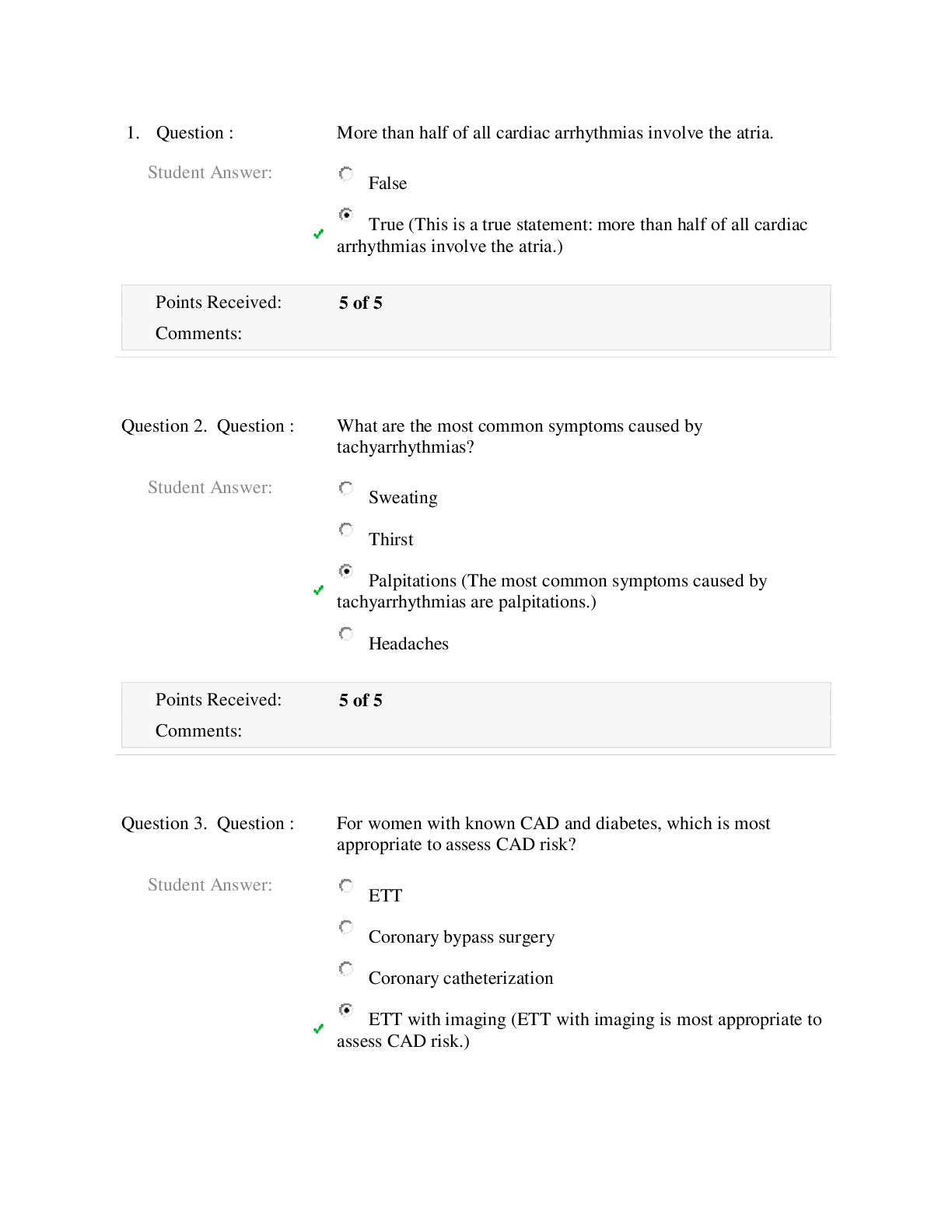
1. Question : Your patient is morbidly obese and cannot sit on a bicycle or walk a treadmill. She
also has marked and severe emphysema. You need to make an assessment of the
...
NSG 6001 Midterm Exam Question and Answers
1. Question : Your patient is morbidly obese and cannot sit on a bicycle or walk a treadmill. She
also has marked and severe emphysema. You need to make an assessment of the
risk of significant CAD and your patient’s family says that their relative had their
diagnosis based on an ultrasound echocardiography. What facts would influence
your decision regarding the family request for echo assessment?
Student Answer:
Specificity would be increased because of obesity
Sensitivity would be reduced because of obesity and lung disease (Sensitivity
would be reduced because of obesity and lung disease.)
Sensitivity would be increased because of lung disease
Specificity would be reduced because of obesity and lung disease
2. Question : Medicaid is mandated to be provided by each state through federal codes. Each
state must offer Medicaid exactly as the federal government prescribes. True or
false?
Student Answer:
False (Medicaid is mandated to be provided by each state, however,
Mediciad is not required to be delivered by any certain formula. Each state has
autonomy to deliver Mediciad services under its own guidelines, provided that each
state meets the federal guidelines for Medicaid coverage. )
True
3. Question : By standard criteria, how is a positive stress test defined?
Student Answer:
Development of a horizontal or down sloping ST-segment depression of
10mm
Development of a horizontal or down sloping ST-segment depression of
1mm (A positive stress test is defined as the development of a horizontal or down
sloping ST-segment depression of 1mm. )
Upward sloping ST-segment measured at the J point of the QRS
Down sloping of the ST-segment at the J point of the QRS
4. Question : Population disease management is a term used to describe:
Student Answer:
Low prevalence specific diseases
High prevalence specific diseases (Population disease management is a term
used to describe the high prevalence of specific diseases. )
Low specificity diseases states
High specificity disease states
5. Question : What are two of the most common forms of Exercise Stress Tests used today?
https://www.coursehero.com/file/52531152/NSG-6001-Midterm-Exam-Question-and-Answerspdf/
This study resource was
shared via CourseHero.comStudent Answer:
Bicycle and treadmill (Bicycle and treadmill are the two most common forms
of exercise stress tests used today. )
Unicycle and Running in pace
Thallium and Dobutamine
Bicycle and rowing machine
6. Question : You are counseling a patient diagnosed with stress-induced ischemia. You base
your discussion on your knowledge that stress-induced ischemia is thought to be
caused by what phenomena?
Student Answer:
Too many carbonated drinks
Diet and exercise
Endothelial dysfunction of the microvascular (You base your discussion on
your knowledge that stress-induced ischemia is thought to be caused by
endothelial dysfunction of the microvascular.)
Heart muscle dysfunction
7. Question : Narrowed coronary arteries or plague rupture within the arteries of the coronary
system may directly cause which condition?
Student Answer:
Venous Statis
Diabetes
Hypertension
Coronary artery disease (Narrowed coronary arteries, plague rupture, and
sometimes even spasms of the coronary arteries are the three most common
direct causes for the diagnosis of coronary artery disease. )
8. Question : Of the following, which is the best answer when asked for an advantage of
echocardiogram exercise testing over thallium stress testing?
Student Answer:
Results are available more quickly (Echocardiogram exercise test results are
available more quickly.)
Does not depend on operator experience
Doesn’t matter because there are no advantages
Costs are the same
9. Question : A 55-year old man is referred to your clinic. He has been sedentary all of his life, is
gaining weight and wishes to get into better physical shape. He has never had any
chest pain or shortness of breath when walking or climbing a flight of stairs. Before
recommending a vigorous exercise routine for this patient, you order what test?
https://www.coursehero.com/file/52531152/NSG-6001-Midterm-Exam-Question-and-Answerspdf/
This study resource was
shared via CourseHero.comStudent Answer:
Stool samples
CBC
ETT (Many patients have underlying CAD but remain asymptomatic. Before
beginning any new vigorous activities after years of sedentary lifestyle, it is
recommended that the patient obtains an ETT to rule out underlying CAD.)
Thyroid levels
10. Question : What ECG changes can reduce the specificity of the ETT?
Student Answer:
Paced rhythm and resting bundle branch block (The ECG changes that can
reduce the specificity of the ETT are paced rhythm and resting bundle branch
block. )
Low voltage up sloping of the ST-segment
Exercise induced bundle branch blocks
Paced rhythm and exercise induced bundle branch blocks
11. Question : In women, you need to know the limitations of certain tests for CAD. For example,
single-photon emissions CT imaging, while an acceptable test for most men and
some women, is technically limited in women for two reasons. From the following,
choose the best possible answer.
Student Answer:
Breasts and fat deposits in abdomen
Smoking rates and lack of uptake of photons
Breasts and smaller coronary arteries (Single-photon emissions CT imaging
is technically limited in women due to breasts and smaller coronary arteries.)
Multiple vessel disease and fat deposits
12. Question : Improvements in the delivery and management of healthcare are necessary if we
are to improve the overall health of this nation’s population. Which of the following
are identified in your readings as strategic in the movement to improve the
healthcare system?
Student Answer:
Monetary savings and limited disruption in healthcare delivery
Population management and healthcare practice (Population management
and healthcare practice are strategic in the movement to improve the nation’s
healthcare system. )
Socialized medicine and governmental controls
President and Congress
https://www.coursehero.com/file/52531152/NSG-6001-Midterm-Exam-Question-and-Answerspdf/
This study resource was
shared via CourseHero.com13. Question : The sensitivity of a routine ETT is effort dependent. What physiological changes
occur during effort in the routine ETT?
Student Answer:
Decrease in coronary blood flow
Increased coronary flow and increased systolic blood pressure (The
physiological changes that occur during effort in the routine ETT are increased
coronary flow and increased systolic blood pressure.)
Rapid heart rates and coronary artery narrowing
Decreased heart rate and increased systolic blood pressure
14. Question : Your mentor says that you should be prepared to know how to determine the
maximum heart rate for your patient during the ETT. How is the age-predicted
maximum heart rate during an ETT determined?
Student Answer:
220+age
120-age
220-age (The age-predicted maximum heart rate during an ETT determined
by subtracting the patient’s age from 220 (220 – age). )
65+age
15. Question : Medicare hospital insurance (Part A) is funded through what system?
Student Answer:
Interest from investments
State income taxes
Federal income taxes
Federal payroll taxes (Medicare Part A is funded through federal payroll
taxes. )
16. Question : We all know that collaboration is integral to becoming a successful nurse
practitioner. Among collaborations, however, only one can be considered as the
most important. While each example below is important, which is the most
important collaboration? The one that occurs:
Student Answer:
Between the patient and their family
Between the patient and the nurse practitioner (The collaboration that is most
important is the one that occurs between the patient and the nurse practitioner. )
Between the nurse practitioner and their physician mentor
Between two healthcare providers about a single patient
https://www.coursehero.com/file/52531152/NSG-6001-Midterm-Exam-Question-and-Answerspdf/
This study resource was
shared via CourseHero.com17. Question : The leads on the ECG showing ischemic changes during or immediately after an
ETT can correlate roughly to the culprit artery or arteries with significant CAD. Is
this true or false?
Student Answer:
False
True (This statement is true: the leads on the ECG showing ischemic
changes during or immediately after an ETT can correlate roughly to the culprit
artery or arteries with significant CAD. )
18. Question : Ischemic changes on ECG during ETT is highly predictive of CAD. What is another
important strong predictor of CAD that you might see during an ETT?
Student Answer:
Slow heart rate
Exercise-induced hypotension (Another important strong predictor of CAD
that you might see during an ETT is exercise-induced hypotension. )
Exercise-induced hypertension
Rapid heart rate
19. Question : In CAD, after both systolic and diastolic dysfunction have occurred, the typical
pattern of chest pain and related EKG changes occur. During an EKG, you should
expect to see ST-segment and T-wave changes that are central to demonstration
of ischemia occurring relatively late in the ischemic cascade. Is this true or false?
Student Answer:
False
True (This is a true statement. During an EKG, you should expect to see STsegment and T-wave changes that are central to demonstration of ischemia
occurring relatively late in the ischemic cascade. )
20. Question : Chronic, non-communicable diseases account for disproportionate costs to the
healthcare system. According to the World Health Organization, what percent of
preventable deaths and disabilities occur in the Americas related to chronic noncommunicable diseases?
Student Answer:
10%-15%
80%-90%
35%-45%
60%-70% (According to the World Health Organization, 60%--7 0% of
preventable deaths and disabilities occur in the Americas related to chronic noncommunicable diseases.
)
21. Question : Your patient has a maximum age-predicted heart rate of 180. During the exercise,
he reaches a heart rate of 140 and then states he can no longer exercise. You see
no evidence of ischemia on the ECG. This would be diagnostic for what condition?
https://www.coursehero.com/file/52531152/NSG-6001-Midterm-Exam-Question-and-Answerspdf/
This study resource was
shared via CourseHero.comStudent Answer:
Has no diagnostic value to rule out CAD (This scenario has no diagnostic
value to rule out CAD.)
Predictive of no CAD
Diagnostic of laziness
Diagnostic for impending Myocardial Infarction
22. Question : What happens to coronary flow related to CAD?
Student Answer:
Functional systolic pressures
Hyper profusion of the myocardium
Cerebral vascular infarction
Hypo profusion of the myocardium (Because of the restrictive flow of blook
through the coronary ateries,hypo profusion of the myocardium results from
coronary flow related to CAD which causes the presenting symptoms. )
23. Question : Your patient cannot sit on a bicycle and has difficulties walking a treadmill with
limited capacity for exercising. Still, you know that the ETT is the preferred test for
CAD. You consider adding a pharmacological agent to get to maximum heart rate.
What agent would be the most commonly used agent to assist in an ETT?
Student Answer:
Epinephrine
Dobutamine (The pharmacological agent most commonly used to assist in an
ETT is dobutamine.)
Dopamine
Aspirin
24. Question : A 47-year old female with general complaints of fatigue and shortness of breath
shows up in your clinic as a referral from another nurse practitioner. Several blood
tests and chest x-rays have been completed without any diagnosis or outstanding
abnormalities. You decide to order an ETT despite the fact that the recent ECG
does not show any abnormalities. From the answers below, which would be the
best answer to support your decision?
Student Answer:
To please the patient
CAD in women is under diagnosed (You make this choice because you are
aware that CAD in women is under diagnosed.)
Women present with the same pattern of CAD as do males
You are out of other options
25. Question : Why would inability to exercise reduce the specificity of the routine ETT?
https://www.coursehero.com/file/52531152/NSG-6001-Midterm-Exam-Question-and-Answerspdf/
This study resource was
shared via CourseHero.comStudent Answer:
Produces persistent ST-segmental changes and T-wave abnormalities (The
inability to exercise reduces the specificity of the routine ETT because it produces
persistent ST-segmental changes and T-wave abnormalities. )
Will not produce any changes in ECG
Produces QRS changes that cannot be interpreted
Causes ST-segment changes and P-wave abnormalities
26. Question : On the echocardiography during the ETT you notice the following change:
abnormal left ventricular ejection fraction. What do these changes suggest related
to this patient?
Student Answer:
Ischemia of the myocardium (Abnormal left ventricular ejection fraction
suggests ischemia of the myocardium.)
Weak ventricular muscles
Rise in heart rate without evidence of ischemia
Non-ischemic changes of the baseline ECG
27. Question : Specifically, when is an ETT considered to be negative?
Student Answer:
Patient exercises to 20% maximum age-predicted heart rate without induced
ischemia
Patient exercises to 85% of age predicted maximum heart rate without
evidence of induced ischemia (An ETT is considered to be negative when the
patient exercises to 85% of age predicted maximum heart rate without evidence of
induced ischemia. )
Patient exercises until tired without evidence of induced ischemia
Patient has ST-segmental changes with down sloping of greater than 1 mm at
50% of age-predicted maximum heart rate
28. Question : Eligibility for Medicaid includes the following:
Student Answer:
Elderly, children and women living in poverty (Eligibility for Medicaid includes
the elderly as well as children and women living in poverty. )
Very young and elderly only
Everyone unemployed
Children and women regardless of income
29. Question : What is the leading cause of death for women in the United States?
Student Answer:
Complications of childbirth
https://www.coursehero.com/file/52531152/NSG-6001-Midterm-Exam-Question-and-Answerspdf/
This study resource was
shared via CourseHero.comLung cancer
Breast cancer
Heart disease (Heart disease is the leading cause of death for women in the
United States.)
30. Question : What do you know regarding ischemia that is confined to only the posterior and or
lateral segments of the left ventricle?
Student Answer:
Requires both for detection of changes by ETT
Easier to detect by ETT
Difficult to detect by ETT (Ischemia that is confined to only the posterior and
or lateral segments of the left ventricle is difficult to detect by ETT, but that does
not mean that ETT cannot detect ischemia limited to these functional areas of the
heart.
[Show More]