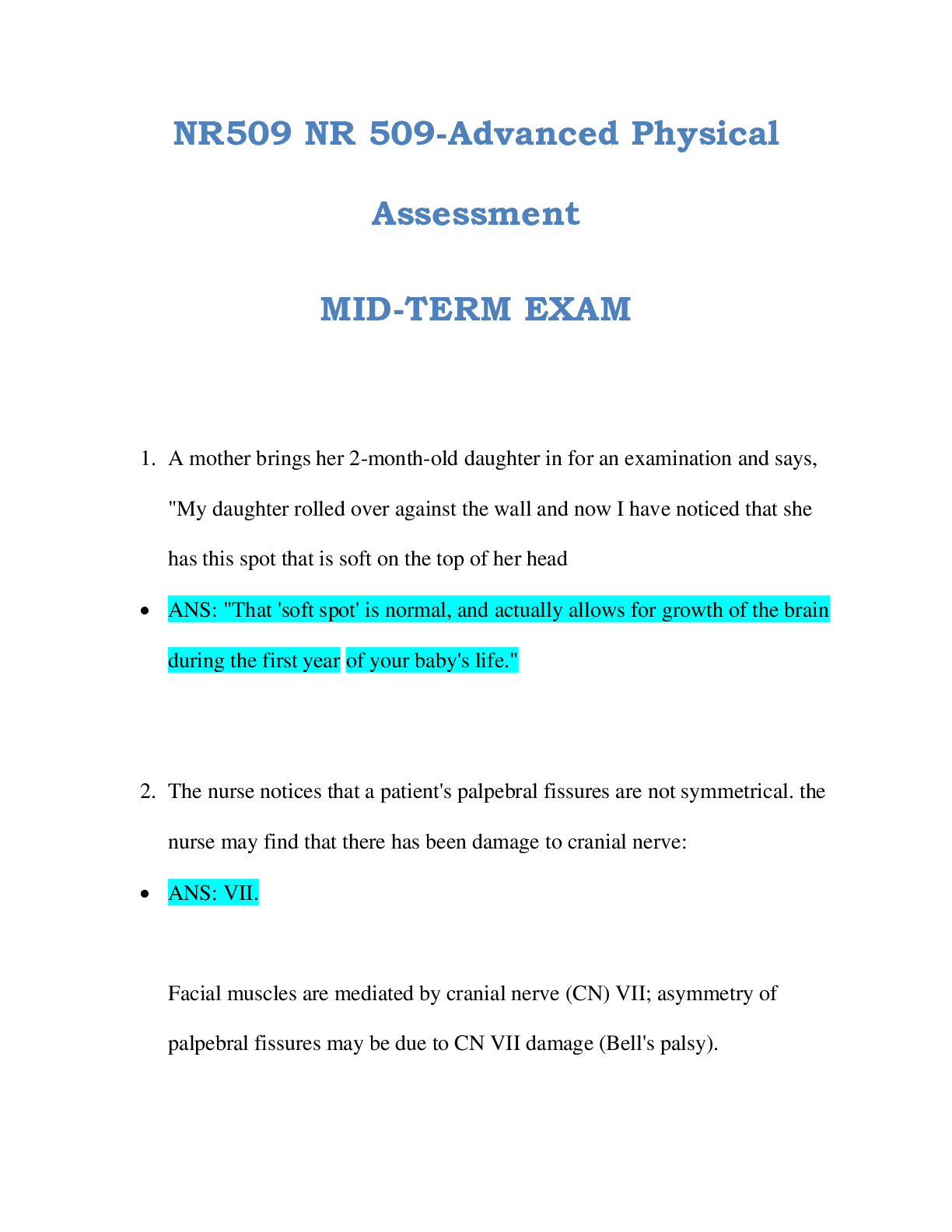
NR509 NR 509-Advanced Physical Assessment MID-TERM EXAM
NR509 NR 509-Advanced Physical
Assessment
MID-TERM EXAM
1. A mother brings her 2-month-old daughter in for an examination and says,
"My daughter rolled over ag
...
NR509 NR 509-Advanced Physical Assessment MID-TERM EXAM
NR509 NR 509-Advanced Physical
Assessment
MID-TERM EXAM
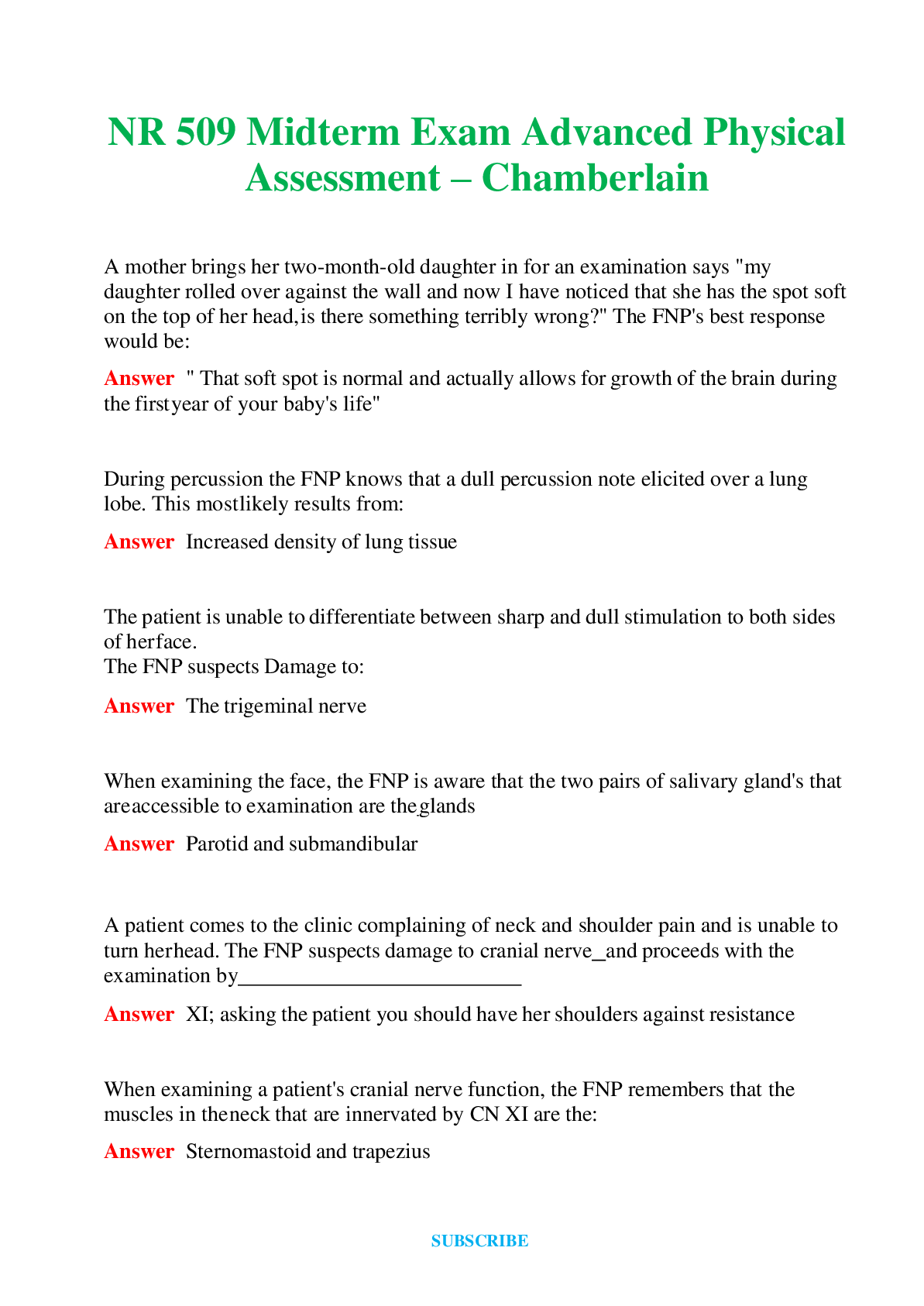
1. A mother brings her 2-month-old daughter in for an examination and says,
"My daughter rolled over against the wall and now I have noticed that she
has this spot that is soft on the top of her head
ANS: "That 'soft spot' is normal, and actually allows for growth of the brain
during the first year of your baby's life."
2. The nurse notices that a patient's palpebral fissures are not symmetrical. the
nurse may find that there has been damage to cranial nerve:
ANS: VII.
Facial muscles are mediated by cranial nerve (CN) VII; asymmetry of
palpebral fissures may be due to CN VII damage (Bell's palsy).3. A patient is unable to differentiate between sharp and dull stimulation to
both sides of her face. The nurse suspects:
ANS: damage to the trigeminal nerve.
4. When examining the face, the nurse is aware that the two pairs of salivary
glands that are accessible to examination are the _____ glands.
ANS: parotid and submandibular
5. A patient comes to the clinic complaining of neck and shoulder pain and is
unable to turn her head. The nurse suspects damage to cranial nerve (CN)
_____ and proceeds with the examination by _____.
ANS: XI; asking the patient to shrug her shoulders against resistance
6. When examining a patient's cranial nerve (CN) function, the nurse
remembers that the muscles in the neck that are innervated by CN XI are
the:
ANS: sternomastoid and trapezius.7. A patient's laboratory data reveal an elevated thyroxine level. The nurse
would proceed with an examination of the _____ gland.
ANS: thyroid
The thyroid gland is a highly vascular endocrine gland that secretes
thyroxine (T4) and tri-iodothyronine (T3).
8. A patient says that she has recently noticed a lump in the front of her neck
below her "Adam's apple" that seems to be getting bigger. During the
assessment, the finding that leads the nurse to suspect that this may not be a
cancerous thyroid nodule is that the lump (nodule):
ANS: is mobile and not hard.
9. A mother brings her newborn in for an assessment and asks, "Is there
something wrong with my baby? His head seems so big." The nurse
recognizes that
ANS: Head circumference should be greater than chest circumference at
birth.10.A patient, an 85-year-old woman, is complaining about the fact that the
bones in her face have become more noticeable. What explanation?
ANS: It is probably due to a combination of factors related to aging, such as
decreased elasticity, subcutaneous fat, and moisture in her skin.
11.A patient presents with excruciating headache pain on one side of his head,
especially around his eye, forehead, and cheek that lasts about 1/2 to 2
hours,
ANS: cluster headaches.
12.A patient complains that while studying for an examination he began to
notice a severe headache in the frontotemporal area of his head that is
throbbing and is somewhat relieved when he lies down.
ANS: migraine headaches.
Migraine headaches tend to be supraorbital, retro-orbital, or frontotemporal
with a throbbing quality. They are of a severe quality and are relieved by
lying down. Migraines are associated with family history of migraines.
13.A 19-year-old college student is brought to the emergency department with a
severe headache, His temperature is 104° F, and he has a stiff neck. ANS: Meningeal inflammation
14.During a well-baby check, the nurse notices that a 1-week-old infant's face
looks small compared with his cranium, which seems enlarged. On further
examination, the nurse also notices dilated scalp veins and downcast, or
"setting sun," eyes. The nurse suspects which condition?
ANS: Hydrocephalus
15.The nurse needs to palpate the temporomandibular joint for crepitation. This
joint is located just below the temporal artery and anterior to the:
ANS: tragus.
The temporomandibular joint is just below the temporal artery and anterior
to the tragus.
16.A male patient with a history of AIDS has come in for an examination and
he states, "I think that I have the mumps." The nurse would begin by
examining the:
ANS: parotid gland.
The parotid gland may become swollen with the onset of mumps, and
parotid enlargement has been found with HIV.17.The nurse suspects that a patient has hyperthyroidism and laboratory data
indicate that the patient's thyroxine and tri-iodothyronine hormone levels are
elevated. Which of these findings would the nurse most likely find on
examination?
ANS: Tachycardia
18.A visitor from Poland who does not speak English seems to be somewhat
apprehensive about the nurse examining his neck. He would probably be
most comfortable with the nurse examining his thyroid from:
ANS: the front with the nurse's thumbs placed on either side of his trachea
and his head tilted forward.
19.A patient's thyroid is enlarged, and the nurse is preparing to auscultate the
thyroid for the presence of a bruit. A bruit is a __________ of the
stethoscope.
ANS: soft, whooshing, pulsatile sound best heard with the bell20.The nurse notices that an infant has a large, soft lump on the side of his head
and that his mother is very concerned. She tells the nurse that she noticed the
lump about 8 hours after her baby's birth, and that it seems to be getting
bigger. One possible explanation for this is:
ANS: cephalhematoma.
21.A mother brings in her newborn infant for an assessment and tells the nurse
that she has noticed that whenever her newborn's head is turned to the right
side, she straightens out the arm and leg on the same side and flexes the
opposite arm and leg. After finding this on examination, the nurse would tell
her that this is:
ANS: normal and should disappear between 3 and 4 months of age.
The tonic neck reflex disappears between 3 and 4 months of age.
22.During an examination, the nurse knows that Paget's disease would be
indicated by which of these assessment findings?
ANS: Headache, vertigo, tinnitus, and deafness23.During an admission assessment, the nurse notices that a male patient has an
enlarged and rather thick skull. The nurse suspects acromegaly and would
further assess for:
ANS: coarse facial features.
24.Acromegaly is excessive secretion of growth hormone that creates an
enlarged skull and thickened cranial bones. with hyperthyroidism. When
examining children affected with Down syndrome (trisomy 21), the nurse
looks for the possible presence of:
ANS: ear dysplasia.
25.A patient visits the clinic because he has recently noticed that the left side of
his mouth is paralyzed. He states that he cannot raise his eyebrow or whistle.
The nurse suspects that he has:
ANS: had a cerebrovascular accident (stroke).
26.Acutely infected lymph nodes would be:
ANS: firm but freely movable.27.The physician reports that a patient with a neck tumor has a tracheal shift.
The nurse is aware that this means that the patient's trachea is:
ANS: pushed to the unaffected side.
28.During an assessment of an infant, the nurse notes that the fontanels are
depressed and sunken. The nurse suspects which condition?
ANS: Dehydration
29.The nurse is performing an assessment on a 7-year-old child who has
symptoms of chronic watery eyes, sneezing, and clear nasal drainage. The
nurse notices the presence of a transverse line across the bridge of the nose,
dark blue shadows below the eyes, and a double crease on the lower eyelids.
These findings are characteristic of:
ANS: allergies.
30.The nurse has just completed a lymph node assessment on a 60-year-old
healthy female patient. The nurse knows that most lymph nodes in healthy
adults are normally: ANS: not palpable.
31.During an examination of a patient in her third trimester of pregnancy, the
nurse notices that the patient's thyroid gland is slightly enlarged. No
enlargement had been noticed previously. The nurse suspects that:
ANS: this is a normal finding during pregnancy.
32.During an examination, the nurse knows that the best way to palpate the
lymph nodes in the neck is described by which statement?
ANS: Using gentle pressure, palpate with both hands to compare the two
sides.
33.During a well-baby checkup, a mother is concerned because her 2-month-old
infant cannot hold her head up when she is pulled to a sitting position.
Which response by the nurse is appropriate?
[Show More]



![Preview of eBook [PDF] Barash, Cullen, and Stoelting's Clinical Anesthesia 9th Edition By Bruce F. Cu](https://browseimages.nyc3.digitaloceanspaces.com/paper-images/2024/Aug/29/8DF2QRTq2024-08-29-10-3966d0259b7c4b5.png)
![Preview of eBook [PDF] Burns' Pediatric Primary Care 7th Edition BY Dawn Lee Garzon Maaks,, Nancy Bar](https://browseimages.nyc3.digitaloceanspaces.com/paper-images/2024/Aug/26/WR2rowXX2024-08-26-02-0966cc625bea839.png)