HSM-410 Week 4 Midterm Exam (100% Correct solution) | Download To Score An A
Document Content and Description Below
HSM-410 Week 4 Midterm Exam
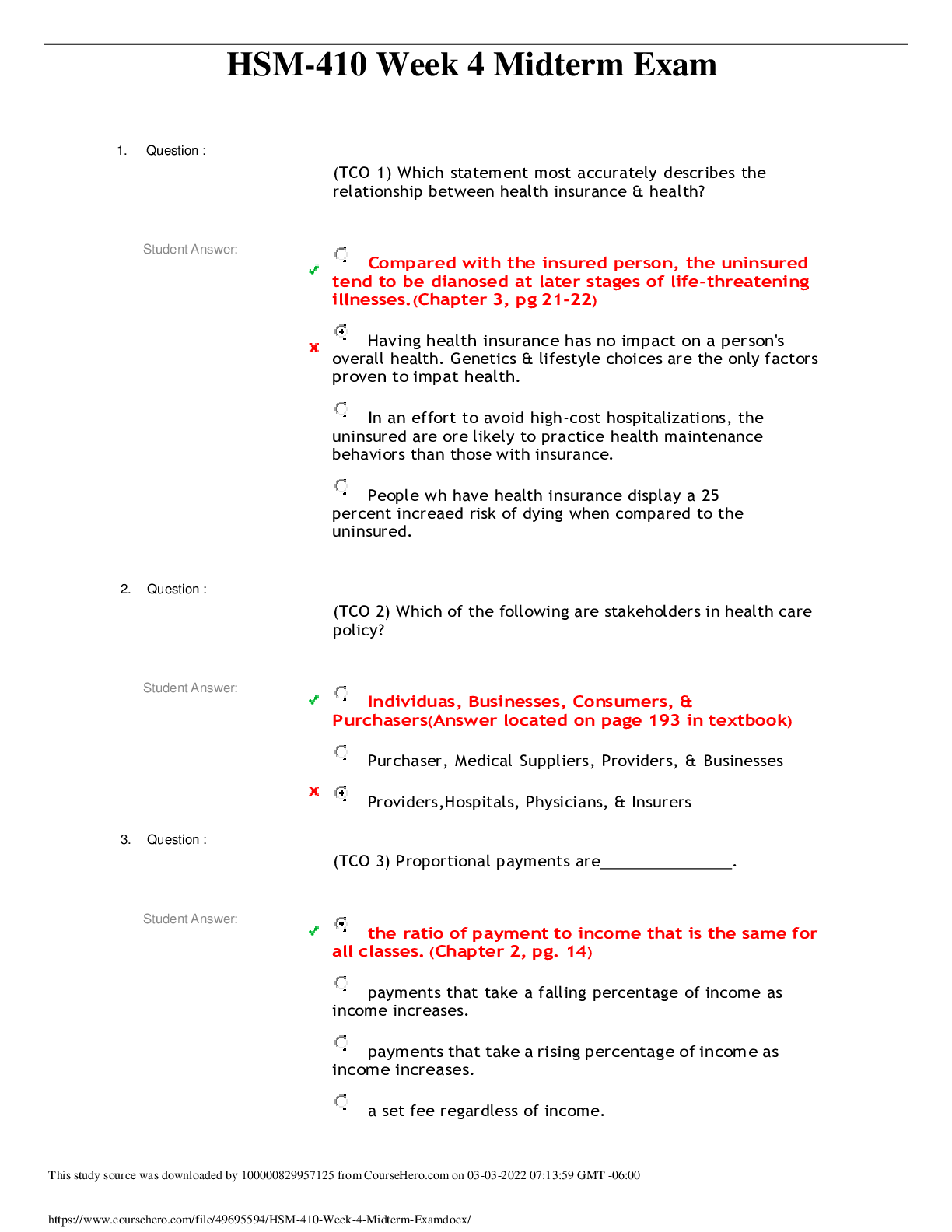
1. Question :
(TCO 1) Which statement most accurately describes the relationship between health insurance & health?
Student Answer:
Compare
...
d with the insured person, the uninsured tend to be dianosed at later stages of life-threatening illnesses.(Chapter 3, pg 21-22)
Having health insurance has no impact on a person's overall health. Genetics & lifestyle choices are the only factors proven to impat health.
In an effort to avoid high-cost hospitalizations, the uninsured are ore likely to practice health maintenance behaviors than those with insurance.
People wh have health insurance display a 25 percent increaed risk of dying when compared to the uninsured.
2. Question :
(TCO 2) Which of the following are stakeholders in health care policy?
Student Answer:
Individuas, Businesses, Consumers, & Purchasers(Answer located on page 193 in textbook)
Purchaser, Medical Suppliers, Providers, & Businesses Providers,Hospitals, Physicians, & Insurers
3. Question :
(TCO 3) Proportional payments are .
Student Answer:
the ratio of payment to income that is the same for all classes. (Chapter 2, pg. 14)
payments that take a falling percentage of income as income increases.
payments that take a rising percentage of income as income increases.
a set fee regardless of income.
4. Question :
(TCO 4) Which of the following is an effective cost control mechanism?
Student Answer:
Raising physician fees
Capitation payments (Located in Chapter 9 on page 108)
Patient cost sharing Risk tranfer
5. Question :
(TCO 1) How is Health Policy Formed?
Student Answer:
Through discussion with patients Through the judicial system Through the legislative process Both B & C (Week 1 Lecture)
6. Question :
(TCO 3) Which of the following are modes of paying for health care?
Student Answer:
Capitation, Fee-for-service, & Salary
Out-of-pocket payments, individual private insurance, employment-based private insurance, & government financing (Chapter 2, pg 5)
Private Insurance & government financing Medicare, Medicaid, Private Insurance
1. Question :
(TCO 2) What were the most common medical care structures of the first half of the twentieth century?
Student Answer: When modern medical care took root in the first half of the twentieth century, a variety of structures blossomed. Among these were multispecialty group practices, community health centers, & prepaid group practices. Multispecialty group practice offers many benefits to both physicians & patients. Doctors have easy access to colleagues from different disciplines for advice & referrals. freedom from administrative responsibilities such as billing & purchasing. & a shared schedule for on-call & weekend duties.
Community clinics & health centers are those nonprofit, tax- exempt clinics that are licensed as community or free clinics, & provide services to patients on a sliding fee scale basis or, in the case of free clinics, at no charge to the patients. Prepaid Group Practice is n organized group of three or more full-time physicians rendering services for a fixed prepayment.
Instructor Explanation: Chapter 6, pg 60 Multi-specialty group practice, Community Health Centers, Prepaid group practice
2. Question :
(TCO 4) List the methods of physician payment.
Student Answer: The methods of physician payment are: Payment per procedure: fee-for-service. Payment per episode of illness. Payment per patient: capitalization. Payment per time: salary
Instructor Explanation: Chapter 4 pg. 32-38 Fee-for-service, Per episode of illness (PPS), Capitation, Salary
3. Question :
(TCO 2) What are the three models of organizing care? Provide a brief description of the care provided at each level.
Student Answer: Models for organizing care are Primary, Secondary, & Tertiary Care The Regionalied Model The Dispersed Model Primary care involves commn health problems & preventative measures that account for most visits to a physician or caregiver. Secodary care involves problems that require more specialize clinical expertise such as hospital care for a patient wih acute renal failure. Tertiary care, which lies at the apex f the organizational pyramid, involves the management o rare & complex disorders such as pituitary tumors & congenital malformations. The Regionalized Model has priary care levels dominated by
GPs (2/3 of all physicians i the UK). Secondary care based on specialists who deal wit patients on an ambulatory basis but refer them back to their GPs for ongoing care. also deal with hospitalized patients. Tertiary care are specialists located at a few tertiary care medical centers The Dispersed Model has no limit on referrals, the physician goes to any level they want whenever they want. Primary care is spread amoungst specialists to a large extent. 1/3 of physicians in the US are general internists or general pediatricians.
Instructor Explanation: Chapter 5, pg. 44 Primary - treatment of common illnesses & preventative medicine; Secondary - specialized clinical care; Tertiary - management of rare & complex diseases
4. Question :
(TCO 4) What is the concept of patient cost sharing? Is it painless form of cost control? For whom?
Student Answer: Cost sharing refers to making patients pay directly out of pocket for some portion of their health care. The primary intent of cost sharing at the point of service is to discourage patient demand for services. Studies have shown that patients who had cost sharing received less preventative services & had poorer hypertension control than those without it. Also those with cost sharing are less likely to purchase needed medications under cost-sharing policies, & failure to obtain these needed medications is associated with worse control of chronic illnesses & more adverse events such as emergency hospitalization. What these studies show is that cost sharing is not a painless form of cost control.
Instructor Explanation: Chapter 9, pg 104-105. Patient cost sharing refers to patients having to pay out of pocket for some portion of their health care. It can be painless if the cost sharing is modest amounts & not applied to people with low incomes.
5. Question :
(TCO 3) Describe why private health insurance coverage has decreased over the past decades, creating the uninsured/under insured crisis? Who are the uninsured?
Student Answer: The bottom line to this initial quetion is that people just simply can't afford to get the health insurance coverage that they need. Costs just keep goingup in everything & health care is no exception. Rising insuance costs have
contributed to a trend in which fewer employrs are offering health insurance, many employers are anaging costs by requiring higher employee contributions, is just becoming that expensive in the US today. Man of the uninsured are the working poor or are unemployed. Others are healthy & choose to just go without it. & th there are the unfortunate people who have been rejected by insurance companies & are considered uninsurable. At that point if you aren't able to pay out of pocket, you are just happy to wake up to see another day.
Instructor Explanation: Chapter 3, pgs. 17-20. Reasons student should cite for the decline in health care: the skyrocketing costs of health insurance premiums has made it unaffordable; the economy has undergone transition - fewer high paying, unionized jobs that provide full enefits & more low paying, part-time jobs that do not provide nsurance; & due most health insurance linked to employment, auses disruptions in insurance coverage.
Week 4 DQ 1, Access
What are the primary access to health care concerns of the U.S. public?
The primary access to health care concerns in the U.S are rising costs & lack of access. Of the two, rising costs are typically viewed as the more pressing concern. Rising health care costs are consistently ranked as not just the most important health
care problem, but the most important economic problem Americans currently face. Other problems are the ability to pay & the availability of health care personnel & facilities that are close to where people live, accessible by transportation, culturally acceptable, & capable of providing appropriate care in a timely manner & in a language spoken by those who need assistance.http://devry.vitalsource.com/#/books/0077893557/pages/50184587.
2nd Response
The most primary access to healthcare concerns of the U.S. public has to be cost. The rising of costs for families have to pay for access is increasing every year. Another concern to many Americans is the insurance policies. Millions of Americans are without work & cant be insured by an employer if they don't have a job. This means families are paying out of pocket & cant afford monthly premiums for their families to access care. These are some major concerns regarding the U.S. public because people need to be treated & without a job, insurance, low- income many people will continue to suffer on a day-to-day basis trying to cough up money that they don't have in order to treat their families to access of healthcare.
[Show More]
Last updated: 3 years ago
Preview 1 out of 5 pages
.png)






 Questions and Answers 100% VERIFIED.png)
 Questions and Answers 100% correct Solutions.png)