HSM 546 Final Exam
A. A.Given the fundamental characteristics of managed care, identify current trends in managed healthcare and the present conditions in the managed care health environment.
The fundamental characteri
...
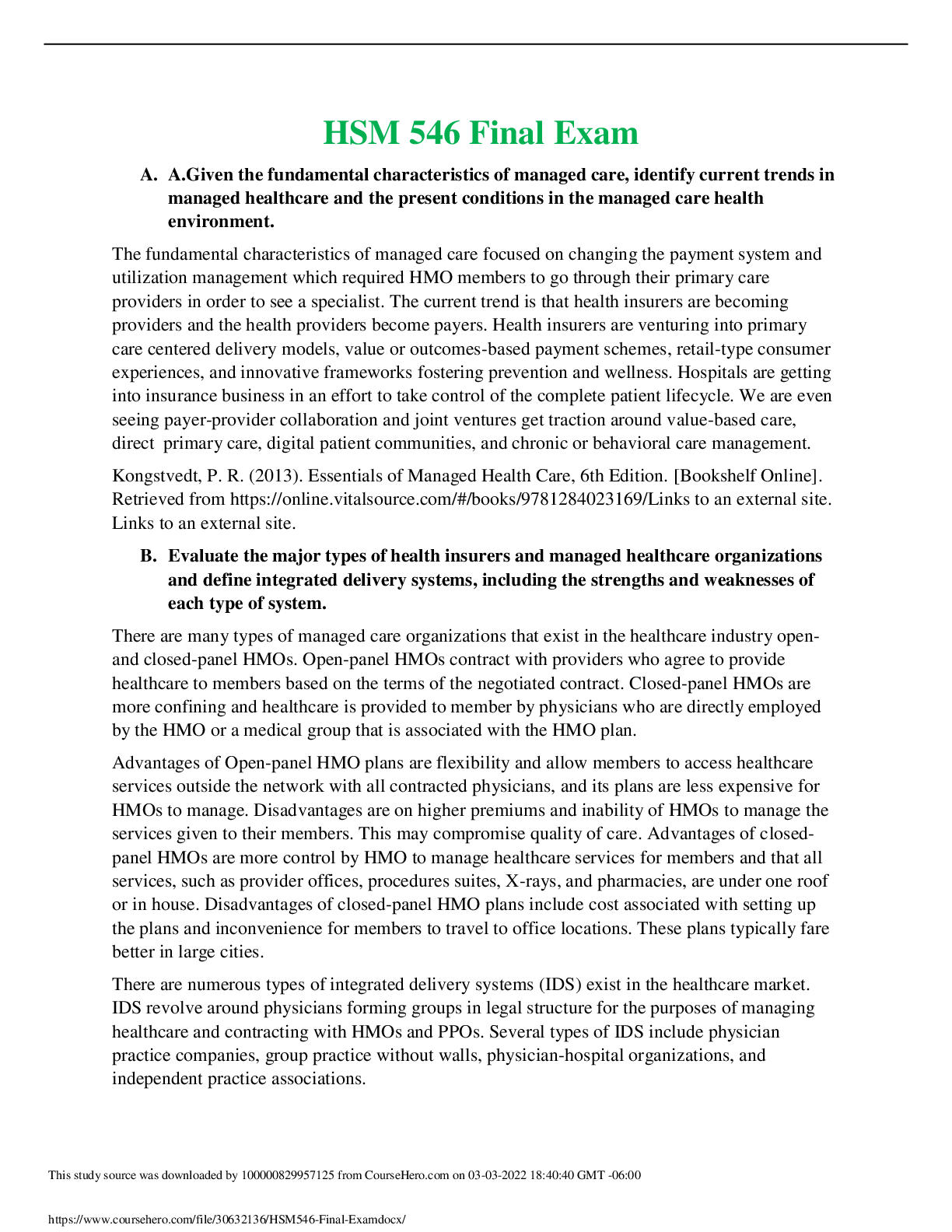
HSM 546 Final Exam
A. A.Given the fundamental characteristics of managed care, identify current trends in managed healthcare and the present conditions in the managed care health environment.
The fundamental characteristics of managed care focused on changing the payment system and utilization management which required HMO members to go through their primary care providers in order to see a specialist. The current trend is that health insurers are becoming providers and the health providers become payers. Health insurers are venturing into primary care centered delivery models, value or outcomes-based payment schemes, retail-type consumer experiences, and innovative frameworks fostering prevention and wellness. Hospitals are getting into insurance business in an effort to take control of the complete patient lifecycle. We are even seeing payer-provider collaboration and joint ventures get traction around value-based care, direct primary care, digital patient communities, and chronic or behavioral care management.
Kongstvedt, P. R. (2013). Essentials of Managed Health Care, 6th Edition. [Bookshelf Online]. Retrieved from https://online.vitalsource.com/#/books/9781284023169/Links to an external site. Links to an external site.
B. Evaluate the major types of health insurers and managed healthcare organizations and define integrated delivery systems, including the strengths and weaknesses of each type of system.
There are many types of managed care organizations that exist in the healthcare industry open- and closed-panel HMOs. Open-panel HMOs contract with providers who agree to provide healthcare to members based on the terms of the negotiated contract. Closed-panel HMOs are more confining and healthcare is provided to member by physicians who are directly employed by the HMO or a medical group that is associated with the HMO plan.
Advantages of Open-panel HMO plans are flexibility and allow members to access healthcare services outside the network with all contracted physicians, and its plans are less expensive for HMOs to manage. Disadvantages are on higher premiums and inability of HMOs to manage the services given to their members. This may compromise quality of care. Advantages of closed- panel HMOs are more control by HMO to manage healthcare services for members and that all services, such as provider offices, procedures suites, X-rays, and pharmacies, are under one roof or in house. Disadvantages of closed-panel HMO plans include cost associated with setting up the plans and inconvenience for members to travel to office locations. These plans typically fare better in large cities.
There are numerous types of integrated delivery systems (IDS) exist in the healthcare market. IDS revolve around physicians forming groups in legal structure for the purposes of managing healthcare and contracting with HMOs and PPOs. Several types of IDS include physician practice companies, group practice without walls, physician-hospital organizations, and independent practice associations.
Kongstvedt, P. R. (2013). Essentials of Managed Health Care, 6th Edition. [Bookshelf Online]. Retrieved from https://online.vitalsource.com/#/books/9781284023169/Links to an external site. Links to an external site.
C. Given the development of the Patient Protection and Affordability Act, evaluate governance requirements, risk management, and provider networks.
State oversight of managed care focuses on techniques and processes used by the payer and delivery of healthcare services to enrollees. Insurers and HMOs must be licensed, registered, and certified. State laws also govern consumer disclosures and protections. Federal regulation of health insurance and managed care was established in 1973 under the HMO Act and has continued to evolve throughout the years.
Board of directors in HMOs and other types of managed care plans have a special responsibility for oversight of the quality management (QM) program and for the quality of care delivered to members.
Risk Management
Physician behavior plays a key role in risk management. Four principles that can be used for changing physician behaviors include relationships, letting data speak for themselves, peers as influencers, and peers as leaders. Managed care is built around the concept of managing healthcare costs while providing quality healthcare services. Providers are faced with making decisions about medical care and what services need to be provided and ordered for their patients while managing utilization at the same time. It is very important to note that evidence reflects that it is possible to lower costs, raise quality, and provider greater value under managed care.
Provider Networks
Provider networks are the core component of the managed care plans. Provider networks consist of all healthcare providers, including contracted physicians, hospitals and other health systems, ancillary and therapeutic services, and non-physician professionals. Open-panel managed care plans contract with these providers to provide healthcare services to plan members. Reasons being that the agreement that the provider will provide services to plan members, hold harmless that the provider agrees to not bill members for amounts owed by the plan, and providers agree to cooperate with the plan’s utilization management program.
Kongstvedt, P. R. (2013). Essentials of Managed Health Care, 6th Edition. [Bookshelf Online]. Retrieved from https://online.vitalsource.com/#/books/9781284023169/Links to an external site. Links to an external site.
D. Analyze and contrast the general principles of the different methods of provider payment, and compare the basic approaches to hospital- and physician-focused pay for performance.
There are numerous methods used to pay healthcare providers. Fee-for service (FFS) is a payment method where the actual amount billed is paid out. This payment method may encourage unbuddling, upcoding, churning, and other forms of abuse in order to increase fees. On the other hand, fee-for services may encourage better healthcare for sicker patients, because physicians will spend more time caring for the patients if they earn more money. Other types of hospital payment methodologies used are straight charges, discounted charges, percentage of Medicare, and capitation for HMOs. Straight discount charges are a common payment method in which contracts are in place that determine the amount of charges on the claim. E.g. if a hospital agrees to contract for a straight percentage discount with an HMO plan, the plan will discount the submitted charges based on the contact rate.
Pay-for-Performance (P$) is defined as a payment method where incentives encourage and reinforcw better healthcare outcomes by providing high-quality healthcare. P4P was not designed to reward or punish physicians based on their performance It was designed around
the idea of incorporating financial incentives for quality. It is based on clinical performance, mainly evidence-based clinical practice and patient safety.
E. Articulate a scenario involving a managed care organization or integrated delivery system and develop a plan to proactively address legal issues in provider contracting.
Healthcare professional practice in an environment that is complex, with many regulations, laws and standards of practice. Confidentiality is both an ethical and legal issue. Patient’s information should be kept in a confidential manner to show respect for the person’s autonomy releasing information can damage the patient. There are specific laws regarding
the release of information under the Health Insurance Portability and Accountability Act (HIPAA). The laws define exactly what information can be released and to whom. Insurance companies may not have the right to certain aspects of a patient’s medical record. However, if there is risk to third party, an ethical health care professional may need to break confidentiality to prevent them.
Relationships with patients, particularly sexual relationships, are forbidden by both the medical and nursing code of ethics. Such actions are considered serious misconduct and can result in expulsion from the profession and losing the license to practice. A sexual relationship is considered to be an abuse of power on the part of the physician or nurse, as patients are dependent and vulnerable.
Kongstvedt, P. R. (2013). Essentials of Managed Health Care, 6th Edition. [devry]. Retrieved from https://devry.vitalsource.com/#/books/9781284023169/
F. Compare and contrast basic utilization management techniques and the challenges associated with managing utilization.
The Institute of Medicine (IOM) Committee on Utilization Management by Third Parties recognizes Utilization Management as “a set of techniques used by or on behalf of purchasers of health care benefits to manage health care costs by influencing patient care decision-making
through ca-by-case assessments of the appropriateness of care prior to its provision.” There are three type of Utilization management:
◾ Prospective Review: which is conducted at the onset of a service or treatment and is also referred to as pre-certification or prior authorization. This review is performed before care is rendered in order to eliminate or reduce unnecessary services. Prospective review may have the impact of not authorizing or limiting care that had been recommended by the evaluating providers.
◾ Concurrent Reviews: are performed during the course of treatment or episode of care. Intervention occurs at varied intervals and may encompass case management activities such as care coordination, discharge planning, and care transitioning. Concurrent review may have the impact of curtailing an existing episode of care.
◾ Retrospective review is conducted after the service has been completed and assesses the appropriateness of the procedure, setting, and timing in accordance with specified criteria. Such reviews often relate to payment and may result in denial of a claim. Financial risk for a retrospective denial is often borne by the provider.
Gardner, K. What is utilization management? Retrieved from http://www.apta.org/WhatIsUM/
G. Evaluate the types of healthcare marketplace health plans and compare different healthcare plans
Medicare is the federal health insurance program created in 1965 for people ages 65 and over, regardless of income, medical history, or health status. The program was expanded in 1972 to cover people under age 65 with permanent disabilities. Today, Medicare plays a key role in providing health and financial security to 59 million older people and younger people with disabilities. The program helps to pay for many medical care services, including hospitalizations, physician visits, and prescription drugs, along with post-acute care, skilled nursing facility care, home health care, hospice care, and preventive services.
Most people ages 65 and over are entitled to Medicare Part A if they or their spouse are eligible for Social Security payments and have paid payroll taxes for 10 or more years. People under age 65 who receive Social Security Disability Insurance (SSDI) payments generally become eligible for Medicare after a two-year waiting period, while those diagnosed with end-stage renal disease (ESRD) and amyotrophic lateral sclerosis (ALS) become eligible for Medicare with no waiting period.
Medicare covers many basic health services, including hospital stays, physician services, and prescription drugs. Medicare benefits are organized and paid for in different ways.
◾ Part A covers inpatient hospital stays, skilled nursing facility stays, some home health visits, and hospice care. Part A benefits are subject to a deductible ($1,340 per benefit period in 2018).
Beneficiaries are subject to coinsurance amounts for extended inpatient stays in a hospital or skilled nursing facility.
◾ Part B covers physician visits, outpatient services, preventive services, and some home health visits. Part B benefits are subject to a deductible ($183 in 2018), and most Part B benefits are subject to coinsurance of 20 percent. No coinsurance or deductible is charged for an annual “wellness visit” or for preventive services that are rated ‘A’ or ‘B’ by the U.S. Preventive Services Task Force.
◾ Part C refers to the Medicare Advantage program through which beneficiaries can enroll in a private health plan, such as a health maintenance organization (HMO) or preferred provider organization (PPO), and receive all Medicare-covered Part A and Part B benefits and typically Part D benefits. Enrollment in Medicare Advantage plans has grown over time, with 19 million beneficiaries enrolled in Medicare Advantage plans in 2017, or 33 percent of all Medicare beneficiaries)
An Overview of Medicare. (2017). Retrieved from https://www.kff.org/medicare/issue-brief/an- overview-of-medicare/
H. Given the federal regulations for health insurance and managed care, craft a healthcare policy to address the health insurance portability and accountability act (HIPPA) that meets federal requirements.
As states consider how to effectively control Medicaid costs, many are looking to integrate behavioral and medical care, including long-term services and supports, particularly for individuals with complex needs. Two recent federal rules issued in 2016 are facilitating the transition to integrated care models: the Medicaid managed care rule and the Medicaid managed care mental health parity rule. These changes may not spell the end of fragmented systems, but they certainly do not support a status quo approach to care. While the regulations do not specifically address integrated care, they should facilitate and, in some instances, encourage, state movement to integrated care for Medicaid participants.
Reference,
Edwards, E. (2017). Assessing Changes to Medicaid Managed Care Regulations: Facilitating Integration of Physical and Behavioral Health Care. Retrieved from http://www.commonwealthfund.org/~/media/files/publications/issue- brief/2017/oct/edwards_medicaid_managed_care_behavioral_hlt_integration_ib.pdfLinks to an external site.
HIPPA and ERISA
The Health Insurance Portability and Accountability Act (HIPPA) of 1996 provides federal regulatory standards for private health insurance. Under HIPPA, States share regulatory power with federal agencies that have some regulatory authority over private health insurance and
group health plans. HIPPA was the first direct regulation of the business of health insurance by the federal government.
HIPPA includes tax incentives, antifraud and abuse initiatives, and administrative simplification requirements, in addition to portability and access standards. Other benefits linked to HIPPA include a gradual increase in the deductibility of health insurance, tax incentives for the purchase of long-term care insurance, and the authorization of tax-preferred medical savings-account programs. HIPPA was groundbreaking because it was the first federal law to subject all health plans to federal agencies. It has established minimum federal standards and permits states to offer more protection to group insurance for people with preexisting medical conditions.
Gauging from public comment, this change has been widely viewed as a major accomplishment in the access to healthcare. Essentially, that Act restricts the use of preexisting exclusions and prohibits health plans and insurers from requiring anyone to pay a premium or a contribution that is larger than a similar person based solely upon health status. HIPPA ensures that employees or dependents who do not participate in the initial enrollment period (because of legitimate circumstances) are eligible to join a health plan at a later time.
The Balanced Budget Act of 1997 was an omnibus legislative package enacted by the United State Congress, using the budget reconciliation process, and designed to balance the federal budget by 2002. The act was to result in $160 billion in spending reduction between 1998 and 2002. After taking into account an increase in spending on Welfare and Children’s Healthcare, the savings totaled $127 billion. Medicare cuts were responsible for $112 billion, and hospital inpatient and outpatient payments covered $44 billion. In order to reduce Medicare spending, the act reduced payment to health service providers such as hospitals, doctors, and nurse practitioners. However, some of those changes to payments were reversed by subsequent legislation in 1999 and 2000.
Reference,
Balanced Budget Act of 1997. (n.d). Retrieved from https://en.wikipedia.org/wiki/Balanced_Budget_Act_of_1997
[Show More]