*NURSING > TEST BANKS > NURSING 225 (All)
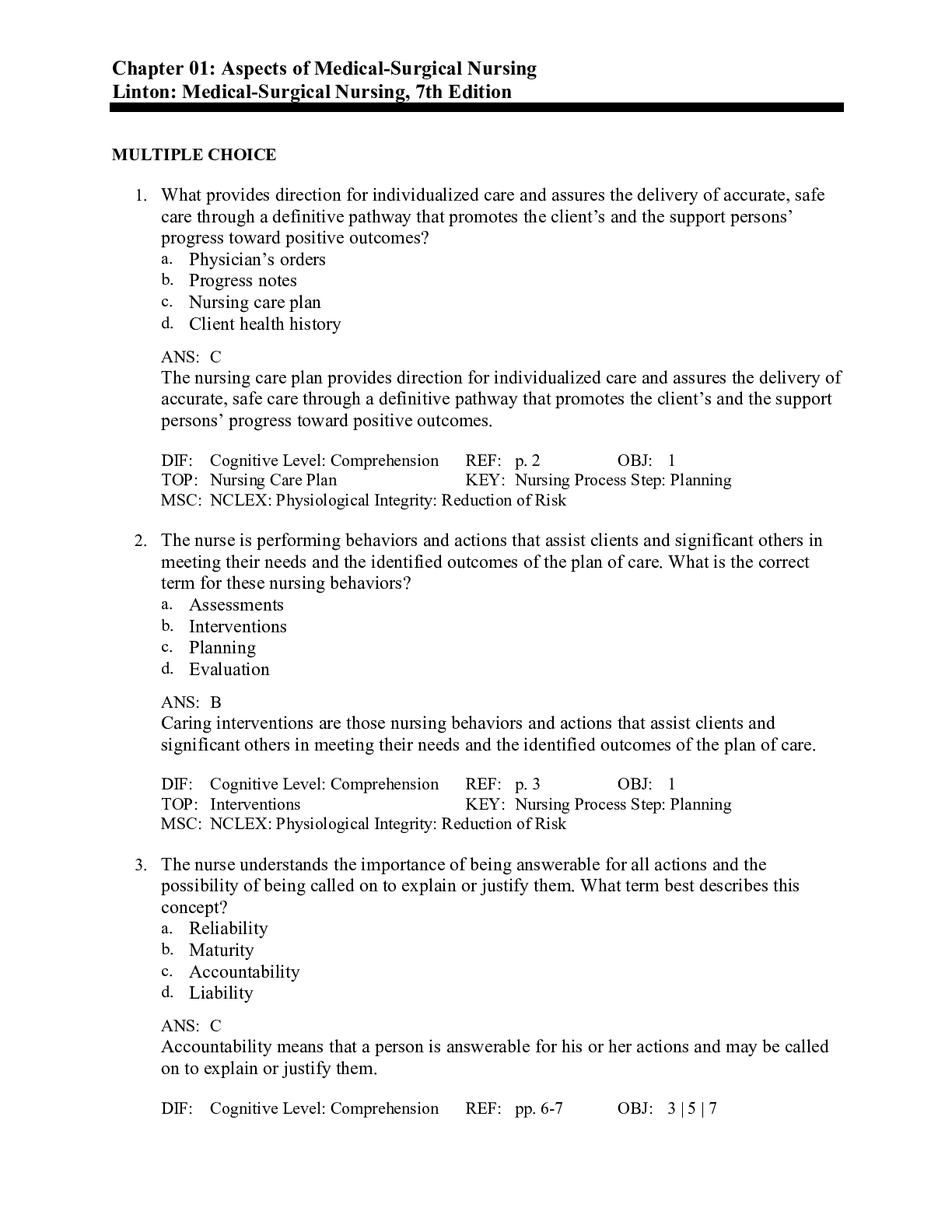
1. The nurse is explaining the physiology of uterine contractions to a group of nursing students. Which statement best explains the maternal-fetal exchange of oxygen and waste products during a cont ... raction? a. Little to no affect b. Increases as blood pressure decreases c. Diminishes as the spiral arteries are compressed d. Continues except when placental functions are reduced ANS: C During labor contractions, the maternal blood supply to the placenta gradually stops as the spiral arteries supplying the intervillous space are compressed by the contracting uterine muscle. The exchange of oxygen and waste products is affected by contractions. The exchange of oxygen and waste products decreases. The maternal blood supply to the placenta gradually stops with contractions. DIF: Cognitive Level: Application OBJ: Nursing Process Step: Implementation MSC: Patient Needs: Physiologic Integrity 2. The nurse is directing an unlicensed assistive personnel (UAP) to obtain maternal vital signs between contractions. Which statement is the appropriate rationale for assessing maternal vital signs between contractions rather than at another interval? a. Vital signs taken during contractions are inaccurate. b. During a contraction, assessing fetal heart rate is the priority. c. Maternal blood flow to the heart is reduced during contractions. d. Maternal circulating blood volume increases temporarily during contractions. ANS: D During uterine contractions, blood flow to the placenta temporarily stops, causing a relative increase in the mother’s blood volume, which in turn temporarily increases blood pressure and slows the pulse. Vital signs are altered by contractions but are considered accurate for a period of time. It is important to monitor the fetal response to contractions, but the question is concerned with the maternal vital signs. Maternal blood flow is increased during a contraction. DIF: Cognitive Level: Application OBJ: Nursing Process Step: Implementation MSC: Patient Needs: Safe and Effective Care Environment 3. Uncontrolled maternal hyperventilation during labor results in a. metabolic acidosis. b. metabolic alkalosis. c. respiratory acidosis. d. respiratory alkalosis. ANS: D NURSINGTB.COM Foundations of Maternal-Newborn and Women's Health Nursing 7th Edition Murray Test Bank NU RS IN GT B.CO M Rapid deep respirations cause the laboring woman to lose carbon dioxide through exhalation, resulting in respiratory alkalosis. Hyperventilation does not cause respiratory acidosis, metabolic acidosis, or metabolic alkalosis. DIF: Cognitive Level: Understanding OBJ: Nursing Process Step: Assessment MSC: Patient Needs: Physiologic Integrity 4. Which mechanism of labor occurs when the largest diameter of the fetal presenting part passes the pelvic inlet? a. Extension b. Engagement c. Internal rotation d. External rotation ANS: B Engagement occurs when the presenting part fully enters the pelvic inlet. Extension occurs when the fetal head meets resistance from the tissues of the pelvic floor and the fetal neck stops under the symphysis. This causes the fetal head to extend. Internal rotation occurs when the fetus enters the pelvic inlet. The rotation allows the longest fetal head diameter to conform to the longest diameter of the maternal pelvis. External rotation occurs after the birth of the head. The head then turns to the side so the shoulders can internally rotate and are positioned with their transverse diameter in the anteroposterior diameter of the pelvic outlet. DIF: Cognitive Level: Understanding OBJ: Nursing Process Step: Assessment MSC: Patient Needs: Health Promotion and Maintenance 5. The laboring patient asks the nurse how the labor contractions cause the cervix to dilate. The nurse responds that labor contractions facilitate cervical dilation by a. promoting blood flow to the cervix. b. contracting the lower uterine segment. c. enlarging the internal size of the uterus. d. pulling the cervix over the fetus and amniotic sac. ANS: D Effective uterine contractions pull the cervix upward at the same time the fetus and amniotic sac are pushed downward. Blood flow decreases to the uterus during a contraction. The contractions are stronger at the fundus. The internal size becomes smaller with the contractions; this helps push the fetus down. [Show More]
Last updated: 2 years ago
Preview 1 out of 13 pages
Buy this document to get the full access instantly
Instant Download Access after purchase
Buy NowInstant download
We Accept:
Can't find what you want? Try our AI powered Search
Connected school, study & course
About the document
Uploaded On
Mar 04, 2022
Number of pages
13
Written in
All
This document has been written for:
Uploaded
Mar 04, 2022
Downloads
0
Views
96
Scholarfriends.com Online Platform by Browsegrades Inc. 651N South Broad St, Middletown DE. United States.
We're available through e-mail, Twitter, Facebook, and live chat.
FAQ
Questions? Leave a message!
Copyright © Scholarfriends · High quality services·