*NURSING > EXAM REVIEW > NEI questions on ADHD, Dementia, Substance Abuse & impulsive Compulsive Disorders. (Test 4) Answered (All)
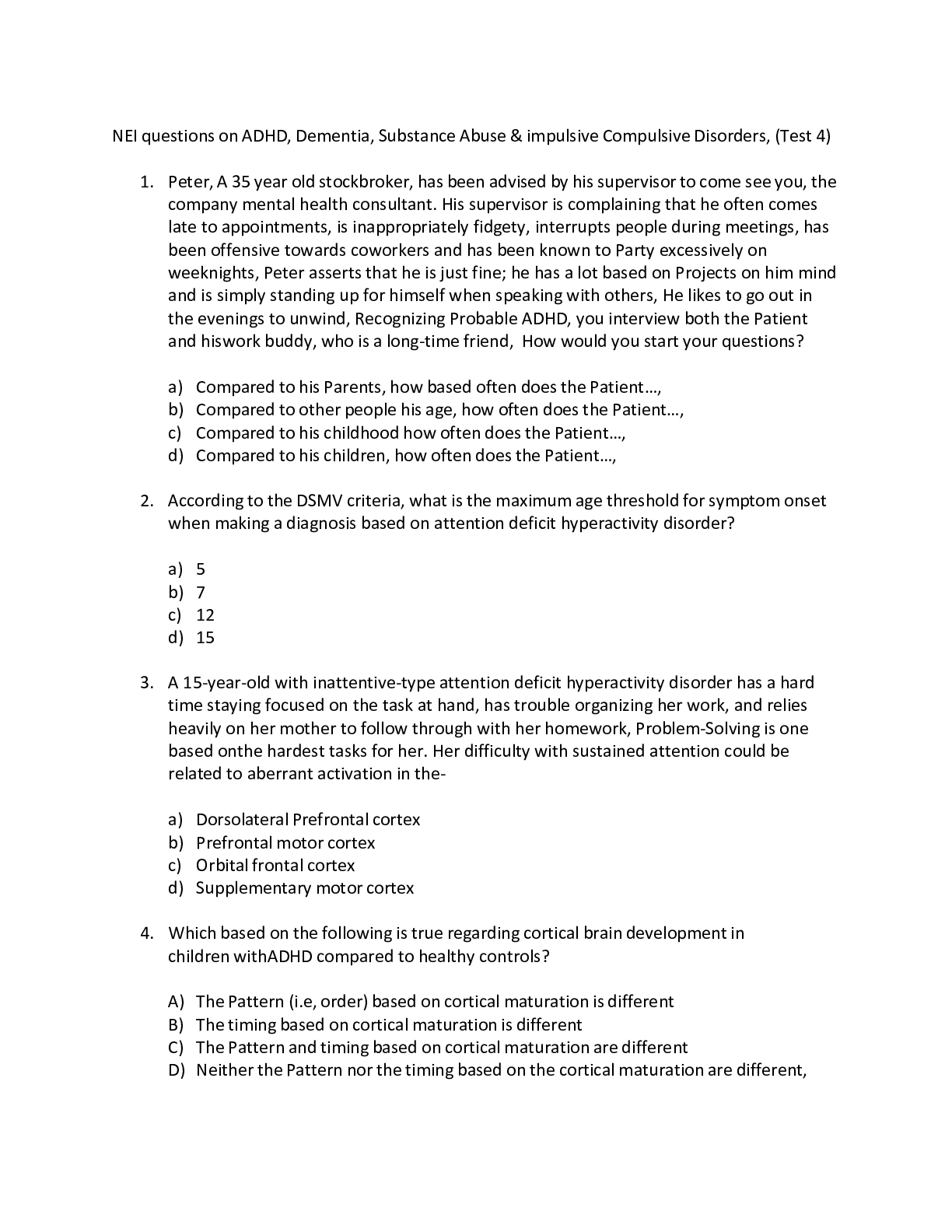
NEI questions on ADHD, Dementia, Substance Abuse & impulsive Compulsive Disorders. (Test 4) Answered. 1. Peter, a 35-year-old stockbroker, has been advised by his supervisor to come and see you, the ... company mental health consultant. His supervisor is complaining that he often comes late to appointments, is inappropriately fidgety, interrupts people during meetings, has been offensive towards coworkers, and has been known to party excessively on weeknights. Peter asserts that he is just fine; he has a lot of projects on his mind and is simply standing up for himself when speaking with others. He likes to go out in the evenings to unwind. Recognizing probable ADHD, you interview both the patient and his work buddy, who is a longtime friend. How would you start your questions? A. Compared to his parents, how often does the patient... B. Compared to other people his age, how often does the patient... C. Compared to his childhood, how often does the patient... D. Compared to his children, how often does the patient... 2. According to DSM-5 criteria, what is the maximum age threshold for symptom onset when making a diagnosis of attention deficit hyperactivity disorder (ADHD)? A. 5 B. 7 C. 12 D. 15 3. A 15-year-old with inattentive-type attention deficit hyperactivity disorder has a hard time staying focused on the task at hand, has trouble organizing her work, and relies heavily on her mother to follow through with her homework. Problem solving is one of the hardest tasks for her. Her difficulty with sustained attention could be related to aberrant activation in the: A. Dorsolateral prefrontal cortex B. Prefrontal motor cortex C. Orbital frontal cortex D. Supplementary motor cortex 4. Which of the following is true regarding cortical brain development in children with ADHD compared to healthy controls? A. The pattern (i.e., order) of cortical maturation is different B. The timing of cortical maturation is different C. The pattern and timing of cortical maturation are different D. Neither the pattern nor the timing of cortical maturation are different 5. A clinician is considering treatment options for a 26-year-old man with ADHD who has a history of alcohol and marijuana abuse. Which of the following accurately explains the effects of different stimulant formulations on neuronal firing? A. Pulsatile stimulation amplifies undesirable phasic dopamine (DA) and norepinephrine (NE) firing, which can lead to euphoria and abuse B. Immediate release stimulants lead to tonic firing, which can lead to euphoria and abuse C. Tonic firing is the result of rapid receptor occupancy and fast onset of action as seen with extended release formulations D. Extended release stimulants result in phasic stimulation of NE and DA signals, but this does not lead to euphoria and abuse 6. Scarlet, a 25-year-old bartender, was diagnosed with ADHD at age 10. She has been on and off medication since then; first on immediate-release methylphenidate, then on the methylphenidate patch. She has experimented with illicit drugs during her late adolescence and is still a heavy drinker. After a few years of self-medication with alcohol and cigarettes, she is seeking medical attention again. You decide to put her on 80 mg/day of atomoxetine, one of the non-stimulant medications effective in ADHD. Why does atomoxetine lack abuse potential? A. It decreases norepinephrine levels in the nucleus accumbens, but not in the prefrontal cortex B. It increases dopamine levels in the prefrontal cortex but not in the nucleus accumbens C. It modulates serotonin levels in the raphe nucleus D. It increases dopamine in the striatum and anterior cingulate cortex Answer- Atomoxetine is a selective norepinephrine reuptake inhibitor (NET inhibitor). 7. A 15-year-old patient with ADHD has a rare mutation in the gene for the dopamine transporter (DAT). In deciding which treatment to initiate for this patient's ADHD, you know it will be important to avoid treatments that depend on normally functioning DAT. Which of the following drugs are transported into neurons via the dopamine transporter? A. Amphetamine B. Atomoxetine C. Methylphenidate D. A and B E. None of the above 8. A patient with attention deficit hyperactivity disorder (ADHD) has not yet had successful treatment: he has experienced either loss of efficacy toward the end of the day or efficacy but insomnia at night. He is frustrated and wants to know what other treatment options exist. The most recently available new treatments for attention deficit hyperactivity (ADHD) represent: A. Novel neurotransmitter targets B. New formulations of existing active ingredients C. A and B 9. Rita is a 28-year-old patient with untreated ADHD. You are currently deciding between guanfacine and clonidine as potential treatments for this patient. The selective alpha 2A agonist guanfacine appears to be: A. Less tolerated than the alpha 2 agonist clonidine B. Better tolerated than the alpha 2 agonist clonidine C. Less efficacious than the alpha 2 agonist clonidine D. More efficacious than the alpha 2 agonist clonidine 10. Aggregate data suggest that, compared to stimulants, nonstimulants have: A. Smaller effect sizes B. Approximately the same effect sizes C. Larger effect sizes 11. A 44-year-old man was diagnosed with ADHD-inattentive subtype in college but has not taken medication for the last several years. He is seeking treatment now because of declining work performance following a promotion 7 months ago. Specifically, he complains of difficulty finishing paper and staying focused during meetings and fears that his boss is losing confidence in him. Assessment confirms a diagnosis of ADHD-inattentive subtype. After 2 months treatment on a therapeutic dose of a long-acting stimulant, he states that his focus, sustained attention, and distractibility are much better, but that he still can't get organized and that it takes him longer to complete tasks than it should. At this point, would it be appropriate to raise the dose of the stimulant to try to address his residual symptoms? A. Yes B. No 12. The cumulative data on the effects of physical exercise as an adjunctive treatment for children with ADHD have demonstrated the potential beneficial effects of: A. Acute aerobic exercise B. Chronic aerobic exercise C. A and B D. Neither A nor B 13. A patient with a history of alcohol use disorder has been sober for 6 weeks. He begins medication treatment for adult attention deficit hyperactivity disorder and experiences improvement, but 4 months later relapses with his alcohol use disorder, engaging in 3 binge drinking episodes over a 2-week period. Does this patient need to discontinue medication treatment for ADHD? A. Yes, he should be switched to non-medication treatment B. Only if he is currently on a long-acting stimulant; non-stimulant medication is acceptable in this scenario C. No, both long-acting stimulants and non-stimulant medications are acceptable in this scenario 14. A 7-year-old boy has just been diagnosed with attention deficit hyperactivity disorder (ADHD), combined type, and his care provider feels that the best therapeutic choice is a stimulant. Family history is significant for depression and diabetes. The patient's medical history is significant for asthma; physical exam reveals no abnormalities. According to current recommendations, what should be the care provider's next step? A. Prescribe a stimulant, as no additional tests are indicated for this patient B. Obtain an electrocardiogram (ECG), as this patient's family history and exam results warrant it C. Obtain an ECG, as this is mandatory prior to prescribing a stimulant to any child D. Prescribe a nonstimulant, as a stimulant would not be appropriate for this patient 1. An excitatory signal is received at the dendrite of a pyramidal glutamate neuron. When the signal is released from the incoming presynaptic dopaminergic axon, it is received as an inhibitory signal. However, this signal is not integrated properly with other incoming signals to that neuron. Which is the most likely site at which the error of integrating this signal with other incoming signals occurred? A. Dendritic membrane B. Soma C. Axonal zone D. Presynaptic zone 2. A receptor synthesized with an erroneous amino acid sequence is sent via fast anterograde transport to its axonal destination. If you want to find the original site of error, which organelle would you elect to observe? A. Free polysome B. Golgi apparatus C. Mitochondria D. Rough endoplasmic reticulum 3. Which of the following are involved in regulating neurotransmission via excitation-secretion coupling? A. Voltage-sensitive sodium channels B. Voltage-sensitive calcium channels C. Both A and B D. Neither A nor B Agonists cause ligand-gated ion channels to: A. Open wider B. Open for longer duration of time C. Open more frequently D. A and B E. A and C 5. Presynaptic reuptake transporters are a major method of inactivation for which of the following? A. Serotonin B. Serotonin and GABA C. Serotonin, GABA, and histamine D. Serotonin, GABA, histamine, and neuropeptides Answer 6. A neuron is infected with a toxin and causes a rather sudden inflammatory reaction. You detect a high concentration of cytokines in the surrounding area. Which process has taken place? A. Necrosis B. Synaptogenesis C. Excitotoxicity D. Apoptosis E. Neurogenesis 7. Communication between human CNS neurons at synapses is: A. Chemical B. Electrical C. Both A and B D. Neither A nor B 8. A serotonin molecule binds to a 5HT2A receptor causing electrical impulses to be sent down a GABA neuron's axon terminal, eventually releasing GABA to the GABA-A receptor of its postsynaptic neuron. Which type of neurotransmission does this describe? A. Classic synaptic neurotransmission B. Retrograde neurotransmission C. Volume neurotransmission D. Signal transduction cascade 9. A receptor with four transmembrane regions changes conformation as GABA binds. Which system is this process describing? A. Presynaptic transporter B. Ligand-gated ion channel C. Voltage-sensitive ion channel 10. The direct role of transcription factors is to: A. Cause neurotransmitter release B. Influence gene expression C. Synthesize enzymes D. Trigger signal transduction cascades 11. Which of the following is the most likely impetus for upregulation of D2 receptors on a striatal dopamine neuron? A. A bound receptor is taken out of circulation B. A new receptor is bound and put to use C. A D2 agonist persistently binds to the receptor D. A D2 antagonist persistently binds to the receptor 12. What is the correct order and direction of ion flow into and out of a neuron experiencing an action potential? A. Na+ in, K+ out, Ca2+ in B. Ca2+ in, K+ out, Na+ in C. K+ in, Na+ in, Ca2+ in D. Na+ in, Ca2+ in, K+ out E. Ca2+ in, Na+ out, K+ out F. K+ in, Ca2+ in, Na+ out 13. What are the molecular mechanisms of epigenetics? A. Molecular gates are opened by acetylation and/or demethylation of histones, allowing transcription factors access to genes, thus activating them B. Molecular gates are opened by deacetylation and/or methylation, allowing transcription factors access to genes, thus activating them C. Molecular gates are closed by deacetylation and/or methylation, preventing access of transcription factors to genes, thus silencing them. D. A and C D - Correct. 14. N-methyl-d-aspartate (NMDA) receptors are activated by: A. Glutamate B. Glycine C. Depolarization D. Glutamate and glycine E. Glutamate and depolarization F. Glycine and depolarization G. Glutamate, glycine, and depolarization 15. Neurogenesis has recently been discovered to occur in adults: A. Only in the dentate gyrus of the hippocampus B. In the dentate gyrus of the hippocampus and in the olfactory bulb C. In the dentate gyrus of the hippocampus, in the olfactory bulb, and in the lateral nucleus of the amygdala D. Throughout the brain 16. A signal transduction cascade passes its message from an extracellular first messenger to an intracellular second messenger. In the case of the G-protein-linked systems, the second messenger is a(n): A. Ion B. Hormone C. Chemical D. Kinase enzyme [Show More]
Last updated: 3 years ago
Preview 1 out of 14 pages
Buy this document to get the full access instantly
Instant Download Access after purchase
Buy NowInstant download
We Accept:
Can't find what you want? Try our AI powered Search
Connected school, study & course
About the document
Uploaded On
Mar 05, 2022
Number of pages
14
Written in
All
This document has been written for:
Uploaded
Mar 05, 2022
Downloads
0
Views
185
Scholarfriends.com Online Platform by Browsegrades Inc. 651N South Broad St, Middletown DE. United States.
We're available through e-mail, Twitter, Facebook, and live chat.
FAQ
Questions? Leave a message!
Copyright © Scholarfriends · High quality services·