1. As can be confirmed from information on the Help Screen for a company's
Plant Operations
Report (see the Plant Investment section), if a company adds new plant
capacity at a cost of
$30 million, then its annual de
...
1. As can be confirmed from information on the Help Screen for a company's
Plant Operations
Report (see the Plant Investment section), if a company adds new plant
capacity at a cost of
$30 million, then its annual depreciation costs will rise by
4% or $1.200,000.
15% or $4,500,000.
8% or $2,400,000.
5% or $1,500,000.
10% or $3,000.000.
2. Which of the following statements about striving to reduce labor costs per
pair produced at each
of the company's plants is true?
Achieving labor productivity of 3,000 pairs per worker at a plant is nearly
always sufficiently
high for a company's labor costs per pair produced at the plant to be close to
the lowest in
the industry.
The cheapest way for a company to achieve low labor costs per pair
produced is to give plant
workers base pay increases in the range of 10% to 15% annually in each
geographic region
where it has plants, pay a piecework incentive of no more than $0.25 per
pair, and spend
minimally on best practices training for plant workers.
To achieve labor costs per pair produced at a particular plant that are
"attractively low"
compared to other plants in the same geographic region, company managers
must--each decision round--seek out a combination of base pay increases,
piecework
incentives per non-defective pair produced, and expenditures for best
practices
training at the plant that is projected to produce big enough gains in labor
productivity
to drive down labor costs per pair produced even further.
Companies producing 50 models/styles of branded footwear having a high
S/Q rating at a
plant in the Asia-Pacific region are unlikely to be able to achieve labor costsper pair
produced that are below the industry average.
The simplest and most reliable way for a company to achieve labor costs per
pair produced
that are below the industry average is to pay a piecework incentive of $1.50
per pair in every
geographic region where it has plants.
3. Assume a company has 10 million shares of stock outstanding and that its
Income Statement
for Year 12 is as follows:
Based on the above income statement data, the company's operating profit
margin and EPS are
15.6% and $5.00.
15.6% and $2.80.
8.75% and $2.80.
15.6% and $4.00
12.5% and $5.00
4. Which one of the following is NOT a way to improve the SIC) rating of
branded pairs produced at
a particular plant?
Increasing the percentage use of superior materials
Increasing Best Practices Training expenditures per worker
Increasing piecework incentive pay per non-defective pair produced
Increasing expenditures for enhanced styling/features
Increasing expenditures for TQM/Six Sigma programs
5. A company cannot effectively differentiate its branded footwear from the
brands of rivals by
delivering orders for branded footwear to footwear retailers in a shorter time
than most all
other rivals.
spending more on advertising than most all other rivals.
producing and marketing branded footwear with a higher S/Q rating than the
branded
footwear of most all other rivals.
refraining from bidding on contracts to supply private-label footwear to chainretailers.
offering a higher rebate than most all other rivals.
6. In supplying private-label footwear to chain retailers. the sizes of a
company's margins over
direct costs (as reported on p. 6 of each issue of the FIR) should be viewed as
how much the company receives on each pair of private-label footwear
supplied to chain
retailers over and above materials costs and direct labor costs--these dollars
represent free
cash flow that management can use for whatever purpose it sees fit.
how much each pair of private-label footwear sold adds to the company's
pretax
profits, assuming that the company's margins on branded footwear were
sufficient to
cover all administrative expenses and all interest costs.
how much the company received from private-label sales over and above
materials costs and
direct labor costs--these dollars thus represent a "contribution" to the
payment of the
company's plant overhead costs and to warehouse expenses and marketing
expenses in the
region where the private-label pairs were sold.
the net profit a company earns on each pair of private-label footwear
supplied to chain
retailers.
how much the company received from private-label sales over and above
materials costs and
direct labor costs--these dollars are automatically deposited in the
company's retained
earnings account and help boost the company's ROE and stock price.
7. The benefits of pursu ng a strategy of social responsibility and corporate
citizenship include
the positive impact that such a strategy has on the company's S/Q rating for
branded
footwear.
the positive impact that such a strategy can have on the company's image
rating if the
company spends a meaningful amount on socially responsible activities over
a
multi-year period.
the enhanced profitability that results when a company opts to spend money
on socially
responsible activities.
the boost such a strategy gives to increasing the company's global sales
volume and globalmarket share of branded and private-label footwear.
the boost such a strategy gives to the company's stock price.
8. The industry-low, industry-average, and industry-high cost benchmarks
that appear on p. 6 of
each issue of the Footwear Industry Report
are of considerable value to the managers of companies pursuing a low-cost
strategy but are
of very limited value to company managers employing other types of
strategies.
are worth careful scrutiny by the managers of all companies because when
the
benchmarking data signals that a company's costs for one or more of the
benchmarks
are out-of-line, managers are well advised to take corrective action in the
next decision
round.
are of little value because the benchnnarking data do not identify which
companies have the
lowest/highest costs for any of these cost benchmarks.
are of value only to the managers of companies having negative operating
profit per pair sold
in one of more geographic regions
are most valuable to the managers of companies whose cost benchmarks are
above the
industry average and/or who are looking for evidence to confirm the need to
substantially
increase their efforts to secure celebrity endorsements in the upcoming
decision round in
order to help take branded market share away from rivals
9. Which one of the following results from the latest decision round are least
important in providing
guidance to company managers in making their strategic moves and
decisions to improve their
company's competitiveness and rank among the top-performing companies
in the upcoming
decision round?
The information in the Competitive Intelligence Report for each geographic
region
The Industry Scoreboard and each company's performance on EPS, ROE,
stock price, credit
rating, and image rating displayed on the first 3 pages of the FIR
The Industry Performance Benchmarks on p. 6 of the FIR
The dividend data, the credit rating data, the income statement data, and
the balancesheet data for each company that are part of the Financial Performance
Summary on p.
5 of the FIR
The Demand Forecast data, the Potential Footwear Supply data, and the
Plant Capacity data
for each company that are part of the Footwear Industry Overview on p. 4 of
the FIR
10. If a company wants to enhance the profitability of differentiating its
branded product offering
from rivals by offering buyers 500 models/styles to choose from, then it
should consider
reducing the $14 million annual costs for production run setup costs
associated with producing
500 models/styles at each of its plants by
doubling the expenditures for enhanced styling/features.
instituting plant upgrade option B (at a cost of $8 million per million pairs of
plant
capacity).
building plants in all four geographic regions and producing 500
models/styles at each plant.
instituting plant upgrade option C.
cutting the percentage use of superior materials (to help offset some of the
$14 million in
annual production run setup costs for 500 models/styles).
11. The plant and production cost benchmarking data reported in each issue
of the Footwear
Industry Report
is of value only to companies pursuing a strategy to be the industry's overall
low cost provider
of branded footwear; companies producing high-quality branded footwear
can learn nothing
from this data about how their production-related costs compare with
production-related costs
of other makers of high-quality branded footwear.
is of little value to company managers in making production-related
decisions for the next
decision round because it does not show each company's overall
manufacturing costs per
pair produced at each plant.
is of little value to companies producing branded footwear with a high S/Q
rating (6-star or
higher) because such companies will always have above-average costs for
materials costs.for labor costs per pair produced, and for reject rates .
is of little value to company managers in making production-related
decisions for the next
decision round because it does not identify which specific company has the
lowest costs for
each of the production cost benchmarks.
always merit close examination because they enable company managers to
check
whether certain aspects of production costs at company plants are
competitive with
the costs of rival companies and whether actions should be taken in the
upcoming
decision round to reduce one or more production cost components that are
excessively high.
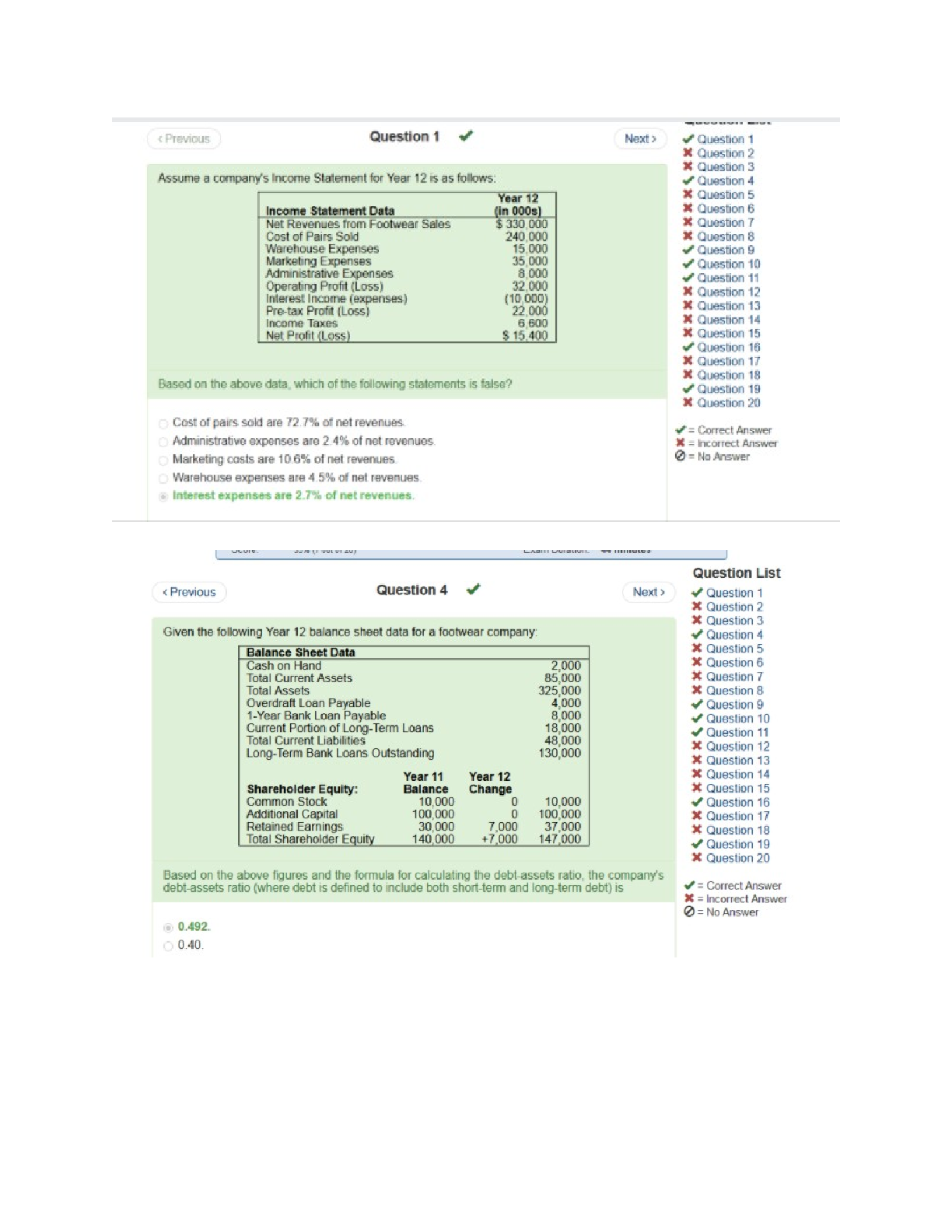
12. Assume a company's Income Statement for Year 12 is as follows:
Warehouse expenses are 5.4% of net revenues .
Cost of pairs sold are 53.6% of net revenues .
Interest expenses are 3.6% of net revenues.
Marketing costs are 10.9% of net revenues.
Administrative expenses are 2.9% of net revenues.
13.Given the following Year 12 balance sheet data for a footwear company:
Based on the above figures and the formula for calculating the debt-assets
ratio, the company's
debt-assets ratio (where debt is defined to include both short-term and longterm debt) is
0.318.
0.40.
0.413.
0.375.
0.333.
[Show More]



.png)

.png)