Question 1
2 / 2 pts
In hyperkalemia, cardiac rhythm changes are a direct result of
Correct!
cardiac cell hypopolarization.
cardiac cell repolarization.
cardiac cell hyperexcitability.
depression of the si
...
Question 1
2 / 2 pts
In hyperkalemia, cardiac rhythm changes are a direct result of
Correct!
cardiac cell hypopolarization.
cardiac cell repolarization.
cardiac cell hyperexcitability.
depression of the sinoatrial (SA) node.
If extracellular potassium concentration increases without a significant change in
intracellular potassium, the resting membrane potential becomes more positive (i.e.,
changes from –90 to –80 mV) and the cell membrane is hypopolarized (the inside of the
cell becomes less negative or partially depolarized [increase excitability]). (Electrical
properties of cells are discussed in Chapter 1.)
Question 2
2 / 2 pts
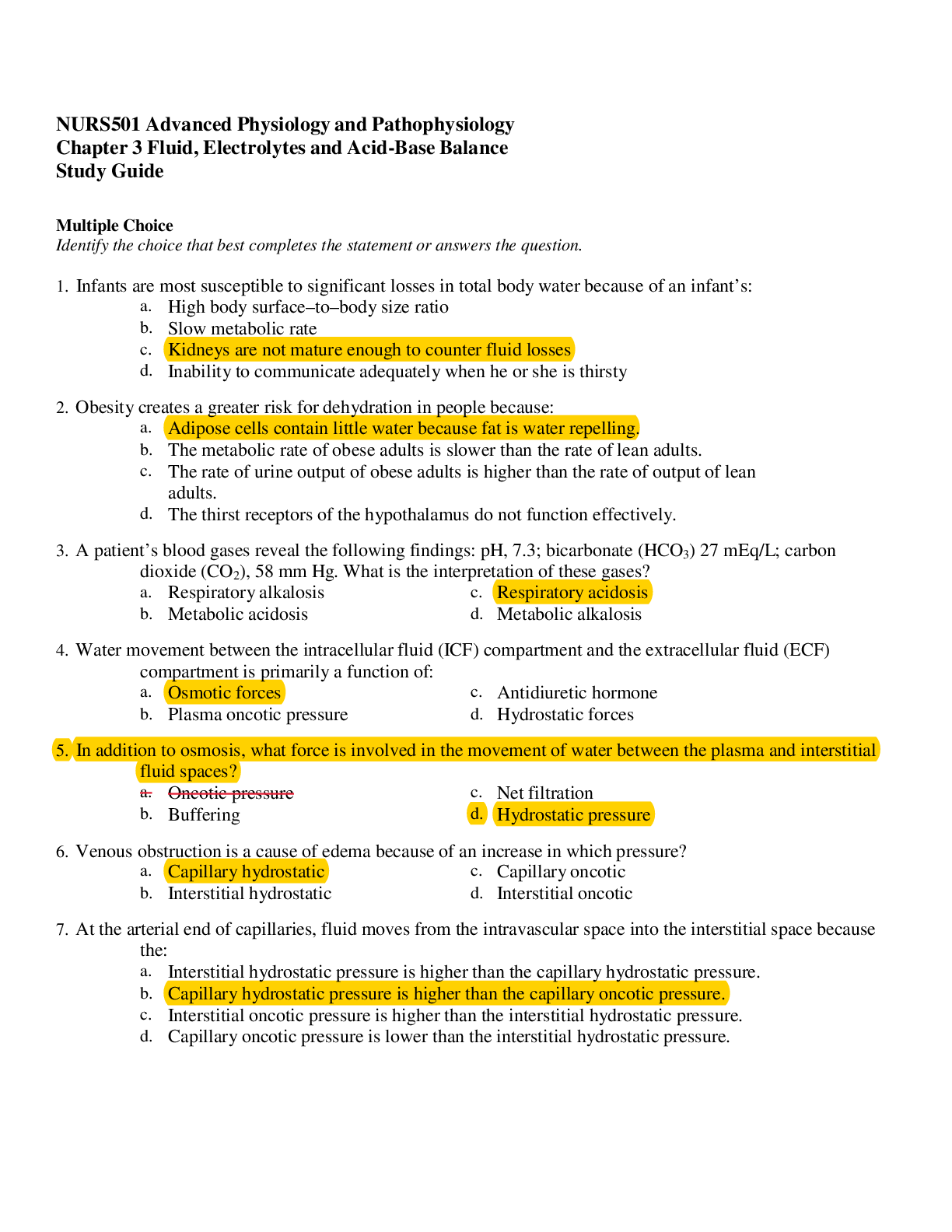
Water movement between the intracellular fluid compartment and the extracellular compartment is
primarily a function of
plasma oncotic pressure.
antidiuretic hormone.
hydrostatic forces.
Correct!
osmotic forces.
The movement of water between ICF and ECF compartments is primarily a function of
osmotic forces. (Osmosis and other mechanisms of passive transport are discussed in
Chapter 1.)
Question 3
2 / 2 pts
Chvostek sign and Trousseau sign indicate
Correct!
hypocalcemia.
hyperkalemia.
hypercalcemia.
hypokalemia.
Two clinical signs are Chvostek sign and Trousseau sign.
Question 4
2 / 2 pts
Physiologic pH is maintained around 7.4 because bicarbonate (HCO3) and carbonic acid (H2CO3) exist in
a ratio of
Correct!
20:1.
10:5.
10:2.
1:20.
The relationship between bicarbonate and carbonic acid is usually expressed as a ratio.
When the pH is 7.40, this ratio is 20:1 (bicarbonate/carbonic acid).
Question 5
2 / 2 pts
What is a major determinant of the resting membrane potential necessary for transmission of nerve
impulses?
The ratio between intracellular Na+ and extracellular K+
The ratio between intracellular K+ and extracellular Na+
Correct!
The ratio between intracellular K+ and extracellular potassium
The ratio between intracellular Na+ and extracellular sodium
The ratio of K+
in the ICF to K+
in the ECF is the major determinant of the resting
membrane potential, which is necessary for the transmission and conduction of nerve
impulses, maintenance of normal cardiac rhythms, and skeletal and smooth muscle
contraction.
Question 6
2 / 2 pts
Why are infants susceptible to significant losses in total body water (TBW)?
Because they are unable communicate adequately when they are thirsty
Correct!
Because an infant’s kidneys are not mature enough to counter fluids losses
Because infants have a slow metabolic rate
Because more than half of an infant’s body weight is water
Infants are particularly susceptible to significant changes in TBW because of their high
metabolic rate and the accelerated turnover of body fluids caused by their greater body
surface area in proportion to total body size. Loss of fluids from diarrhea can represent
a significant proportion of body weight. Renal mechanisms that regulate fluid and
electrolyte conservation may not be mature enough to counter the losses, so
dehydration may develop rapidly.
Question 7
2 / 2 pts
Which enzyme is secreted by the juxtaglomerular cells of the kidney when circulating blood volume is
reduced?
Aldosterone
Correct!
Renin
Angiotensin II
Angiotensin I
When circulating blood volume or blood pressure is reduced, renin, an enzyme secreted
by the juxtaglomerular cells of the kidney, is released in response to sympathetic nerve
stimulation and decreased perfusion of the renal vasculature.
Question 8
2 / 2 pts
Which pleural abnormality involves a site of pleural rupture that act as a one-way valve, permitting air to
enter on inspiration but preventing its escape by closing during expiration?
Open pneumothorax
Correct!
Tension pneumothorax
Secondary pneumothorax
Spontaneous pneumothorax
In tension pneumothorax, the site of pleural rupture acts as a one-way valve, permitting
air to enter on inspiration but preventing its escape by closing up during expiration. As
more and more air enters the pleural space, air pressure in the pneumothorax begins to
exceed barometric pressure.
Question 9
2 / 2 pts
Clinical manifestations of pulmonary hypertension include
Correct!
peripheral edema and jugular venous distention.
dyspnea on exertion and paroxysmal nocturnal dyspnea.
systemic blood pressure greater than 130/90.
productive cough and rhonchi bilaterally.
Symptoms of fatigue, chest discomfort, tachypnea, and dyspnea on exertion,
palpitations, and cough are common. Examination may reveal peripheral edema, jugular
venous distention, a precordial heave, and accentuation of the pulmonary compartment
of the second heart sound.
Question 10
2 / 2 pts
In ARDS, alveoli and respiratory bronchioles fill with fluid as a result of the
compression on the pores of Kohn, thus preventing collateral ventilation.
increased capillary permeability, which causes alveoli and respiratory bronchioles to fill with fluid.
Correct!
inactivation of surfactant and the impairment of type II alveolar cells.
increased capillary hydrostatic pressure that forces fluid into the alveoli and respiratory bronchioles.
Lung inflammation and injury damages the alveolar epithelium and the vascular
endothelium. Surfactant is inactivated, and its production by type II alveolar cells is
impaired as alveoli and respiratory bronchioles fill with fluid or collapse.
[Show More]