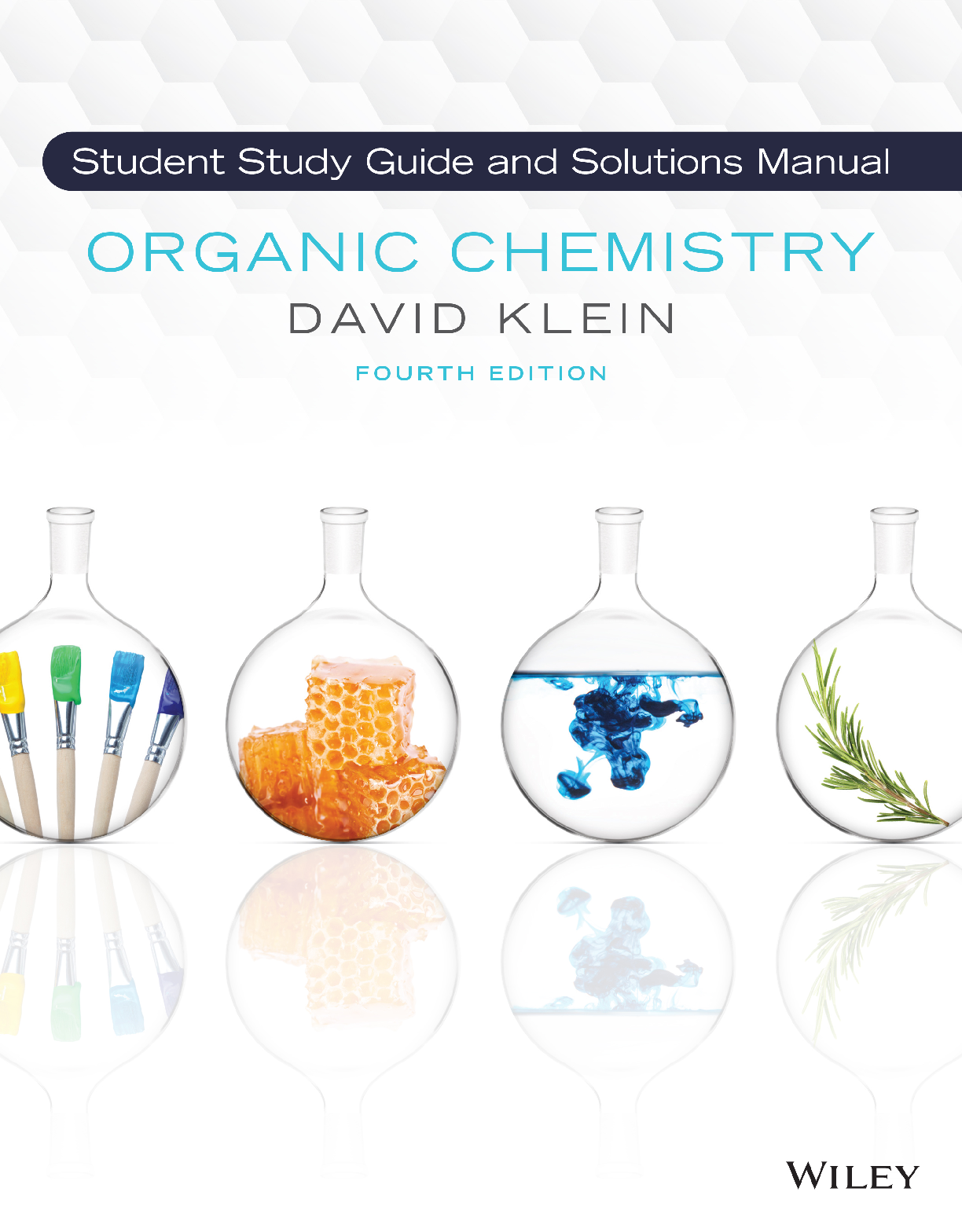
Cover
Approximate pKa Values for Commonly Encountered Structural Types
Title Page
Preface
1 A Review of General Chemistry
1.1 Introduction to Organic Chemistry
1.2 The Structural Theory of Matter
1.3 Electrons, Bo
...
Cover
Approximate pKa Values for Commonly Encountered Structural Types
Title Page
Preface
1 A Review of General Chemistry
1.1 Introduction to Organic Chemistry
1.2 The Structural Theory of Matter
1.3 Electrons, Bonds, and Lewis Structures
1.4 Identifying Formal Charges
1.5 Induction and Polar Covalent Bonds
1.6 Atomic Orbitals
1.7 Valence Bond Theory
1.8 Molecular Orbital Theory
1.9 Hybridized Atomic Orbitals
1.10 Predicting Molecular Geometry: VSEPR Theory
1.11 Dipole Moments and Molecular Polarity
1.12 Intermolecular Forces and Physical Properties
1.13 Solubility
Review of Concepts & Vocabulary
SkillBuilder Review
Practice Problems
Integrated Problems
Challenge Problems
2 Molecular Representations
2.1 Molecular Representations
2.2 Bond-Line Structures
2.3 Identifying Functional Groups
2.4 Carbon Atoms with Formal Charges
2.5 Identifying Lone Pairs
2.6 Three-Dimensional Bond-Line Structures
2.7 Introduction to Resonance
2.8 Curved Arrows
2.9 Formal Charges in Resonance Structures
2.10 Drawing Resonance Structures via Pattern Recognition
2.11 Assessing the Relative Importance of Resonance Structures
2.12 The Resonance Hybrid
2.13 Delocalized and Localized Lone Pairs
Review of Concepts & Vocabulary
SkillBuilder Review
Practice Problems
Integrated Problems
Challenge Problems
3 Acids and Bases
3.1 Introduction to Brønsted-Lowry Acids and Bases
3.2 Flow of Electron Density: Curved-Arrow Notation
3.3 Brønsted-Lowry Acidity: Quantitative Perspective
3.4 Brønsted-Lowry Acidity: Qualitative Perspective
3.5 Position of Equilibrium and Choice of Reagents
3.6 Leveling Effect
3.7 Solvating Effects
3.8 Counterions
3.9 Lewis Acids and Bases
Review of Concepts & Vocabulary
SkillBuilder Review
Practice Problems
Integrated Problems
Challenge Problems
4 Alkanes and Cycloalkanes
4.1 Introduction to Alkanes
4.2 Nomenclature of Alkanes
4.3 Constitutional Isomers of Alkanes
4.4 Relative Stability of Isomeric Alkanes
4.5 Sources and Uses of Alkanes
4.6 Drawing Newman Projections
4.7 Conformational Analysis of Ethane and Propane
4.8 Conformational Analysis of Butane
4.9 Cycloalkanes
4.10 Conformations of Cyclohexane
4.11 Drawing Chair Conformations
4.12 Monosubstituted Cyclohexane
4.13 Disubstituted Cyclohexane
4.14 cis-trans Stereoisomerism
4.15 Polycyclic Systems
Review of Concepts & Vocabulary
SkillBuilder Review
Practice Problems
Integrated Problems
Challenge Problems
5 Stereoisomerism
5.1 Overview of Isomerism
5.2 Introduction to Stereoisomerism
5.3 Designating Configuration Using the Cahn-Ingold-Prelog System
5.4 Optical Activity
5.5 Stereoisomeric Relationships: Enantiomers and Diastereomers
5.6 Symmetry and Chirality
5.7 Fischer Projections
5.8 Conformationally Mobile Systems
5.9 Chiral Compounds That Lack a Chiral Center
5.10 Resolution of Enantiomers
5.11 E and Z Designations for Diastereomeric Alkenes
Review of Concepts & Vocabulary
SkillBuilder Review
Practice Problems
Integrated Problems
Challenge Problems
6 Chemical Reactivity and Mechanisms
6.1 Enthalpy
6.2 Entropy
6.3 Gibbs Free Energy
6.4 Equilibria
6.5 Kinetics
6.6 Reading Energy Diagrams
6.7 Nucleophiles and Electrophiles
6.8 Mechanisms and Arrow Pushing
6.9 Combining the Patterns of Arrow Pushing
6.10 Drawing Curved Arrows
6.11 Carbocation Rearrangements
6.12 Reversible and Irreversible Reaction Arrows
Review of Concepts & Vocabulary
SkillBuilder Review
Practice Problems
Integrated Problems
Challenge Problems
7 Alkyl Halides: Nucleophilic Substitution and Elimination Reactions
7.1 Introduction to Substitution and Elimination Reactions
7.2 Nomenclature and Uses of Alkyl Halides
7.3 SN2 Reactions
7.4 Nucleophilic Strength and Solvent Effects in SN2 Reactions
7.5 SN2 Reactions in Biological Systems—Methylation
7.6 Introduction to E2 Reactions
7.7 Nomenclature and Stability of Alkenes
7.8 Regiochemical and Stereochemical Outcomes for E2 Reactions
7.9 Unimolecular Reactions (SN1 and E1)
7.10 Kinetic Isotope Effects in Elimination Reactions
7.11 Predicting Products: Substitution vs. Elimination
7.12 Substitution and Elimination Reactions with Other Substrates
7.13 Synthesis Strategies
Review of Concepts & Vocabulary
SkillBuilder Review
Practice Problems
Integrated Problems
Challenge Problems
8 Addition Reactions of Alkenes
8.1 Introduction to Addition Reactions
8.2 Alkenes in Nature and in Industry
8.3 Addition vs. Elimination: A Thermodynamic Perspective
8.4 Hydrohalogenation
8.5 Acid-Catalyzed Hydration
8.6 Oxymercuration-Demercuration
8.7 Hydroboration-Oxidation
8.8 Catalytic Hydrogenation
8.9 Halogenation and Halohydrin Formation
8.10 Anti Dihydroxylation
8.11 Syn Dihydroxylation
8.12 Oxidative Cleavage
8.13 Predicting the Products of an Addition Reaction
8.14 Synthesis Strategies
Review of Concepts & Vocabulary
SkillBuilder Review
Practice Problems
Integrated Problems
Challenge Problems
9 Alkynes
9.1 Introduction to Alkynes
9.2 Nomenclature of Alkynes
9.3 Acidity of Acetylene and Terminal Alkynes
9.4 Preparation of Alkynes
9.5 Reduction of Alkynes
9.6 Hydrohalogenation of Alkynes
9.7 Hydration of Alkynes
9.8 Halogenation of Alkynes
9.9 Ozonolysis of Alkynes
9.10 Alkylation of Terminal Alkynes
9.11 Synthesis Strategies
Review of Concepts & Vocabulary
SkillBuilder Review
Practice Problems
Integrated Problems
Challenge Problems
10 Radical Reactions
10.1 Radicals
10.2 Common Patterns in Radical Mechanisms
10.3 Chlorination of Methane
10.4 Thermodynamic Considerations for Halogenation Reactions
10.5 Selectivity of Halogenation
10.6 Stereochemistry of Halogenation
10.7 Allylic Bromination
10.8 Atmospheric Chemistry and the Ozone Layer
10.9 Autooxidation and Antioxidants
10.10 Radical Addition of HBr: Anti-Markovnikov Addition
10.11 Radical Polymerization
10.12 Radical Processes in the Petrochemical Industry
10.13 Halogenation as a Synthetic Technique
Review of Concepts & Vocabulary
SkillBuilder Review
Practice Problems
Integrated Problems
Challenge Problems
11 Synthesis
11.1 One-Step Syntheses
11.2 Functional Group Transformations
11.3 Reactions That Change the Carbon Skeleton
11.4 How to Approach a Synthesis Problem
11.5 Retrosynthetic Analysis
11.6 Green Chemistry
11.7 Practical Tips for Increasing Proficiency
Review of Concepts & Vocabulary
SkillBuilder Review
Practice Problems
Integrated Problems
Challenge Problems
12 Alcohols and Phenols
12.1 Structure and Properties of Alcohols
12.2 Acidity of Alcohols and Phenols
12.3 Preparation of Alcohols via Substitution or Addition
12.4 Preparation of Alcohols via Reduction
12.5 Preparation of Diols
12.6 Preparation of Alcohols via Grignard Reagents
12.7 Protection of Alcohols
12.8 Preparation of Phenols
12.9 Reactions of Alcohols: Substitution and Elimination
12.10 Reactions of Alcohols: Oxidation
12.11 Biological Redox Reactions
12.12 Oxidation of Phenol
12.13 Synthesis Strategies
Review of Concepts & Vocabulary
SkillBuilder Review
Practice Problems
Integrated Problems
Challenge Problems
13 Ethers and Epoxides; Thiols and Sulfides
13.1 Introduction to Ethers
13.2 Nomenclature of Ethers
13.3 Structure and Properties of Ethers
13.4 Crown Ethers
13.5 Preparation of Ethers
13.6 Reactions of Ethers
13.7 Nomenclature of Epoxides
13.8 Preparation of Epoxides
13.9 Enantioselective Epoxidation
13.10 Ring-Opening Reactions of Epoxides
13.11 Thiols and Sulfides
13.12 Synthesis Strategies Involving Epoxides
Review of Concepts & Vocabulary
SkillBuilder Review
Practice Problems
Integrated Problems
Challenge Problems
14 Infrared Spectroscopy and Mass Spectrometry
14.1 Introduction to Spectroscopy
14.2 IR Spectroscopy
14.3 Signal Characteristics: Wavenumber
14.4 Signal Characteristics: Intensity
14.5 Signal Characteristics: Shape
14.6 Analyzing an IR Spectrum
14.7 Using IR Spectroscopy to Distinguish between Two Compounds
14.8 Introduction to Mass Spectrometry
14.9 Analyzing the (M) Peak
14.10 Analyzing the (M+1) Peak
14.11 Analyzing the (M+2) Peak
14.12 Analyzing the Fragments
14.13 High-Resolution Mass Spectrometry
14.14 Gas Chromatography–Mass Spectrometry
14.15 Mass Spectrometry of Large Biomolecules
14.16 Hydrogen Deficiency Index: Degrees of Unsaturation
Review of Concepts & Vocabulary
SkillBuilder Review
Practice Problems
Integrated Problems
Challenge Problems
15 Nuclear Magnetic Resonance Spectroscopy
15.1 Introduction to NMR Spectroscopy
15.2 Acquiring a H NMR Spectrum
15.3 Characteristics of a H NMR Spectrum
15.4 Number of Signals
15.5 Chemical Shift
15.6 Integration
15.7 Multiplicity
15.8 Drawing the Expected H NMR Spectrum of a Compound
15.9 Using H NMR Spectroscopy to Distinguish between Compounds
15.10 Analyzing a H NMR Spectrum
15.11 Acquiring a C NMR Spectrum
15.12 Chemical Shifts in C NMR Spectroscopy
15.13 DEPT C NMR Spectroscopy
Review of Concepts & Vocabulary
SkillBuilder Review
Practice Problems
Integrated Problems
Challenge Problems
16 Conjugated Pi Systems and Pericyclic Reactions
16.1 Classes of Dienes
16.2 Conjugated Dienes
16.3 Molecular Orbital Theory
16.4 Electrophilic Addition
16.5 Thermodynamic Control vs. Kinetic Control
16.6 An Introduction to Pericyclic Reactions
16.7 Diels–Alder Reactions
16.8 MO Description of Cycloadditions
16.9 Electrocyclic Reactions
16.10 Sigmatropic Rearrangements
16.11 UV-Vis Spectroscopy
16.12 Color
16.13 Chemistry of Vision
Review of Concepts & Vocabulary
SkillBuilder Review
Practice Problems
Integrated Problems
Challenge Problems
17 Aromatic Compounds
17.1 Introduction to Aromatic Compounds
17.2 Nomenclature of Benzene Derivatives
17.3 Structure of Benzene
17.4 Stability of Benzene
17.5 Aromatic Compounds Other Than Benzene
17.6 Reactions at the Benzylic Position
17.7 Reduction of Benzene and Its Derivatives
17.8 Spectroscopy of Aromatic Compounds
Review of Concepts & Vocabulary
SkillBuilder Review
Practice Problems
Integrated Problems
Challenge Problems
18 Aromatic Substitution Reactions
18.1 Introduction to Electrophilic Aromatic Substitution
18.2 Halogenation
18.3 Sulfonation
18.4 Nitration
18.5 Friedel–Crafts Alkylation
18.6 Friedel–Crafts Acylation
18.7 Activating Groups
18.8 Deactivating Groups
18.9 Halogens: The Exception
18.10 Determining the Directing Effects of a Substituent
18.11 Multiple Substituents
18.12 Synthesis Strategies
18.13 Nucleophilic Aromatic Substitution
18.14 Elimination-Addition
18.15 Identifying the Mechanism of an Aromatic Substitution Reaction
Review of Concepts & Vocabulary
SkillBuilder Review
Practice Problems
Integrated Problems
Challenge Problems
19 Aldehydes and Ketones
19.1 Introduction to Aldehydes and Ketones
19.2 Nomenclature
19.3 Preparing Aldehydes and Ketones: A Review
19.4 Introduction to Nucleophilic Addition Reactions
19.5 Oxygen Nucleophiles
19.6 Nitrogen Nucleophiles
19.7 Hydrolysis of Acetals, Imines, and Enamines
19.8 Sulfur Nucleophiles
19.9 Hydrogen Nucleophiles
19.10 Carbon Nucleophiles
19.11 Baeyer–Villiger Oxidation of Aldehydes and Ketones
19.12 Synthesis Strategies
19.13 Spectroscopic Analysis of Aldehydes and Ketones
Review of Concepts & Vocabulary
SkillBuilder Review
Practice Problems
Integrated Problems
Challenge Problems
20 Carboxylic Acids and Their Derivatives
20.1 Introduction to Carboxylic Acids
20.2 Nomenclature of Carboxylic Acids
20.3 Structure and Properties of Carboxylic Acids
20.4 Preparation of Carboxylic Acids
20.5 Reactions of Carboxylic Acids
20.6 Introduction to Carboxylic Acid Derivatives
20.7 Reactivity of Carboxylic Acid Derivatives
20.8 Preparation and Reactions of Acid Chlorides
20.9 Preparation and Reactions of Acid Anhydrides
20.10 Preparation of Esters
20.11 Reactions of Esters
20.12 Preparation and Reactions of Amides
20.13 Preparation and Reactions of Nitriles
20.14 Synthesis Strategies
20.15 Spectroscopy of Carboxylic Acids and Their Derivatives
Review of Concepts & Vocabulary
SkillBuilder Review
Practice Problems
Integrated Problems
Challenge Problems
21 Alpha Carbon Chemistry: Enols and Enolates
21.1 Introduction to Alpha Carbon Chemistry: Enols and Enolates
21.2 Alpha Halogenation of Enols and Enolates
21.3 Aldol Reactions
21.4 Claisen Condensations
21.5 Alkylation of the Alpha Position
21.6 Conjugate Addition Reactions
21.7 Synthesis Strategies
Review of Concepts & Vocabulary
SkillBuilder Review
Practice Problems
Integrated Problems
Challenge Problems
22 Amines
22.1 Introduction to Amines
22.2 Nomenclature of Amines
22.3 Properties of Amines
22.4 Preparation of Amines: A Review
22.5 Preparation of Amines via Substitution Reactions
22.6 Preparation of Amines via Reductive Amination
22.7 Synthesis Strategies
22.8 Acylation of Amines
22.9 Hofmann Elimination
22.10 Reactions of Amines with Nitrous Acid
22.11 Reactions of Aryl Diazonium Ions
22.12 Nitrogen Heterocycles
22.13 Spectroscopy of Amines
Review of Concepts & Vocabulary
SkillBuilder Review
Practice Problems
Integrated Problems
Challenge Problems
23 Introduction to Organometallic Compounds
23.1 General Properties of Organometallic Compounds
23.2 Organolithium and Organomagnesium Compounds
23.3 Lithium Dialkyl Cuprates (Gilman Reagents)
23.4 The Simmons–Smith Reaction and Carbenoids
23.5 Stille Coupling
23.6 Suzuki Coupling
23.7 Negishi Coupling
23.8 The Heck Reaction
23.9 Alkene Metathesis
Review of Concepts & Vocabulary
SkillBuilder Review
Practice Problems
Integrated Problems
Challenge Problems
24 Carbohydrates
24.1 Introduction to Carbohydrates
24.2 Classification of Monosaccharides
24.3 Configuration of Aldoses
24.4 Configuration of Ketoses
24.5 Cyclic Structures of Monosaccharides
24.6 Reactions of Monosaccharides
24.7 Disaccharides
24.8 Polysaccharides
24.9 Amino Sugars
24.10 N-Glycosides
Review of Concepts & Vocabulary
SkillBuilder Review
Practice Problems
Integrated Problems
Challenge Problems
25 Amino Acids, Peptides, and Proteins
25.1 Introduction to Amino Acids, Peptides, and Proteins
25.2 Structure and Properties of Amino Acids
25.3 Amino Acid Synthesis
25.4 Structure of Peptides
25.5 Sequencing a Peptide
25.6 Peptide Synthesis
25.7 Protein Structure
25.8 Protein Function
Review of Concepts & Vocabulary
SkillBuilder Review
Practice Problems
Integrated Problems
Challenge Problems
26 Lipids
26.1 Introduction to Lipids
26.2 Waxes
26.3 Triglycerides
26.4 Reactions of Triglycerides
26.5 Phospholipids
26.6 Steroids
26.7 Prostaglandins
26.8 Terpenes
Review of Concepts & Vocabulary
SkillBuilder Review
Practice Problems
Integrated Problems
Challenge Problems
27 Synthetic Polymers
27.1 Introduction to Synthetic Polymers
27.2 Nomenclature of Synthetic Polymers
27.3 Copolymers
27.4 Polymer Classification by Reaction Type
27.5 Polymer Classification by Mode of Assembly
27.6 Polymer Classification by Structure
27.7 Polymer Classification by Properties
27.8 Polymer Recycling
Review of Concepts & Vocabulary
SkillBuilder Review
Practice Problems
Integrated Problems
Challenge Problems
Student Study Guide and Solutions Manual
Title Page
Chapter 1 A Review of General Chemistry: Electrons, Bonds and Molecular Properties
Chapter 2 Molecular Representations
Chapter 3 Acids and Bases
Chapter 4 Alkanes and Cycloalkanes
Chapter 5 Stereoisomerism
Chapter 6 Chemical Reactivity and Mechanisms
Chapter 7 Alkyl Halides: Nucleophilic Substitution and Elimination Reactions
Chapter 8 Addition Reactions of Alkenes
Chapter 9 Alkynes
Chapter 10 Radical Reactions
Chapter 11 Synthesis
Chapter 12 Alcohols
Chapter 13 Ethers and Epoxides; Thiols and Sulfides
Chapter 14 Infrared Spectroscopy and Mass Spectrometry
Chapter 15 Nuclear Magnetic Resonance Spectroscopy
Chapter 16 Conjugated Pi Systems and Pericyclic Reactions
Chapter 17 Aromatic Compounds
Chapter 18 Aromatic Substitution Reactions
Chapter 19 Ketones and Aldehydes
Chapter 20 Carboxylic Acids and Their Derivatives
Chapter 21 Alpha Carbon Chemistry: Enols and Enolates
Chapter 22 Amines
Chapter 23 Organometallic Compounds
Chapter 24 Carbohydrates
Chapter 25 Amino Acids, Peptides, and Proteins
Chapter 26 Lipids
Chapter 27 Synthetic Polymers
Appendix Nomenclature of Polyfunctional Compounds
Appendix Nomenclature of Polyfunctional Compounds
Glossary
Credits
Index
Examples of Common Functional Groups
Periodic Table of Elements
End User License Agreement
Read More
[Show More]
Preview 1 out of 1344 pages










 Gary Donell, Clarence Byrd, Ida Chen.png)
 Gary Donell, Clarence Byrd, Ida Chen.png)