You would like to have $30,000 in an account after five years' time.
If the account earns 3% compounded interest yearly, how much would you have to deposit today?
•
$29,126
•
$28,092
•
$25,878
•
$26,08
...
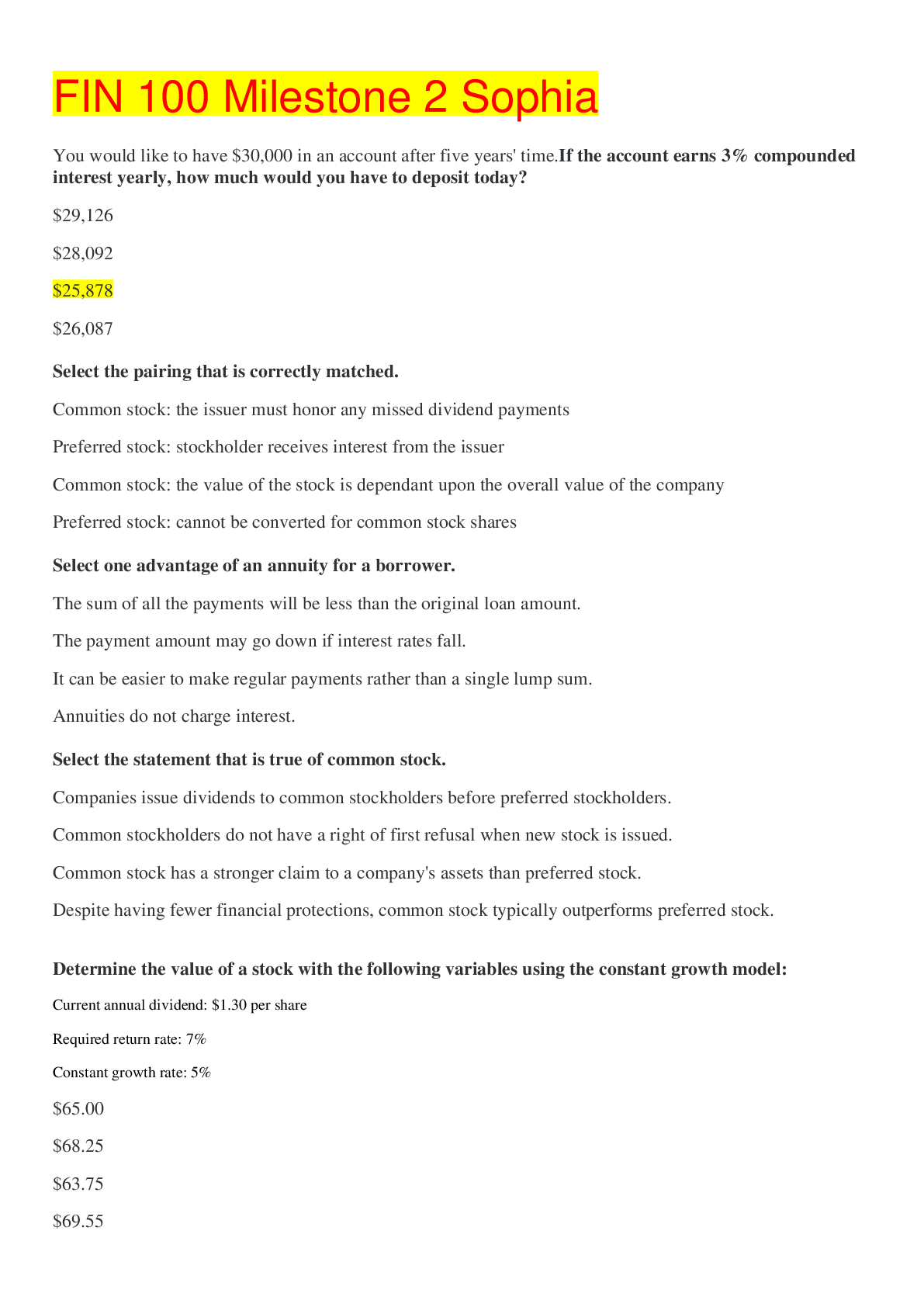
You would like to have $30,000 in an account after five years' time.
If the account earns 3% compounded interest yearly, how much would you have to deposit today?
•
$29,126
•
$28,092
•
$25,878
•
$26,087
2
Select the pairing that is correctly matched.
•
Common stock: the issuer must honor any missed dividend payments
•
Preferred stock: stockholder receives interest from the issuer
•
Common stock: the value of the stock is dependant upon the overall value of the company
•
Preferred stock: cannot be converted for common stock shares
3
Select one advantage of an annuity for a borrower.
•
The sum of all the payments will be less than the original loan amount.
•
The payment amount may go down if interest rates fall.
•
It can be easier to make regular payments rather than a single lump sum.
•
Annuities do not charge interest.
4
Select the statement that is true of common stock.
•
Companies issue dividends to common stockholders before preferred stockholders.
•
Common stockholders do not have a right of first refusal when new stock is issued.
•
Common stock has a stronger claim to a company's assets than preferred stock.
•
Despite having fewer financial protections, common stock typically outperforms preferred stock.
5
Determine the value of a stock with the following variables using the constant growth model:
• Current annual dividend: $1.30 per share
• Required return rate: 7%
• Constant growth rate: 5%
•
$65.00
•
$68.25
•
$63.75
•
$69.55
6
Chen purchased a 30-year corporate bond in 2018 that promised to pay him 4% interest semi-annually for the life of the loan. The corporation reserved the right to redeem the bond in 2038.
Which of those numbers represents the bond's call feature?
•
2038
•
4
•
30
•
2018
7
Select the true statement about interest rate risk.
•
It stems from the fact that bond prices and market interest rates are inversely correlated.
•
Shorter-term bonds are more sensitive to interest rate risk than longer-term bonds.
•
It is the risk that a bond's coupon payment will fall if market interest rates fall.
•
Interest rate risk is particularly problematic for investors who do not wish to sell their bonds.
8
You make a loan of $400 with a 6% annual compounded interest for a period of seven years.
What is your $400 worth seven years later?
•
$568
•
$601
•
$199
•
$232
9
Which of the following is true for calculating the present value of multiple cash flows?
•
The PV of multiple cash flows is the sum of the FV of each individual cash flow divided by the interest rate.
•
All of the cash flows must be discounted to the same point in time.
•
You can only find the PV of multiple cash flows if they originate at the same time.
•
It is more complex to find the PV of annuities than the PV of irregular cash flows.
10
An investment fund that uses more complex investment strategies to generate returns for their wealthy or institutional investors is a(n) __________.
•
index fund
•
mutual fund
•
exchange-traded fund
•
hedge fund
11
Select the statement that correctly explains the relationship between interest rates and present or future value.
•
Assuming other variables stay the same, if the interest rate decreases, the future value of an investment increases.
•
The interest rate and the present value of an investment are inversely related.
•
Assuming other variables stay the same, if the interest rate increases, the present value of an investment increases.
•
Assuming other variables stay the same, if the interest rate decreases, the present value of an investment decreases.
12
Max is willing to take on a little risk when she buys a bond, but she wants to be compensated for her risk with an elevated interest rate.
What kind of bond should she buy?
•
Zero-coupon
•
Convertible
•
Inflation-linked
•
Subordinated
13
What effect would a CCC credit rating likely have on a bond?
•
The bond's interest rate would be unaffected because credit rating agencies are not considered impartial.
•
The bond would have a higher interest rate to compensate for increased risk.
•
The bond would have a typical interest rate because the bond is considered investment grade.
•
The bond would have a lower interest rate because the credit rating is poor.
14
Nadia is going to receive $1,000 from her grandparents next year.
According to the time value of money, the gift of $1,000 is worth __________ a gift of $1,000 if she received it today.
•
twice as much as
•
the same as
•
more than
•
less than
15
Which of the following accurately describes a normal yield curve?
•
A negatively sloping curve that indicates the expectation that the economy will contract in the future.
•
A negatively sloping curve that indicates confidence in rising inflation in the future.
•
A positively sloping curve that indicates confidence in sustained economic growth in the future.
•
A positively sloping curve that indicates the expectation that inflation will fall in the future.
16
Which descriptor relates to the asset-based approach for valuing corporations?
•
Involves an analysis of risk
•
Analyzes what the company owns
•
Considers the weighted average cost of capital
•
Multiplies the share price by number of shares outstanding
17
In calculating the yield of an investment, what is the relationship between APR and APY?
•
APR and APY are two ways of expressing the same measurement of yield.
•
APR is always slightly higher than APY if an investment is earning compounding interest.
•
APR is always slightly lower than APY if an investment is earning compounding interest.
•
APR can be higher or lower than the APY of a compounding investment, depending on how high the interest rate is.
18
Which of the following is a disadvantage of bonds for a potential investor?
•
They have less legal protection than stocks.
•
They are more likely than stocks to end up valueless if a company goes bankrupt.
•
Bondholders risk a significant price drop if a large number of bonds are sold at once.
•
Some bonds can be redeemed early by the issuer.
19
Consider what you have learned about valuing bonds.
• A: Coupon rate = 4.5%, YTM = 5.2%
• B: Coupon rate = 5%, YTM = 4.5%
• C: Coupon rate = 3.5%, YTM = 3.75%
• D: Coupon rate = 4%, YTM = 4%
Which of the bonds is selling at par?
•
D
•
B
•
A
•
C
20
When an investor purchases stock, he or she becomes a(n) __________ of the issuing company.
•
director
•
owner
•
creditor
•
employee
[Show More]