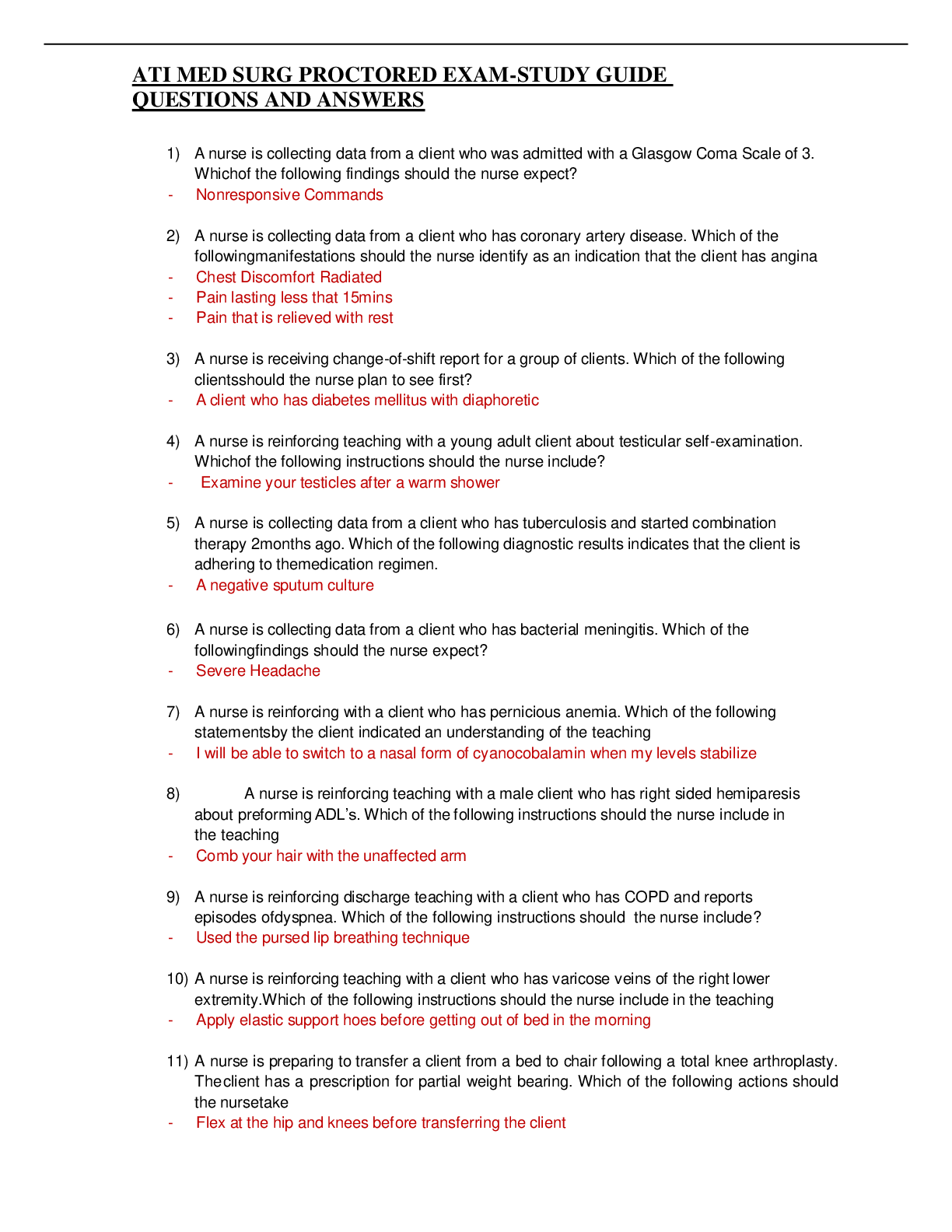
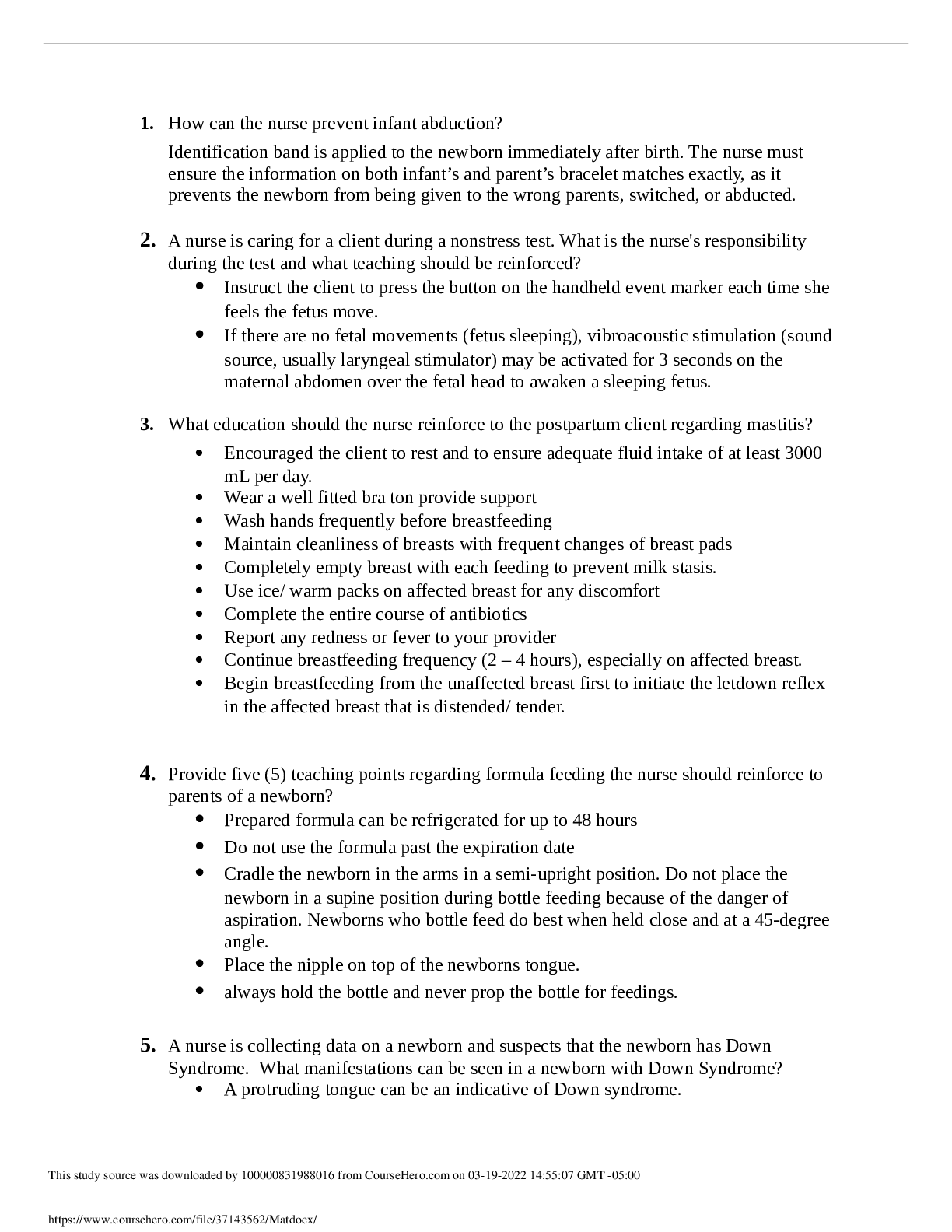
1. How can the nurse prevent infant abduction?
Identification band is applied to the newborn immediately after birth. The nurse must
ensure the information on both infant’s and parent’s bracelet matches exactly, as it
...
1. How can the nurse prevent infant abduction?
Identification band is applied to the newborn immediately after birth. The nurse must
ensure the information on both infant’s and parent’s bracelet matches exactly, as it
prevents the newborn from being given to the wrong parents, switched, or abducted.
2. A nurse is caring for a client during a nonstress test. What is the nurse's responsibility
during the test and what teaching should be reinforced?
Instruct the client to press the button on the handheld event marker each time she
feels the fetus move.
If there are no fetal movements (fetus sleeping), vibroacoustic stimulation (sound
source, usually laryngeal stimulator) may be activated for 3 seconds on the
maternal abdomen over the fetal head to awaken a sleeping fetus.
3. What education should the nurse reinforce to the postpartum client regarding mastitis?
Encouraged the client to rest and to ensure adequate fluid intake of at least 3000
mL per day.
Wear a well fitted bra ton provide support
Wash hands frequently before breastfeeding
Maintain cleanliness of breasts with frequent changes of breast pads
Completely empty breast with each feeding to prevent milk stasis.
Use ice/ warm packs on affected breast for any discomfort
Complete the entire course of antibiotics
Report any redness or fever to your provider
Continue breastfeeding frequency (2 – 4 hours), especially on affected breast.
Begin breastfeeding from the unaffected breast first to initiate the letdown reflex
in the affected breast that is distended/ tender.
4. Provide five (5) teaching points regarding formula feeding the nurse should reinforce to
parents of a newborn?
Prepared formula can be refrigerated for up to 48 hours
Do not use the formula past the expiration date
Cradle the newborn in the arms in a semi-upright position. Do not place the
newborn in a supine position during bottle feeding because of the danger of
aspiration. Newborns who bottle feed do best when held close and at a 45-degree
angle.
Place the nipple on top of the newborns tongue.
always hold the bottle and never prop the bottle for feedings.
5. A nurse is collecting data on a newborn and suspects that the newborn has Down
Syndrome. What manifestations can be seen in a newborn with Down Syndrome?
A protruding tongue can be an indicative of Down syndrome.
This study source was downloaded by 100000831988016 from CourseHero.com on 03-19-2022 14:55:07 GMT -05:00
https://www.coursehero.com/file/37143562/Matdocx/
6. A nurse is reinforcing discharge instructions with a postpartum client. What findings
should the client report to the health care provider that could suspect mastitis?
Painful or tender localized mass and redden area, usually on one breast.
Chills
Fever
Enlarged tender axillary lymph nodes, with an area of inflammation that can be
red, swollen, warm, and tender.
7. How is Nagele's rule used to calculate the estimated date of birth?
Take the first days of the client’s last menstrual cycle, subtract 3 months, and then add 7
days and a year, adjusting for the year as necessary.
8. What are abnormal findings during pregnancy that the client should be instructed to
notify their provider about if they occur?
During the first trimester the client should report the provider immediately if she is
experiencing burning on urination, diarrhea, fever or chills as these are signs of infection.
She should report sever vomiting, abdominal cramps and or vaginal bleeding as this
maybe a sign of a miscarriage and ectopic pregnancy.
During the second/ third trimester the client should report any:
Gushing of fluids from the vagina prior to 37 weeks of gestation
Vaginal bleeding
Abdominal pain
Change in fetal activity
Edema of the face and hands
Epigastric pain
[Show More]










![Preview of [SOLVED] EDCO 740 / EDCO740 Quiz 1 (LATES 2021/2022 Graded A)](https://scholarfriends.com/storage/EDCO_740_Quiz_1.png)