Contents
1. Creating and capturing customer value........................................................................2
2. Partnering to build customer relationships .................................................
...
Contents
1. Creating and capturing customer value........................................................................2
2. Partnering to build customer relationships ........................................................................8
3. Analyzing the marketing environment ....................................................................... 14
4. Managing marketing information to gain customer insights............................................ 18
5. Understanding consumer and business buyer behavior ................................................... 22
6. Customer-driven marketing strategy; Creating value for target customers ..................... 27
7. Products, services, and brands: Building customer value................................................. 32
8. Developing new products and managing the product life cycle ....................................... 38
9. Pricing: Understanding and capturing customer value..................................................... 43
10. Marketing channels: delivering customer value............................................................. 48
11. Retailing and wholesaling ................................................................................ 52
12. Communitcating customer value; advertising and public relations................................ 56
13. Personal selling and sales promotion ....................................................................... 60
14. Direct and online marketing: building direct customer relationship .............................. 64
15. The global marketplace .................................................................................... 68
16. Sustainable marketing: social responsibility and ethics................................................. 73
© StuDocu.com 1lOMoAR cPSD|414721
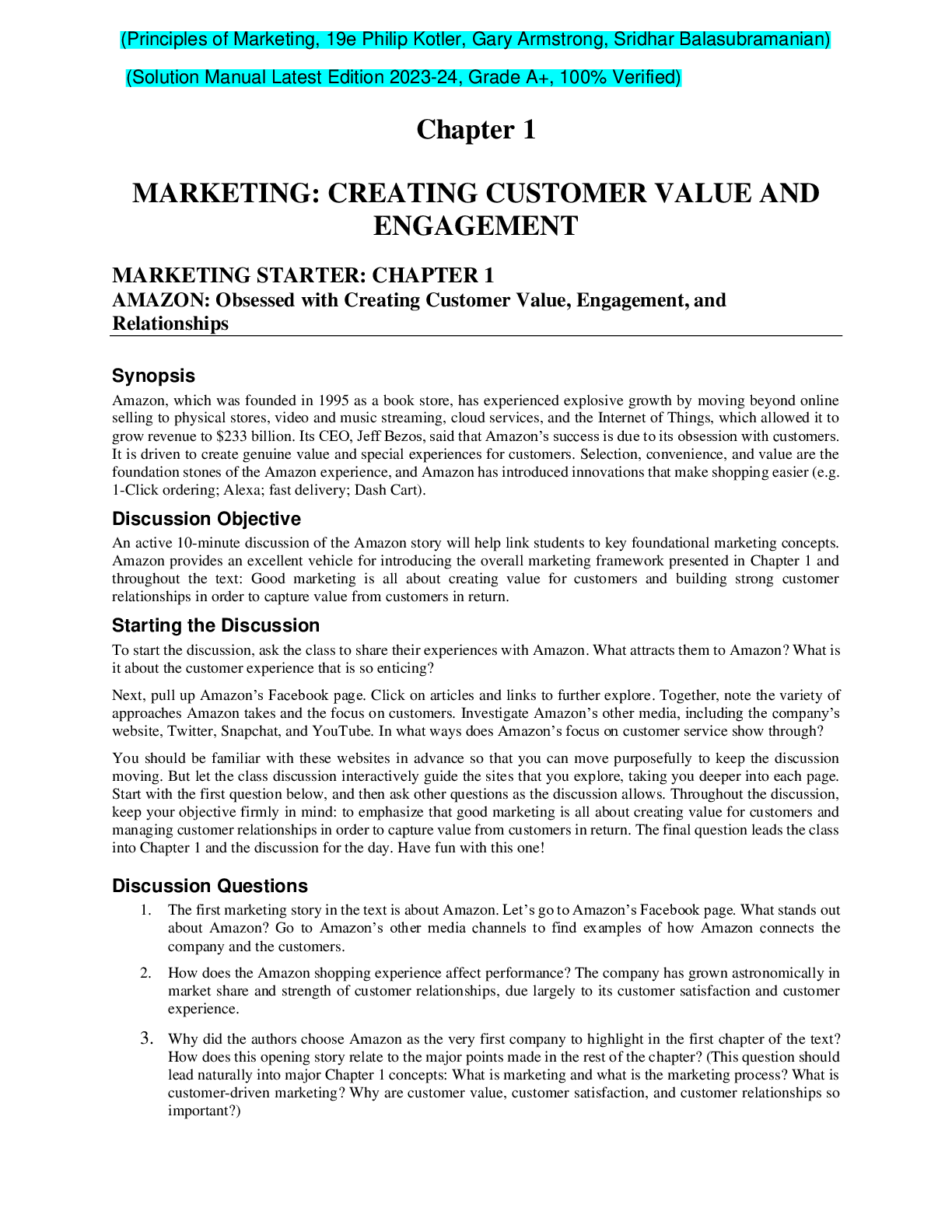
1. Creating and capturing customer value
Chapter 1 introduces you to the basic concepts of marketing. Marketing is managing
profitable customer relationships. The aim of marketing is to create value for
customers and capture value from customers in return. There are five steps in the
marketing process – from understanding customer needs, to design customer-driven
marketing strategies and integrated marketing programs, to building customer
relationships and capturing value for the firm.
What is marketing?
Marketing deals with customers and the simplest definition is: Marketing is managing
profitable customer relationships.
The twofold goal of marketing is to attract new customers by promising superior
value and to keep and grow current customers by delivering satisfaction.
We define marketing as the process by which companies create value for customers
and build strong customer relationships in order to capture value from customers in
return
The marketing process
There is a simple, five-step model of the marketing process. In the first four steps,
companies work to understand customers, create customer value, and build strong
customer relationships. In the final step, companies reap the rewards of creating
© StuDocu.com 2lOMoAR cPSD|414721
superior customer value. By creating value for customers, they in return capture value
from consumers in the form of sales, profits, and long-term customer equity
Step 1: Understanding the marketplace and customer needs
As a first step, marketers need to understand customer needs, wants and the
marketplace in which they operate. We examine five core customer and marketplace
concepts: 1) needs, wants and demands 2) market offerings (products, services and
experiences) 3) value and satisfaction
4) exchanges and relationships 5) markets
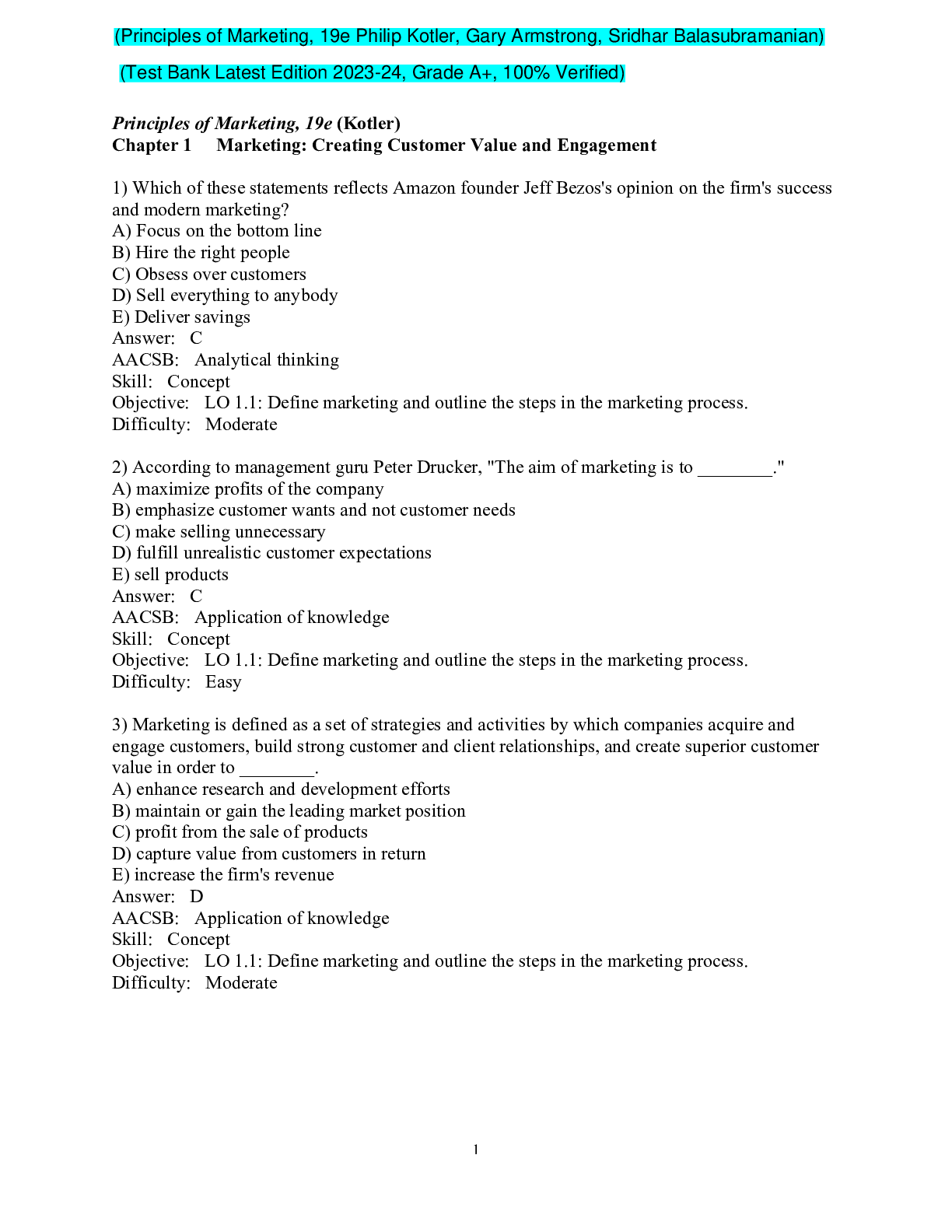
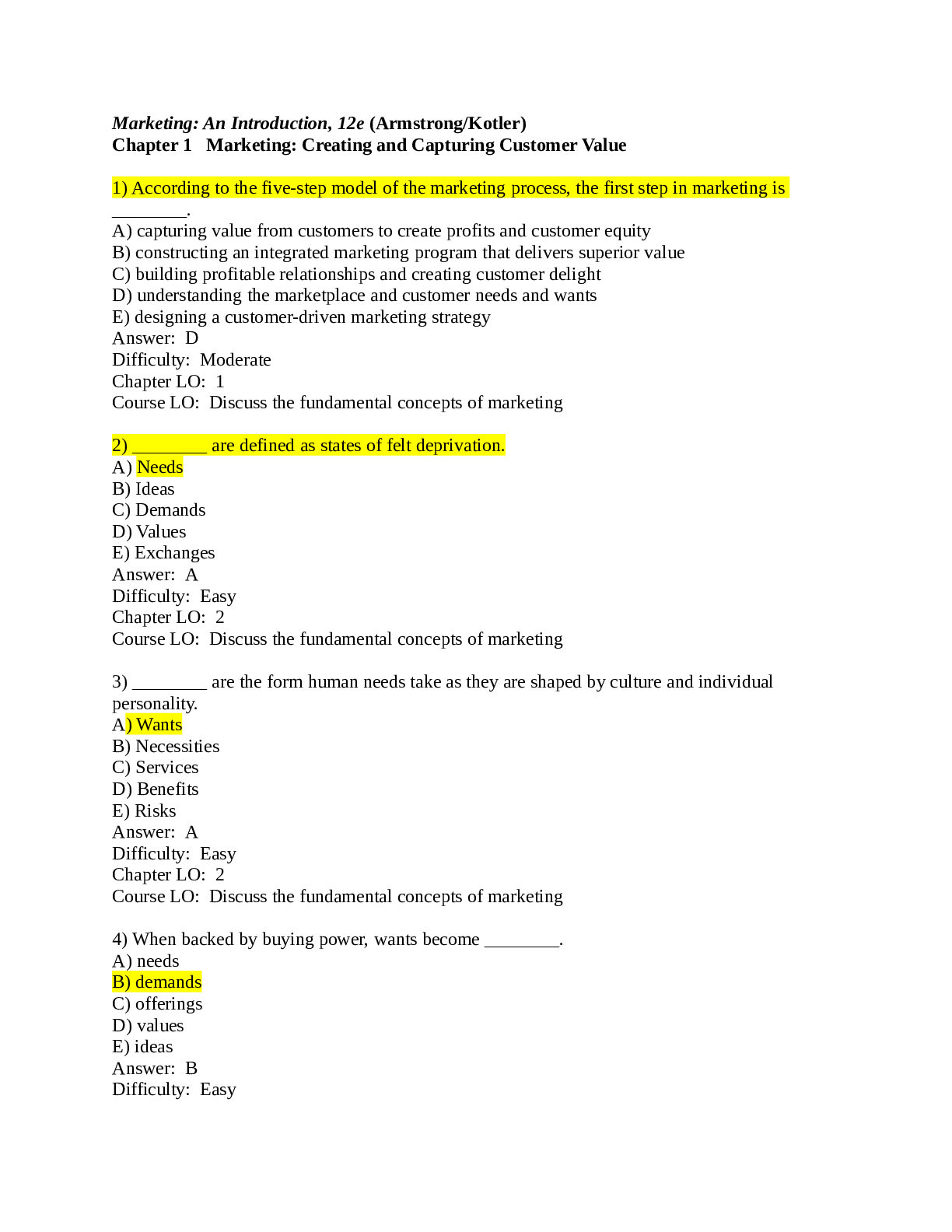
1) Human needs are states of felt deprivation. There are psychical needs (food), social
needs (belonging) and individual needs (knowledge).
Wants are the form humans needs take as they are shaped by culture and individual
personality.
For example, an American needs food but wants a Big Mac, French fries and a soft
drink.
When backed by buying power, wants become demands. Given their wants and
resources, people demand products with benefits hat add up the most value and
satisfaction
2) Consumers' need and wants are fulfilled through market offerings- some
combination of products, services, information, or experiences offered to a market to
satisfy a need or a want. Many sellers make the mistake of paying more attention to
the specific products they offer than the benefits and experiences produced by these
products. These sellers suffer from marketing myopia. They are so taken with their
products that they focus only on existing wants and lose sight of underlying customer
needs.
3) Customers form expectations about the value and satisfaction that various market
offerings will deliver and buy accordingly. Satisfied customers buy again and tell
others about their experiences. Dissatisfied customers often switch to competitors
and disparage the product to others.
4) Marketing consists of actions taken to create, maintain and grow desirable
exchange relationships with target audiences involving a product or service.
5) The concepts of exchange and relationships lead to the concept of a market.
A market is the set of actual and potential buyers of a product service. These buyers
share a particular need or want that can be satisfied through exchange relationships
© StuDocu.com 3lOMoAR cPSD|414721
Step 2: Designing a customer-driven marketing strategy
To design a winning marketing strategy, the marketing manager must answer two
important questions:
1. What customers will we serve? ( what's our target market?)
2. How can we serve these customers best? ( what's our value proposition)
What customers will we serve?
The company divides the market into segment of customers (market segmentation)
and selecting which segments it will go after (target marketing).
How can we serve these customers the best?
A company has to differentiate and position itself in the marketplace. The company
needs a value proposition. A value proposition is the set of benefits or values it
promises to deliver to consumers to satisfy their needs.
[Show More]
.png)