Week 2: Discussion
53 53 unread replies. 74 74 replies.
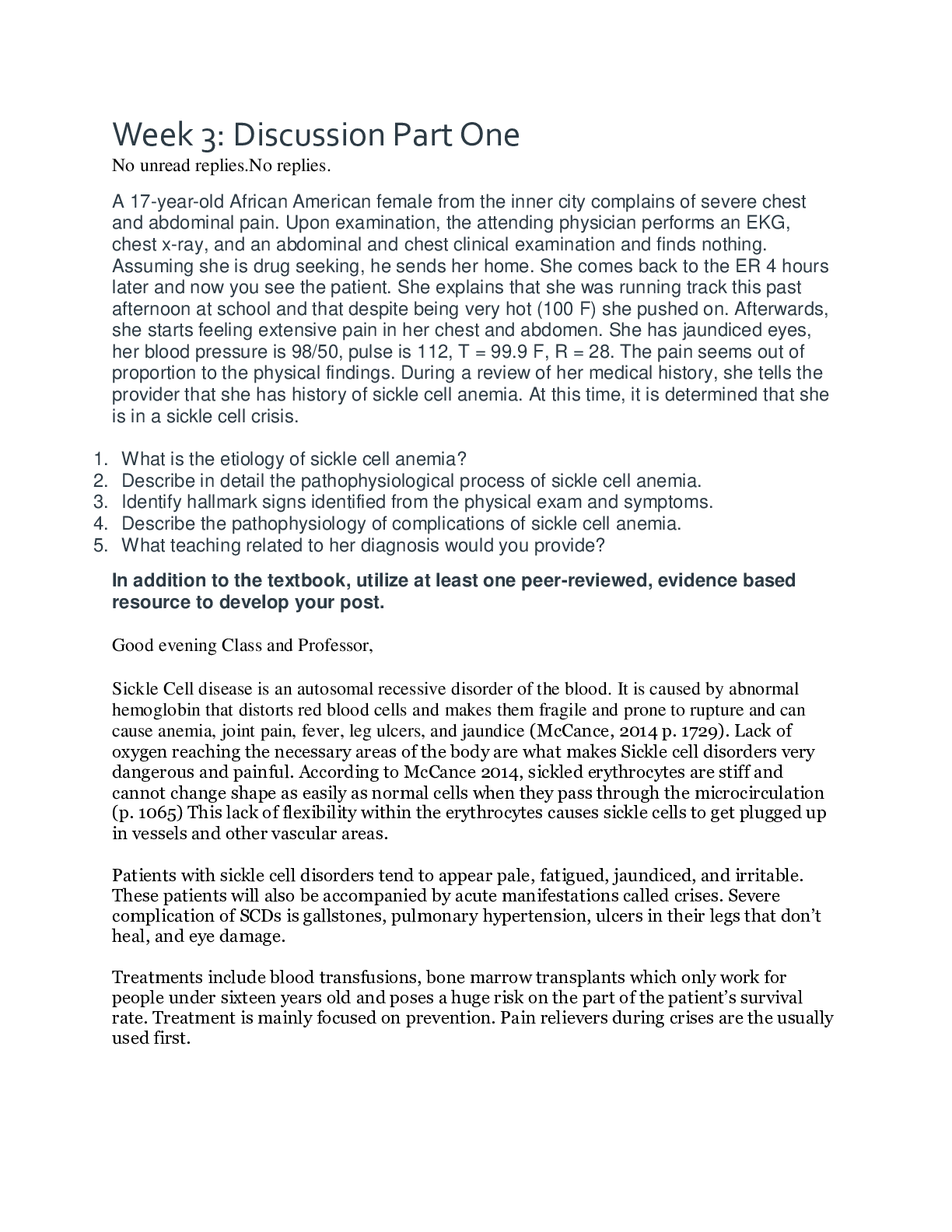
Claudia is a 36-year-old mother of two G2P2, she recently delivered her last child 9 months ago, and has
been using condoms for birth control for the last 7 mont
...
Week 2: Discussion
53 53 unread replies. 74 74 replies.
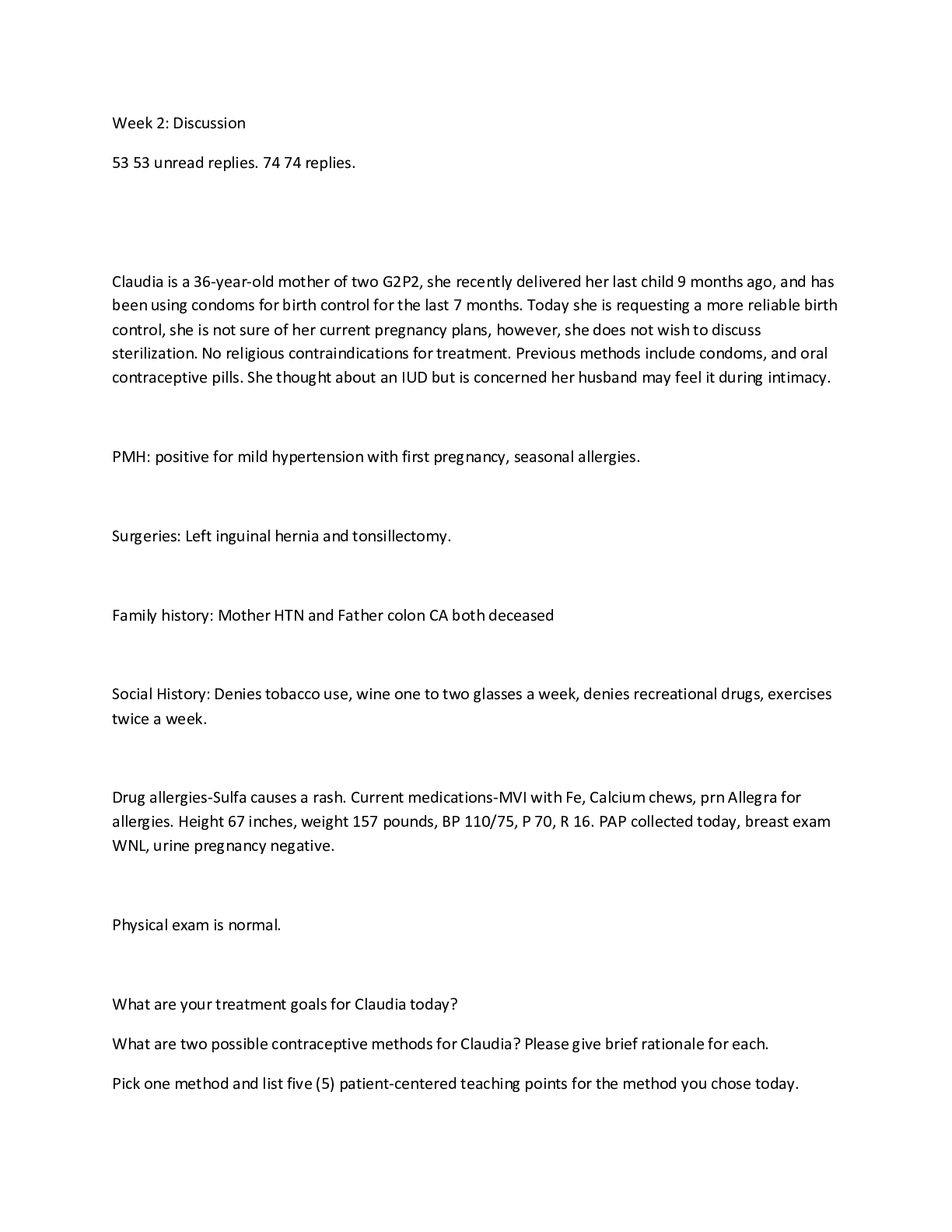
Claudia is a 36-year-old mother of two G2P2, she recently delivered her last child 9 months ago, and has
been using condoms for birth control for the last 7 months. Today she is requesting a more reliable birth
control, she is not sure of her current pregnancy plans, however, she does not wish to discuss
sterilization. No religious contraindications for treatment. Previous methods include condoms, and oral
contraceptive pills. She thought about an IUD but is concerned her husband may feel it during intimacy.
PMH: positive for mild hypertension with first pregnancy, seasonal allergies.
Surgeries: Left inguinal hernia and tonsillectomy.
Family history: Mother HTN and Father colon CA both deceased
Social History: Denies tobacco use, wine one to two glasses a week, denies recreational drugs, exercises
twice a week.
Drug allergies-Sulfa causes a rash. Current medications-MVI with Fe, Calcium chews, prn Allegra for
allergies. Height 67 inches, weight 157 pounds, BP 110/75, P 70, R 16. PAP collected today, breast exam
WNL, urine pregnancy negative.
Physical exam is normal.
What are your treatment goals for Claudia today?
What are two possible contraceptive methods for Claudia? Please give brief rationale for each.
Pick one method and list five (5) patient-centered teaching points for the method you chose today.
What would your contraceptive choice be if Claudia smoked 10-15 cigarettes per day? Explain your
answer.
Search entries or author
Search entries or author
Filter replies by unread
Reply Reply to Week 2: Discussion
Collapse SubdiscussionPatrick Ryan
Patrick Ryan
Jan 7, 2019 Jan 7 at 9:26am
Class,
This week, we will discuss Claudia, a 26-year-old who presents for contraceptive needs. Please read her
case study outlined above, and discuss in detail. Remember to always use evidence-based resources in
your responses.
Dr Ryan
Reply Reply to Comment
Collapse SubdiscussionJason Kissick
Jason Kissick
Jan 13, 2019 Jan 13 at 2:29pm
Dr. Ryan and classmates,
My treatment goal for Claudia is to address her desire to use a more reliable birth control. I would
educate Claudia on the different forms of contraception, and answer any questions she has so she can
choose the best option for her and her husband. According to Woo and Robinson, the treatment goals
for pharmacological contraception are “to use the safest, best-tolerated, and most effective method
that the patient desires” (2016).
The first step in choosing the right contraceptive for Claudia is to eliminate the methods that are
contraindicated due to her age, weight, or health, as well as the methods that have been already ruledout by personal preference. Starting with personal preference, an intrauterine device (IUD) will not be
discussed because her husband has voiced concerns about feeling it during intimacy. Secondly, condoms
will not be discussed because Claudia and her husband have used those for seven months and are
looking for a more reliable form of birth control. Since body mass index (BMI) is used for selecting an
appropriate birth control, Claudia’s BMI will need to be calculated. In addition, her home medications
will have to be cross-checked for any possible reactions to birth control.
Claudia has a normal BMI of 24.6, is a non-smoker, has a medical history of gestational
hypertension and seasonal allergies, and takes over-the-counter allergy medication and vitamins.
Furthermore, Claudia and her husband are uncertain of their pregnancy plans. After considering all of
the available information, two viable forms of contraception for Claudia and are oral contraceptives and
a diaphragm.
Given Claudia’s health history and the fact she is a non-smoker, I would recommend a combined
oral contraceptives (COC). In fact, COCs are most common form of birth control used in the United
States (Marlene, 2013). Secondly, combined oral contraceptives are safe for Claudia to use if she is still
breastfeeding. According to United States Medical Eligibility Criteria (US MEC) for contraceptive use,
COCs are a classification-2 for woman over the age of 35, who have a history of gestational hypertension
(Centers for Disease Control and prevention, 2017). The CDC defines the US MEC classification-2 as “A
condition for which the advantages of using the method generally outweigh the theoretical or proven
risks” (2017).
There are two types of combined or contraceptives (COCs), monophasic and multiphasic.
Monophasic COCs are the most commonly prescribed oral contraceptive in the United States (Marlene,
2013). Monophasic birth control pills have the same amount of estrogen and progestin in each pill. An
advantage with monophasic pills are woman experience less side effects that are associated with
fluctuating hormone levels. Multiphasic birth control pills have different levels of estrogen and progestin
in each pack. The purpose of multiphasic birth control is to limit a female’s exposure to hormones while
still suppressing ovulation (Allen, Evans, & Sutton, 2016).
The second method of contraception I would recommend to Claudia is a diaphragm. Like
condoms, diaphragms are a barrier contraceptive. However, when combined with a spermicide,
diaphragms are more effective then condoms (Allen, 2004). A contraceptive diaphragm is a circular
dome made of thin, soft silicone that can be inserted into the vagina before sex. The diaphragm covers
the cervix which prevents sperm from being able travel to the fallopian tube and fertilize an egg.
The method I chose for Claudia was the combined oral contraceptive, Ethinyl
Estradiol/Norgestimate. The brand name for this birth control is Ortho Tri-Cyclen. The first patientcentered teaching point of using Ortho Tri-Cyclen is to explain the mechanism of action, which is
ovulation suppression and thickening of cervical mucous which prevents sperm penetration. The second
patient-centered teaching point is because Claudia has never been on any hormonal contraception, she
will need to start taking the pills on the first day of her menstrual cycle or the first Sunday after start of
menstrual cycle. Thirdly, if Claudia began smoking or started having migraines, she would need to stop
taking Ortho Tri-Cyclen because those are contraindications. The fourth teaching point would be
possible side effects, which include nausea, vomiting, cramping, bloating, and breast tenderness. The
last teaching point is Claudia will need to use an alternate contraceptive method while taking an
antibiotic (Ortho Tr-Cyclen, 2018).
The combination of high dosages of estrogen and smoking have a synergistic effect which
increases the risks of a myocardial infarction and/or a stroke (Ethinyl Estradiol/Norgestimate, 2019).
Therefore, if Claudia is over the age 35 and smokes more than 10 cigarettes a day, she will need to be
switched to norethindrone, which is a progestogen-only pill. The mechanism of action is the same as
Ortho Tri-Cyclen. However, the biggest difference in these contraceptives is progestogen-only pills have
to be taken at the same time every day or could be ineffective (Norethindrone, 2018).
References
Allen, C., Evans, G., & Sutton, E. L. (2016). Pharmacologic Therapies in Women’s Health.
Contraception and Menopause Treatment. Medical Clinics of North America, 100, 763–
doi:10.1016/j.mcna.2016.03.008
Allen, R. E. (2004). Diaphragm fitting. American Family Physician, 69(1), 97-100. Retrieved
From https://www.aafp.org/afp/2004/0101/p97.html
Centers for Disease Control and prevention (CDC). (2017). US Medical Eligibility Criteria (US
MEC) for contraceptive use. Retrieved from https://www.cdc.gov/reproductivehealth/
contraception/mmwr/mec/appendixd.html
Ethinyl Estradiol/Norgestimate: In-depth answers. (2019). In Micromedex (Columbia
Basin College Library ed.) [Electronic version]. Greenwood Village, CO: Truven Health
Analytics. Retrieved November 7, 2018, from https://www-micromedexsolutionscom.chamberlainuniversity.idm.oclc.org
Marlene, S. (2013) Update on Oral Contraceptives. J Women’s Health, Issues Care 2(1).
doi:10.4172/2325-9795.1000e105
Norethindrone: In-depth answers (2019). In Micromedex (Columbia Basin College Library ed.)
[Electronic version]. Greenwood Village, CO: Truven Health Analytics. Retrieved
November 7, 2018, from https://www-micromedexsolutions-com.chamberlainuniversity
.idm.oclc.org
Woo, T. M., & Robinson, M. V. (2016). Contraception. In T. Gerlt (Ed), Pharmacotherapeutics
for Advance Practice Nurse prescribers (4th ed., pp. 943-956). Philadelphia, PA: Davis.
Reply Reply to Comment
Collapse SubdiscussionJasmine Hardaway
Jasmine Hardaway
Saturday Jan 19 at 5:29pm
Hello Jason,
You made some really great points. I believe that we should consider all factors from Claudia's primary
history when considering the best form of birth control for her and her husband. I consider starting
Claudia on a monophasic birth control method. According to Woo and Robinson (2016), levonorgestrel
combined with a low dose of estrogen is recommended for women who has any one of the risk factors
that will cause them to clot while taking high doses of Estrogen. Those risk factors are, women who are
older than 35 years of age, women who has a family history of clotting disorders, women who had
hypertension during pregnancy, and women who are obese (Fruzzetti and Cagnacci, 2018). My concern
with starting her on a combination contraceptive is how often we would need to monitor her. It could
be costly and time consuming having her to come back to in the office to be seen. Not to mention, it still
place her at high risk in getting a clot. She has 3 out four risk factors mention above. So I actually went
with a progestin only contraceptive instead.
Fruzzetti, F., & Cagnacci, A. (2018). Venous thrombosis and hormonal contraception: what's new with
estradiol-based hormonal contraceptives? Open Access Journal of Contraception, 9, 75-79.
doi:10.2147/OAJC.S179673
Woo, T. M., & Robinson, M. V. (2016). Pharmacotherapeutics for Advance Practice Nurse prescribers
(4th ed.). Philadelphia, PA: F. A. Davis Company.
Reply Reply to Comment
Reply Reply to Comment
Collapse SubdiscussionTysharra Wilson
Tysharra Wilson
Saturday Jan 19 at 6:24pm
Hi Jason,
I really enjoyed reading your post, and seeing your perspective as a Nurse Prescriber in this situation. I
agree with your reasonings why Claudia could benefit from the contraceptives that you mentioned, but I
think it is important to take into consideration, a patient's lifestyle. Claudia has mentioned trying birth
control pills and condoms in the past, and brought up the possibility of inserting a IUD. Both the barrier
method and pills places Claudia at a disadvantage to be noncompliant, and experience an unwanted
pregnancy. According to Woo & Robinson, Table 31-1, the diaphragm must be used with spermicide,
requires Claudia to insert it herself, and with typical use is only 88% effective (2015). We know that
Claudia is a busy mother, and wife, and possibly a career woman as well, and requiring additional steps
like this can cause her to have a unintentional pregnancy. I do, however, respect your perspective, and if
Claudia was open to pills, and has been compliant with taking them, I would take Ortho Tri-Cyclen into
consideration. However, I would still recommend, if the patient is receptive to it, a Long acting
Reversible Contraceptive (LARC), such as an IUD, or Implant due to the no decreased risk of user error,
and ability to forget to take "the pill" (Curtis & Peipert, 2017). It important to mention that these
methods are about 20 times as effective as pills, patches, and rings and are safe for almost all women
(Curtis & Peipert, 2017).
Curtis, K. M., & Peipert, J. F. (2017). Long-Acting Reversible Contraception. New England Journal of
Medicine, 376(5), 461-468. doi:10.1056/nejmcp1608736
Reply Reply to Comment
Collapse SubdiscussionJessica Ruiz
Jessica Ruiz
Saturday Jan 19 at 7:09pm
Hello Jason
I enjoyed reading your discussion thanks for sharing your thoughts with the class. I think allowing the
patient to choose which method they prefer is important and must always be addressed, whether it be
taking a pill each day, an injection, or an implant, like you mentioned. You mentioned your second
choice being the Nexplanon. I think it is a good option being a long acting reversible contraceptive.
Nexplanon is a progestin only implant that extends the length of contraception without the risk of nonadherence, reduced dysmenorrhea, and pelvic pain. It inhibits ovulation. Side effects of Nexplanon
include vaginally bleeding which will resolve over time, weight gain, acne, breast tenderness, and
emotional lability (Cabrera, 2017). Contraindications include pregnancy, thromboembolic disease,
undiagnosed genital bleeding, liver disease, liver tumors, and breast cancer (Edmunds & Mayhew,
2013).
I think that is great advice that you received from the PA. That was one reason I chose Paragard for
Claudia myself, because it was hormone free. It is important though to review the patient’s history and
inform the patient about the side effects, such as increased bleeding with Paragard and weight gain,
which may be reasons that alter their decision.
Reference
Cabrera, G. M. (2017). Pregnancy in adolescence: Prevention- Progestin-only contraception (United
States). CINAHL Nursing Guide.
Edmunds, M. W., & Mayhew, M. S. (2013). Pharmacology for the primary care provider (4th ed.).
Retrieved from http://bookshelf.vitalsource.com
Thanks,
[Show More]

.png)
.png)

 (1).png)









.png)


.png)