CRITICAL-CARE-EXIT-HESI QUESTIONS AND ANSWERS (LATEST UPDATE)
1.A client, receiving treatment for diabetic ketoacidosis, begins to demonstrate confusion, lethargy, and an irregular pulse. The nurse should
assess
...
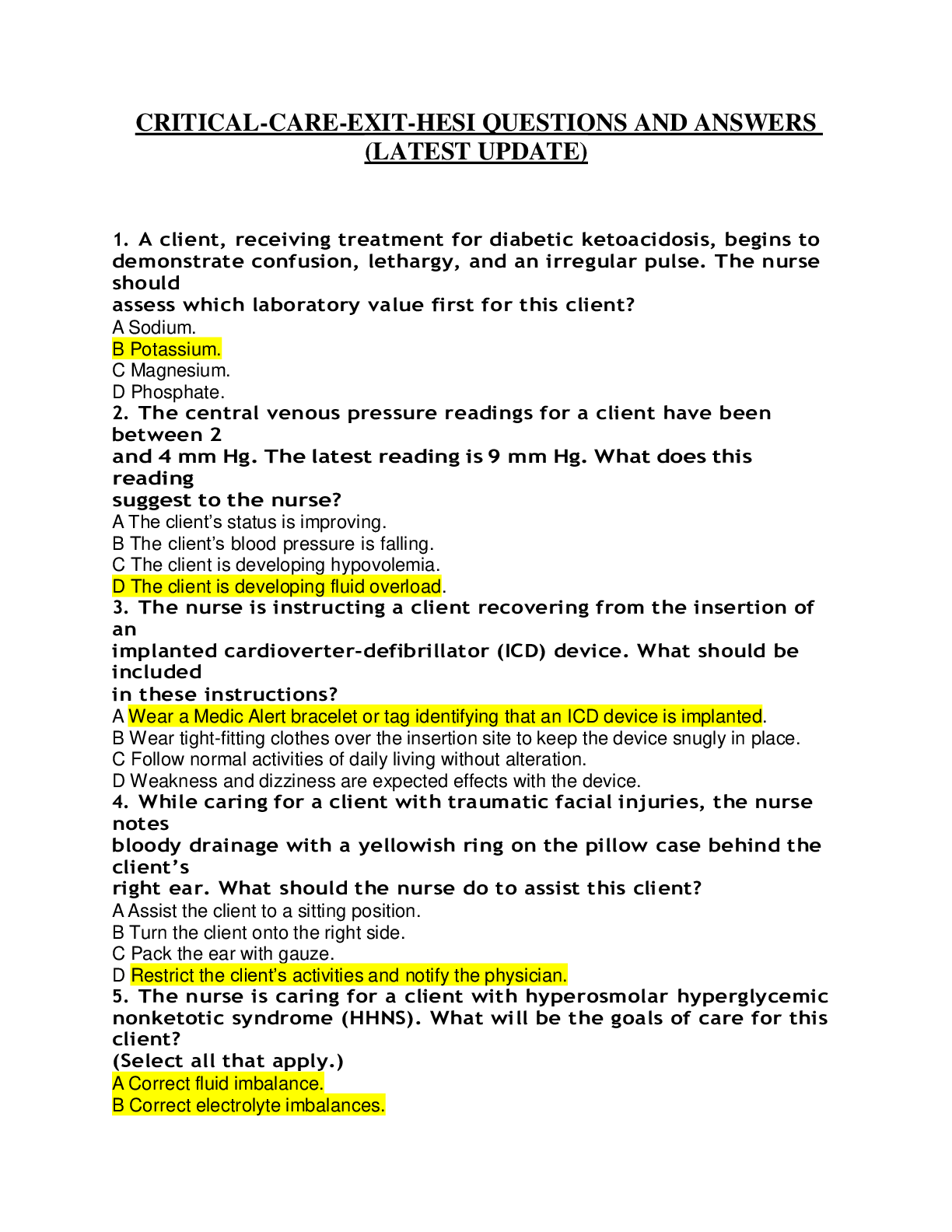
CRITICAL-CARE-EXIT-HESI QUESTIONS AND ANSWERS (LATEST UPDATE)
1.A client, receiving treatment for diabetic ketoacidosis, begins to demonstrate confusion, lethargy, and an irregular pulse. The nurse should
assess which laboratory value first for this client?
A Sodium.
B Potassium.
C Magnesium.
D Phosphate.
2.The central venous pressure readings for a client have been between 2
and 4 mm Hg. The latest reading is 9 mm Hg. What does this reading
suggest to the nurse?
A The client’s status is improving.
B The client’s blood pressure is falling. C The client is developing hypovolemia. D The client is developing fluid overload.
3.The nurse is instructing a client recovering from the insertion of an
implanted cardioverter-defibrillator (ICD) device. What should be included
in these instructions?
A Wear a Medic Alert bracelet or tag identifying that an ICD device is implanted.
B Wear tight-fitting clothes over the insertion site to keep the device snugly in place. C Follow normal activities of daily living without alteration.
D Weakness and dizziness are expected effects with the device.
4.While caring for a client with traumatic facial injuries, the nurse notes
bloody drainage with a yellowish ring on the pillow case behind the client’s
right ear. What should the nurse do to assist this client?
A Assist the client to a sitting position. B Turn the client onto the right side.
C Pack the ear with gauze.
D Restrict the client’s activities and notify the physician.
5.The nurse is caring for a client with hyperosmolar hyperglycemic nonketotic syndrome (HHNS). What will be the goals of care for this client?
(Select all that apply.)
A Correct fluid imbalance.
B Correct electrolyte imbalances.
C Lower blood glucose levels with insulin. D Treat underlying condition.
E Treat metabolic acidosis.
[Show More]

 Exam Elaborations Questions and Answers.png)




.png)


.png)
.png)
.png)

.png)
.png)

