Directions: Follow the instructions to go through the simulation. Respond to the questions and
prompts in the orange boxes.
Vocabulary: bacteriophage, capsid, host cell, lyse, lytic cycle, virus
Prior Knowledge Questi
...
Directions: Follow the instructions to go through the simulation. Respond to the questions and
prompts in the orange boxes.
Vocabulary: bacteriophage, capsid, host cell, lyse, lytic cycle, virus
Prior Knowledge Questions (Do these BEFORE using the Gizmo.)
1. A computer virus is a program that can copy itself and infect a computer without the permission of the
owner. How do you think a computer virus compares to a real virus?
I would say that is similar in some ways such as it entering, penetrating the hardware of the computer,
and injecting its virus into the hardware and this makes it spread all over. This is somewhat similar to
the viral life cycle.
2. Have you ever been infected with a virus,
such as the cold virus or flu virus?
Of course. I am pretty sure everyone who has been alive on
this Earth has been infected by these.
3. If so, how did the virus affect you? The virus entered my body and entered the cells to which it
is supposed to because they are host-specific. It then goes
through reverse transcriptase, biosynthesis, maturation and
release at the end to spread the virus.
Gizmo Warm-up
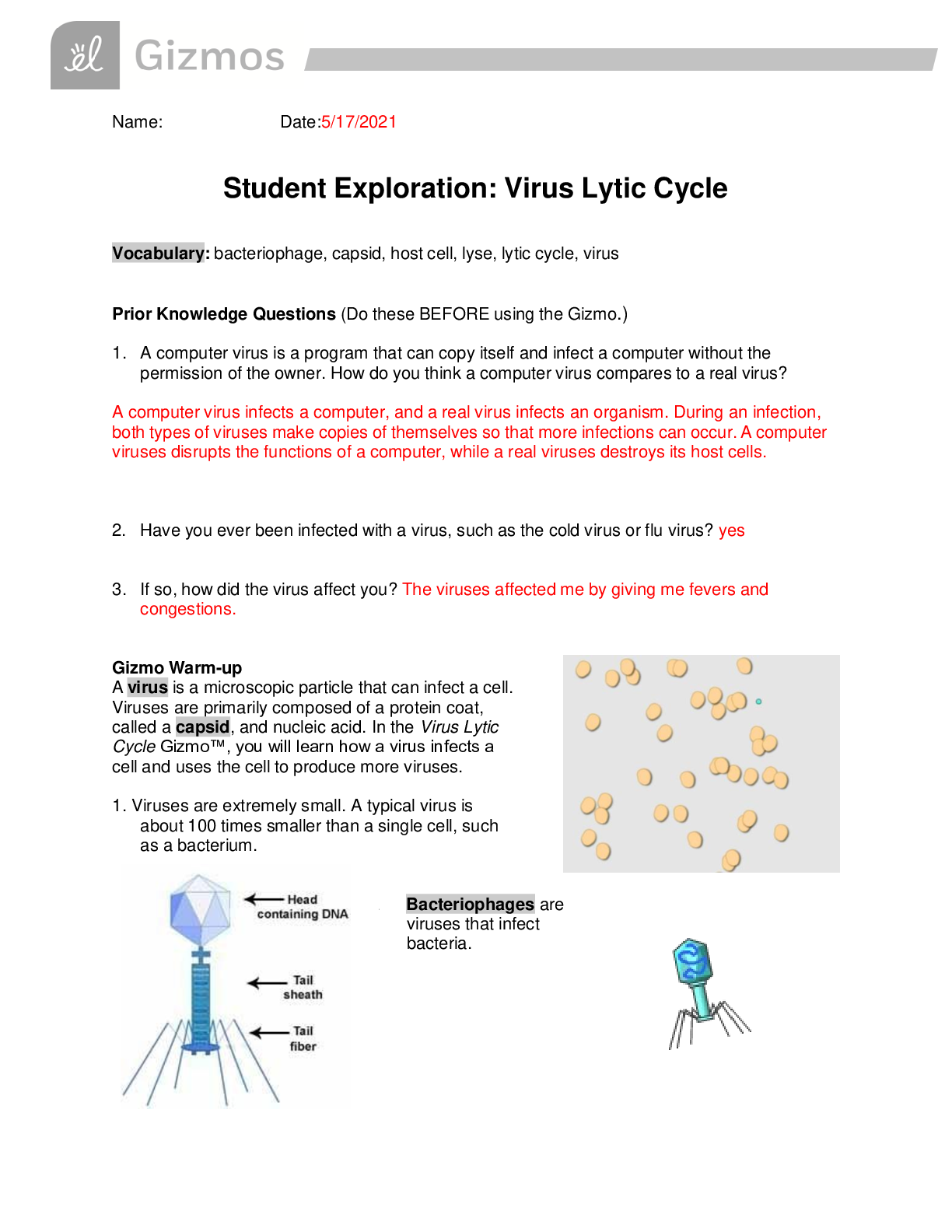
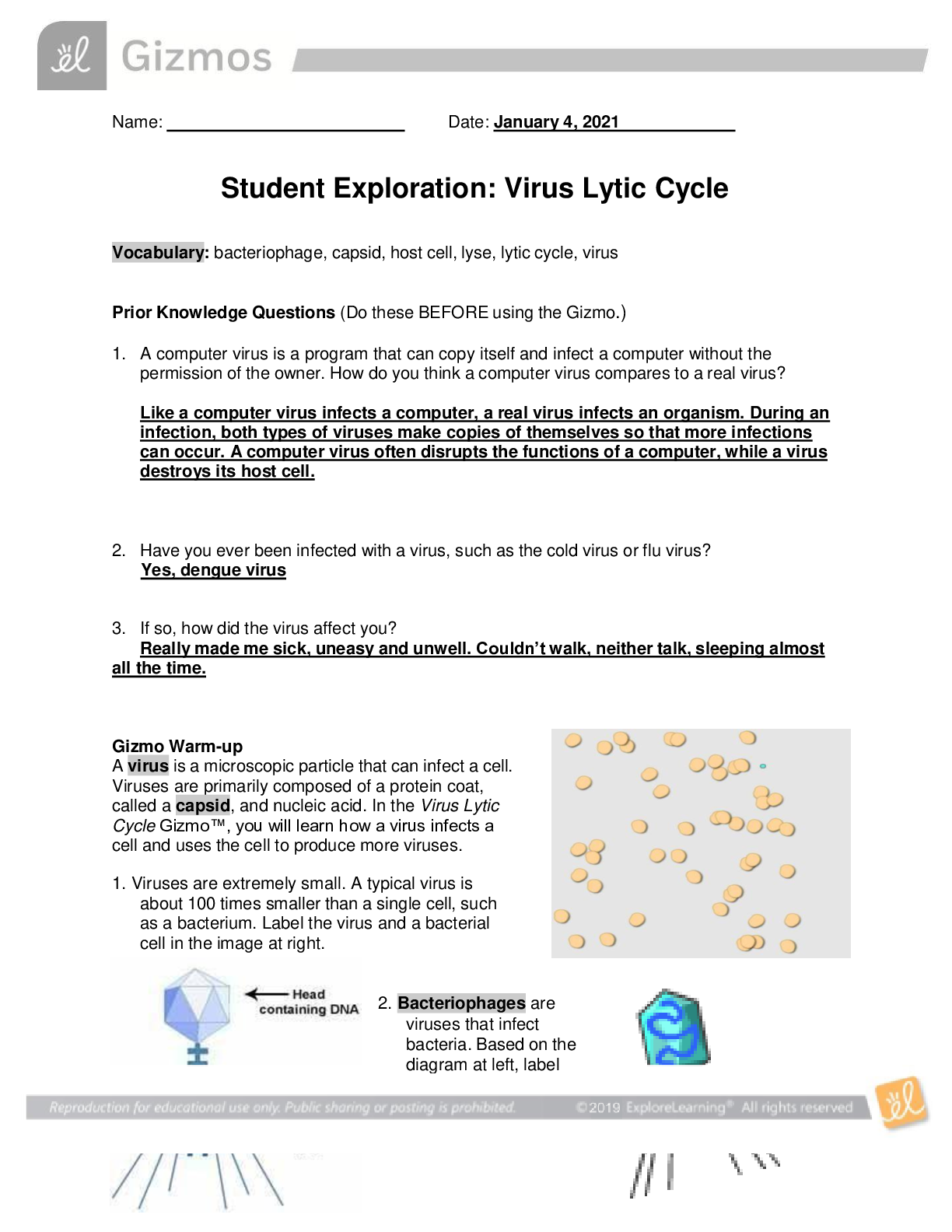
A virus is a microscopic particle that can infect a cell. Viruses are
primarily composed of a protein coat, called a capsid, and nucleic
acid. In the Virus Lytic Cycle Gizmo™, you will learn how a virus
infects a cell and uses the cell to produce more viruses.
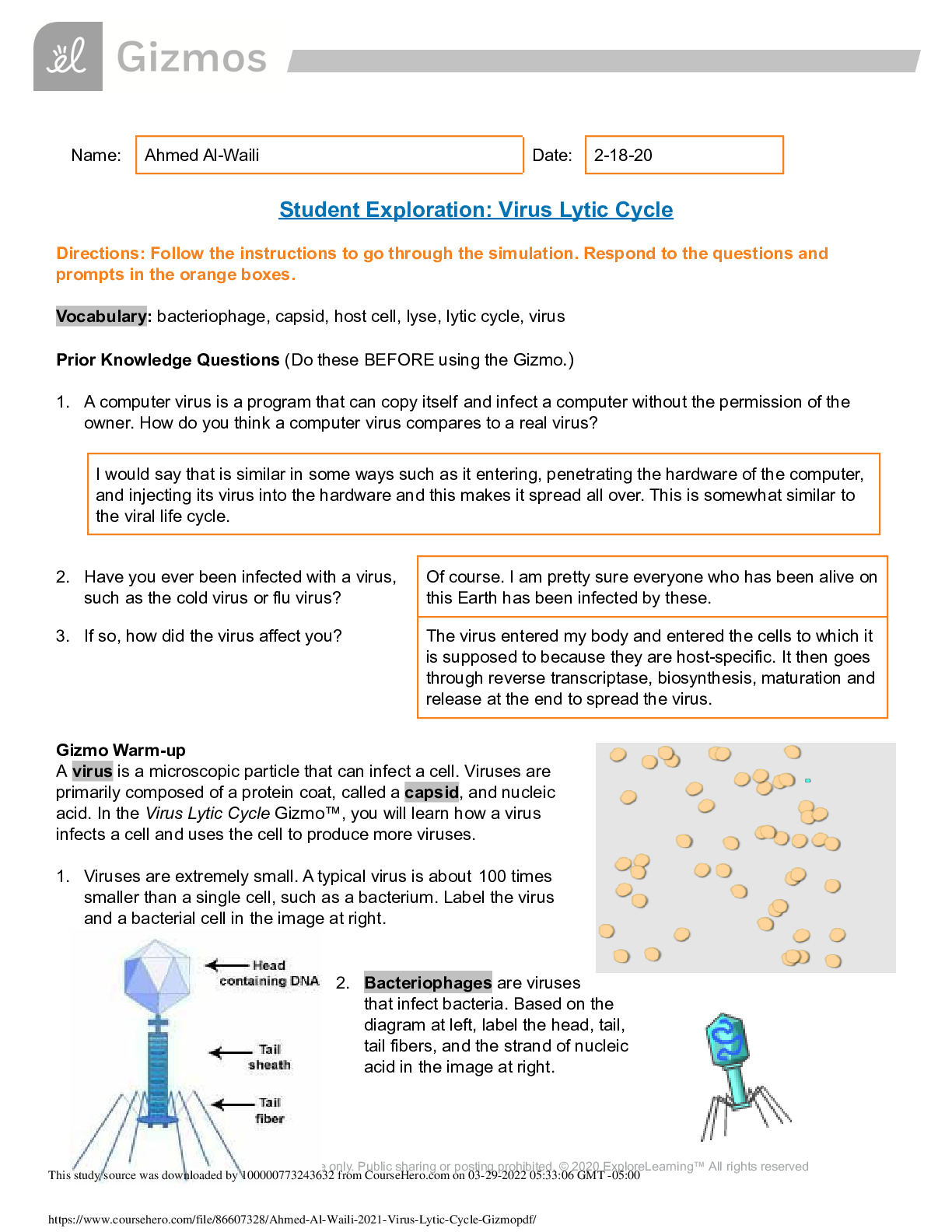
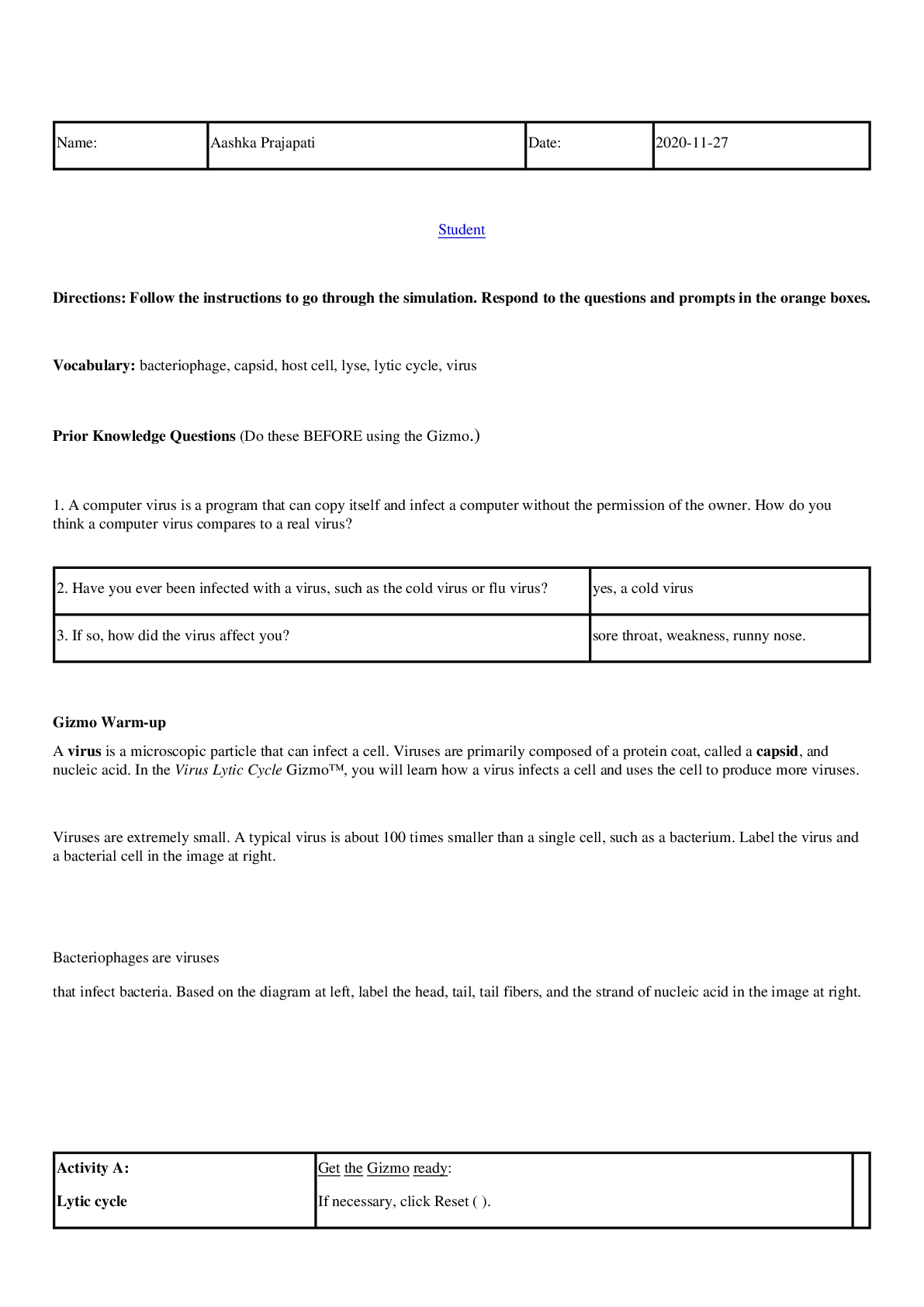
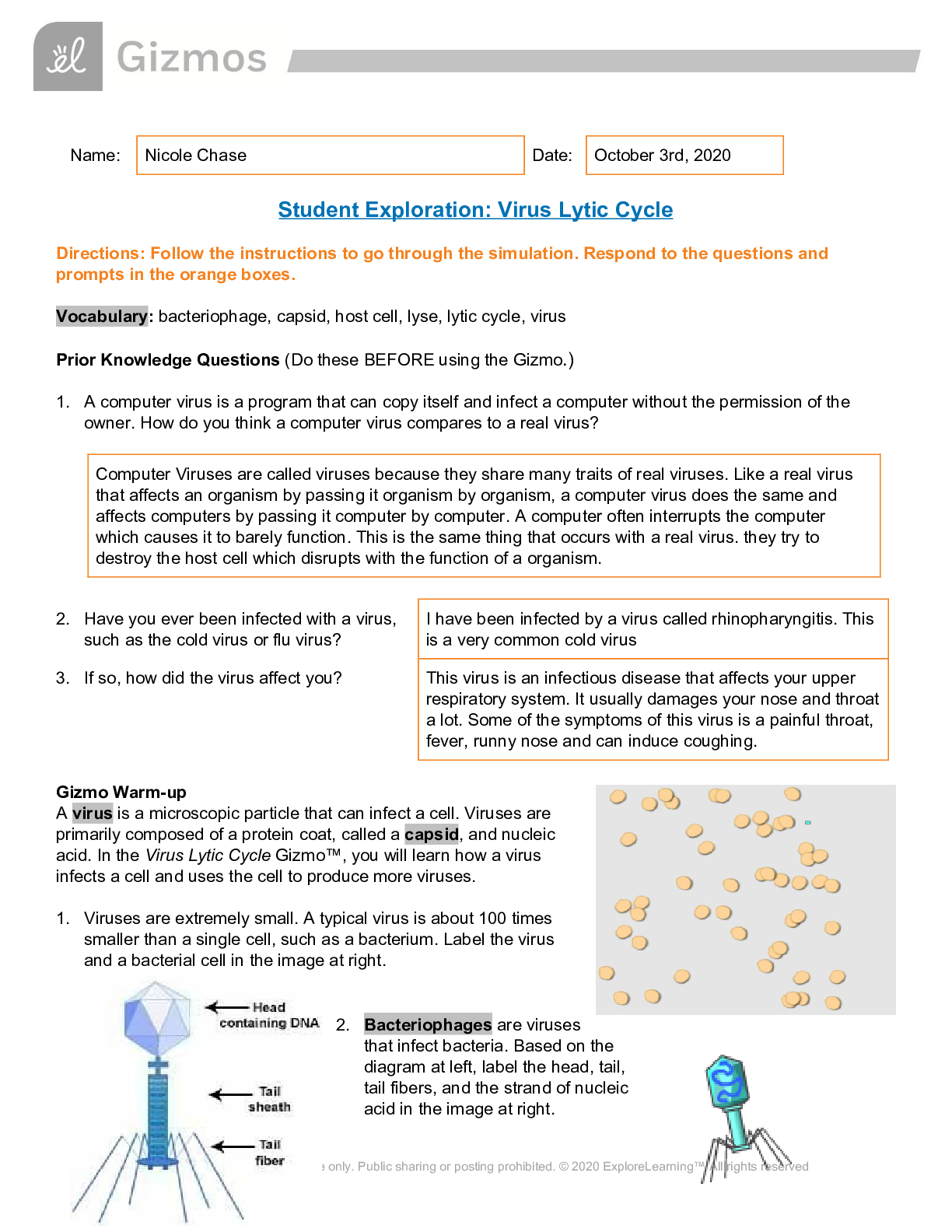
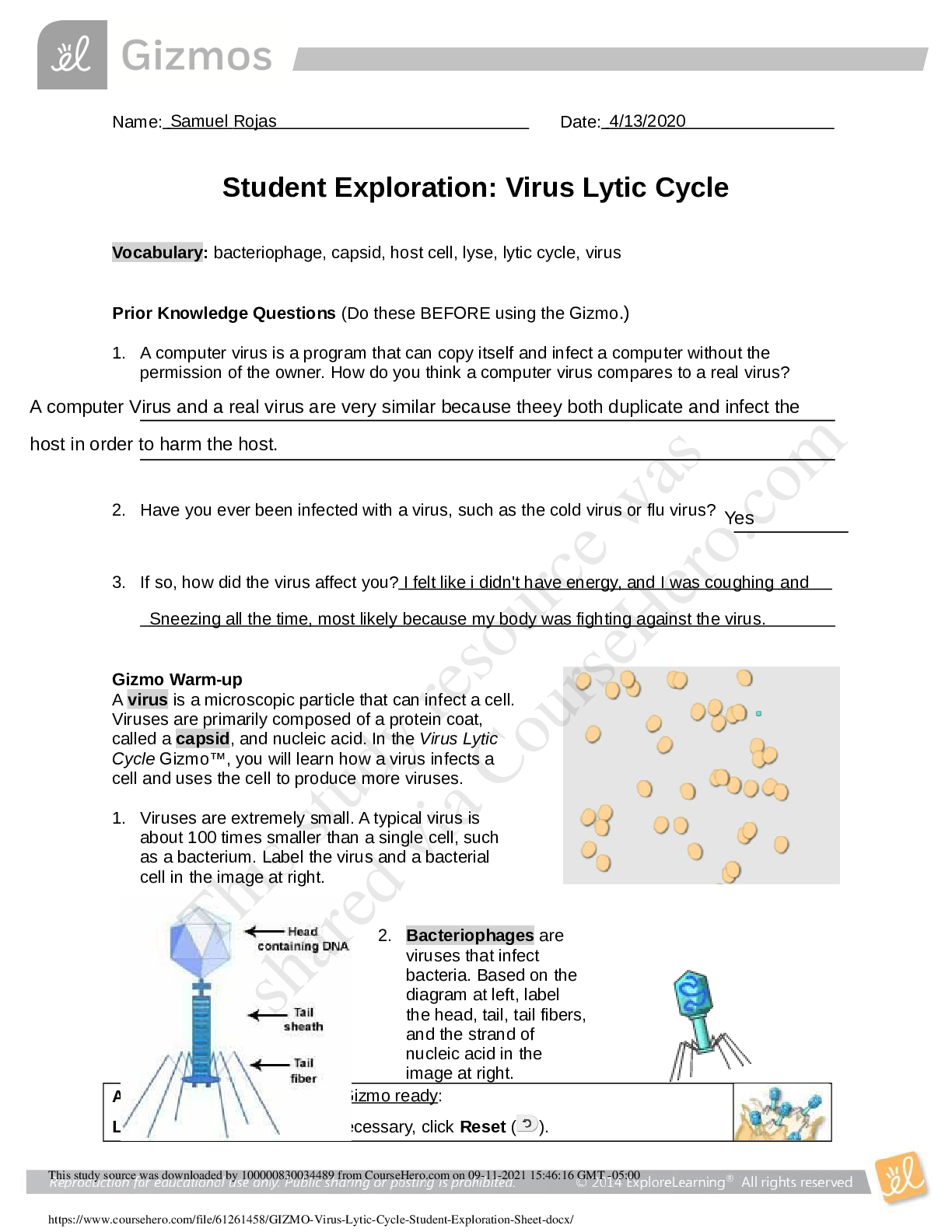
1. Viruses are extremely small. A typical virus is about 100 times
smaller than a single cell, such as a bacterium. Label the virus
and a bacterial cell in the image at right.
2. Bacteriophages are viruses
that infect bacteria. Based on the
diagram at left, label the head, tail,
tail fibers, and the strand of nucleic
acid in the image at right.
Reproduction for educational use only. Public sharing or posting prohibited. © 2020 ExploreLearning™ All rights reserved
This study source was downloaded by 100000773243632 from CourseHero.com on 03-29-2022 05:33:06 GMT -05:00
https://www.coursehero.com/file/86607328/Ahmed-Al-Waili-2021-Virus-Lytic-Cycle-Gizmopdf/
Activity A:
Lytic cycle
Get the Gizmo ready:
● If necessary, click Reset ( ).
Introduction: Unlike living organisms, viruses cannot reproduce on their own. Instead, viruses infect host
cells, taking over the cell’s machinery to produce more viruses. This process is called the lytic cycle.
Question: What are the steps of the lytic cycle?
1. 75.Observe: Use the navigation arrows on the DESCRIPTION tab to read about the stages of the lytic
cycle. Using your own words, summarize each step of the cycle.
Step Summary
1
Attachment- Virus binds to a specific host cell based on the
host-specific match between virus surface molecules and host cell
receptors.
↓
2
Penetration - The hose cell engulfs the virus or the virus injects its
genome into the cytoplasm.
↓
[Show More]