Student Exploration: Identifying Nutrients
Vocabulary: carbohydrate, disaccharide, lipid, monosaccharide, polysaccharide, protein, starch
Prior Knowledge Questions (Do these BEFORE using the Gizmo.)
1. What are the ma
...
Student Exploration: Identifying Nutrients
Vocabulary: carbohydrate, disaccharide, lipid, monosaccharide, polysaccharide, protein, starch
Prior Knowledge Questions (Do these BEFORE using the Gizmo.)
1. What are the major types of nutrients you can get from food?
Carbohydrates, Fats, and Protien
2. How are these nutrients used by your body?
From carbohydrates comes glucose, your body's fuel; from fats we get glycerol and fatty acids,
which are in; and from proteins we get amino acids, which are the building blocks to structures
in our body. Each of these nutrients can fuel the body's production of ATP, which is essentially
our bodies' ultimate energy currency.
Gizmo Warm-up
Have you ever wondered what is in your food? Scientists
use a variety of tests to determine the nutritional content of
food. You will learn four of those tests with the Identifying
Nutrients Gizmo™.
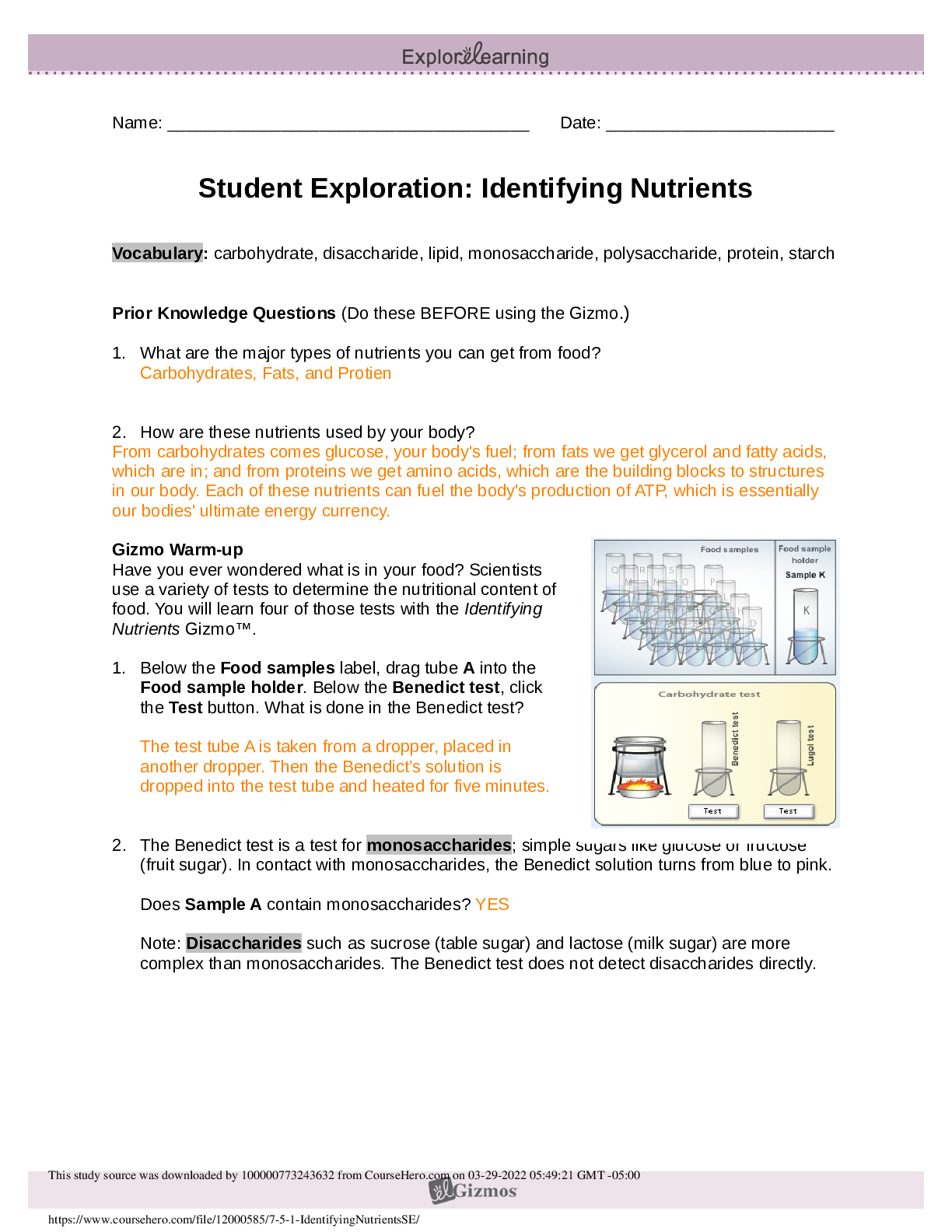
1. Below the Food samples label, drag tube A into the
Food sample holder. Below the Benedict test, click
the Test button. What is done in the Benedict test?
The test tube A is taken from a dropper, placed in
another dropper. Then the Benedict’s solution is
dropped into the test tube and heated for five minutes.
2. The Benedict test is a test for monosaccharides; simple sugars like glucose or fructose
(fruit sugar). In contact with monosaccharides, the Benedict solution turns from blue to pink.
Does Sample A contain monosaccharides? YES
Note: Disaccharides such as sucrose (table sugar) and lactose (milk sugar) are more
complex than monosaccharides. The Benedict test does not detect disaccharides directly.
This study source was downloaded by 100000773243632 from CourseHero.com on 03-29-2022 05:49:21 GMT -05:00
https://www.coursehero.com/file/12000585/7-5-1-IdentifyingNutrientsSE/
Activity A:
Identifying
nutrients
Get the Gizmo ready:
Click Reset.
Drag Sample A into the Food sample holder.
Introduction: Most food is composed of three types of molecules: carbohydrates, proteins,
and lipids.
Carbohydrates such as starches and sugars are major source of energy. Simple sugars
are found in sweets and fruits. Starches are found in potatoes, cereal, pasta, flour, and
other plant products.
Proteins are used in body structures such
[Show More]