CHAPTER 1. THE ROLE OF THE NURSE PRACTITIONER
Multiple Choice
Identify the choice that best completes the statement or answers the question.
1. Nurse practitioner prescriptive authority is regulated by:
1
.
...
CHAPTER 1. THE ROLE OF THE NURSE PRACTITIONER
Multiple Choice
Identify the choice that best completes the statement or answers the question.
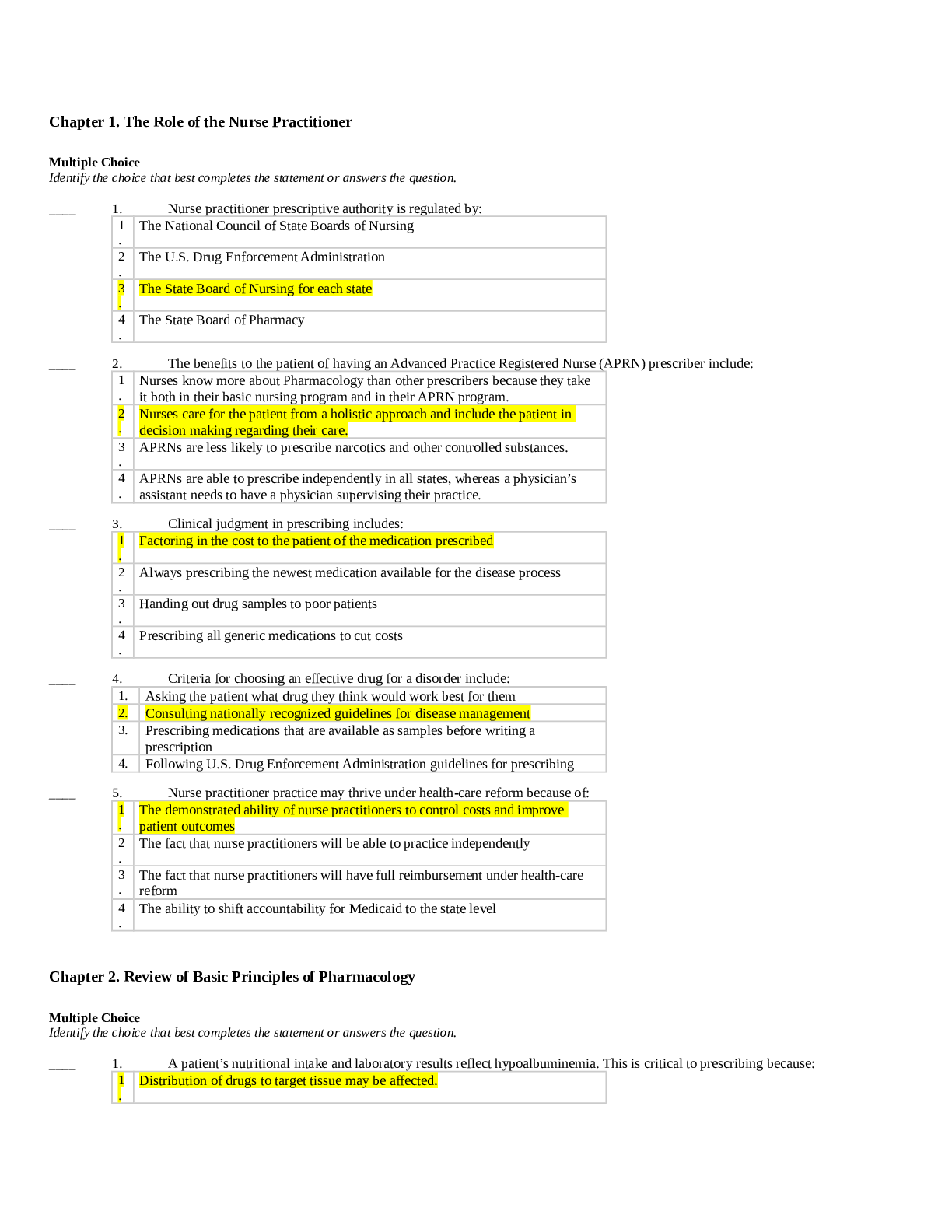
1. Nurse practitioner prescriptive authority is regulated by:
1
. The National Council of State Boards of Nursing
2
. The U.S. Drug Enforcement Administration
3
. The State Board of Nursing for each state
4
. The State Board of Pharmacy
2. The benefits to the patient of having an Advanced Practice Registered Nurse (APRN) prescriber include:
1 Nurses know more about Pharmacology than other
. prescribers because they take it both in their basic
nursing program and in their APRN program.
2 Nurses care for the patient from a holistic approach
. and include the patient in decision making regarding
their care.
3 APRNs are less likely to prescribe narcotics and
. other controlled substances.
4 APRNs are able to prescribe independently in all
. states, whereas a physician’s assistant needs to have
a physician supervising their practice.
3. Clinical judgment in prescribing includes:
1
. Factoring in the cost to the patient of the medication prescribed
2
. Always prescribing the newest medication available
for the disease process
3
. Handing out drug samples to poor patients
4 Prescribing all generic medications to cut costs
.
4. Criteria for choosing an effective drug for a disorder include:
1. Asking the patient what drug they think would work best for them
2. Consulting nationally recognized guidelines for
disease management
3. Prescribing medications that are available as samples before writing a prescription
4. Following U.S. Drug Enforcement Administration
guidelines for prescribing
[Show More]




.png)
.png)
.png)


.png)

