MEDICAL SURGICAL
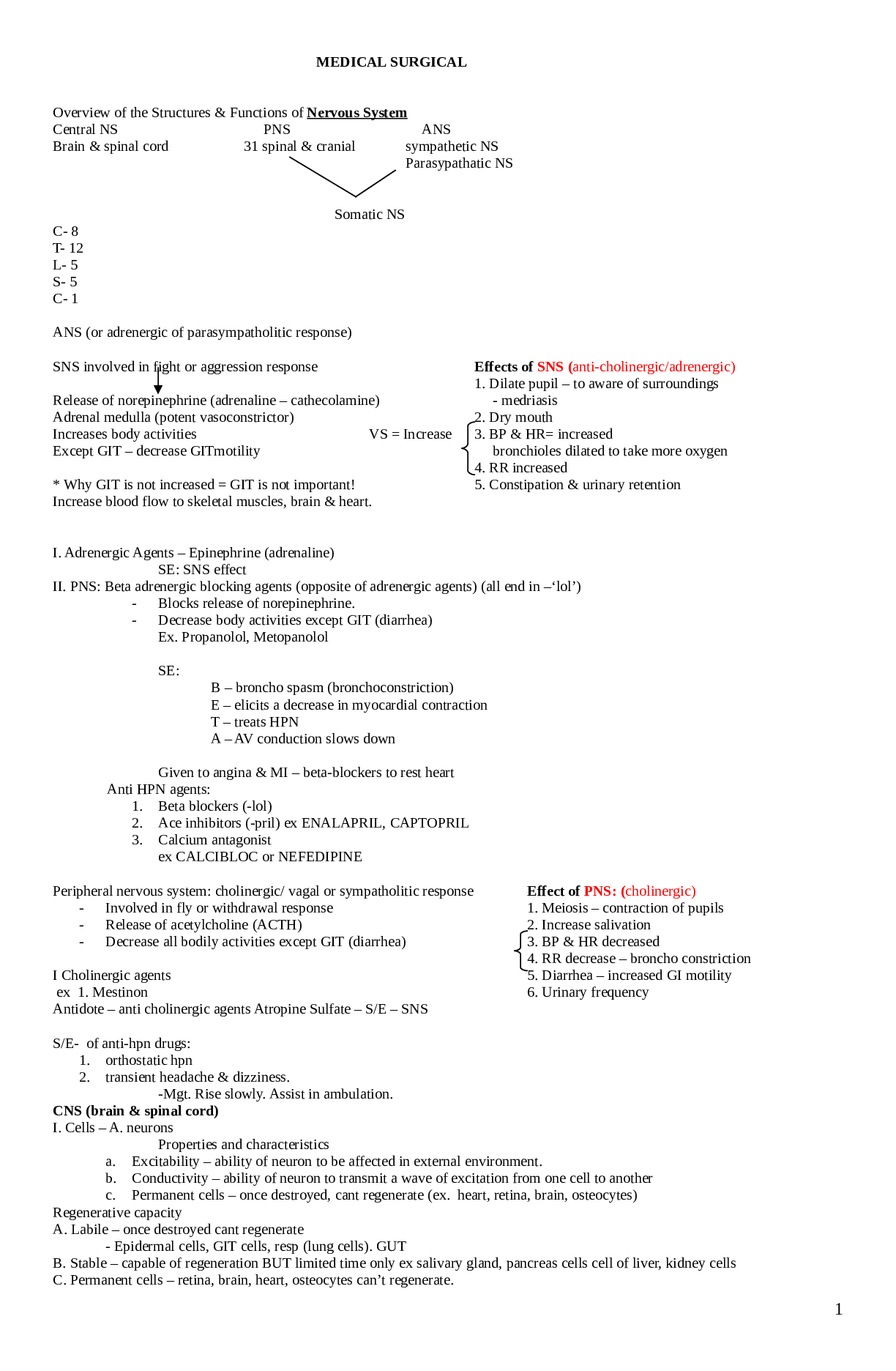
Overview of the Structures & Functions of Nervous System
Central NS PNS ANS
Brain & spinal cord 31 spinal & cranial sympathetic NS
Parasypathatic NS
Somatic NS
C- 8
T- 12
L- 5
S- 5
C- 1
ANS (o
...
MEDICAL SURGICAL
Overview of the Structures & Functions of Nervous System
Central NS PNS ANS
Brain & spinal cord 31 spinal & cranial sympathetic NS
Parasypathatic NS
Somatic NS
C- 8
T- 12
L- 5
S- 5
C- 1
ANS (or adrenergic of parasympatholitic response)
SNS involved in fight or aggression response Effects of SNS (anti-cholinergic/adrenergic)
1. Dilate pupil – to aware of surroundings
Release of norepinephrine (adrenaline – cathecolamine) - medriasis
Adrenal medulla (potent vasoconstrictor) 2. Dry mouth
Increases body activities VS = Increase 3. BP & HR= increased
Except GIT – decrease GITmotility bronchioles dilated to take more oxygen
4. RR increased
* Why GIT is not increased = GIT is not important! 5. Constipation & urinary retention
Increase blood flow to skeletal muscles, brain & heart.
I. Adrenergic Agents – Epinephrine (adrenaline)
SE: SNS effect
II. PNS: Beta adrenergic blocking agents (opposite of adrenergic agents) (all end in –‘lol’)
- Blocks release of norepinephrine.
- Decrease body activities except GIT (diarrhea)
Ex. Propanolol, Metopanolol
SE:
B – broncho spasm (bronchoconstriction)
E – elicits a decrease in myocardial contraction
T – treats HPN
A – AV conduction slows down
Given to angina & MI – beta-blockers to rest heart
Anti HPN agents:
1. Beta blockers (-lol)
2. Ace inhibitors (-pril) ex ENALAPRIL, CAPTOPRIL
3. Calcium antagonist
ex CALCIBLOC or NEFEDIPINE
Peripheral nervous system: cholinergic/ vagal or sympatholitic response Effect of PNS: (cholinergic)
- Involved in fly or withdrawal response 1. Meiosis – contraction of pupils
- Release of acetylcholine (ACTH) 2. Increase salivation
- Decrease all bodily activities except GIT (diarrhea) 3. BP & HR decreased
4. RR decrease – broncho constriction
I Cholinergic agents 5. Diarrhea – increased GI motility
ex 1. Mestinon 6. Urinary frequency
Antidote – anti cholinergic agents Atropine Sulfate – S/E – SNS
S/E- of anti-hpn drugs:
1. orthostatic hpn
2. transient headache & dizziness.
-Mgt. Rise slowly. Assist in ambulation.
CNS (brain & spinal cord)
I. Cells – A. neurons
Properties and characteristics
a. Excitability – ability of neuron to be affected in external environment.
b. Conductivity – ability of neuron to transmit a wave of excitation from one cell to another
c. Permanent cells – once destroyed, cant regenerate (ex. heart, retina, brain, osteocytes)
Regenerative capacity
A. Labile – once destroyed cant regenerate
- Epidermal cells, GIT cells, resp (lung cells). GUT
B. Stable – capable of regeneration BUT limited time only ex salivary gland, pancreas cells cell of liver, kidney cells
C. Permanent cells – retina, brain, heart, osteocytes can’t regenerate.
[Show More]