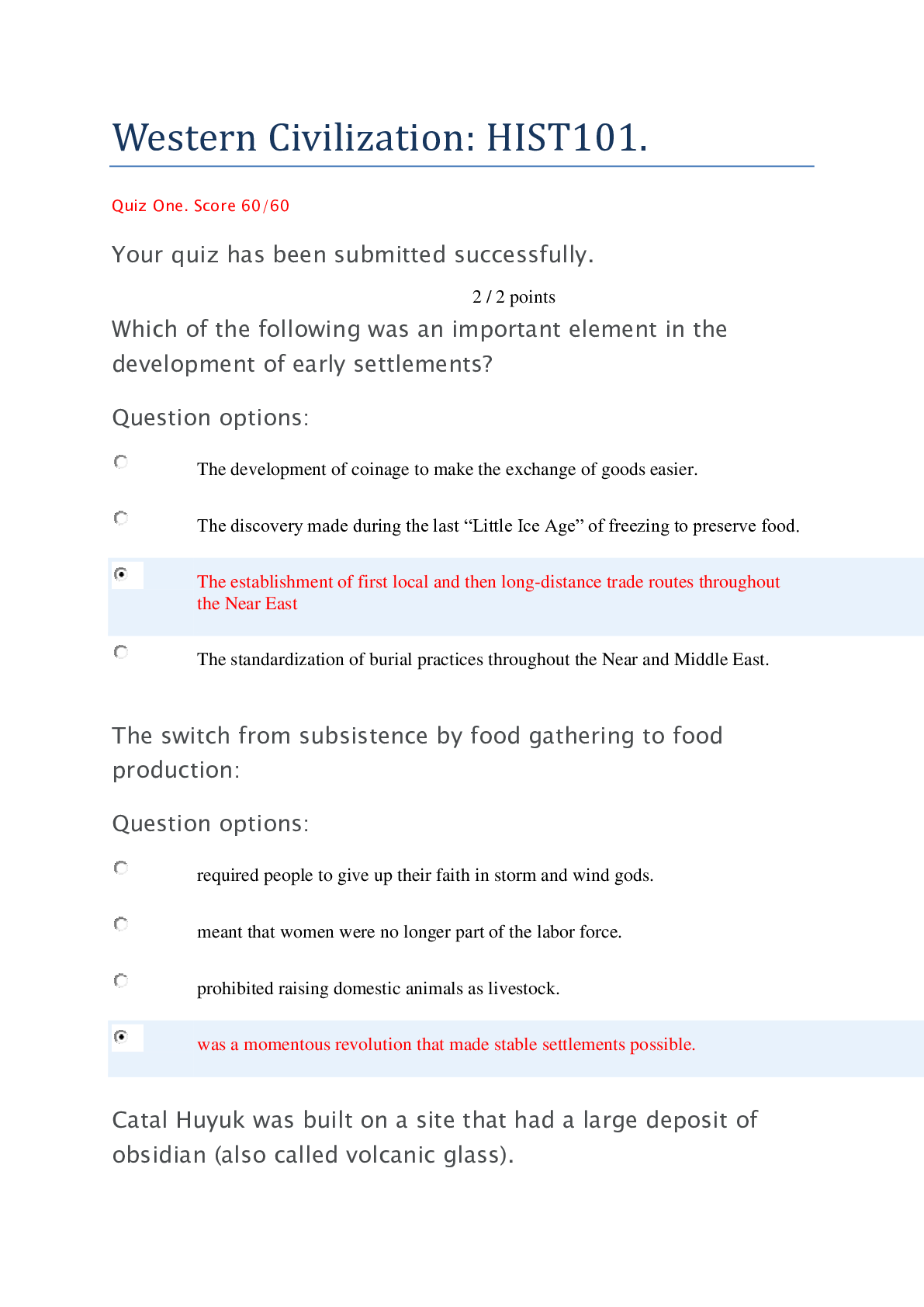
Western Civilization: HIST101.
Quiz One. Score 60/60
Your quiz has been submitted successfully.
Question 1 2 / 2 points
Which of the following was an important element in the development of early settlements?
Quest
...
Western Civilization: HIST101.
Quiz One. Score 60/60
Your quiz has been submitted successfully.
Question 1 2 / 2 points
Which of the following was an important element in the development of early settlements?
Question options:
The development of coinage to make the exchange of goods easier.
The discovery made during the last “Little Ice Age” of freezing to preserve food.
The establishment of first local and then long-distance trade routes throughout
the Near East
The standardization of burial practices throughout the Near and Middle East.
Question 2 2 / 2 points
The switch from subsistence by food gathering to food production:
Question options:
required people to give up their faith in storm and wind gods.
meant that women were no longer part of the labor force.
prohibited raising domestic animals as livestock.
was a momentous revolution that made stable settlements possible.
Question 3 2 / 2 points
Catal Huyuk was built on a site that had a large deposit of obsidian (also called volcanic glass).
Question options:
True
False
Question 4 2 / 2 points
Of the areas in which agriculture developed, The Fertile Crescent enjoyed which of the following significant advantages:
Question options:
Many nutritious staple crops like wheat and barley grew naturally in the region.
Several of the key animal species that were first domesticated by humans were native to the region.
All of these
The region was also much more temperate and fertile than it is today
Question 5 2 / 2 points
Cave paintings, such as those found in Lascaux, France, are evidence of development of:
Question options:
permanent settlement
a priestly class
a stratified society
religious and artistic ideas
Question 6 2 / 2 points
To the peoples of the ancient world, the characteristic manifestations of civilization—government, literature, science, and art—were necessarily products of:
Question options:
rural life
warfare
religion
city life
Question 7 2 / 2 points
The ability of Neanderthals to make jewelry, bury their dead in distinctive graves, and create cave paintings, suggests which of the following?
Question options:
Neanderthals were the most advanced ancient peoples.
Neanderthals likely became extinct as a result of famine.
Neanderthal women did the same work as men.
Neanderthals had some recognizable human traits.
Question 8 2 / 2 points
The earliest primates with human characteristics originated roughly 4 million years ago in:
Question options:
North America
China
South America
Africa
Question 9 2 / 2 points
Sumerian distrust of nature and fear of the world were paralyzing to their culture as they lacked motivation to make significant advances in science, technology, and trade.
Question options:
True
False
Question 10 2 / 2 points
Political leaders in ancient Mesopotamia appear to have been drawn from both priesthoods and the warrior elite, with the two classes working closely together in governing the cities.
Question options:
True
False
Question 11 2 / 2 points
The Ur III dynasty is an example of an early bureaucratic empire.
Question options:
True
False
Question 12 2 / 2 points
Following Utnapishtim’s advice, Gilgamesh finds the magical plant that will give him immortality, however, it is stolen by a snake.
Question options:
True
False
Question 13 2 / 2 points
Myths can be considered an early form of history.
Question options:
True
False
Question 14 2 / 2 points
Several versions of the Gilgamesh story use both Sumerian and Akkadian names for gods.
Question options:
True
False
Question 15 2 / 2 points
Why was Sumer an uninviting environment for the first cities?
Question options:
The soil was sandy and the rivers flooded unpredictably.
The area has no natural defenses.
The marshy land between the rivers was fertile breeding ground for malaria and other deadly diseases.
The rivers were largely unnavigable during long periods of the year, making trade difficult.
Question 16 2 / 2 points
Enkidu’s death in the Epic of Gilgamesh and Gilgamesh’s inability to revive him illustrates that Sumerians believed that:
Question options:
the Sumerians believed that the gods would reward those who did their bidding
rural life is superior to urban life and “civilization.”
human effort was futile to stop the forces of nature.
a powerful king owes no allegiance to the gods
Question 17 2 / 2 points
By about 1650 BCE, a group known as the __________, an Egyptian term which simply means “leaders of foreigners,” seized power in Lower Egypt
Question options:
Hittites
Hyksos
Minoans
Akkadians
Question 18 2 / 2 points
The Egyptians developed elaborate tombs and burial techniques:
Question options:
following the example of the Hebrews and other nomadic people.
to enable a person’s afterlife and ensure he or she had all that was necessary there
to preserve their sacred cats in the harsh desert climate
because they believed deceased people would be reincarnated as animals.
Question 19 2 / 2 points
Before entering an enjoyable afterlife, the deceased Egyptian supposedly:
Question options:
confessed all sins.
had to build a pyramid, large or small, according to social status.
would be judged by gods.
had to buy access to heaven with offerings to the gods
Question 20 2 / 2 points
The essential characteristics of Egyptian religion emerged during the Old Kingdom, especially the idea that the king was a:
Question options:
mortal ruler
god
animal spirit
priest
Question 21 2 / 2 points
Ma’at:
Question options:
or “size,” meant that temples and palaces had to be very large
was a male god who made the universe move forward in time.
includes ideas of harmony, order, justice, and truth.
is equivalent to the English “human rights.”
Question 22 2 / 2 points
The New Kingdom saw the only known female pharaoh, called
Question options:
Abu Simbel
Cleopatra
Hatshepsut
Nefertiti
Question 23 2 / 2 points
The First Intermediate Period refers to a period in which Egypt ceased to be unified.
Question options:
True
False
Question 24 2 / 2 points
The culture of the Mycenaeans was
Question options:
hindered by their lack of writing.
preserved for posterity by the Kassittes.
strongly militaristic, prone to attacks on other peoples
based on ideas borrowed from the Hebrews
Question 25 2 / 2 points
The story of Moses’s childhood was apparently based on a similar story about:
Question options:
Hammurabi.
Darius.
Sargon the Great.
Ramses II.
Question 26 2 / 2 points
Solomon lived in a manner consistent with other Iron Age kings, with many wives and a harem of concubines.
Question options:
True
False
Question 27 2 / 2 points
The “Babylonian captivity” of the Hebrew people began in the rule of Cyrus the Great
Question options:
True
False
Question 28 2 / 2 points
The Hebrews were allowed to return to their lands following the conquest of Babylon by:
Question options:
Cyrus.
Hammurabi.
Amenhotep IV.
Ramses II.
Question 29 2 / 2 points
The Hebrew Bible is an unparalleled historical source that describes the cultural practices and theological development of the Hebrew people. However, most historians believe that:
Question options:
the biblical stories are essentially unique to the Hebrews, with no parallels in other Near Eastern societies.
the Hebrew people never really struggled with the Canaanites.
it represents a factual account of the events it relates—the most accurate record of the period
we have today.
the Bible’s composite nature means that each biblical book should be analyzed within its
particular context.
Question 30 2 / 2 points
All of the following are true of the Hebrew conception of God except
Question options:
he was the creator of but not an inherent part of nature
all peoples of the world were subject to him.
he would punish those not following him.
there was no room for personal relationships with him, as his word was law.
________________________________________
Attempt Score:
60 / 60 - 100 %
Overall Grade (highest attempt):
60 / 60 - 100 %
[Show More]

 (1).png)


.png)