2.5.6 Test (TST): Trigonometric Functions Test
Precalculus Sem 2
Points Possible:100
Name: David Mejia
Date:
Answer the following questions using what you've learned from this unit. Write your responses
in the spac
...
2.5.6 Test (TST): Trigonometric Functions Test
Precalculus Sem 2
Points Possible:100
Name: David Mejia
Date:
Answer the following questions using what you've learned from this unit. Write your responses
in the space provided.
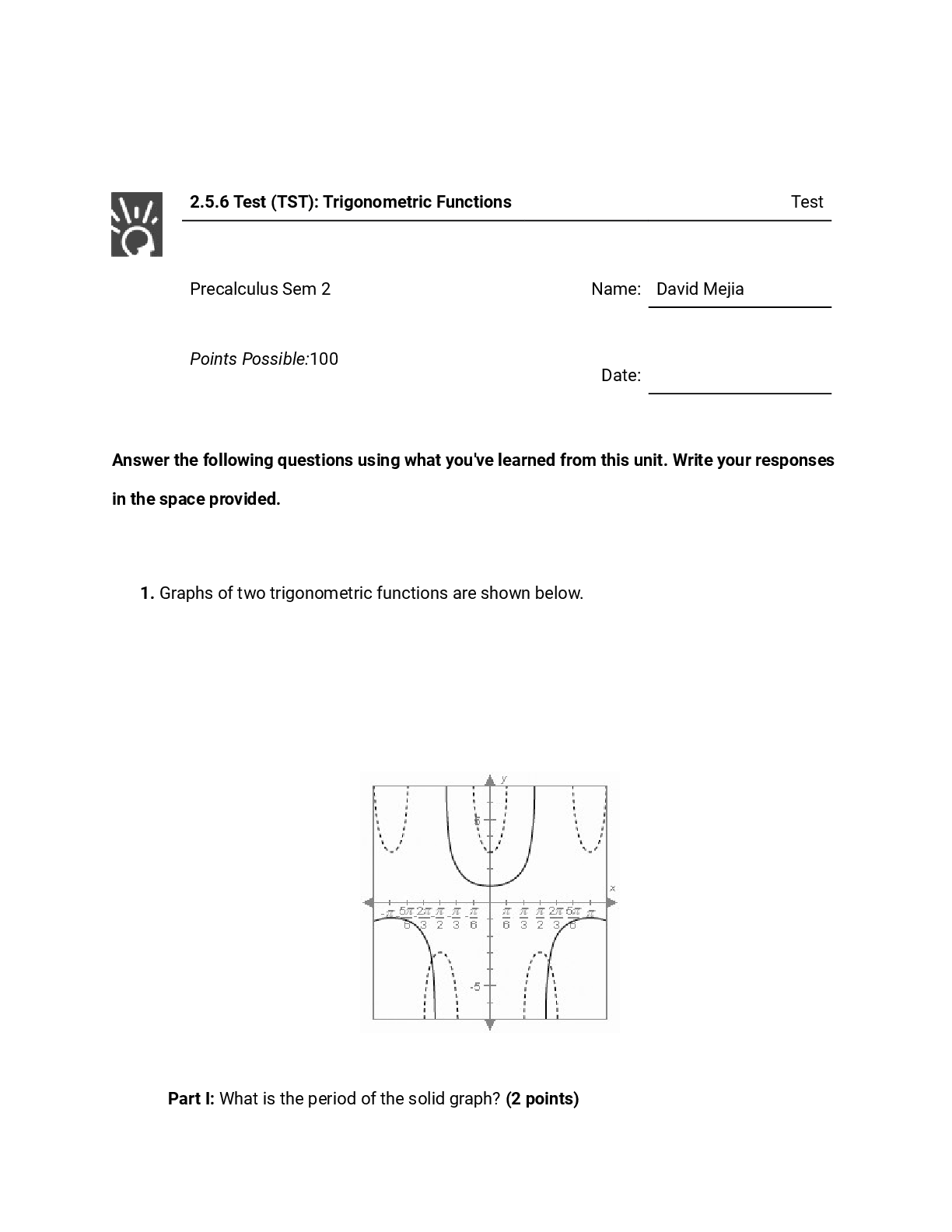
1. Graphs of two trigonometric functions are shown below.
Part I: What is the period of the solid graph? (2 points)pi
Part II: What is the period of the dotted graph? (2 points)
2pi
Part III: The solid graph is the graph of one of the six main trigonometric functions.
Which of the six is it? How do you know this? (4 points)
Csent- it's a recupond of sinePart IV: The dotted graph is a transformation of the solid graph. It shows a vertical
stretch and a horizontal compression. What is the vertical stretch factor of the dotted
graph? (2 points)
Vertical stretch: 3
Horizontal stretch: 1/2
Part V: Take your answers to Part II and Part III and apply the transformation from Part
IV to generate the function that produces the dotted graph. (4 points)
j=3sec (2x)Part VI: The function that produces the solid graph is the reciprocal function for another
trigonometric function. Use the y-intercept of the solid graph to identify this reciprocal
function. (2 points)
y=csc (x/2)
2. Consider the function and answer the questions that follow.
Part I: Graph two periods of the function . Be sure to identify (with a dot that is
larger than the line of the graph) at least three critical points in the graph. (10 points)Part II: Describe how the graph of the function is related to the graph of
.
A. What is the amplitude of the function ? (2 points)1.5
B. What is the period of the function ? (2 points)
2pi/4=pi/2
C. Compare the amplitude of to the amplitude of . (2 points)The difference of amplitude is .5
D. Compare the period of to the period of . (2 points)
y=1.5sin(4x)= pi/2
y=sinx=2piPart III: Graph two periods of the function . (6 points)3. Consider the two functions below:
Part I: What are the amplitudes of the two functions? (4 points)
f(x) 2COS(pix)= 2
G(x)= 1/2cos (2x)=1/2Part II: What are the periods of the two functions? (4 points)
f(x) 2COS(pix)=2
G(x)= 1/2cos (2x)=pi
Part III: Draw sketches of at least two periods of the two graphs, labeling each of the
graphs. You may have to approximate the critical points of one of the graphs. (8 points)For the functions below, state the amplitude, period, phase shift, and vertical translation of
the graph for the sinusoid. (8 points for each question)
4.With respect to the parent function :
Part I: What is the amplitude of the function H(x)? (2 points)
3
Part II: What is the period of the function H(x)? (2 points)
2pi
Part III: What is the phase shift of the function H(x)? (2 points)pi/4 (pi/4 to the right)
Part IV: What is the vertical translation of the function H(x)? (2 points)
2
5.With respect to the parent function
Part I: What is the amplitude of the function G(x)? (2 points)
2
Part II: What is the period of the function G(x)? (2 points)
1
Part III: What is the phase shift of the function G(x)? (2 points)-2pi/3 (to the left)
Part IV: What is the vertical translation of the function G(x)? (2 points)
-5
6. Explain how the graph of is related to the graph of the basictrigonometric function .
Part I: What kind of reflection does the basic function experience? (2 points)
It will reflect over the x axis
Part II: What is the vertical stretch factor of the function R(x)? (2 points)
nonePart III: What is the horizontal stretch factor of the function R(x)? (4 points)
Part IV: What is the period of the function R(x)? (4 points)
2piUse your answers to Parts I through IV to graph the function .
Part V: What are the equations of the vertical asymptotes of this function? (4 points)
x=pi+2pin where n is an integer
Part VI: What are the zeros of this function? (4 points)
x=2pin ,Part VII: Sketch the graph of the function . (8 points)
[Show More]