CONCEPT MAP WORKSHEET
DESCRIBE DISEASE PROCESS AFFECTING PATIENT
(INCLUDE PATHOPHYSIOLOGY OF DISEASE PROCESS)
DIAGNOSTIC TESTS
(REASON FOR TEST AND RESULTS)
PATIENT INFORMATION ANTICIPATED PHYSICAL FINDINGS
ANTICIP
...
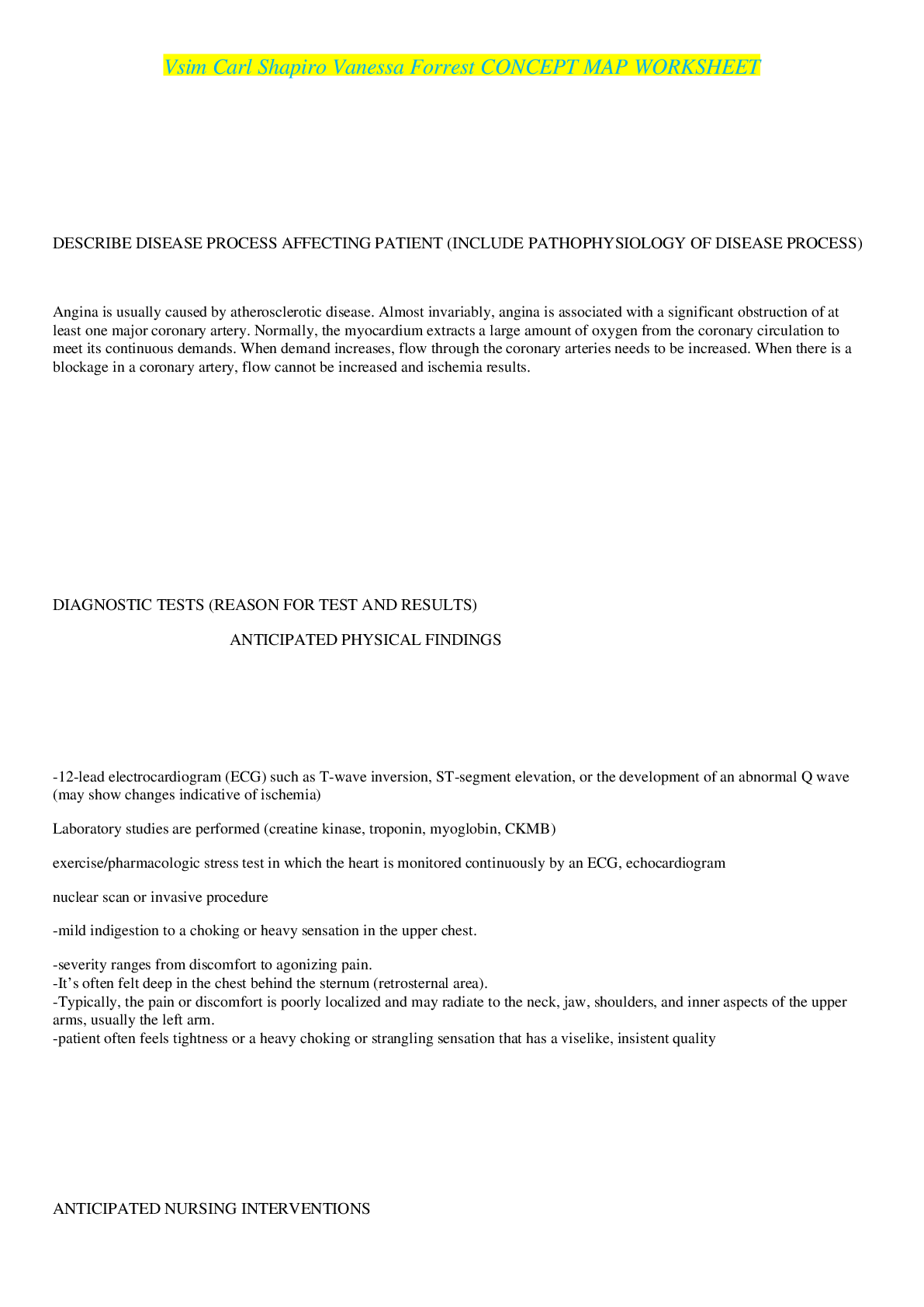
CONCEPT MAP WORKSHEET
DESCRIBE DISEASE PROCESS AFFECTING PATIENT
(INCLUDE PATHOPHYSIOLOGY OF DISEASE PROCESS)
DIAGNOSTIC TESTS
(REASON FOR TEST AND RESULTS)
PATIENT INFORMATION ANTICIPATED PHYSICAL FINDINGS
ANTICIPATED NURSING INTERVENTIONS
Angina is usually caused by atherosclerotic disease. Almost invariably, angina is associated with a significant
obstruction of at least one major coronary artery. Normally, the myocardium extracts a large amount of
oxygen from the coronary circulation to meet its continuous demands. When demand increases, flow through
the coronary arteries needs to be increased. When there is a blockage in a coronary artery, flow cannot be
increased and ischemia results.
-12-lead electrocardiogram
(ECG) such as T-wave
inversion, ST-segment
elevation, or the development
of an abnormal Q wave (may
show changes indicative of
ischemia)
- Laboratory studies are
performed (creatine kinase,
troponin, myoglobin, CKMB)
- exercise/pharmacologic
stress test in which the heart
is monitored continuously by
an ECG, echocardiogram
- nuclear scan or invasive
procedure
-mild indigestion to a choking or
heavy sensation in the upper chest.
-severity ranges from discomfort to
agonizing pain.
-It’s often felt deep in the chest
behind the sternum (retrosternal
area).
-Typically, the pain or discomfort is
poorly localized and may radiate to
the neck, jaw, shoulders, and inner
aspects of the upper arms, usually
the left arm.
-patient often feels tightness or a
heavy choking or strangling sensation
that has a viselike, insistent quality
Shapiro, Carl
54-year-old
History: Diagnosed with
hypertension and
hyperlipidemia. He is
overweight, smokes a half
pack of cigarettes per day,
and describes his job as
stressful
-~ The nurse assesses the patient’s pain level (PQRST)
~Pharmacologic therapy (nitroglycerin, anticoagulants, beta blockers, etc.)
~Measuring vital signs and observing for signs of respiratory distress.
~ 12-lead ECG is usually obtained and assessed for ST-segment and T-wave changes
~Thenurseadministersoxygentherapyifthepatient’srespiratoryrateisincreasedoriftheoxygen
vSim ISBAR ACTIVITY STUDENT WORKSHEET
INTRODUCTION Vanessa Forrest, RN, Telemetry Unit
Your name, position (RN), unit you are
working on
SITUATION Shapiro, Carl
54-year-old
Patient’s name, age, specific reason for visit Acute Chest Pain
BACKGROUND Primary: Coronary Artery Disease
Date of Admission: 4/15/20
Current Orders:
-IV normal saline at 25 mL/hour
-Oxygen to maintain SpO2 over 92%
-Continuous ECG and SpO2 monitoring
-activity: bed rest with bathroom privileges
-healthy heart diet
-Chest Xray, basic metabolic panel, CBC, troponin and CK-MB every
8 hrs x 3
Meds:
-Morphine 2 mg IV push PRN chest pain every 10 mins x 3; every 2
hrs; notify HCP if chest pain returns
Patient’s primary diagnosis, date of
admission, current orders for patient
ASSESSMENT RR- 12 breaths per min
BP: 124/74 mmhg
HR- 81 bpm
Temp-99 F
SPO2- 98%
Current pertinent assessment data using head
to toe approach, pertinent diagnostics, vital
signs
RECOMMENDATION
-~ The nurse assesses the patient’s pain level (PQRST)
~Pharmacologic therapy (nitroglycerin, anticoagulants, beta blockers,
etc.)
~Measuring vital signs and observing for signs of respiratory distress.
~ 12-lead ECG is usually obtained and assessed for ST-segment and Twave changes
~ The nurse administers oxygen therapy if the patient’s respiratory rate
is increased or if the oxygen saturation level is decreased
~ Implement stress reduction methods such as guided imagery or
music therapy
Any orders or recommendations you may have
for this patient
PHARM-4-FUN PATIENT EDUCATION WORKSHEET
NAME OF MEDICATION, CLASSIFICATION, AND INCLUDE PROTOTYPE
MEDICATION: amiodarone hydrochloride
CLASSIFICATION: Antiarrhythmics
PROTOTYPE: Nexterone, Pacerone
SAFE DOSE OR DOSE RANGE, SAFE ROUTE
Injection: 50 mg/mL; 150 mg/100 mL; 360 mg/200 mL; 450 mg/9 mL; 450 mg/200 mL; 750 mg/500 mL; 900 mg/18
mL; 900 mg/500 mL; 1,000 mg/500 mL
Tablets: 100 mg; 200 mg; 400 mg
Adults: Give loading dose of 800 to 1,600 mg PO daily or divided into two equal doses daily for 1 to 3 weeks until
first therapeutic response occurs; then 600 to 800 mg PO daily for 1 month, followed by maintenance dose of 400 mg
PO daily or, for patients with severe GI intolerance, 200 mg PO b.i.d. Determine long-term maintenance dose
according to antiarrhythmic effect
PURPOSE FOR TAKING THIS MEDICATION
Prevention of recurrent life-threatening ventricular arrhythmias, such as ventricular fibrillation or
hemodynamically unstable ventricular tachycardia
Intended for use only in patients with life-threatening recurrent ventricular fibrillation or recurrent hemodynamically
unstable ventricular tachycardia unres
[Show More]