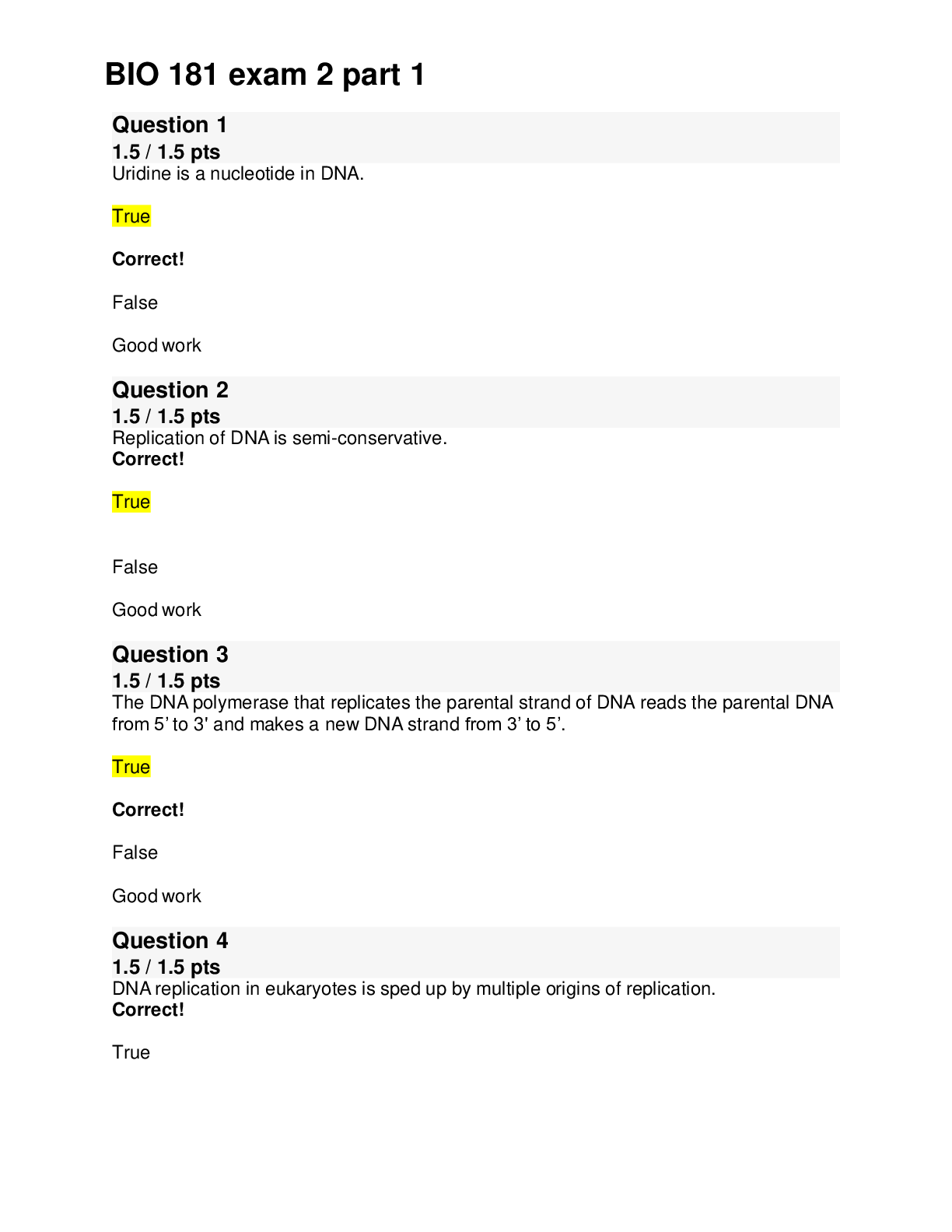
Uridine is a nucleotide in DNA.
True Correct! False Good work
Replication of DNA is semi-conservative.
Correct!
True
False Good work
The DNA polymerase that replicates the parental strand of DNA reads
...
Uridine is a nucleotide in DNA.
True Correct! False Good work
Replication of DNA is semi-conservative.
Correct!
True
False Good work
The DNA polymerase that replicates the parental strand of DNA reads the parental DNA
from 5’ to 3' and makes a new DNA strand from 3’ to 5’. True
Correct! False Good work
DNA replication in eukaryotes is sped up by multiple origins of replication.
Correct!
True
False Good work
Messenger RNA is double stranded.
True Correct! False Good work
The genetic code for the conversion of mRNA codons to proteins has redundancy.
Correct!
True
False Good work
The light reactions of photosynthesis produce and and this process also results in the
release of . Answer 1: Correct!ATP Correct Answer NADPH + H+
Correct Answer
NADPH+ H+
Answer 2:
You AnsweredNADPH+H Correct Answer
ATP
Correct Answer
NADPH+H+
Correct Answer
NADPH+ H+
Answer 3: Correct!oxygen Correct Answer O2
The Calvin-Benson cycle takes in and from the light reaction and also to make carbohydrates.
Answer 1: Correct!ATP Answer 2: Correct!NADPH+H+ Correct Answer NADPH + H+
Answer 3:
You AnsweredWATER, CO2
Correct Answer
carbon dioxide
Correct Answer
CO2
In Photosynthesis the antenna system is in the membranes.
You Answered Correct Answers thylakoid
The most abundant protein in the world is called .
You Answered Correct Answers
rubisco
Protein synthesis changes from the language of to the language of .
Answer 1: Correct!nucleotides Correct Answer nucleotide
Answer 2: Correct!amino acids Correct Answer amino acid
In eukaryotic cells the start codon for protein synthesis is .
Correct!
Correct Answers
AUG or methionine AUG
Methionine
There are two types of protein synthesis in eukaryotic cells. These two types can be distinguished because the polyribosome is either or .
Answer 1: Correct!free Answer 2:
Correct!membrane bound Correct Answer membrane-bound
Glycolysis requires the investment of two in order to obtain a gross output of four .
Answer 1:
Correct!ATPs Correct Answer ATP
Answer 2: Correct!ATP Correct Answer ATPs
The citric acid/Kreb’s cycle breaks down carbohydrates into CO2.
Correct!
True
False Good work
FADH2 results as one of the products of the citric acid cycle.
Correct!
True
False Good work
The cell does not need ATP to survive.
True Correct! False Good work
Specifically in a cell where does Glycolysis occur?
Correct!
Cytoplasm Mitochondrial matrix
Inner mitochondrial membrane Glycolysis
ATP
Good work
Specifically where in a cell does the citric acid/Kreb’s cycle occur? Cytoplasm
Correct!
Mitochondrial matrix
Inner mitochondrial membrane Glycolysis
ATP
Good work
Where is carbon dioxide produced? Carbon dioxide
Correct!
Mitochondrial matrix
Inner mitochondrial membrane Oxygen
carbohydrates Good work
Bone marrow is a site where mature immune cells are found.
True Correct! False Good work
There are times when the spleen can be considered to be the primary lymph node.
Correct!
True
False Good work
Lymph nodes are a place where cells of the immune system accumulate and share information.
Correct!
True
False Good work
You should have your appendix removed whenever possible.
True Correct! False Good work
Red blood cells are a part of the immune system
True Correct! False Good work
Red blood cells originate from the bone marrow.
Correct!
True False
Good work
B and T cells are called lymphocytes
Correct!
True
False Good work
In 1 mL of blood, there are 1.5 million white blood cells
True Correct! False Good work
Natural killer cells are part of the specific immune system.
True Correct! False Good work
Having a fever of 100 degrees F can help you fight off infections.
Correct!
True
False Good work
Mast cells release histamine.
Correct!
True
False Good work
The humoral immune system involves cells in the immune system.
Correct!
True
False Good work
Any cell can present an antigen on a class I major histocompatibility complex (MHC)
protein.
Correct!
True
False Good work
Any cell can present an antigen on a class II major histocompatibility complex (MHC) protein.
True Correct! False Good work
Memory cells “remember” the antigen and make a faster and greater response the next
time the antigen is encountered.
Correct!
True
False Good work
A bacterium coated by antibodies is a signal that a macrophage should endocytose
(eat) it
Correct!
True
False Good work
Memory cells in your immune system will all die after 3 months.
True
Correct!
False Good work
A bacterium your body coated by antibodies is protected from the immune system.
True Correct! False Good work
Inflammation is caused by an increased blood supply due to released by some
cells of the immune system.
Correct!
Correct Answers
histamine histamines
Epithelial cells serve as a barrier to prevent non-specific movement of chemicals from one side of the epithelium to the other side.
Correct!
True
False Good work
The molecular seal that serves as the barrier is called a . While this is a good barrier,
such barriers are not very strong and must be underlined by .
Answer 1:
Correct!tight junction Correct Answer tight junctions
Answer 2: Correct!adhering junctions Correct Answer
adhering junction
The digestive track begins with the and the first enzyme added is .
Answer 1: Correct!mouth Answer 2: Correct!amylase
How does the lymph fluid return from the legs to the circulatory system?
How are the leg muscles involved? Describe the role of the lymph ducts. Your Answer:
movement, and contraction and relaxtion of muscles in the legs lymph ducts have one vales, lymph ducts join with the circulatory system above the heart
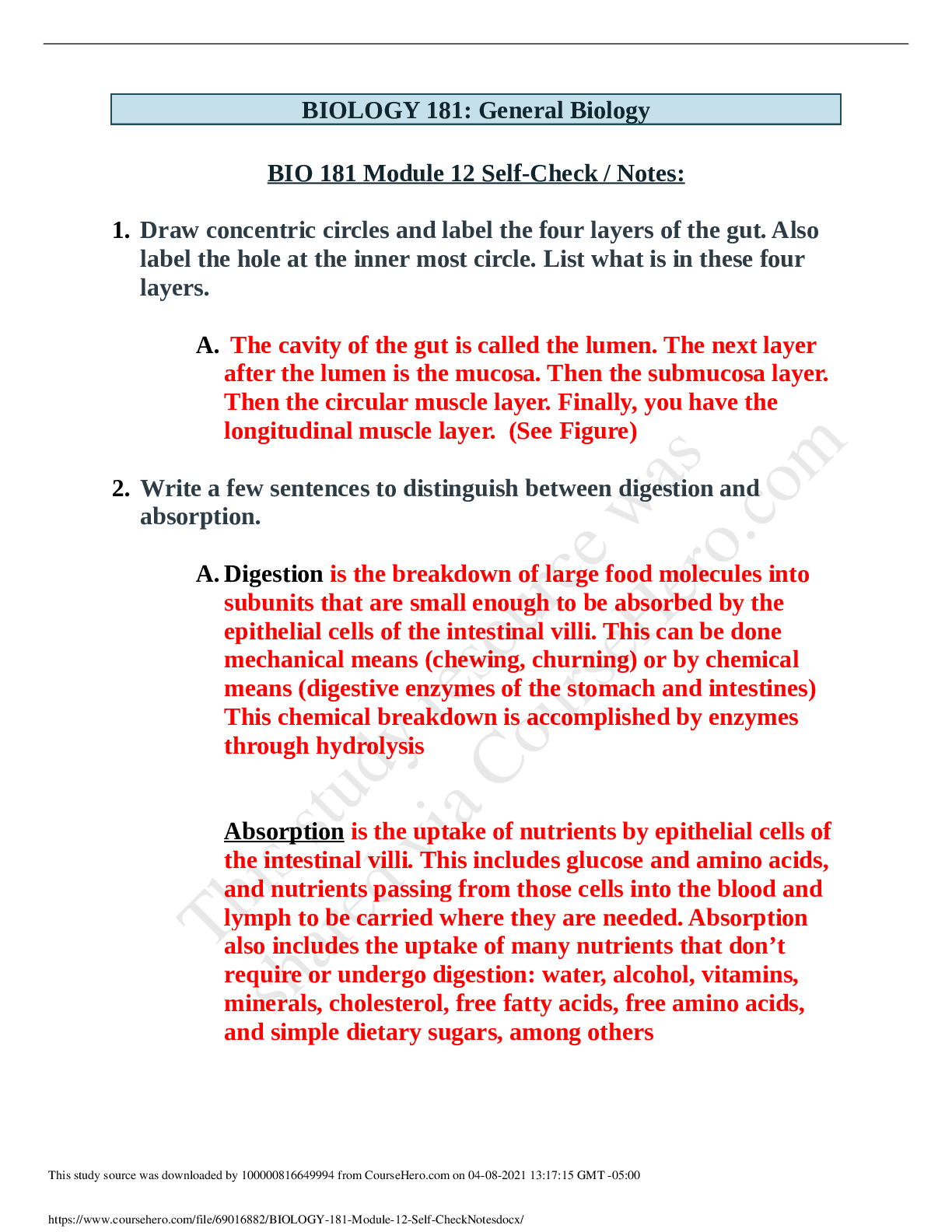
Write a few sentences to distinguish between digestion and absorption. Where do each of these processes occur?
Your Answer:
Digestion is the process in which food is broken down in the GI tract realing many nutrients in forms the body can use. Absorption is the process in which nutrients are taken into the cells lining the GI tract
What is bile made from? And how does oatmeal reduce cholesterol levels? Your Answer:
Choleserol, the oats absorb cholesterol well
Question 46
3 / 5 pts When glucose is taken in by the digestive track and enters your blood, cells are triggered to take in the glucose by what mechanism? describe the pathway of this mechanism.
Your Answer:
realse of insulin from pancreas
#46 Insulin is a ligand that enters the circulatory system and interacts with receptors in the plasma membrane of all cells (in a healthy person) (-2 points)
Using your pen/pencil and paper, draw the sugar in DNA and label the carbons as
discussed in the lecture. Then circle the carbon that is different in RNA.
This question requires a hand-drawn response. When you have finished the drawing, hold the drawing up to your web camera for verification. Then you will scan the image of the drawing (acquired via smartphone, camera or scanner) and load the image into your computer as a file. Then go to the "Exam 2 Part 2" link and upload the file within 45 minutes.
This question is worth 5 points, and credit will be given under Exam 2 Part 2 in your grades area.
Click "Done" below for your answer once you've held up the drawing to the camera.
Correct!
Done, and I now have 45 mins to upload the drawing file to Exam 1 Part 2
Click above when finished
Quiz Score: 88.5 out of 95
[Show More]





 Correct Study Guide, Download to Score A.png)
 Correct Study Guide, Download to Score A.png)