WEEK 2 TEST STUDY GUIDE - ALL ANSWERS ARE CORRECT – BOLDED ARE CORRECTED ANSWERS
Part 1 of 7 - 15.0/ 18.0 Points
Question 1 of 32
3.0/ 3.0 Points
1. Almost all of the liver of a human being is located in which
...
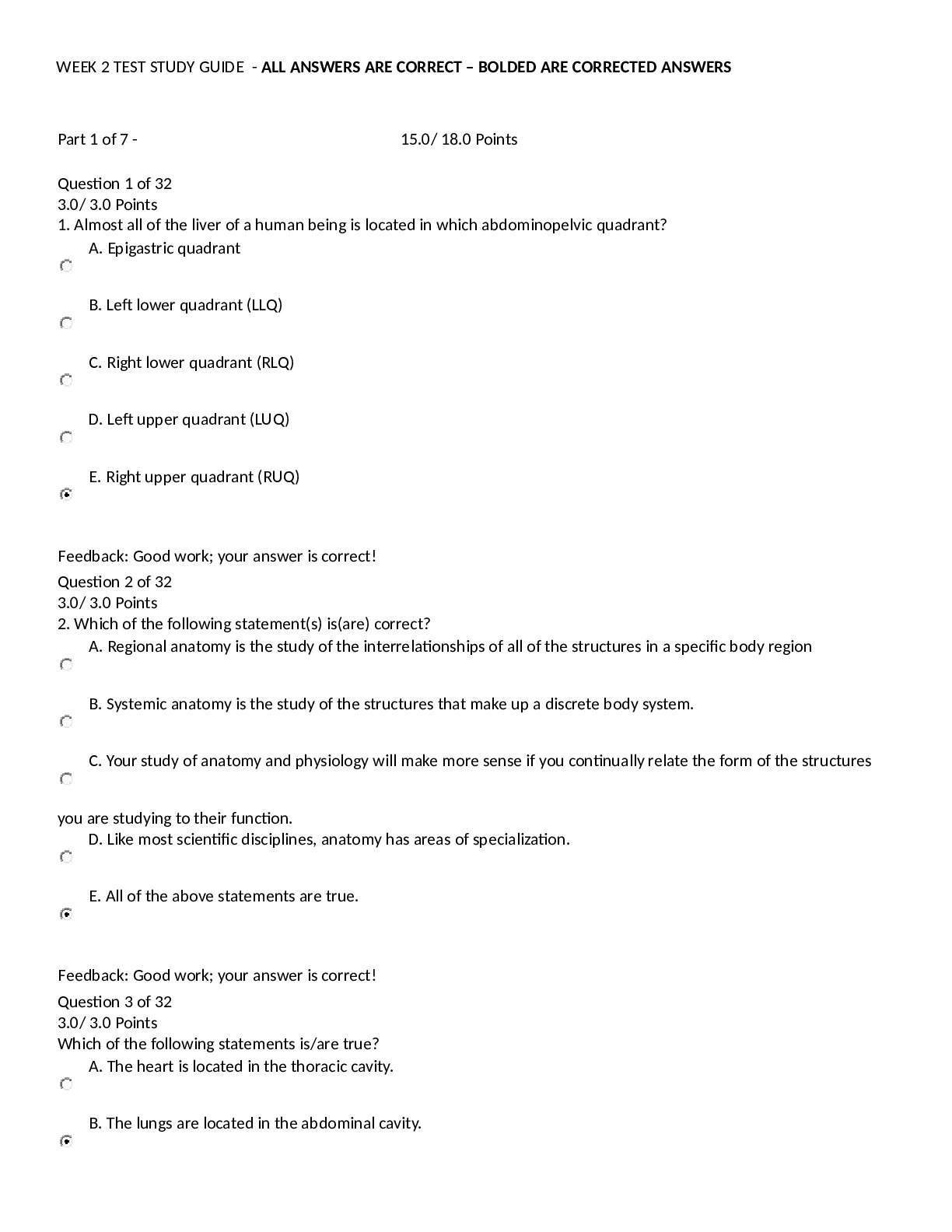
WEEK 2 TEST STUDY GUIDE - ALL ANSWERS ARE CORRECT – BOLDED ARE CORRECTED ANSWERS
Part 1 of 7 - 15.0/ 18.0 Points
Question 1 of 32
3.0/ 3.0 Points
1. Almost all of the liver of a human being is located in which abdominopelvic quadrant?
A. Epigastric quadrant
B. Left lower quadrant (LLQ)
C. Right lower quadrant (RLQ)
D. Left upper quadrant (LUQ)
E. Right upper quadrant (RUQ)
Feedback: Good work; your answer is correct! Question 2 of 32
3.0/ 3.0 Points
2. Which of the following statement(s) is(are) correct?
A. Regional anatomy is the study of the interrelationships of all of the structures in a specific body region
B. Systemic anatomy is the study of the structures that make up a discrete body system.
C. Your study of anatomy and physiology will make more sense if you continually relate the form of the structures you are studying to their function.
D. Like most scientific disciplines, anatomy has areas of specialization.
E. All of the above statements are true.
Feedback: Good work; your answer is correct! Question 3 of 32
3.0 / 3.0 Points
Which of the following statements is/are true?
A. The heart is located in the thoracic cavity.
B. The lungs are located in the abdominal cavity.
Feedback: Good work; your answer is correct! Question 4 of 32
0.0 / 3.0 Points – CORRECTED
Which of the following statements is/are true?
A. The head is inferior to the chest.
B. The feet are superior to the knees
C. The upper extremities are lateral to the abdomen.
D. The hands are distal to the elbows.
E. Both C and D are correct.
Feedback: The head is superior to the chest. The feet are inferior to the knees. Question 5 of 32
3.0 / 3.0 Points
The smallest independently functioning unit of a living organism is a(an):
A. organ
B. tissue
C. molecule
D. atom
E. cell
Feedback: Good work; your answer is correct! Question 6 of 32
3.0/ 3.0 Points
Every cell in an animal is separated from other cells and from the extracellular environment by a cell (plasma) membrane. Which of the following are found inside the cell membrane?
D. organelles
E. Both C and D are correct.
Feedback: Good work; your answer is correct!
Part 2 of 7 - 15.0/ 18.0 Points
Question 7 of 32
3.0 / 3.0 Points
Which of these methods that aids in the movement of ions or molecules across a cell membrane requires the use of energy which is supplied by ATP molecules?
A. Reverse diffusion
B. Facilitated diffusion
C. Osmosis
D. Passive transport
E. Active transport
Feedback: Good work; your answer is correct!
Question 8 of 32
0.0 / 3.0 Points - CORRECTED
The process named "transcription" occurs within the cell nucleus. is produced during this process.
A. A mRNA molecule
B. A pRNA
C. A very short amino acid chain
D. A tRNA molecule
Feedback: Transcription within the cell nucleus produces an mRNA molecule. Question 9 of 32
3.0 / 3.0 Points
The process when the cytoplasm actually divides into two separate cells is named .
A. Meiosis
B. Prophase
C. Interphase
D. Mitosis
E. Cytokinesis
Feedback: Good work; your answer is correct! Question 10 of 32
3.0 / 3.0 Points
What scientist is given credit for coming up with the concept of the cell?
A. Robert Hooke
B. Albert Einstein
C. Galileo
D. Michelangelo
E. Michael Curie
Feedback: Good work; your answer is correct! Question 11 of 32
3.0 / 3.0 Points
A molecule (or region of a molecule) that is attracted to water is known as a(n) molecule.
A. Bipolar
B. Hydrophobic
C. Bi-layerd
Feedback: Good work; your answer is correct!
Question 12 of 32
3.0 / 3.0 Points
The molecules which store the genetic instructions of an organism is .
A. ADP
B. ATP
C. Histone
D. RNA
E. DNA
Feedback: Good work; your answer is correct!
Part 3 of 7 - 12.0/ 15.0 Points
Question 13 of 32
0.0 / 3.0 Points - CORRECTED
According to your author, which of the following functions of connective tissue is its most important function?
A. protection
B. transport of fluid, nutrients, waste
C. support and connect other tissues
D. energy storage
E. forming glands
Feedback: According to your author, the most important function of connective tissue is to support and connect other tissues; from the connective tissue sheath that surrounds muscle cells, to the tendons that attach muscles to bones, and to the skeleton that supports the positions of the body.
Question 14 of 32
3.0/ 3.0 Points
muscle is not voluntary and is responsible for the involuntary movements of internal organs such as the esophagus.
C. Stratified
D. Columnar
E. Smooth
Feedback: Good work; your answer is correct!
Question 15 of 32
3.0 / 3.0 Points
Cells of the body are organized into broad categories of tissue.
A. five
B. two
C. six
D. three
E. four
Feedback: Good work; your answer is correct! Question 16 of 32
3.0 / 3.0 Points
The most abundant cell in connective tissue proper is the .
A. Osteoblast
B. Reticular tissue
C. Adipocyte
Feedback: Good work; your answer is correct! Question 17 of 32
3.0 / 3.0 Points
Which of the following is the epithelial tissue that lines the interior of blood vessels?
A. transitional
B. columnar
C. pseudostratified
D. stratified
E. simple squamous
Feedback: Good work; your answer is correct!
Part 4 of 7 - 15.0/ 15.0 Points
Question 18 of 32
3.0 / 3.0 Points
What is the largest organ of the body?
A. Brain
B. Heart
Feedback: Good work; your answer is correct! Question 19 of 32
3.0 / 3.0 Points
Which of the following receptors responds to vibration?
A. Merkel cell
B. Meissner corpuscle
C. Keratinocyte
D. Melanocyte
E. Pacinian corpuscle
Feedback: Good work; your answer is correct! Question 20 of 32
3.0 / 3.0 Points
Which of the following layers contain blood vessels?
A. Stratum corneum
B. Stratum basale
C. Stratum granulosum
D. Papillary dermis
E. None of the above
Feedback: Good work; your answer is correct! Question 21 of 32
3.0 / 3.0 Points
The cuticle of the nail is also known as the .
A. Eponychium
Feedback: Good work; your answer is correct! Question 22 of 32
3.0 / 3.0 Points
Which of the following is NOT part of the epidermis?
A. Stratum basale
B. Papillary layer
C. Reticular layer
D. Two of the Above are NOT part of the epidermis
E. All of the above are part of the epidermis Feedback: Good work; your answer is correct!
Part 5 of 7 - 15.0/ 21.0 Points
Question 23 of 32
3.0 / 3.0 Points
Which of the following systems can compensate for pH changes in the body the fastest?
A. renal system
B. respiratory system
C. digestive system
D. endocrine system
Feedback: Correct! Question 24 of 32
3.0/ 3.0 Points
Which of the following is a substance that dissolves in water to release hydrogen ions?
Feedback: Correct!
Question 25 of 32
3.0 / 3.0 Points
Respiratory alkalosis is a result of .
A. too much oxygen in the blood
B. too little oxygen in the blood
C. too little carbon dioxide in the blood
D. too much carbon dioxide in the blood
Feedback: Correct!
Question 26 of 32
0.0 / 3.0 Points - CORRECTED
Too much carbon dioxide in the blood can be the result of .
A. hyperventilation
B. emphysema
C. anxiety
Feedback: Learning Objective: List possible causes of hypoventilation. Please review Lab Exercise 10, Activity 2.
Question 27 of 32
3.0 / 3.0 Points Hypoventilation results in
A. numbness around the lips.
B. spasms of the hands and feet.
C. lightheadedness.
D. an accumulation of CO2 in the blood.
Feedback: Correct! Question 28 of 32
3.0 / 3.0 Points
Which of the following is NOT one of the body’s physiological chemical buffering systems?
A. bicarbonate
B. protein
C. hydrochloride
D. phosphate Feedback: Correct!
Question 29 of 32
0.0 / 3.0 Points CORRECTED
Which of the following occurred during rebreathing?
A. carbon dioxide increased
B. pH increased
C. H+ concentration decreased
Feedback: Learning Objective: Define rebreathing and describe an example. Please review Lab Exercise 10, Activity 2.
Part 6 of 7 - 8.0/ 8.0 Points
Answer the following question in your own words without using any resources. Your answer should be written in complete sentences using correct grammar, spelling, and terminology.
Question 30 of 32
4.0/ 4.0 Points
Briefly explain the relationship between hydrogen ion concentration (H+) and the pH value of a solution.
pH is a measure of hydrogen ion concentration, and the results are indirectly proportional to each other, if the H+ increases, the pH will decrease, and vice versa.
Feedback: Learning Objective: Describe the relationship between hydrogen ion (H+) concentration and the pH value of a solution.
Please review Lab Exercise 10, Overview. Comment: inversely proportional, not indirectly. Question 31 of 32
4.0/ 4.0 Points
In the simulation, why did respirations slow or briefly stop completely after hyperventilation? Respirations briefly stopped to retain the Co2 in the system.
Feedback: Learning Objective: Describe the effects of hyperventilation and hypoventilation on blood PCO2 and pH. Please review Lab Exercise 10, Activity 1.
Part 7 of 7 - 2.5/ 5.0 Points
Instructions:
1. Click on the Browse button to find the lab report on your computer.
2. Click on the Upload button to attach your lab report to the quiz.
Question 32 of 32
2.5/ 5.0 Points
Attach your completed Lab Exercise 10, Activity 2: Rebreathing lab report (PEX-10-02_FirstnameLastname.pdf) as the answer to this question.
[Show More]