Case Series Part 1: Assignment. Questions and Answers
Walter Sobchak is a 62-year-old, overweight male who comes to the Emergency Room with a 5-day
history of increased sputum production, increased shortness of breath,
...
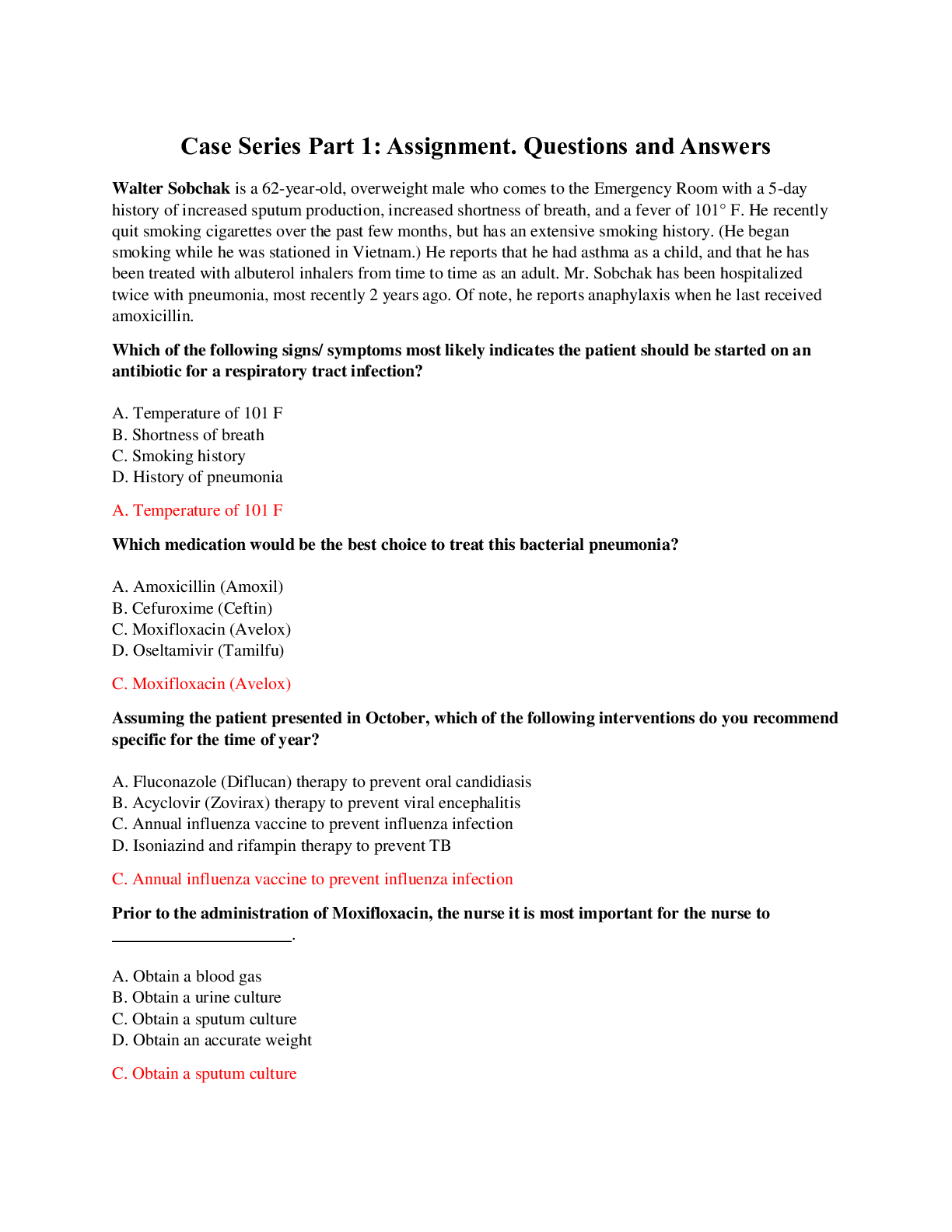
Case Series Part 1: Assignment. Questions and Answers
Walter Sobchak is a 62-year-old, overweight male who comes to the Emergency Room with a 5-day
history of increased sputum production, increased shortness of breath, and a fever of 101° F. He recently
quit smoking cigarettes over the past few months, but has an extensive smoking history. (He began
smoking while he was stationed in Vietnam.) He reports that he had asthma as a child, and that he has
been treated with albuterol inhalers from time to time as an adult. Mr. Sobchak has been hospitalized
twice with pneumonia, most recently 2 years ago. Of note, he reports anaphylaxis when he last received
amoxicillin.
Which of the following signs/ symptoms most likely indicates the patient should be started on an
antibiotic for a respiratory tract infection?
A. Temperature of 101 F
B. Shortness of breath
C. Smoking history
D. History of pneumonia
A. Temperature of 101 F
Which medication would be the best choice to treat this bacterial pneumonia?
A. Amoxicillin (Amoxil)
B. Cefuroxime (Ceftin)
C. Moxifloxacin (Avelox)
D. Oseltamivir (Tamilfu)
C. Moxifloxacin (Avelox)
Assuming the patient presented in October, which of the following interventions do you recommend
specific for the time of year?
A. Fluconazole (Diflucan) therapy to prevent oral candidiasis
B. Acyclovir (Zovirax) therapy to prevent viral encephalitis
C. Annual influenza vaccine to prevent influenza infection
D. Isoniazind and rifampin therapy to prevent TB
C. Annual influenza vaccine to prevent influenza infection
Prior to the administration of Moxifloxacin, the nurse it is most important for the nurse to
_____________________.
A. Obtain a blood gas
B. Obtain a urine culture
C. Obtain a sputum culture
D. Obtain an accurate weight
C. Obtain a sputum cultureMoxifloxacin 400mg IV dosages are available in 100 mL of saline. The infusion must be run at
200mg per hour. How do you set the pump (in terms of mL/hr)?
A. 25 mL/hr
B. 50 mL/hr
C. 100 mL/hr
D. 200 mL/hr
B. 50 mL/hr
The patient recognizes that his asthma symptoms typically get worse when he goes to the bowling
ally. (He rolls in a league one night a week with a few of his friends.) You recognize this as an
allergen. Which of the following medications do you recommend he uses for prophylaxis prior to
going to the bowling ally?
A. Albuterol (Proventil/ Ventolin)
B. Ipratropium (Atrovent)
C. Albuterol/ ipratropium (Combivent)
D. Nedocromil (Tilade)
D. Nedocromil (Tilade)
The patient gets acutely short of breath in your presence. You alert the physician. The physician
instructs you to administer an albuterol nebulization treatment. You monitor the patient for
_________________.
A. Bradycardia
B. Tachycardia
C. Hypotension
D. Urinary retention
B. Tachycardia
The patient asks if there are any chronic oral medications that can be used safely every day for long
periods of time that are useful in preventing asthma exacerbations. You tell him
___________________ is a good and safe long term option.
A. Montelukast (Singulair)
B. Prednisone
C. Epinephrine
D. Erythromycin (E-Mycin)
A. Montelukast (Singulair)
The prescriber decides the patient needs to take beclomethasone (Beclonase). You tell him this
medication should be ____________________.
A. Taken a few minutes before albuterol doses when used in conjunction with albuterol
B. Taken a few minutes after albuterol doses when used in conjunction with albuterolC. Taken during asthma exacerbations only
D. Effective within the first 2-3 days of therapy
B. Taken a few minutes after albuterol doses when used in conjunction with albuterol
You tell the patient it is important to take rinse his mouth out after taking this medication
(beclomethasone) to prevent ___________________________.
A. Infections caused by Aspergillus sp.
B. Infections caused by Staphylococcus sp.
C. Infections caused by Candida sp.
D. Infections caused by Streptococcus sp.
C. Infections caused by Candida sp.
If the patient were to develop an infection in the mouth secondary to the beclomethasone, which of
the following agents would treat it best?
A. Vancomycin (Vancocin) suspension
B. Ciprofloxacin (Cipro) suspension
C. Rifampin (Rifadin) suspension
D. Nystatin (Mycostatin) suspension
D. Nystatin (Mycostatin) suspension
The patient reports that he is having trouble using his inhalers properly. Which of the following
ideas can you try to help him receive the appropriate dosages?
A. Use of a spacer
B. Demonstrating the appropriate use of the inhaler for him using an inhaler that contains no medication
C. Asking him to demonstrate his inhaler technique with an inhaler that contains no medication
D. All of the above
D. All of the above
Case Series Part 2
You are seeing a patient for the first time (Parrot, Pirate). He tells you that he had a 20 pound weight gain
over the past 6 months due to increased stress at work. He tells you things are NOT going well at his job,
and he is afraid he will be laid off in a couple weeks due to his employer's poor performance. He is
complaining of polyphagia and polydipsia. A finger stick reveals a non-fasting blood glucose of 220
mg/dL. It appears as if Mr. Parrot is suffering from some form of diabetes. Prior to any formal testing to
determine the type, you sit down and talk to him.
Mr. Parrot asks what happened to his body that led to this condition. (He knows his pancreas in
involved but doesnt know how.) You tell him his pancreas may have dysfunctional
________________ cells.
A. Alpha
B. BetaC. Delta
D. All of the above.
B. Beta
After receiving the blood glucose result, you ask Mr. Parrot if he is taking _________________ since
this medication class can cause hyperglycemia.
A. Antihistamines
B. NSAIDs
C. Glucocorticoids
D. Antibiotics
C. Glucocorticoids
Mr. Parrot is very worried about his long term health. If he fails to control his diabetes, which of
the following chronic complication(s) is he at risk for?
A. Retinopathy
B. Nephropathy
C. Peripheral neuropathy
D. All of the above.
D. All of the above.
You tell Mr. Parrot that he may be placed on a medication responsible for increasing the secretion
of insulin from the pancreas. Which of the following medications works by this mechanism of
action?
A. Glipizide (Glucotrol)
B. Metformin (Glucophage)
C. Acarbose (Precose)
D. Sitagliptin (Januvia)
A. Glipizide (Glucotrol)
You tell Mr. Parrot that he may require a type of insulin known as glargine (Lantus). This insulin is
used in the treatment of diabetes as __________ insulin coverage due to its
______________________.
A. Bolus; rapid onset of action
B. Basal; rapid onset of action
C. Bolus; long duration of action
D. Basal; long duration of action
D. Basal; long duration of action
The physician tells Mr. Parrot that he will begin taking metformin (Glucophage). You stop the
physican and request that a ___________ be checked prior to initiation to avoid
__________________________.A. Serum blood glucose, hypoglycemia
B. Serum creatinine, hypoglycemia
C. Serum creatinine, lactic acidosis
D. Liver function tests, jaundice
C. Serum creatinine, lactic acidosis
The patient admits to you that he has been suffering from erectile dysfunction. You tell him this can
be related to his diabetes and request that the physican provides a prescription for
______________________ to best treat this.
A. Topical testosterone
B. Oral oxandrolone
C. Oral tadalafil
D. Subcutaneous exenatide
C. Oral tadalafil
[Show More]