Student Exploration: Levers
Vocabulary: effort, first-class lever, fulcrum, lever, load, mechanical advantage, second-class
lever, third-class lever
Prior Knowledge Questions
(Do these BEFORE using the Gizmo.)
1. A
...
Student Exploration: Levers
Vocabulary: effort, first-class lever, fulcrum, lever, load, mechanical advantage, second-class
lever, third-class lever
Prior Knowledge Questions
(Do these BEFORE using the Gizmo.)
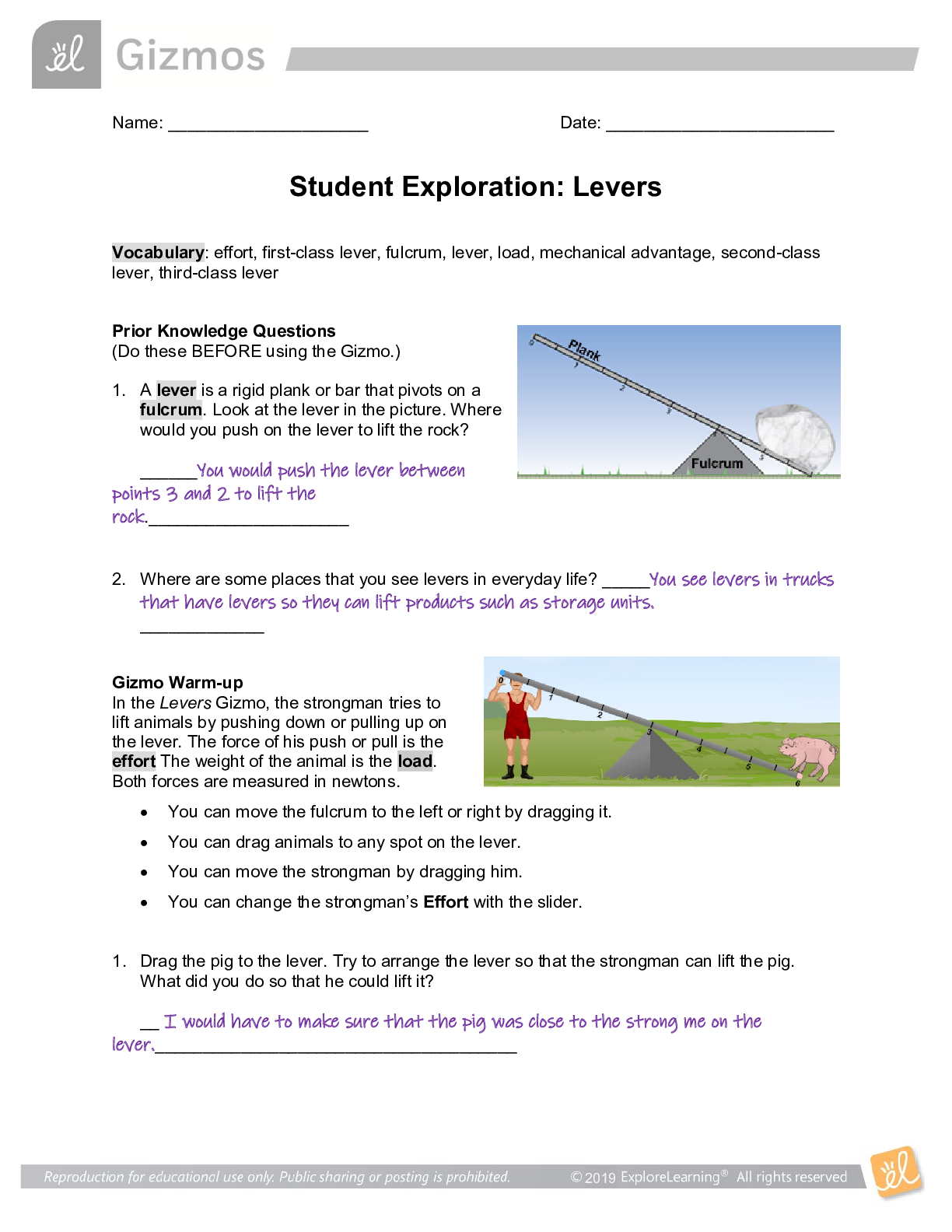
1. A lever is a rigid plank or bar that pivots on a
fulcrum. Look at the lever in the picture. Where
would you push on the lever to lift the rock?
______You would push the lever between
points 3 and 2 to lift the
rock._____________________
2. Where are some places that you see levers in everyday life? _____You see levers in trucks
that have levers so they can lift products such as storage units.
_____________
Gizmo Warm-up
In the Levers Gizmo, the strongman tries to
lift animals by pushing down or pulling up on
the lever. The force of his push or pull is the
effort The weight of the animal is the load.
Both forces are measured in newtons.
• You can move the fulcrum to the left or right by dragging it.
• You can drag animals to any spot on the lever.
• You can move the strongman by dragging him.
• You can change the strongman’s Effort with the slider.
1. Drag the pig to the lever. Try to arrange the lever so that the strongman can lift the pig.
What did you do so that he could lift it?
__ I would have to make sure that the pig was close to the strong me on the
lever.______________________________________
2019
2. Did the strongman pull up or push down to lift the pig? _ He pulled down to life the
pig_____
3. How much effort was needed to lift the pig? ___ One thousand Newtons (N) was needed
to lift the pig. ____________
2019
Activity A:
First-class levers
Get the Gizmo ready:
• Remove the pig from the lever.
• Drag the turkey onto the lever.
Question: In a first-class lever, the fulcrum is between the effort (strongman) and the
load (turkey). How are first-class levers helpful?
First class levers are helpful since they can be used to identify how much effort is needed
to raise the object.
1. Observe: Place the turkey, strongman, and fulcrum at a variety of positions. Each time, pay
attention to the smallest amount of Effort needed to lift the turkey. (Note: In this simulation,
the lever itself has no mass.)
2. Form hypothesis: When does a lever make it easiest to lift the turkey? ________________
I think the lever makes it easiest to lift the turkey because the force put into the
lever amplifies , and the force goes into lifting the turkey.
____________________________________
3. Experiment: Place the fulcrum at position 3, the turkey at position 4, and the strongman at
position 2. Slowly increase the Effort until the turkey is lifted.
A. What is the smallest force that can lift the turkey? __ 110_____________________
B. How does this effort compare to the turkey’s weight? _ The effort equals to the
weight of the turkey when you subtract the bar’s weight______
4. Revise and repeat: Move the strongman further away from the fulcrum and lift the turkey.
A. What is the smallest force that can lift the turkey now? ____ 60_______
B. Which moves more, the turkey or the strongman’s hands? _ The strongman’s
hands moved the most___
5. Draw conclusions:
A. How does a first-class lever help you lift a turkey? _______ The first-class lever
helps lift a turkey because you arent able to put as much force onto the lever.
Because the lever works with you as you lift the turkey therefore balancing the
weight.__________________
B. What is the “price” that you pay for using less force? _______ the price you pay for
using less force is more work to do. _____________________________
2019
6. Predict: What will happen if the turkey is farther from the fulcrum than the strongman?
____ If the turkey was farther from the fulcrum, I believe the man would have a
more difficult time lifting the turkey.______________________________
7. Test: Check your prediction using the Gizmo. Were you correct? My prediction was correct,
once the turkey was farther it took the man 70 more newtons of effort compared to
when the turkey was closer (when it only took him 6o newtons)_____
2019
Activity B:
Mechanical
advantage
Get the Gizmo ready:
• Turn on Show grid.
• Place the fulcrum at position 5.
• Drag the sheep to position 6.
Question: How are forces and distances related?
1. Observe: Move the strongman to a few places on the lever and find the smallest effort
needed to lift the sheep at each place. What do you notice? _____ when he was placed at
the end of the bar, the sheep would not lift with any amount of effort. Each place on
the side of the bar, the man could not lift the
sheep.______________________________________________
2. Form hypothesis: As the strongman gets further from the fulcrum, what happens to the effort
needed to lift the sheep? __ I believe that the effort needed to lift the sheep when the
man is farther from the fulcrum has to in
[Show More]