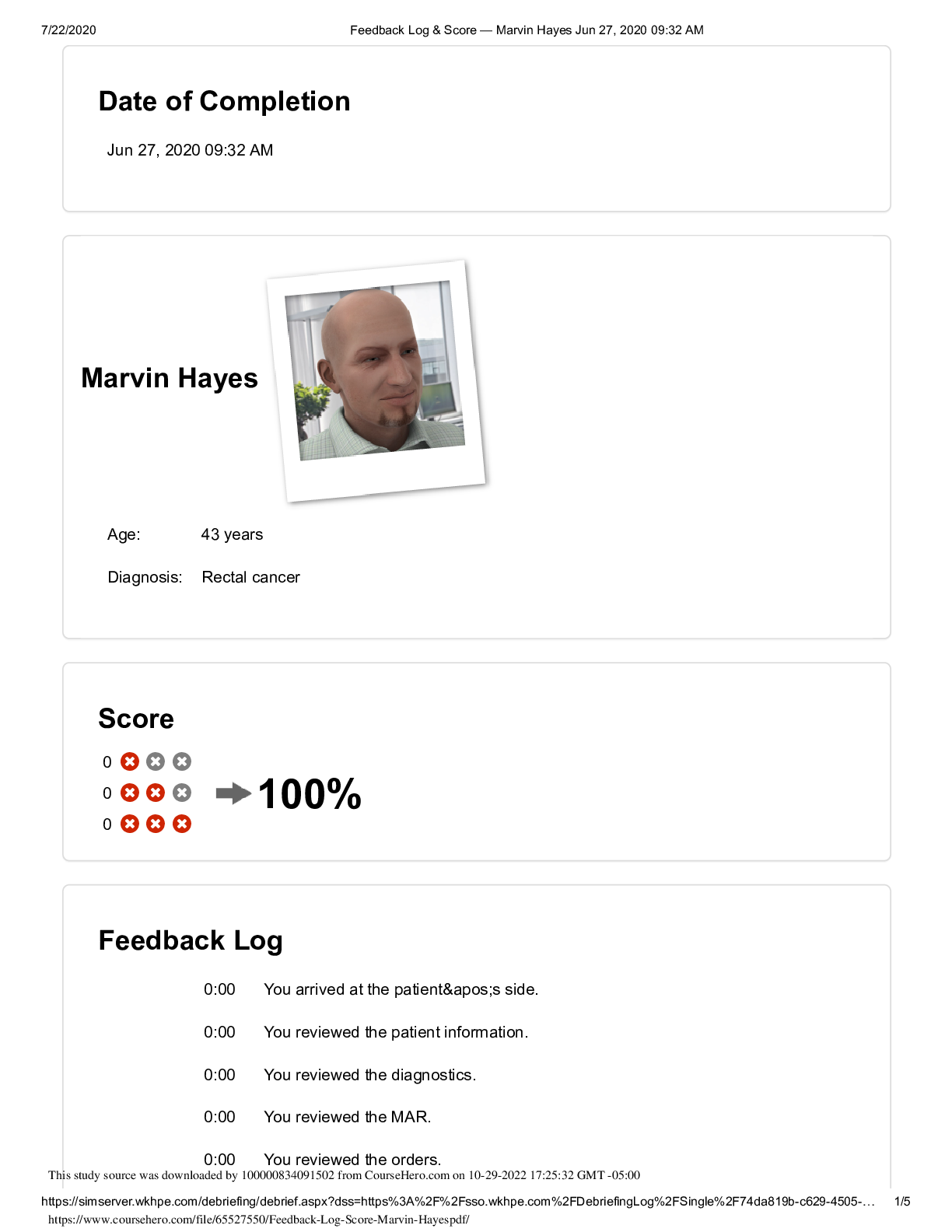
Date of Completion
Jun 13, 2020 09:29 AM
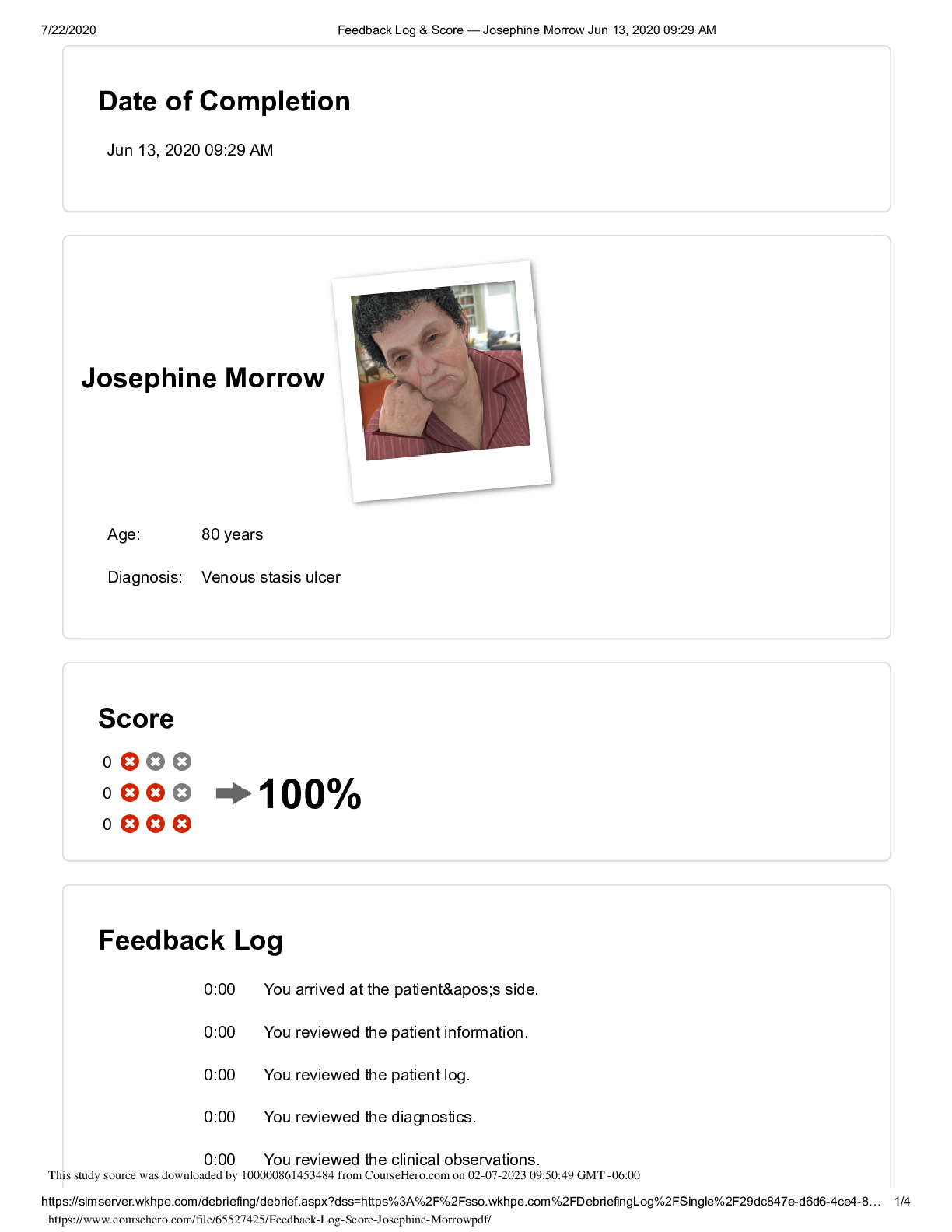
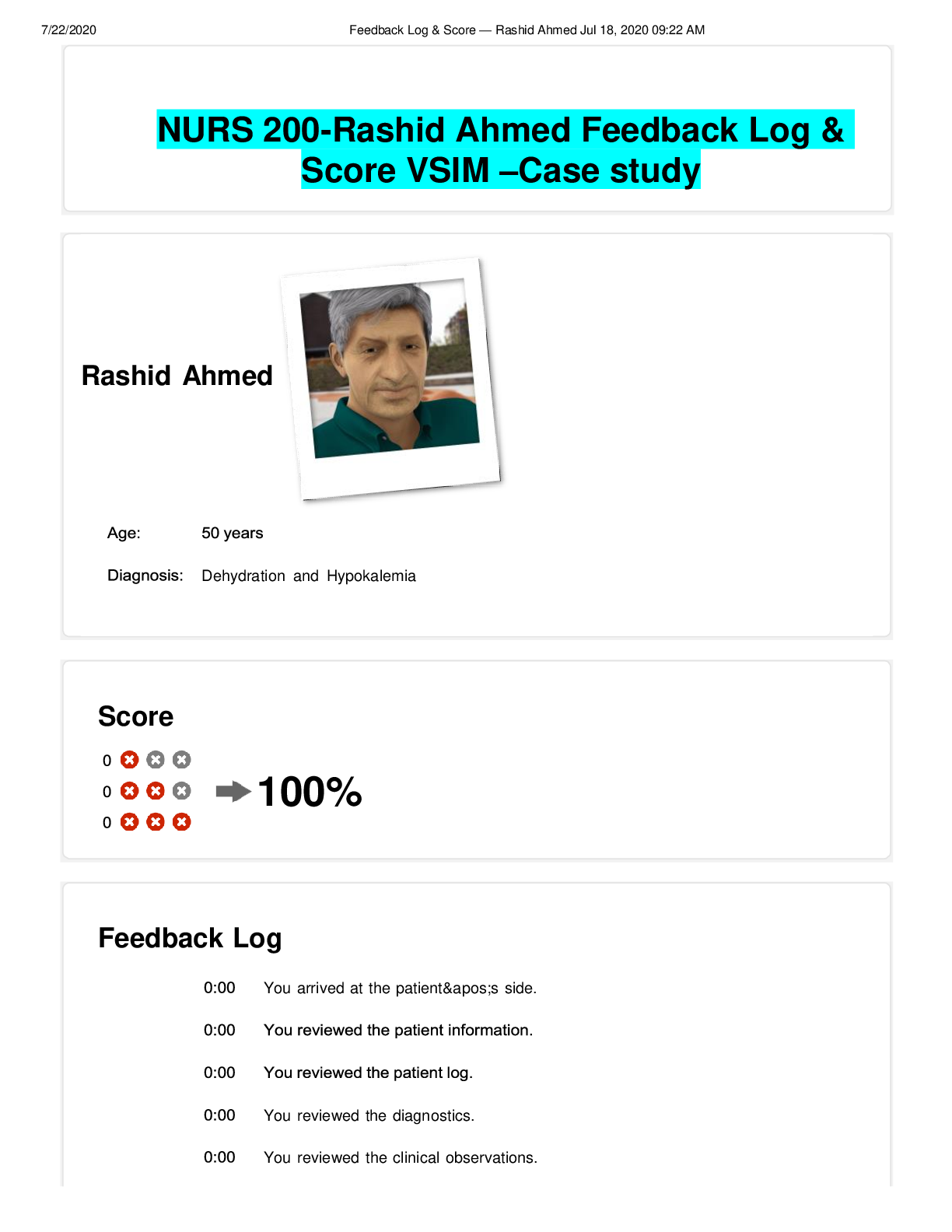
Josephine Morrow
Age: 80 years
Diagnosis: Venous stasis ulcer
Score
0
0
0
100%
Feedback Log
0:00 You arrived at the patient's side.
0:00 You
...
Date of Completion
Jun 13, 2020 09:29 AM
Josephine Morrow
Age: 80 years
Diagnosis: Venous stasis ulcer
Score
0
0
0
100%
Feedback Log
0:00 You arrived at the patient's side.
0:00 You reviewed the patient information.
0:00 You reviewed the patient log.
0:00 You reviewed the diagnostics.
0:00 You reviewed the clinical observations.
This study source was downloaded by 100000831988016 from CourseHero.com on 04-10-2022 14:46:49 GMT -05:00
https://www.coursehero.com/file/65527425/Feedback-Log-Score-Josephine-Morrowpdf/
7/22/2020 Feedback Log & Score — Josephine Morrow Jun 13, 2020 09:29 AM
https://simserver.wkhpe.com/debriefing/debrief.aspx?dss=https%3A%2F%2Fsso.wkhpe.com%2FDebriefingLog%2FSingle%2F29dc847e-d6d6-4ce4-8… 2/4
0:00 You reviewed the MAR.
0:00 You reviewed the orders.
0:00 You reviewed the intake and output.
0:06 You washed your hands. To maintain patient safety, it is important to wash your
hands as soon as you enter the room.
0:10 Patient status - ECG: Sinus rhythm. Heart rate: 95. Pulse: Present. Blood pressure: 121/80
mm Hg. Respiration: 20. Conscious state: Appropriate. SpO2: 94%. Temp: 98 F (36.6 C)
1:10 Patient status - ECG: Sinus rhythm. Heart rate: 95. Pulse: Present. Blood pressure: 120/80
mm Hg. Respiration: 20. Conscious state: Appropriate. SpO2: 94%. Temp: 98 F (36.5 C)
1:18 You introduced yourself. This was reasonable.
1:32 You identified the patient. To maintain patient safety, it is important that you
quickly identify the patient.
1:41 You asked if the patient was <Allergy>allergic<> to anything. She
replied: 'Yes, I am allergic to penicillin.'
1:48 You asked the patient how she felt. She replied: 'I get tired easily.'
1:55 You asked what happened. She replied: 'I have this wound on my leg; it
does not seem to heal.'
2:02 You asked the patient if she needed anything. She replied: 'I need help
with my legs; they are swollen and hurt. I easily get ulcers.'
2:10 Patient status - ECG: Sinus rhythm. Heart rate: 95. Pulse: Present. Blood pressure: 122/81
mm Hg. Respiration: 20. Conscious state: Appropriate. SpO2: 94%. Temp: 98 F (36.4 C)
2:13 You put on gloves.
2:23 You examined the patient's legs. There is moderate edema and
hyperpigmentation of the skin from the knees and down on both sides. There is a
dressing covering the skin lesion on the lower leg. There is normal elasticity of
the skin. Her color is normal, and she is not sweating.
2:58 You educated the patient about wound care. This was reasonable.
3:10 Patient status - ECG: Sinus rhythm. Heart rate: 95. Pulse: Present. Blood pressure: 123/81
mm Hg. Respiration: 20. Conscious state: Appropriate. SpO2: 94%. Temp: 97 F (36.3 C)
3:21 You assessed the patient's dressing. This is correct. Assessing any
dressings the patient has is always important.
3:36 You removed the dressing. This was reasonable. However, make sure to dress
the area appropriately again when possible.
3:46 You assessed the patient's ulcer. This was reasonable. The ulcer is
shallow, 1 inch in width, and looks mostly pink to red, with no signs of necrosis or
infection.
This study source was downloaded by 100000831988016 from CourseHero.com on 04-10-2022 14:46:49 GMT -05:00
https://www.coursehero.com/file/65527425/Feedback-Log-Score-Josephine-Morrowpdf/
7/22/2020 Feedback Log & Score — Josephine Morrow Jun 13, 2020 09:29 AM
https://simserver.wkhpe.com/debriefing/debrief.aspx?dss=https%3A%2F%2Fsso.wkhpe.com%2FDebriefingLog%2FSingle%2F29dc847e-d6d6-4ce4-8… 3/4
4:10 Patient status - ECG: Sinus rhythm. Heart rate: 95. Pulse: Present. Blood pressure: 120/79
mm Hg. Respiration: 20. Conscious state: Appropriate. SpO2: 94%. Temp: 97 F (36.3 C)
4:10 You irrigated the wound with saline. This was reasonable.
4:21 You applied a dressing. This was reasonable.
4:29 You removed the gloves.
4:35 You washed your hands.
5:10 Patient status - ECG: Sinus rhythm. Heart rate: 95. Pulse: Present. Blood pressure: 120/80
mm Hg. Respiration: 20. Conscious state: Appropriate. SpO2: 94%. Temp: 97 F (36.2 C)
5:50 You educated the patient about improving venous return. This was reasonable.
6:10 Patient status - ECG: Sinus rhythm. Heart rate: 95. Pulse: Present. Blood pressure: 123/81
mm Hg. Respiration: 20. Conscious state: Appropriate. SpO2: 94%. Temp: 97 F (36.2 C)
6:11 You asked the patient if she had any pain. She replied: 'No, I don't
have any pain.'
6:28 You applied compression stockings.
6:40 You elevated the patient's legs. This was indicated by order.
6:43 You asked the patient if she had any pain. She replied: 'No, I don't
have any pain.'
7:10 Patient status - ECG: Sinus rhythm. Heart rate: 95. Pulse: Present. Blood pressure: 124/81
mm Hg. Respiration: 19. Conscious state: Appropriate. SpO2: 94%. Temp: 97 F (36.1 C)
7:12 You listened to the lungs of the patient. The breath sounds are clear and equal
bilaterally.
7:34 You listened to the heart of the patient. This is reasonable. There were regular
heart sounds without murmurs.
8:03 You listened to the abdomen of the patient. Normal bowel sounds were heard.
8:10 Patient status - ECG: Sinus rhythm. Heart rate: 95. Pulse: Present. Blood pressure: 123/81
mm Hg. Respiration: 19. Conscious state: Appropriate. SpO2: 94%. Temp: 97 F (36.1 C)
8:23 You attached the <Pulseoximeter>pulse oximeter.<> Consider
assessing the patient's pulse oximetry as part of the first assessments you do.
8:35 You checked the <Temperature>temperature<> at the ear. The
temperature was 97 F (36.1 C). Consider assessing the patient's temperature as
part of the first assessments you do.
8:44 You looked for normal breathing. She is breathing at 19 breaths per minute. The
chest is moving equally. Consider assessing the patient's breathing and
respiratory rate as part of the first assessments you do.
9:06 You checked the radial pulse. The pulse is strong, 95 per minute, and regular. It is
correct to assess the patient's vital signs. Consider assessing the patient's
This study source was downloaded by 100000831988016 from CourseHero.com on 04-10-2022 14:46:49 GMT -05:00
https://www.coursehero.com/file/65527425/Feedback-Log-Score-Josephine-Morrowpdf/
7/22/2020 Feedback Log & Score — Josephine Morrow Jun 13, 2020 09:29 AM
https://simserver.wkhpe.com/debriefing/debrief.aspx?dss=https%3A%2F%2Fsso.wkhpe.com%2FDebriefingLog%2FSingle%2F29dc847e-d6d6-4ce4-8… 4/4
pulse as part of the first assessments you do.
9:10 Patient status - ECG: Sinus rhythm. Heart rate: 95. Pulse: Present. Blood pressure: 122/81
mm Hg. Respiration: 19. Conscious state: Appropriate. SpO2: 94%. Temp: 97 F (36.1 C)
9:30 You checked the radial pulse. The pulse is strong, 95 per minute, and regular.
9:45 You disconnected the <Pulseoximeter>pulse oximeter.<>
10:00 You measured the <Bloodpressure>blood pressure<> at 122/82 mm Hg.
Consider assessing the patient's blood pressure as part of the first assessments
you do.
10:10 Patient status - ECG: Sinus rhythm. Heart rate: 95. Pulse: Present. Blood pressure: 123/81
mm Hg. Respiration: 19. Conscious state: Appropriate. SpO2: 94%. Temp: 97 F (36.1 C)
10:18 You asked the patient if she had any pain. She replied: 'No, I don't
have any pain.'
10:22 A patient handoff was performed.
This patient is an obese, 80-year old female in a skilled nursing home care facility
with a venous stasis ulcer. The students are expected to assess the leg wound,
assess the patient's pain, and perform a dressing change. The students
are also expected to assess lab values, and provide patient education on
interventions to promote venous return. Venous stasis ulcers occur in the lower
extremities from impaired venous circulation and are usually shallow with an
irregular shape over bony prominences, particularly the medial malleolus.
Hypertension in the venous system of the legs can lead to pain, edema, varicose
veins, skin changes, dermatitis
[Show More]






, All Correct, Download to Score A.png)