Earth Science > QUESTIONS & ANSWERS > PHSC 211 Elements of Earth Science Chapter 4 Quiz – Liberty University (A grade) | (All)
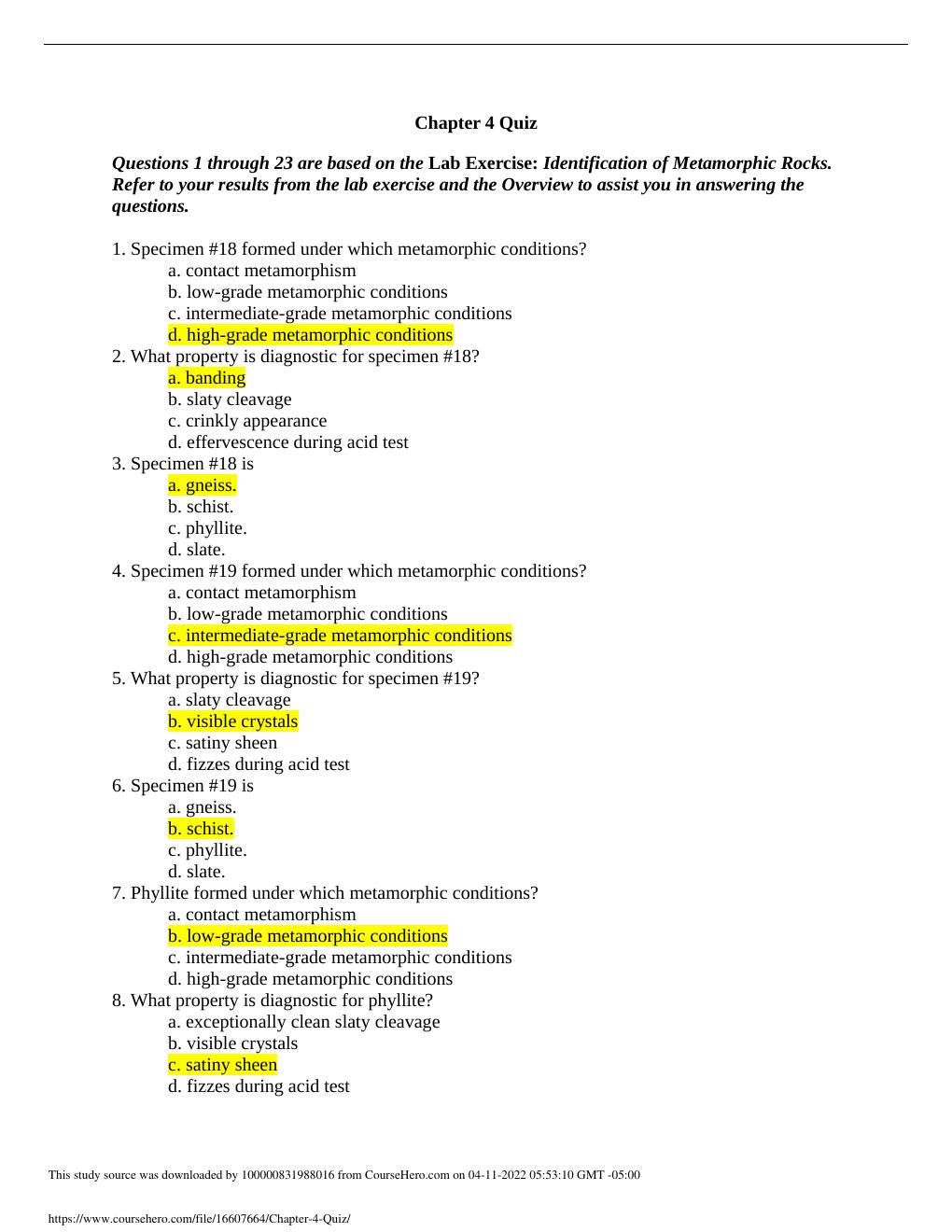
PHSC 211 Elements of Earth Science Chapter 4 Quiz – Liberty University (A grade) |
Document Content and Description Below
Last updated: 2 months ago
Preview 1 out of 4 pages
Instant download
Buy this Document to get the Full Access Instantly
Provided by Students Who Aced it
We Verify Document Content to Gurantee Accuracy
Also available in bundle (1)
Click Below to Access Bundle(s)

PHSC 211 Elements of Earth Science Chapters 1 - 16 Quiz – Liberty University (A grade)
PHSC 211 Chapter 2 Quiz (Fall 2020)– Liberty University (A grade) 1. What mineral composition is most characteristic of felsic rocks? a. olivine, pyroxene, and calcium-rich plagioclase b. orthoclase,...
By Nutmegs 4 years ago
$55
13
Associated Textbook
Reviews( 0 )
Document information
Connected school, study & course
About the document
Uploaded On
Apr 11, 2022
Number of pages
4
Written in
All

Additional information
This document has been written for:
Uploaded
Apr 11, 2022
Downloads
0
Views
206
Topic Tags
Recommended For You
Get more on QUESTIONS & ANSWERS »
PHSC 211 Elements of Earth Science Chapter 3 Quiz Liberty Univ...
PHSC 211 Elements of Earth Science Chapter 1 Quiz – Liberty Un...
PHSC 211 Elements of Earth Science Chapter 6 Quiz Liberty Univ...

PHSC 211 Chapter 16 Quiz (Fall 2020)– Liberty University (A gr...
PHSC 211 Chapter 9 Quiz (Fall 2019)– Liberty University (A gra...


Earth Science, 14e Edward Tarbuck, Frederick Lutgens, Dennis T...
.png)
Foundations of Earth Science, 8e Frederick Lutgens, Edward Tar...
.png)
Foundations of Earth Science, 8e Frederick Lutgens, Edward Tar...
Test Bank for Foundations of Earth Science, 8th Edition Freder...

Test Bank for Foundations of Earth Science, 8e Frederick Lutge...

[eBook] [PDF] Earth Science An Introduction, 3rd Edition By Ma...

Test Bank for Foundations of Earth Science 9th Edition by Fred...

eBook Air Quality Monitoring and Advanced Bayesian Modeling,1s...

eBook [PDF] Laboratory Manual for Earth Science 1st Edition...

IB ESS 1.1 Environmental Value Systems Includes the different...


ebook Philip Larkin and the Place of Writing 1st Edition By Uj...

The Commodification Gap Gentrification and Public Policy in Lo...











