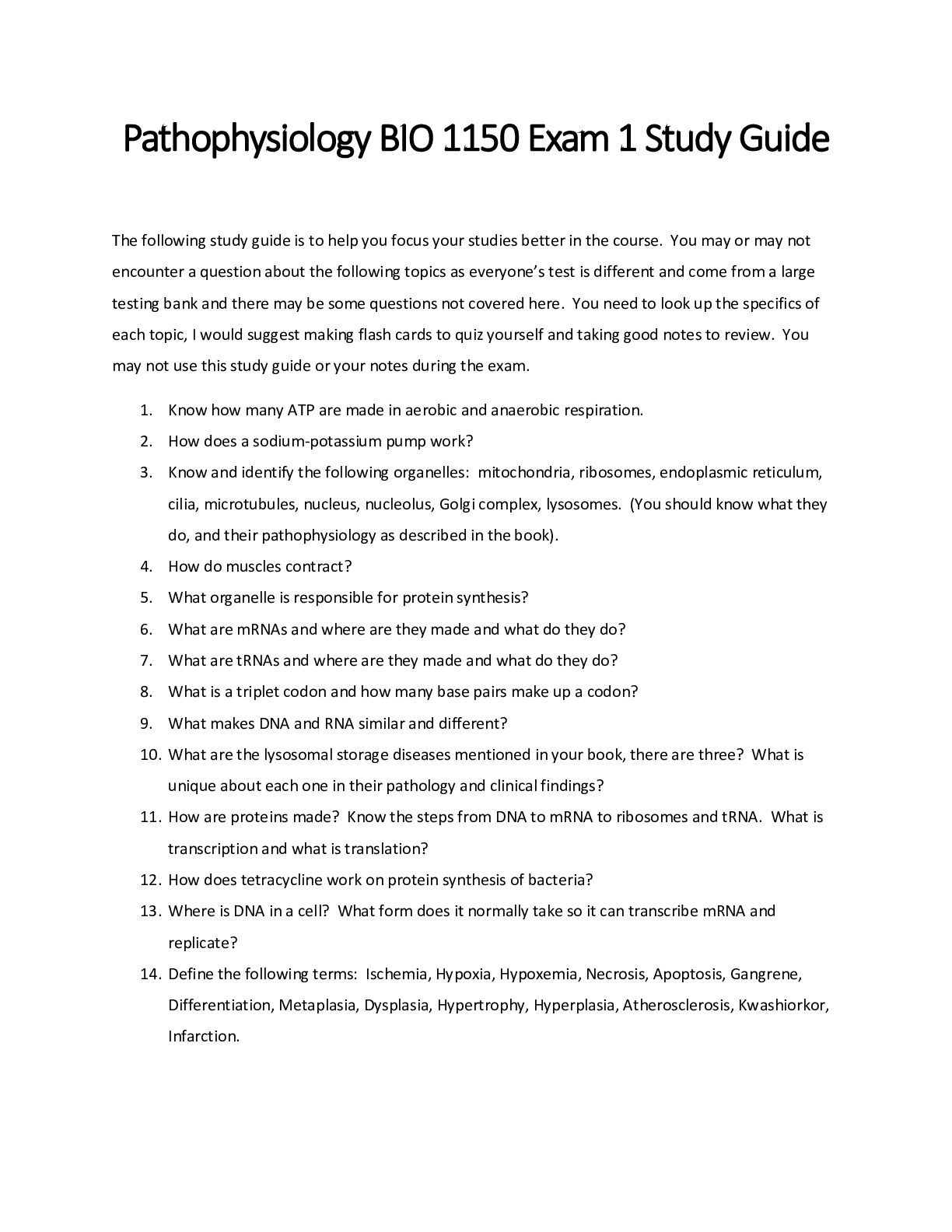
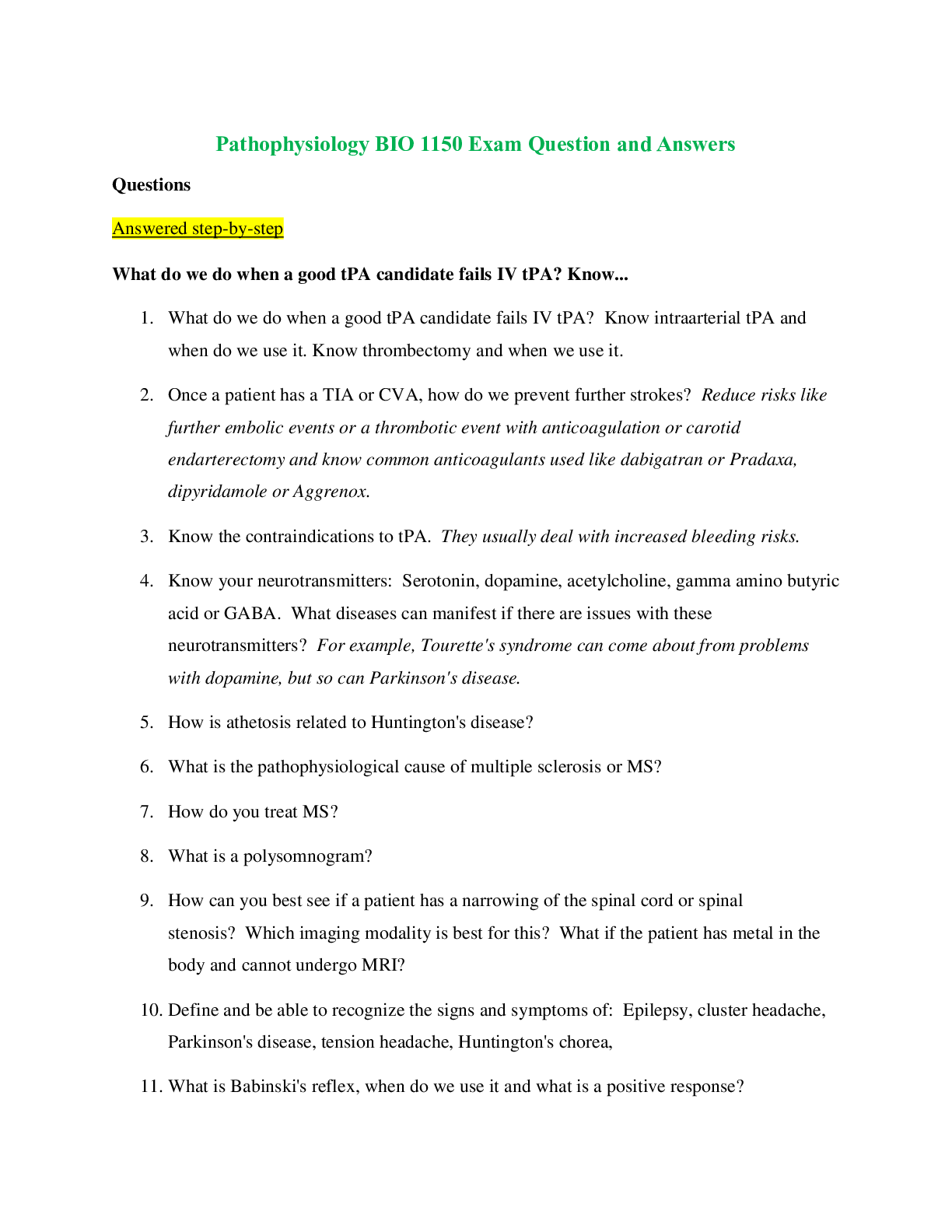
Pathophysiology BIO 1150 Exam 1 Study Guide. Best for the Last minute Exam Preparation. The following study guide is to help you focus your studies better in the course. You may or may not
encounter a question about the
...
Pathophysiology BIO 1150 Exam 1 Study Guide. Best for the Last minute Exam Preparation. The following study guide is to help you focus your studies better in the course. You may or may not
encounter a question about the following topics as everyone’s test is different and come from a large
testing bank and there may be some questions not covered here. You need to look up the specifics of
each topic, I would suggest making flash cards to quiz yourself and taking good notes to review. You
may not use this study guide or your notes during the exam.
1. Know how many ATP are made in aerobic and anaerobic respiration.
2. How does a sodium-potassium pump work?
3. Know and identify the following organelles: mitochondria, ribosomes, endoplasmic reticulum,
cilia, microtubules, nucleus, nucleolus, Golgi complex, lysosomes. (You should know what they
do, and their pathophysiology as described in the book).
4. How do muscles contract?
5. What organelle is responsible for protein synthesis?
6. What are mRNAs and where are they made and what do they do?
7. What are tRNAs and where are they made and what do they do?
8. What is a triplet codon and how many base pairs make up a codon?
9. What makes DNA and RNA similar and different?
10. What are the lysosomal storage diseases mentioned in your book, there are three? What is
unique about each one in their pathology and clinical findings?
11. How are proteins made? Know the steps from DNA to mRNA to ribosomes and tRNA. What is
transcription and what is translation?
12. How does tetracycline work on protein synthesis of bacteria?
13. Where is DNA in a cell? What form does it normally take so it can transcribe mRNA and
replicate?
14. Define the following terms: Ischemia, Hypoxia, Hypoxemia, Necrosis, Apoptosis, Gangrene,
Differentiation, Metaplasia, Dysplasia, Hypertrophy, Hyperplasia, Atherosclerosis, Kwashiorkor,
Infarction.15. Know Hypertension, Hypotension, Hypothyroidism, Hyperthyroidism, Diabetes Mellitus, Berry
Aneurysm, Barrett’s Esophagus, Stem Cell Restoration, Therapeutic Cloning, Reproductive
Cloning, Transplantation, Keloid, Oxidative Stress.
16. What are the fat soluble vitamins?
17. Free radicals versus antioxidants.
18. What does a pulse oximeter do?
19. Why do prenatal testing? Know each type and why we do them.
20. Know Marfan syndrome and what a patient looks like that has it. (Think of Abraham Lincoln)
21. Ehlers-Danlos syndrome, what is it? How is it similar and different to Marfan?
22. What is a karyotype?
23. Know what PCR or polymerase chain reaction is and why we use it.
24. Know Wilson’s disease and what is the pathophysiology behind it. How does it usually present?
This is one of the liver diseases.
25. Know Familial Hypercholesterolemia.
26. How does fertilization work? How many chromosomes do each parent contribute?
27. What is a Punnett square and how does it work?
28. Define dominant and recessive traits. Define X-linked traits or sex-linked.
29. Know cystic fibrosis.
30. Recognize Huntington’s chorea.
31. What attracts platelets?
32. Which WBCs fight bacteria? Viruses? Parasites?
33. Which WBC secretes histamine? Which WBC is increased in allergic reactions?
34. Which WBC arrives first to an injury?
35. Define CRP or C-reactive proteins. Define ESR or erythrocyte sedimentation rate. How are
these used to detect inflammation in the body?
36. When should you use hyperbaric oxygen therapy on a patient?
37. What are the classic signs of inflammation?
38. What is a left shift?
39. What is a fever and what is the pathophysiology behind it?
40. What is a pressure ulcer or decubitus ulcer? How do you treat it?
41. Know what nutrition aids in wound healing.
42. What are the stages of wound healing?
[Show More]